Italy
Mediterranean Sailing Guide
Italy Mediterranean sailing guide. Italy occupies the central arc of the Mediterranean, extending from the Ligurian Sea down the Tyrrhenian coast, around the Strait of Messina, and northward along the Adriatic toward Slovenia. This extensive and varied coastline forms one of the most operationally significant sailing regions in the basin, shaped by a combination of deep offshore waters, complex headlands, island groups, and major commercial ports. Italy’s maritime geography supports a wide range of sailing conditions, from the sheltered gulfs of the northwest to the exposed southern capes and the long, open stretches of the Adriatic. The coastline is well‑surveyed, heavily trafficked, and supported by a dense network of marinas and harbours that facilitate both local cruising and long‑range Mediterranean routing.
Italy’s position at the centre of the basin makes it a natural crossroads for yachts moving between the western Mediterranean, the Adriatic, the Ionian Sea, and the Tyrrhenian approaches. The country’s ports offer comprehensive technical services, reliable provisioning, and predictable formalities, creating a stable operational environment for seasonal and long‑distance movements. Italy’s island groups, Sardinia, Sicily, Elba, and the Pontine and Aeolian archipelagos add further complexity and opportunity, forming distinct navigation zones that support both short‑range coastal passages and extended offshore itineraries. The combination of infrastructure, geography, and routing significance makes Italy one of the most important sailing regions in the Mediterranean.
Italy
Mediterranean Sailing Guide - Primary Ports by Region
Ligurian Coast: Ventimiglia, Sanremo, Imperia, Alassio, Savona, Genoa, Rapallo, Santa Margherita Ligure, Portofino, La Spezia (secondary: Bordighera, Varazze, Chiavari, Lavagna)
Tuscan Coast & Archipelago: Viareggio, Livorno, Piombino, Portoferraio, Marciana Marina (secondary: Punta Ala, Marina di Campo, Porto Azzurro)
Northern Tyrrhenian: Civitavecchia, Riva di Traiano, Fiumicino, Ostia (secondary: Anzio, Nettuno)
Pontine Islands: Ponza, Ventotene (secondary: Palmarola, Zannone)
Southern Tyrrhenian: Naples, Pozzuoli, Sorrento, Salerno, Agropoli (secondary: Castellammare di Stabia, Amalfi, Cetara)
Gulf of Naples & Islands: Capri, Ischia, Procida (secondary: Forio, Casamicciola)
Aeolian Islands: Lipari, Vulcano, Salina, Stromboli (secondary: Panarea, Filicudi, Alicudi)
Sicilian North Coast: Palermo, Cefalù, Milazzo (secondary: Termini Imerese, Sant’Agata di Militello) Milazzo
Strait of Messina: Messina, Reggio Calabria (secondary: Villa San Giovanni)
Sicilian East Coast: Catania, Siracusa, Riposto, Taormina (secondary: Augusta, Marzamemi)
Sicilian South & West Coast: Trapani, Marsala, Sciacca, Licata (secondary: Mazara del Vallo, Porto Empedocle)
Egadi Islands: Favignana, Levanzo (secondary: Marettimo)
Ionian Coast: Taranto, Gallipoli, Santa Maria di Leuca (secondary: Otranto, Crotone)
Southern Adriatic: Brindisi, Bari, Barletta (secondary: Monopoli, Trani)
Central Adriatic: Pescara, Ancona, Fano (secondary: San Benedetto del Tronto, Civitanova Marche)
Northern Adriatic: Venice, Chioggia, Ravenna, Trieste (secondary: Caorle, Grado, Lignano Sabbiadoro)
Sardinia: North Coast: Santa Teresa Gallura, Palau, La Maddalena, Cannigione, Porto Cervo, Porto Rotondo, Olbia, Golfo Aranci (secondary: Porto Pozzo); East Coast: Porto Ottiolu, La Caletta, Orosei (Marina di Orosei), Arbatax, Santa Maria Navarrese, Porto Corallo (secondary: Cala Gonone); South Coast: Cagliari, Villasimius, Carloforte (Isola di San Pietro), Sant’Antioco (secondary: Capitana); West Coast: Oristano (Torregrande), Bosa, Alghero, Porto Torres (secondary: Stintino)
Secondary ports: Secondary ports across the Ligurian, Tyrrhenian, Sicilian, Ionian and Adriatic basins provide additional shelter and operational flexibility. Ligurian: Bordighera, Varazze, Chiavari Tyrrhenian: Marina di Pisa, Castiglione della Pescaia, Porto Santo Stefano, Terracina, Formia, Castellammare di Stabia, Sapri, Tropea, La Maddalena, Cannigione, Santa Teresa Gallura, Favignana, Ustica, Ponza, Ventotene Ionian: Roccella Ionica, Otranto, Monopoli Adriatic: Vieste, Senigallia, Pesaro, Cesenatico, Grado
Italy
Mediterranean Sailing Guide - Navigation
Navigation along Italy’s Mediterranean coastline is shaped by a combination of deep offshore waters, complex headlands, island groups, and heavily trafficked commercial routes. The Ligurian coast features steep underwater profiles and narrow shelves, allowing vessels to maintain safe depth margins close to shore, while the Tyrrhenian coast introduces a mix of gulfs, capes, and island passages that require careful routing. The Strait of Messina presents a unique navigational environment, with strong currents, traffic separation schemes, and localised acceleration zones that demand precise timing and pilotage. The Adriatic coast is more exposed, with long, open stretches and shallow shelves that influence sea state and require attention during strong northerly winds. Traffic density is high throughout Italy, particularly near major ports and ferry routes, requiring continuous situational awareness.
Italy Mediterranean Sailing Guide - Chart Accuracy
Italy benefits from modern and regularly updated hydrographic surveys, with harbour approaches, dredged channels, and coastal depths generally matching official data across both mainland and island waters. Official ENCs provide the most authoritative digital representation of surveyed depths and harbour layouts, while Navionics offers strong general accuracy but may show minor offsets in older marina basins or areas undergoing redevelopment, particularly along the Tyrrhenian coast. C‑Map behaves similarly, sometimes presenting more conservative depth shading in shallow approaches, while Garmin BlueChart typically aligns with Navionics but may lag in reflecting recent construction or dredging works. Satellite imagery remains the most reliable tool for identifying shoal patterns, sediment plumes, volcanic shelves, and unmarked obstructions, particularly around the Aeolian Islands, Sicily’s eastern coast, and the shallow northern Adriatic. Cross‑checking electronic charts against visual references, depth trend logic, and updated notices ensures accurate pilotage when entering ports or navigating nearshore features.
Italy
Mediterranean Sailing Guide - Weather
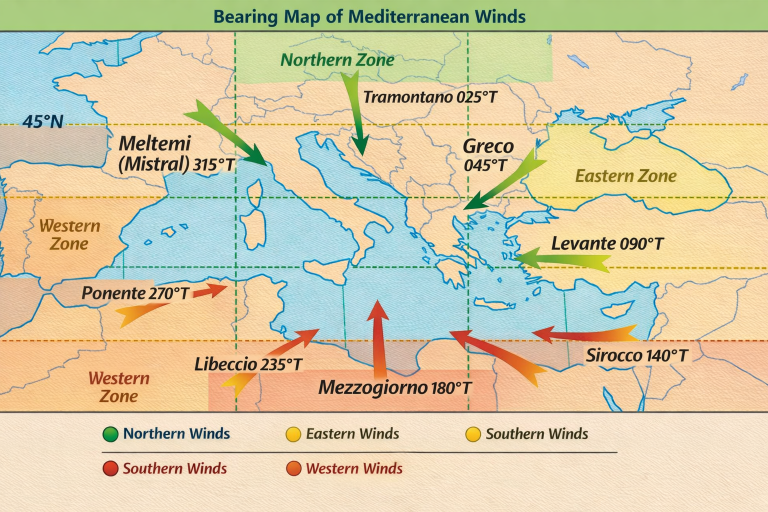
Weather along Italy’s Mediterranean coastline varies significantly between regions. The Ligurian Sea experiences localised acceleration zones around capes and predictable thermal breezes in summer, while the Tyrrhenian coast is shaped by sea‑breeze cycles, occasional strong westerlies, and the influence of nearby island groups. The Strait of Messina introduces its own microclimate, with rapid wind shifts and funnelled flows that can intensify sea state. Sicily experiences a mix of Mediterranean and regional patterns, with strong southerlies and occasional sirocco events affecting approaches on the eastern and southern coasts.
The Adriatic is dominated by the Bora and Sirocco, both of which can develop rapidly and produce challenging conditions, particularly in the northern sector. Seasonal patterns are well‑defined, with stable summer conditions and more variable weather in spring and autumn.
The Sirocco is a warm, humid southerly wind that originates over the Sahara and moves northward across the Mediterranean, carrying dust and reduced visibility into coastal regions. As it reaches Italy, Malta, Tunisia, and the central Mediterranean, it produces long‑fetch swell, rising humidity, and uncomfortable sea states that build ahead of approaching low‑pressure systems. Its strength and duration depend on the pressure gradient between North Africa and the central Mediterranean, with the most pronounced effects occurring when a deep low forms over the Gulf of Genoa or the Adriatic.
The Bora is a cold, dense northeasterly wind that descends abruptly from the Dinaric Alps toward the Adriatic, producing violent gusts and rapid sea‑state changes. Its katabatic nature creates extreme acceleration zones at gaps and valleys, especially around Trieste, Senj and the Velebit Channel, where gusts can exceed storm force with little warning. The Bora is most common in winter but can occur year‑round, defined by sharp pressure gradients and the rapid onset that makes it one of the Adriatic’s most operationally significant winds.
The Marine Electrical and Electronics Bible has a complete list of Italian VHF Radio Channel information and weather forecast times for Italy along with NAVTEX UK and Europe and NAVTEX Mediterranean for 490kHz and 518kHz.
Italy
Mediterranean Sailing Guide - Entry
Formalities
Italy is part of the Schengen area, requiring yachts arriving from outside Schengen to complete immigration and customs procedures at designated ports of entry. Once formalities are completed, movement within Schengen is straightforward, with no additional immigration checks when continuing to France, Monaco, Slovenia, or Croatia. Clearance procedures are consistent and well‑defined, with harbourmaster, immigration, and customs offices typically located within the same port complex. Reporting requirements for equipment such as satellite communications systems may apply depending on the vessel’s configuration and intended movements, and yachts must ensure compliance with local regulations regarding radio equipment and safety gear when operating along the Italian coastline.
Italy
Mediterranean Sailing Guide - Provisioning
Provisioning in Italy is reliable and comprehensive, with widespread access to supermarkets, markets, fuel stations, and marine services. Major ports such as Genoa, La Spezia, Naples, Palermo, Cagliari, and Trieste offer extensive technical support, while smaller towns provide adequate supplies for routine needs. Fuel quality is consistent across the region, and spare parts are readily available in larger centres. Island provisioning varies by location, with Sardinia and Sicily offering strong networks, while smaller islands may require planning for seasonal availability. The density of provisioning points along both mainland and island sectors makes Italy one of the most dependable resupply regions in the Mediterranean, supporting both short‑range coastal movements and longer offshore passages.
Italy
Mediterranean Sailing Guide - Cuisine
If you were a Monty Python fan and you had to answer the question “what have the Romans ever done for us?” well the answer would absolutely have to be the food! Italian coastal cuisine along the Ligurian, Tyrrhenian, and Sicilian sectors is defined by regional ingredients that directly influence provisioning patterns for yachts. Liguria relies on basil, pine nuts, pecorino, and local olive oil, producing pesto alla genovese, a cold basil sauce used with pasta or potatoes and green beans, and focaccia genovese, a flatbread with high‑hydration dough and coarse salt. The coastline’s fishing ports supply anchovies, sardines, and small pelagic species used in acciughe sotto sale, salt‑cured anchovies that store well aboard and provide a concentrated umami base for sauces. Ligurian harbours also supply farinata, a chickpea‑flour bake that requires only water, oil, and heat, making it a practical provisioning item for crews needing simple, durable ingredients.
Tuscany Cuisine. Moving south into Tuscany, the cuisine shifts toward seafood stews and bread‑based dishes. Cacciucco from Livorno is a dense fish stew built from mixed species such as scorpionfish, conger, and mussels, cooked with tomato and red wine; its operational relevance lies in the availability of mixed catch in Tuscan ports. Panzanella uses stale bread, tomatoes, and olive oil, providing a low‑waste provisioning pattern for yachts. The Tuscan archipelago supplies rockfish, octopus, and cuttlefish, which appear in polpo lesso (boiled octopus with olive oil and lemon) and seppie in zimino (cuttlefish with chard), both relying on ingredients widely available in island markets.
Lazio’s Tyrrhenian coastline introduces dishes shaped by Roman culinary logic. Spaghetti alle vongole uses local clams from Gaeta and Anzio, cooked with garlic, olive oil, and white wine; the dish’s simplicity aligns with provisioning patterns based on fresh shellfish and dry pasta. Filetti di baccalà uses salted cod, a durable protein that stores well aboard and appears frequently in coastal markets. Carciofi alla romana uses Roman artichokes braised with mint and garlic, reflecting the region’s vegetable supply chain rather than maritime catch, but still relevant for provisioning due to its durability and low‑waste preparation.
Campania’s coastline, including Naples, Sorrento, and the Amalfi sector, is defined by tomatoes, buffalo mozzarella, lemons, and small pelagic fish. Spaghetti alle cozze uses local mussels from the Gulf of Naples, while alici indorate e fritte uses fresh anchovies dredged in egg and flour. Insalata caprese combines tomatoes, basil, and mozzarella, relying on ingredients widely available in coastal markets. The Amalfi lemon appears in scialatielli ai frutti di mare, a fresh pasta dish with mixed shellfish, and in delizia al limone, a lemon‑based sponge dessert that reflects the region’s citrus production rather than maritime provisioning but remains part of the coastal food identity.
Calabria’s Tyrrhenian sector introduces stronger flavours and preserved ingredients. Nduja, a spreadable fermented pork and chilli paste from Spilinga, stores well aboard and provides a high‑flavour base for pasta or bread. Pesce spada alla ghiotta uses swordfish cooked with tomatoes, olives, and capers, reflecting the region’s offshore catch. Stocco alla mammolese uses stockfish rehydrated with potatoes and tomatoes, showing the region’s reliance on preserved fish for long‑distance provisioning.
Sicily forms the most diverse maritime food landscape in Italy, shaped by volcanic soils, mixed fisheries, and centuries of trade. Pasta con le sarde uses fresh sardines, wild fennel, pine nuts, and raisins, combining local catch with durable dry goods. Caponata is a cooked vegetable conserve of aubergine, celery, capers, and vinegar, storing well aboard and widely available in Sicilian markets. Arancini use rice, ragù, and peas formed into fried spheres, providing a portable provisioning item. Pesce spada alla messinese uses swordfish with tomato, oregano, and capers, reflecting the Strait of Messina’s pelagic fisheries. Gambero rosso di Mazara refers to deep‑water red prawns landed in Mazara del Vallo, prized for their sweetness and often eaten raw or lightly cooked. Cannoli siciliani use ricotta‑filled pastry shells, relying on sheep’s milk ricotta produced inland but distributed through coastal markets.
Across Sicily’s smaller islands, cuisine reflects local catch and limited agricultural supply. The Aeolian Islands produce insalata eoliana, a salad of tomatoes, capers, and baked bread, relying on durable ingredients suited to island provisioning. Totani ripieni uses stuffed squid cooked with tomato and herbs, reflecting the region’s cephalopod fisheries. Pantelleria contributes capers preserved in salt, a long‑life ingredient used across Sicilian dishes and widely available in coastal shops.
Throughout Italy’s western and island sectors, provisioning logic follows a consistent pattern: durable dry goods such as pasta, chickpea flour, and preserved fish combine with fresh catch and regionally specific vegetables. Olive oil, lemons, capers, anchovies, and tomatoes form the backbone of coastal cooking, with each region adding its own distinctive ingredient set. This creates a provisioning environment where yachts can reliably source fresh seafood, high‑quality produce, and long‑life staples in every major port, with regional dishes reflecting the availability of these ingredients rather than restaurant‑driven interpretations.
Mechanical and Electrical Repairs
Resource
If you are headed somewhere remote consider the need to expand your knowledge base or have an information resource on board. Why not get a copy of my book The Marine and Electrical and Electronics Bible 4th Edition. By and for yachties, with everything from batteries and charging, solar and wind, diesel engines and marine electronics and so much more. Your complete systems guide. 650 pages of practical advice. In Australia and New Zealand order a copy through Boat Books. UK and European boats can buy the UK Edition Here. US and Canadian boats can get the US Edition Order Here. Marine systems are my profession so let me help you. By a liveaboard boat owner for other boat owners.


Italy
Mediterranean Sailing Guide - Summary
Italy provides a diverse and operationally rich sailing environment, with reliable navigation, accurate charting, straightforward formalities, and strong provisioning. Its mainland and island ports form a dense network that supports both local cruising and basin‑wide routing, making Italy a central hub for yachts moving between the western Mediterranean, the Adriatic, the Ionian Sea, and the wider region. Italy Mediterranean Sailing Guide for all you need to know.