How to Cross a Coastal Bar Safely
How to Cross a Coastal Bar Safely. Hydrodynamics, timing, boat handling, judgement and the real decisions skippers make. Crossing a coastal bar is one of the few manoeuvres in seamanship where timing, observation and judgement matter more than power or equipment. A bar is not simply a shallow patch; it is a dynamic system where swell, tide and sandbanks interact in ways that amplify mistakes and reward discipline. Every bar has its own character, but the principles remain constant: the safest crossings occur when the tide is lifting the bar, the swell is understood, the gutters are identified and the skipper commits with confidence and control. The most dangerous crossings occur when impatience replaces planning or when a skipper allows the bar to dictate the terms.
A bar crossing begins long before the vessel reaches the outer waypoint. It starts with understanding the tide cycle, the swell direction and the shape of the banks. The incoming tide is the ally; it lifts the shallowest sections and flattens the sea state. The ebb is the enemy; it steepens the swell, accelerates the flow and creates breaking waves where none existed an hour earlier. A skipper who arrives early waits offshore in settled water, watching the sets and reading the rhythm of the swell. A skipper who arrives late holds position inside the river or estuary until the next safe window. The bar does not care about schedules, fatigue or deadlines; it responds only to tide and swell.
How to Cross a Coastal Bar Safely
A coastal bar is one of the most dynamic and unforgiving environments a skipper will ever handle. Every bar behaves differently, but the forces that shape them are universal: swell direction and period, tide state, river outflow, wind strength and the shifting contours of the seabed. A safe crossing is never improvised. It is planned, timed and executed with clarity, commitment and a full understanding of how the bar is behaving at that moment. A skipper approaching any bar treats it as a hydrodynamic system, not a waypoint, and respects the fact that conditions can change within minutes.
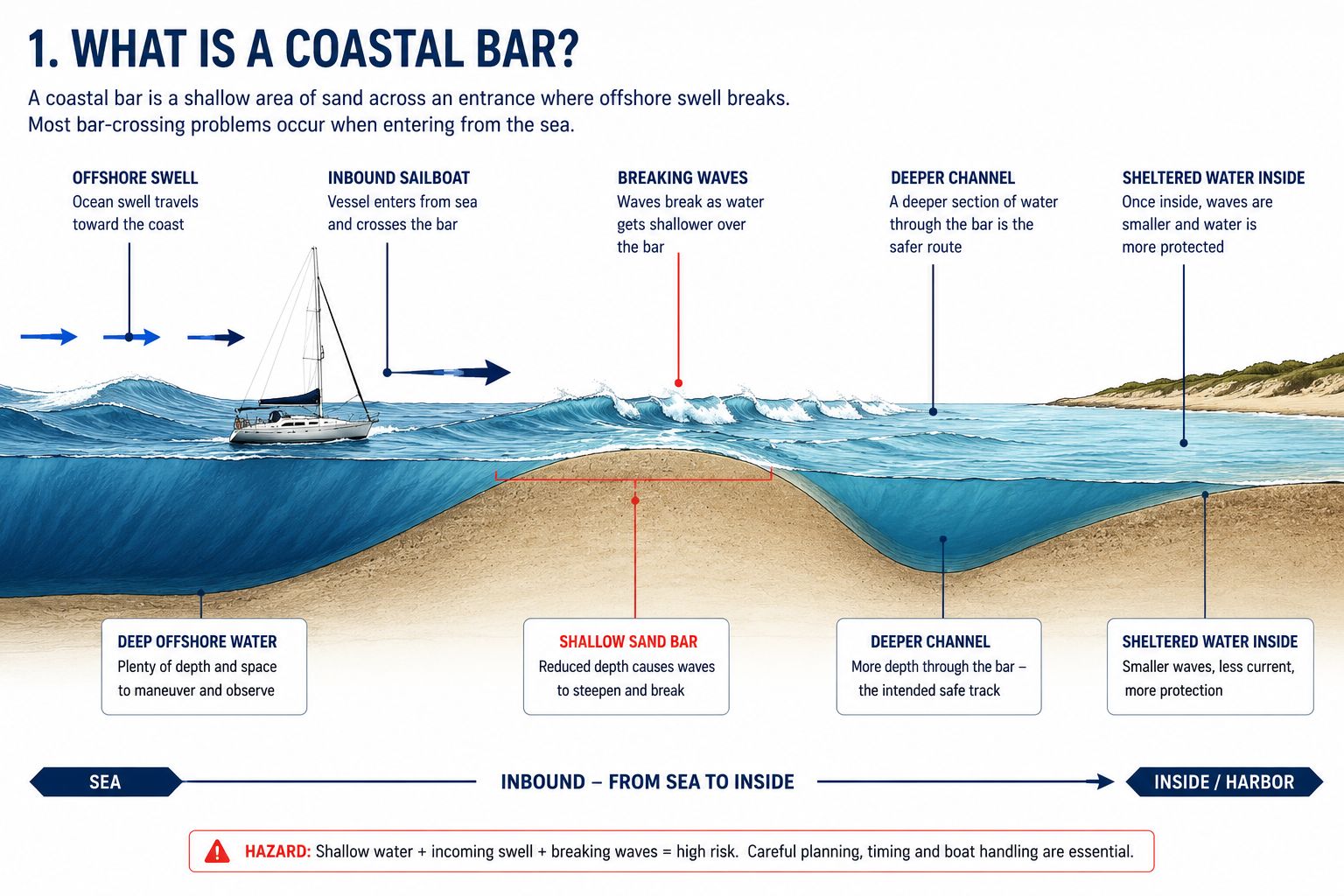 A coastal bar is a shallow entrance area where swell, tide, current and seabed shape combine to create breaking water.
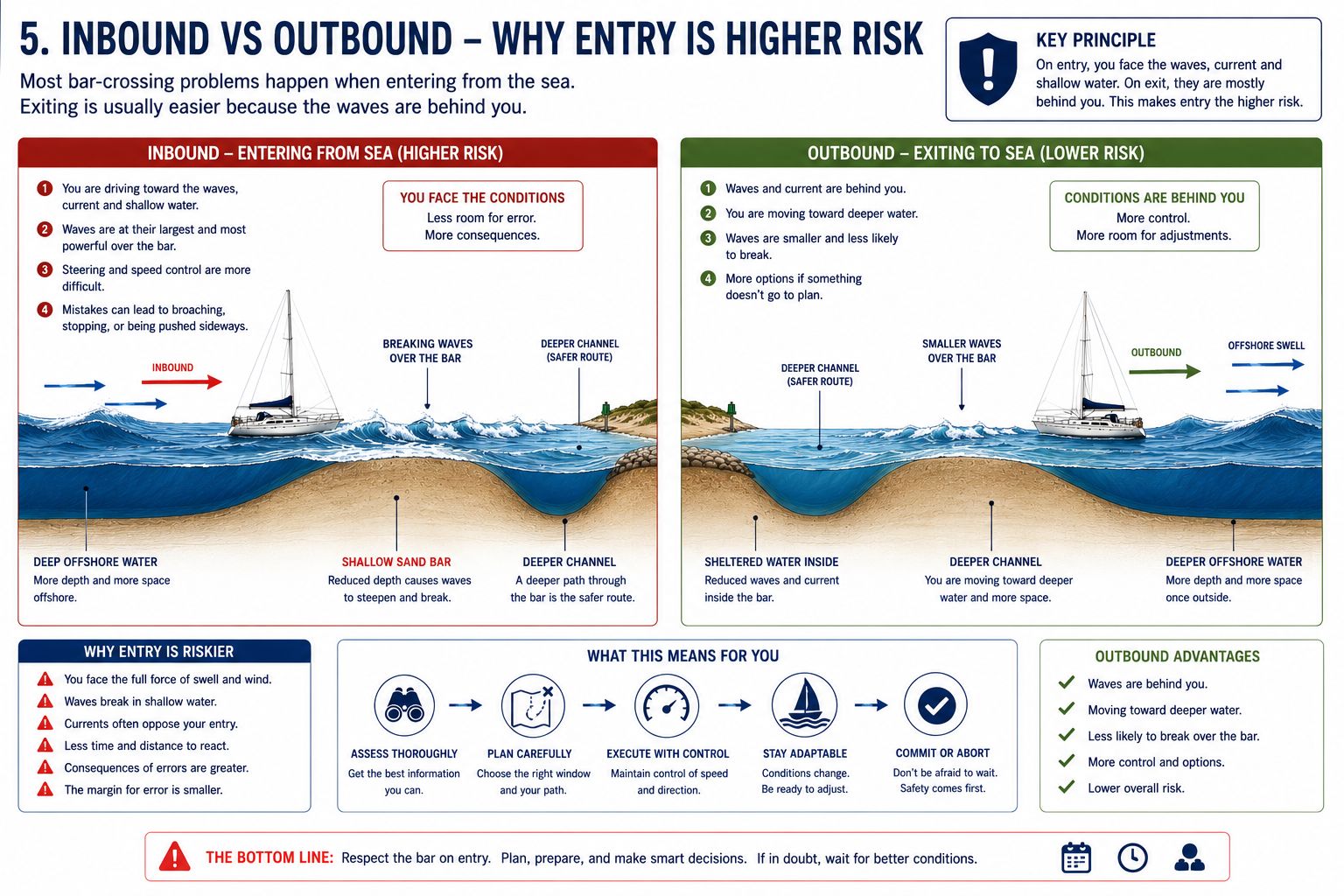
A bar is always safest on a rising tide, when the flood lifts the depth over the outer bank and softens the break. The ebb steepens the waves, accelerates the outflow and creates short, standing seas that can stop a vessel abruptly. A skipper who attempts a bar on the ebb is fighting the system; a skipper who waits for the flood is working with it. The difference is not subtle. The flood gives margin, depth and control. The ebb removes all three. The skipper studies the bar before committing, watching the rhythm of the sets, the height of the breaking waves and the behaviour of the deeper channels. The vessel does not approach until the skipper understands the pattern and has identified the safest line.
How to Cross a Coastal Bar Safely - Understanding
the Bar as a System
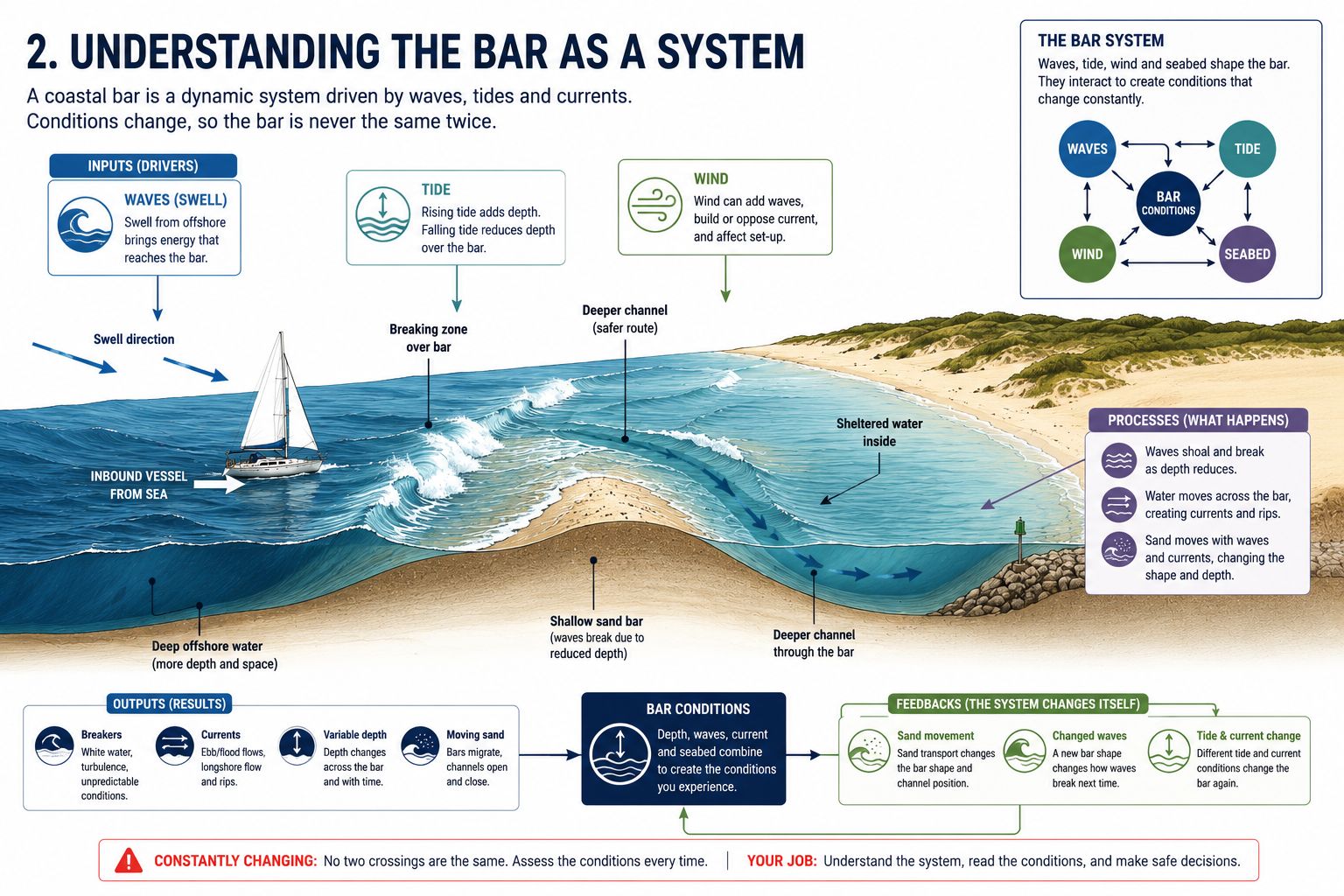
A bar is shaped by the interaction of ocean swell and river outflow. Long‑period swell pushes water over the outer bank and creates powerful, slow‑moving sets that can break far outside the visible line. Short‑period swell creates steep, closely spaced waves that leave little room for recovery. The river outflow meets the incoming swell and either flattens or steepens the waves depending on the tide. On the flood, the incoming tide pushes against the river flow and lifts the depth over the bank. On the ebb, the river accelerates seaward and steepens the waves into short, abrupt faces that can break without warning. The skipper reads the bar as a living system, not a fixed charted feature.
How to Cross a Coastal Bar Safely - Using
the Tide to Advantage
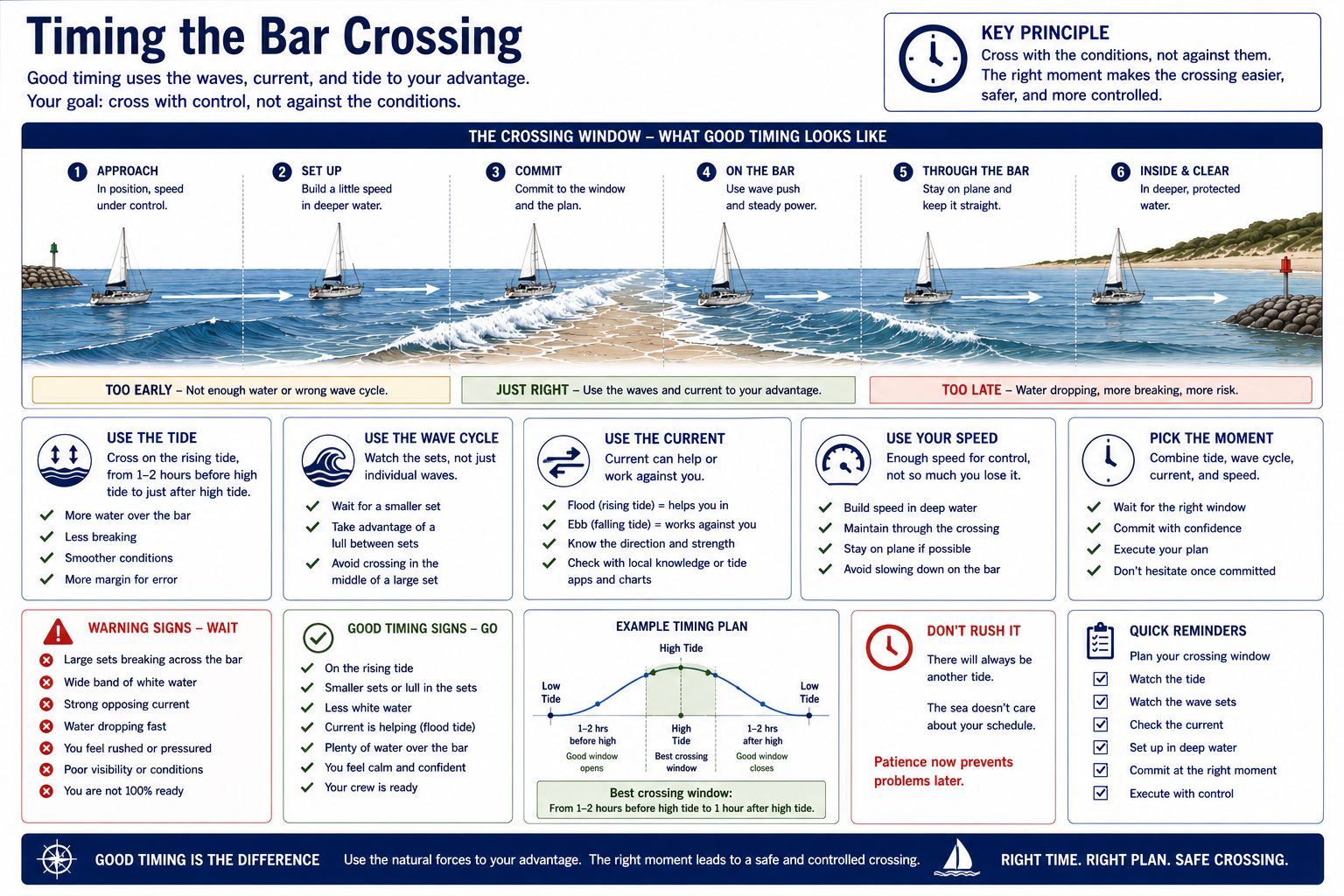
The tide is the single most powerful tool a skipper has when approaching any coastal bar. A rising tide lifts the depth over the outer bank, softens the break and slows the river outflow, turning a marginal bar into a workable one. The flood fills the gutters, flattens the faces of the waves and gives the vessel a cushion of water beneath the keel. A skipper who times the crossing for the flood is working with the system, using the ocean’s own energy to create depth, stability and margin.
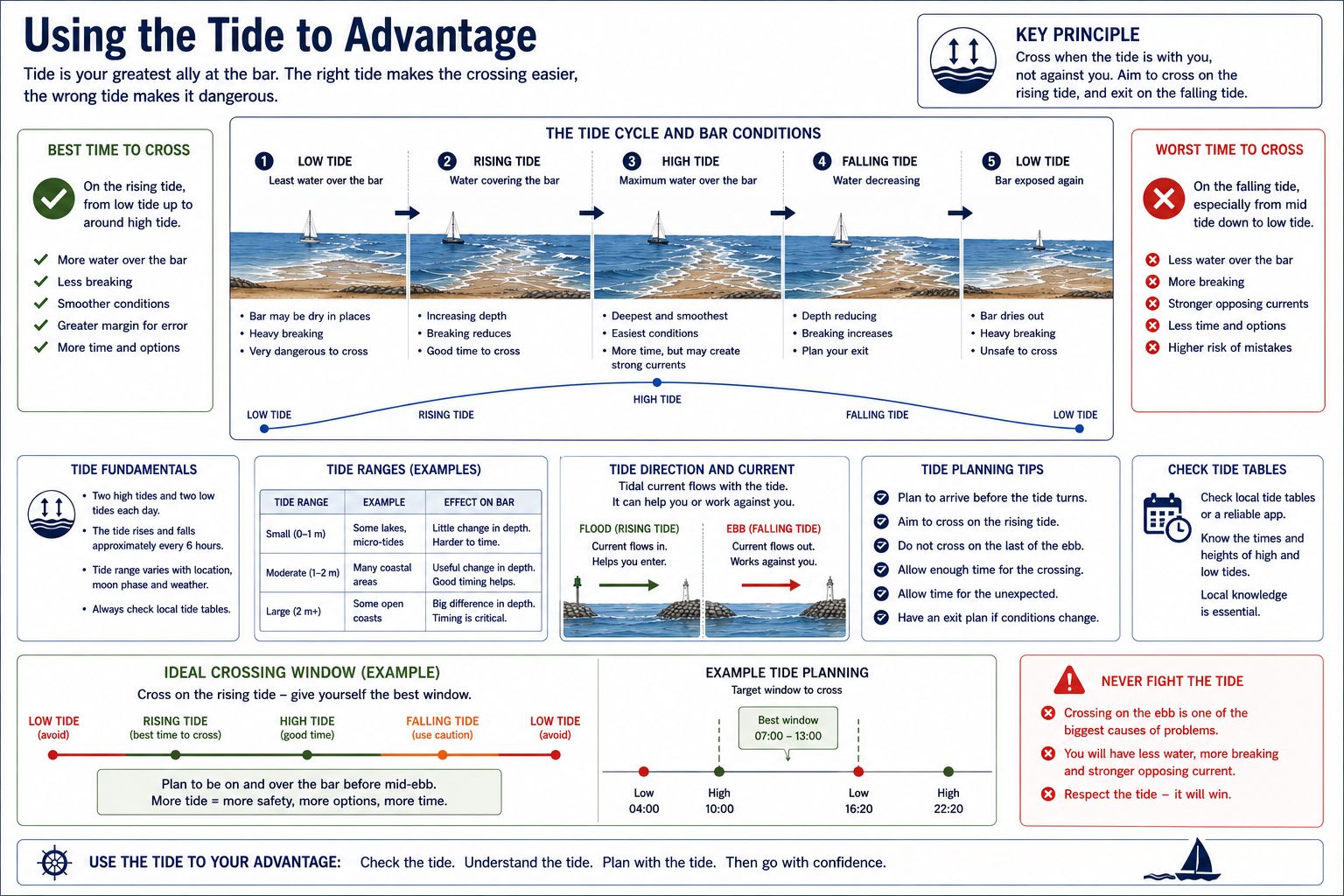
The ebb does the opposite. It accelerates the river outflow, steepens the waves and drains the depth off the bar. Even a modest swell becomes abrupt and unpredictable when it meets a strong ebb. The faces stand up sharply, the troughs deepen and the breaking line becomes chaotic. A skipper who attempts a bar on the ebb is fighting the system, relying on power alone to overcome forces that are working directly against them. The difference between flood and ebb is not theoretical; it is visible in the shape of the water and felt in the handling of the vessel.
Using the tide to your advantage means more than simply choosing the right moment. It means understanding how the tide interacts with swell direction, river flow and seabed shape. A long‑period swell arriving on a rising tide can create long, manageable sets with clear lulls. The same swell arriving on the ebb can produce sudden, explosive breaks that appear without warning. A skipper who reads the tide as part of the bar’s overall system gains control, predictability and time. A skipper who ignores it gives all three away.
How to Cross a Coastal Bar Safely - Decision‑Making
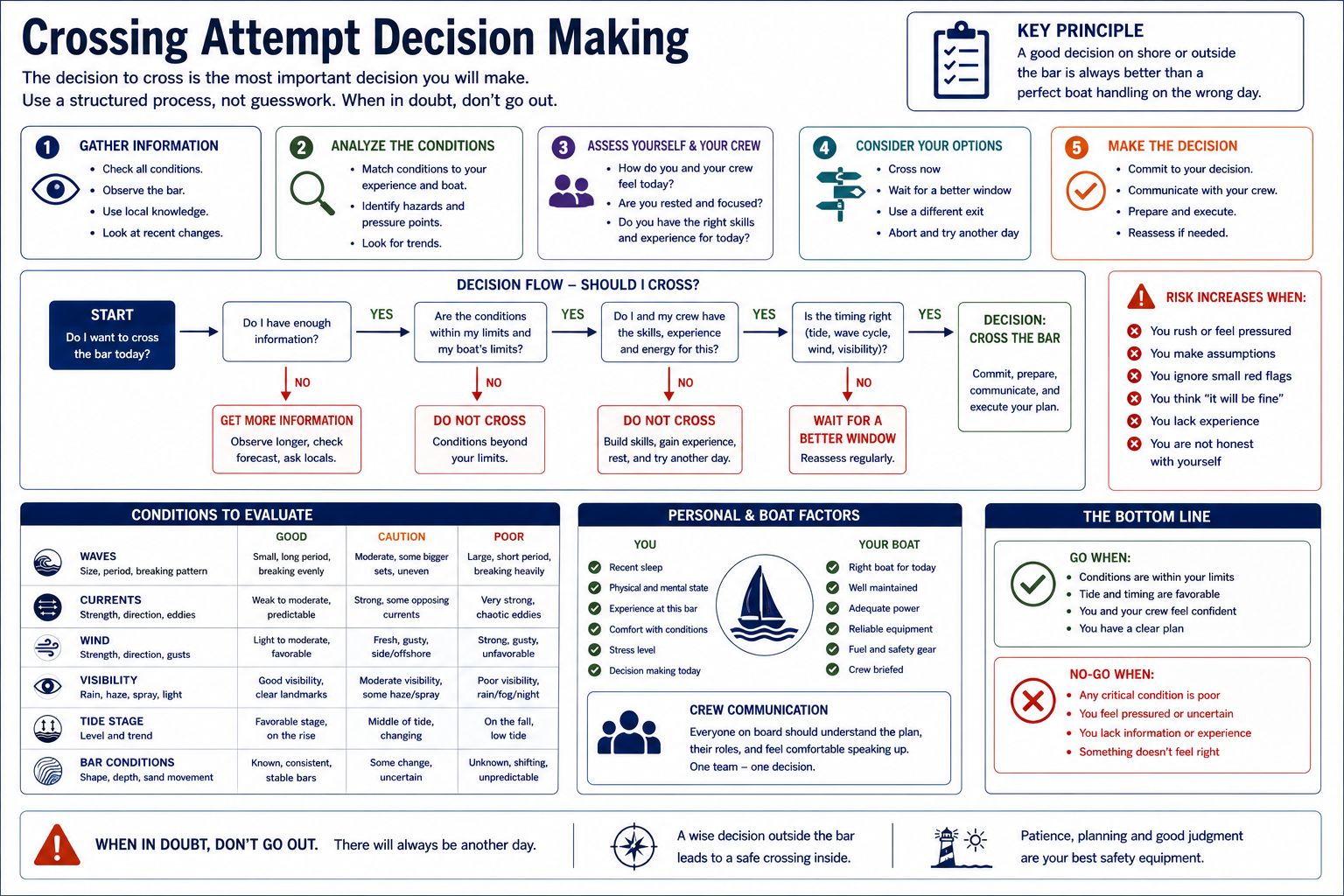
A skipper approaching a bar moves through a quiet, deliberate sequence of decisions long before the throttle is advanced. The first decision is whether the bar is workable at all. This is judged by the height and period of the swell, the strength of the wind, the state of the tide and the behaviour of the breaking line. If any one of these elements is outside the vessel’s safe operating envelope, the skipper does not approach. The second decision is whether the bar will be safer later. A rising tide, a dropping wind or a lengthening lull pattern can turn an unsafe bar into a manageable one, and the skipper considers whether waiting will improve the conditions.
Once the skipper determines that the bar is workable, the next decision is the choice of line. The deeper water is identified visually, and the skipper forms a mental picture of the run from the outer bank to the inner channel. Only when the line is clear does the skipper move to the final decision: whether the next lull is the right moment to commit. This decision is made calmly, without pressure, and only when the skipper is satisfied that the sets have revealed their rhythm. When the moment arrives, the skipper commits with purpose. The decision‑making flow ends the instant the throttle is advanced; from that point forward, the crossing becomes a single, continuous manoeuvre with no further deliberation. The thinking happens outside the break. The doing happens inside it.
How to Cross a Coastal Bar Safely - Approach
and Observation
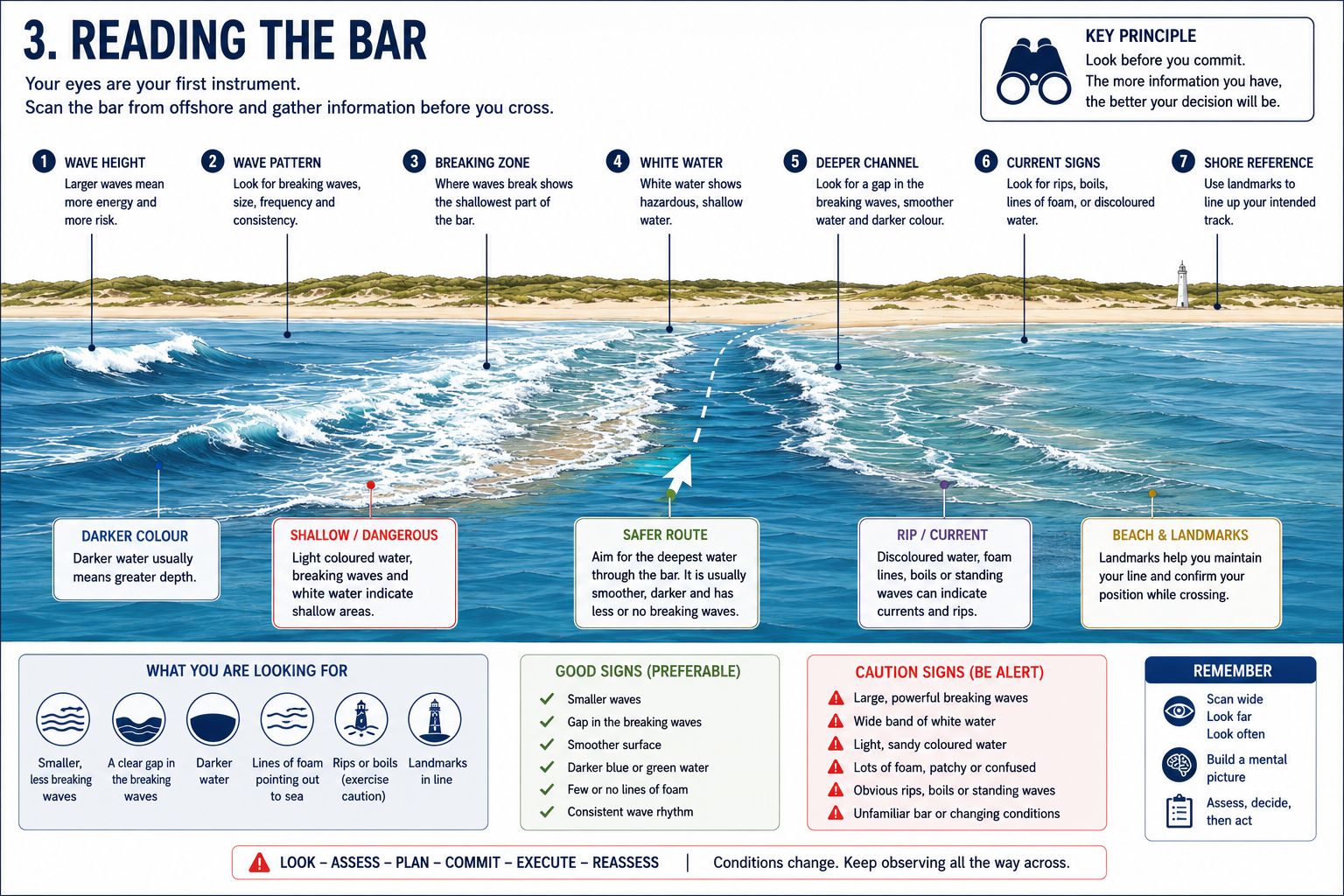
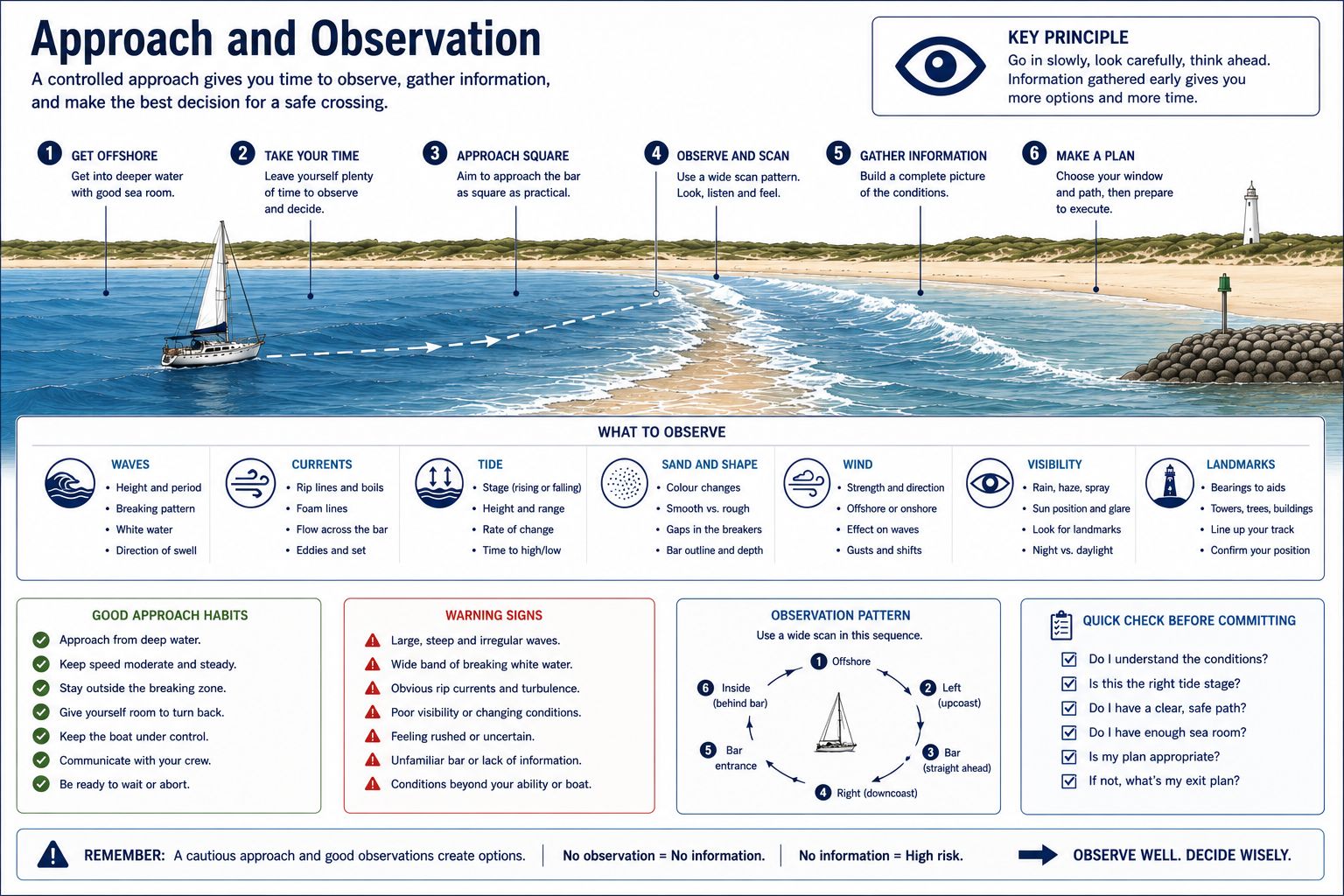
Read the bar! The bar approach begins well outside the break, with the vessel positioned safely in deep water while the skipper studies the bar. Every bar has a rhythm: long sets, short sets, double sets or irregular pulses driven by distant weather. The skipper watches the pattern until the lull is clear. A lull is not the absence of waves but the moment when the energy drops and the breaking line softens. The skipper uses this time to identify the deeper water, which is almost always visible as darker, smoother patches between the breaking sections. The vessel remains outside the break until the skipper has a complete mental picture of the crossing.
How to Cross a Coastal Bar Safely - Timing
the Bar Crossing
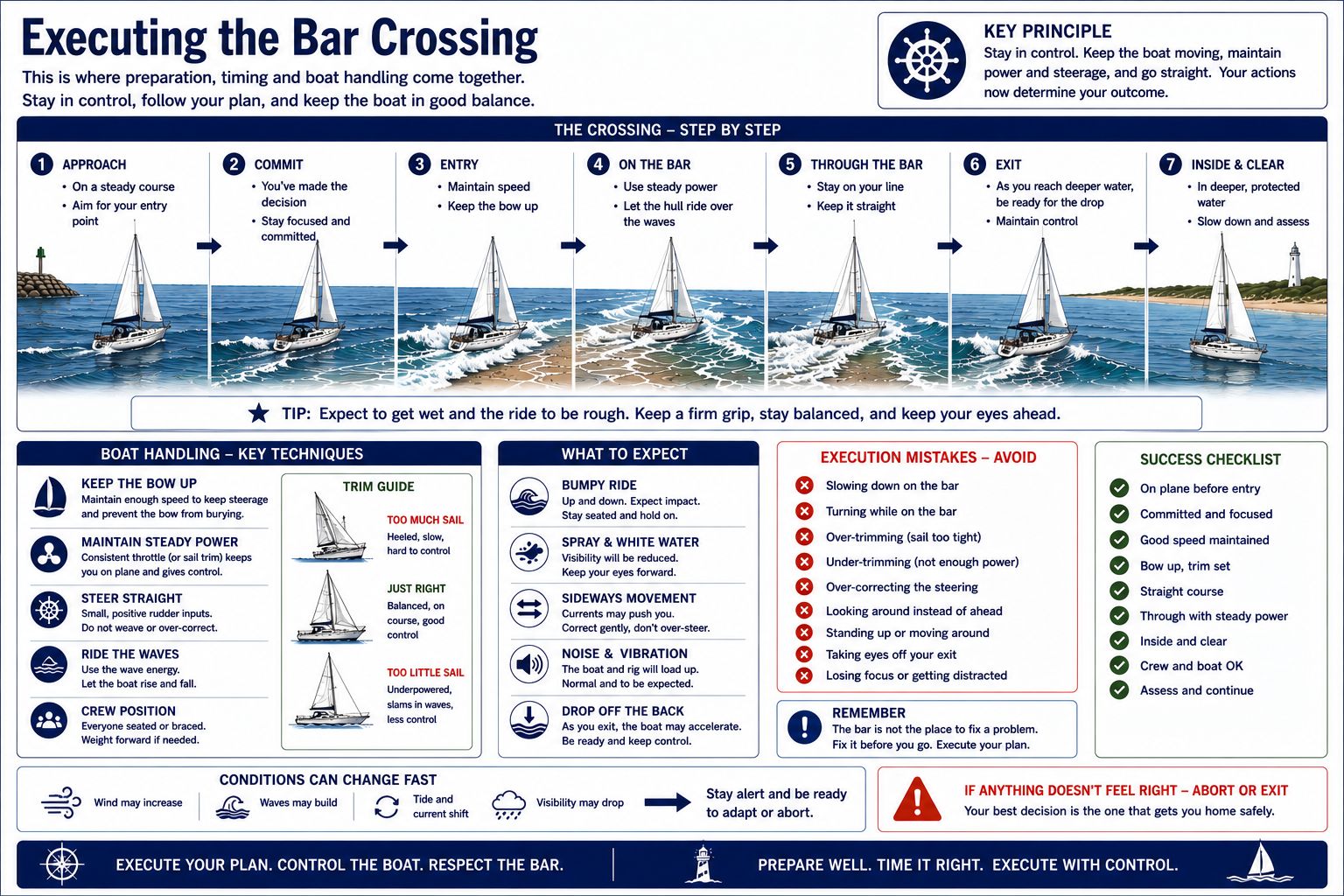
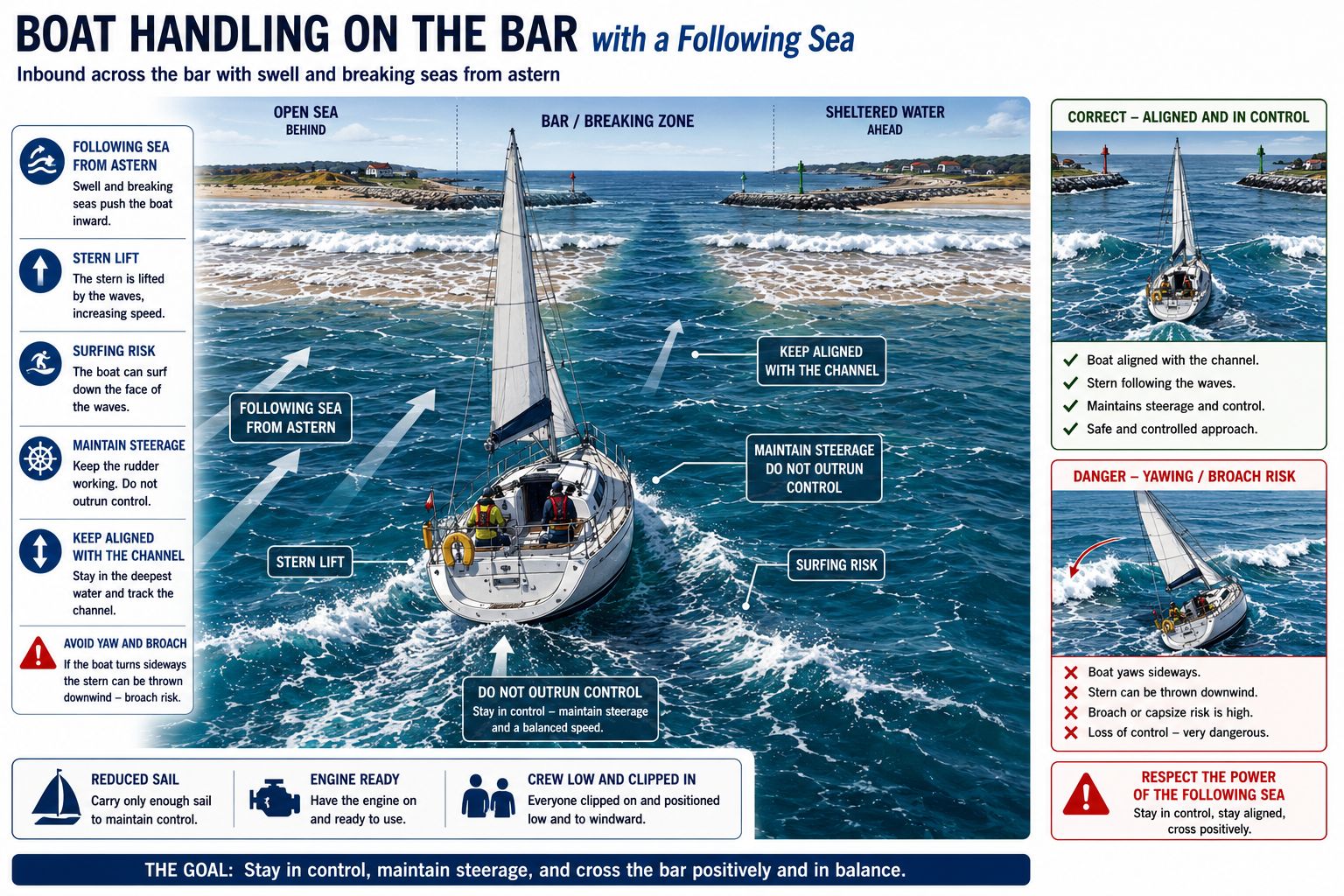
A bar crossing is timed to coincide with the lull in the sets and the rise of the tide. The skipper waits for the moment when the swell eases, the breaking line softens and the deeper channel becomes workable. When the lull arrives, the skipper commits with firm, continuous power. A bar crossing is not a place for hesitation or throttle‑shyness. The vessel must maintain enough speed to hold steerage and climb the backs of the waves without burying the bow. Once committed, the skipper stays on the chosen line and keeps the bow square to the incoming swell. A bar crossing is a single, uninterrupted manoeuvre from the outer bank to the inner channel.
How to Cross a Coastal Bar Safely - Executing
the Bar Crossing
The vessel moves through the bar with deliberate, controlled power. The skipper keeps the bow perpendicular to the waves, never allowing the vessel to be caught side‑on to a breaking crest. If a wave stands up ahead, the skipper reduces speed just enough to let the bow rise cleanly over it, then increases power again to maintain control. The deeper water is followed visually, using the darker patches as a guide. The skipper avoids the temptation to chase smoother water off to the side, as this often leads toward the shoals. The vessel remains committed to the line chosen during the observation phase.
How to Cross a Coastal Bar Safely - Boat
Handling on the Bar
Boat handling on a bar is a deliberate, controlled exercise in power management and hull attitude. The skipper keeps the vessel balanced between too little throttle, which risks losing steerage, and too much throttle, which can drive the bow into the back of the next wave. The vessel must remain responsive, with the propeller engaged and the rudder loaded, so the skipper can make small, continuous corrections as the water shape changes beneath the hull. The bow is kept square to the swell at all times; even a slight angle can expose the vessel to a breaking crest that rolls in from the shoulder.
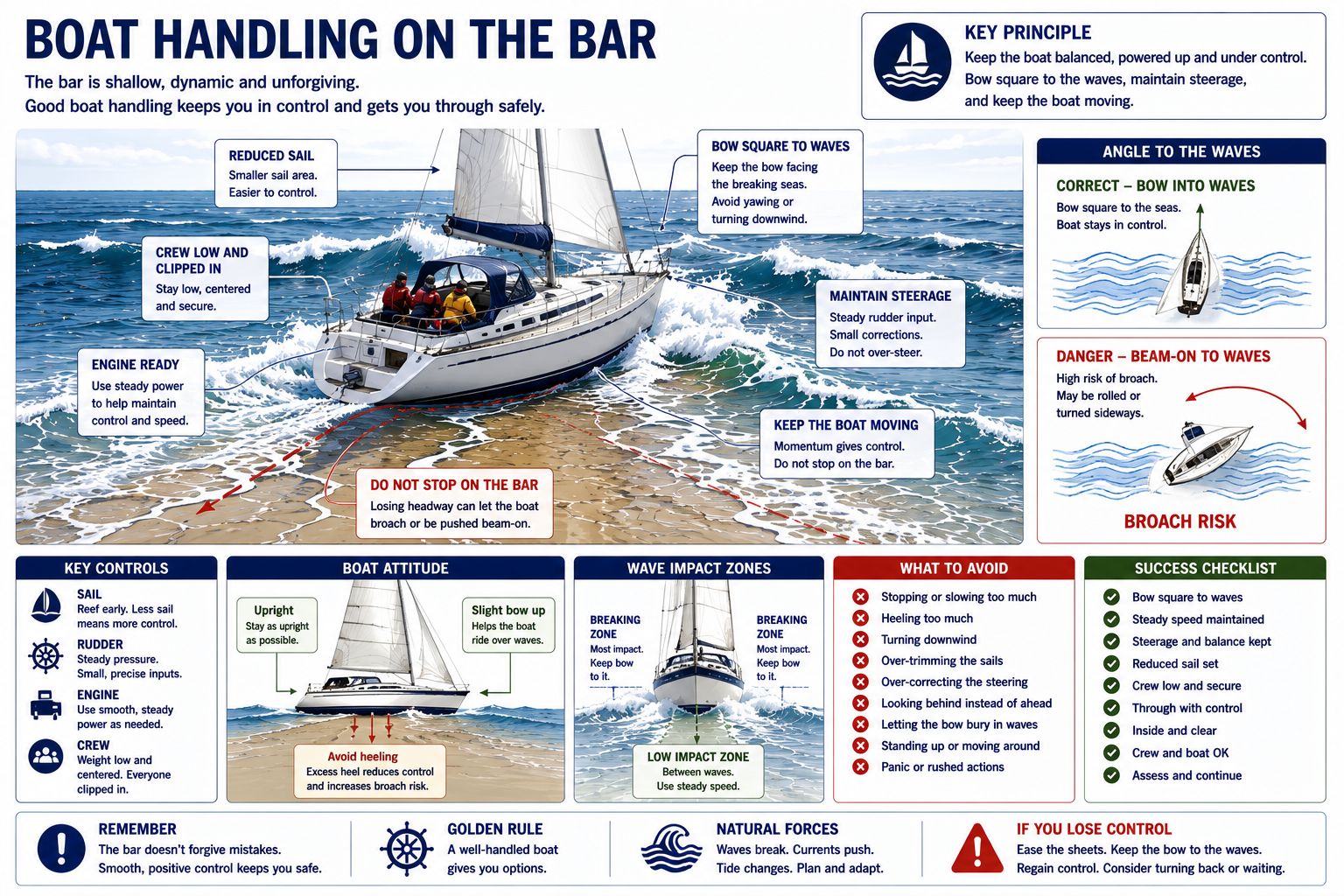
The skipper uses the throttle as a fine‑control tool, not an on‑off switch. When a wave stands up ahead, the skipper eases back just enough to let the bow rise cleanly over the face, then increases power again to maintain momentum. The vessel climbs the backs of the waves rather than punching through them. The deeper water is followed visually, using the darker patches as a guide, and the skipper avoids drifting toward the edges where the waves steepen and break. Boat handling on a bar is not about speed; it is about maintaining control, attitude and authority over the vessel from the first moment of commitment to the final moment of safety inside the channel.
Commitment and the Point of No Return
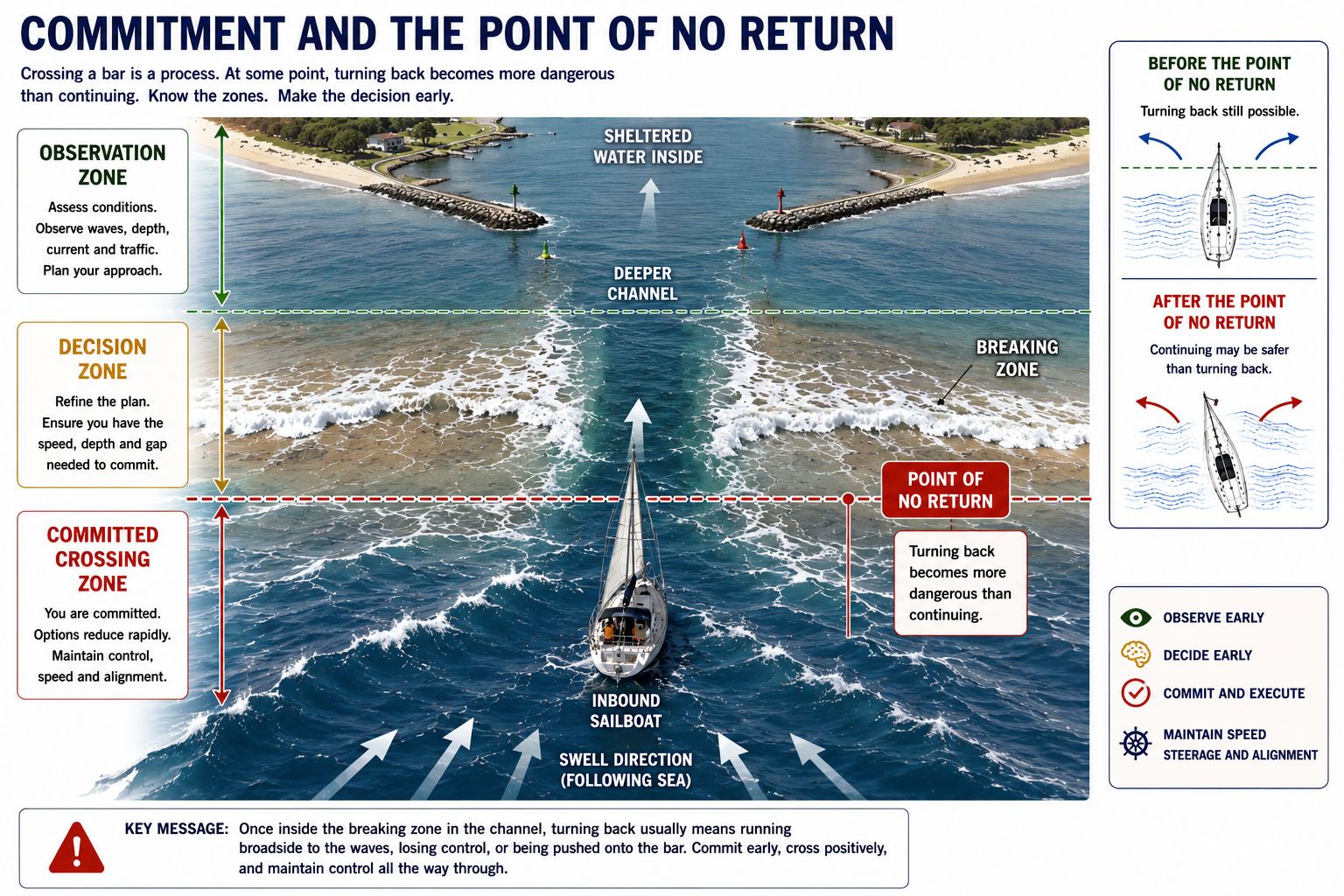
Every bar has a point where the skipper must commit fully to the crossing. This point is not marked on any chart; it is defined by the sea state, the vessel’s momentum and the behaviour of the sets. Once the skipper passes this point, turning around is no longer an option. The vessel is committed to the run, and hesitation becomes dangerous. A skipper who tries to abort after crossing the point of no return risks being caught beam‑on to a breaking wave or losing steerage in the turbulence between sets.
Commitment is a psychological and technical decision made before the throttle is advanced. The skipper waits outside the break until the lull is clear, the line is chosen and the vessel is fully prepared. When the moment arrives, the skipper advances the throttle with purpose and holds that commitment through the entire run. The vessel remains on the chosen line, the bow stays square to the swell, and the skipper maintains continuous situational awareness. The point of no return is respected because it is the boundary between control and vulnerability. Once crossed, the only safe direction is forward, with clarity, confidence and unwavering focus.
How to Cross a Coastal Bar Safely - Inside
the Bar
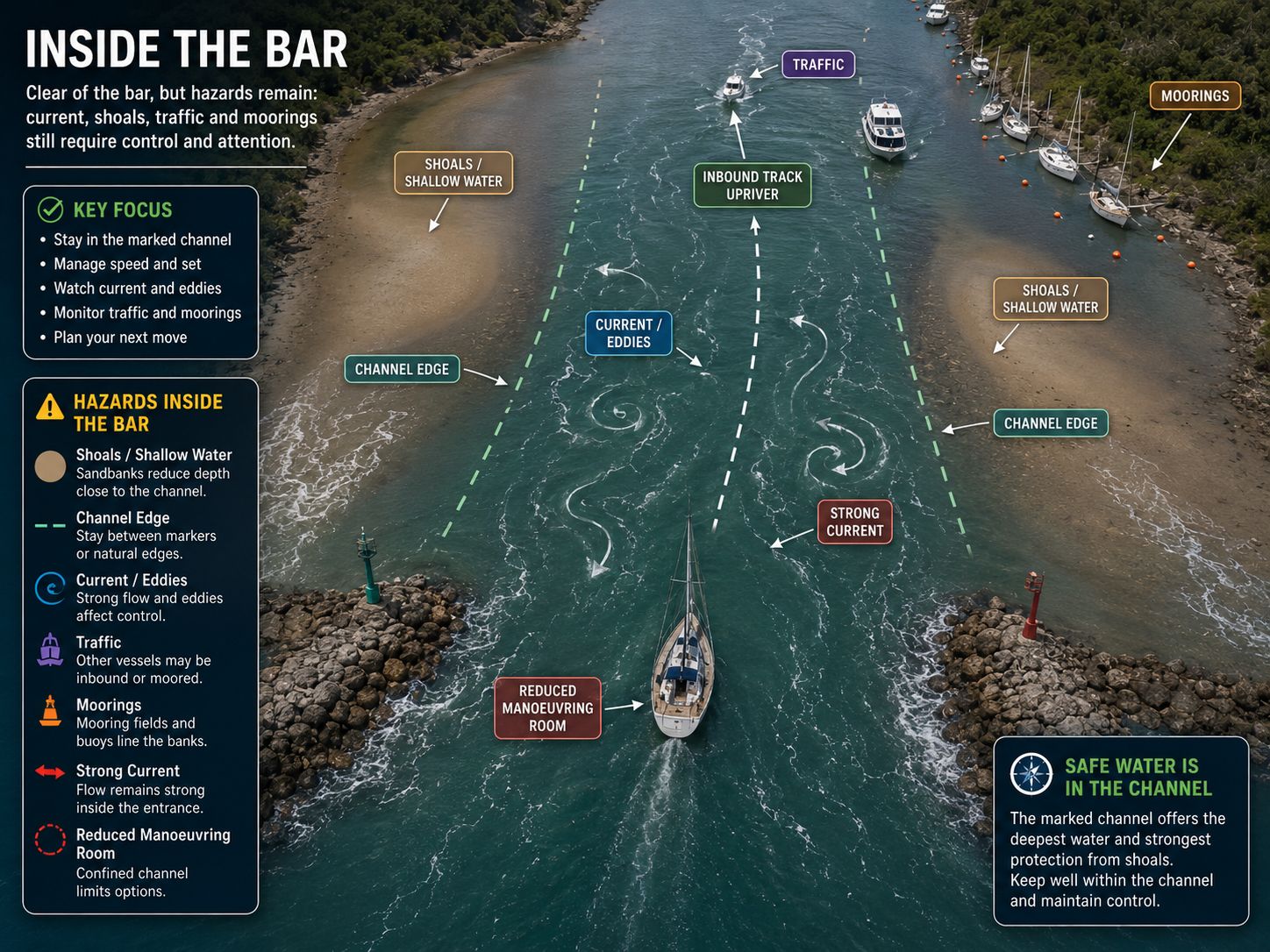
The danger does not end once the vessel passes the outer break. Many bars have a secondary break or a shallow inner bank that can surprise the skipper who relaxes too early. The vessel continues under firm control until the water is fully calm and the river flow has stabilised. Only then does the skipper reduce power and resume normal navigation. A bar crossing is not complete until the vessel is well inside the protected water.
How to Cross a Coastal Bar Safely - Weather
and Sea State
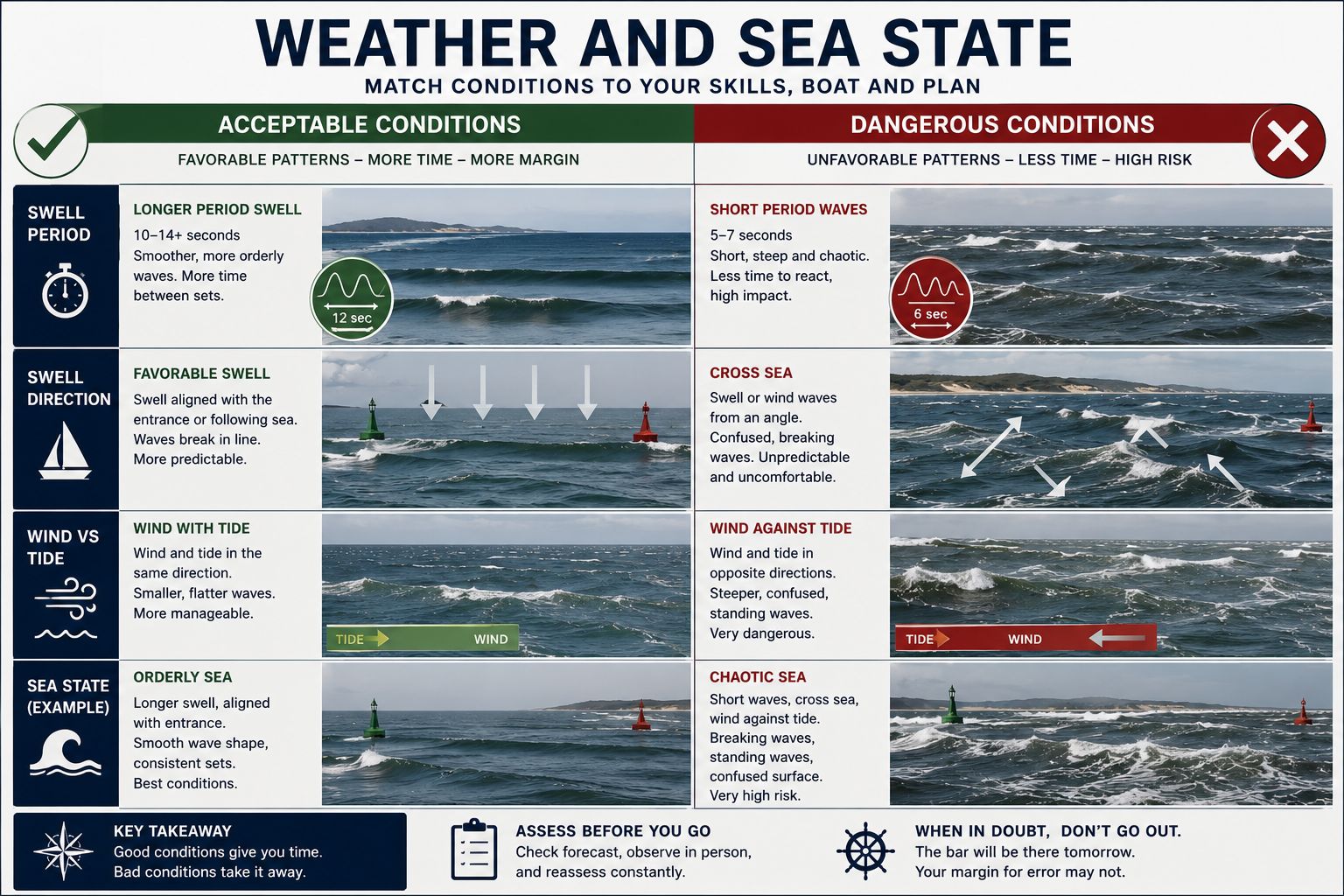
Weather plays a decisive role in bar behaviour. Strong winds steepen the waves, especially when blowing against the tide. Long‑period swell can create powerful sets that break far outside the visible line. Low‑pressure systems lift water levels and can soften the break, while high‑pressure systems depress water levels and tighten the margins. Rain and runoff reduce visibility of the water colour and make the deeper channels harder to identify. A skipper treats wind, swell, tide and river flow as a single system and times the crossing accordingly.
Common Bar‑Crossing Mistakes Skippers
Actually Make
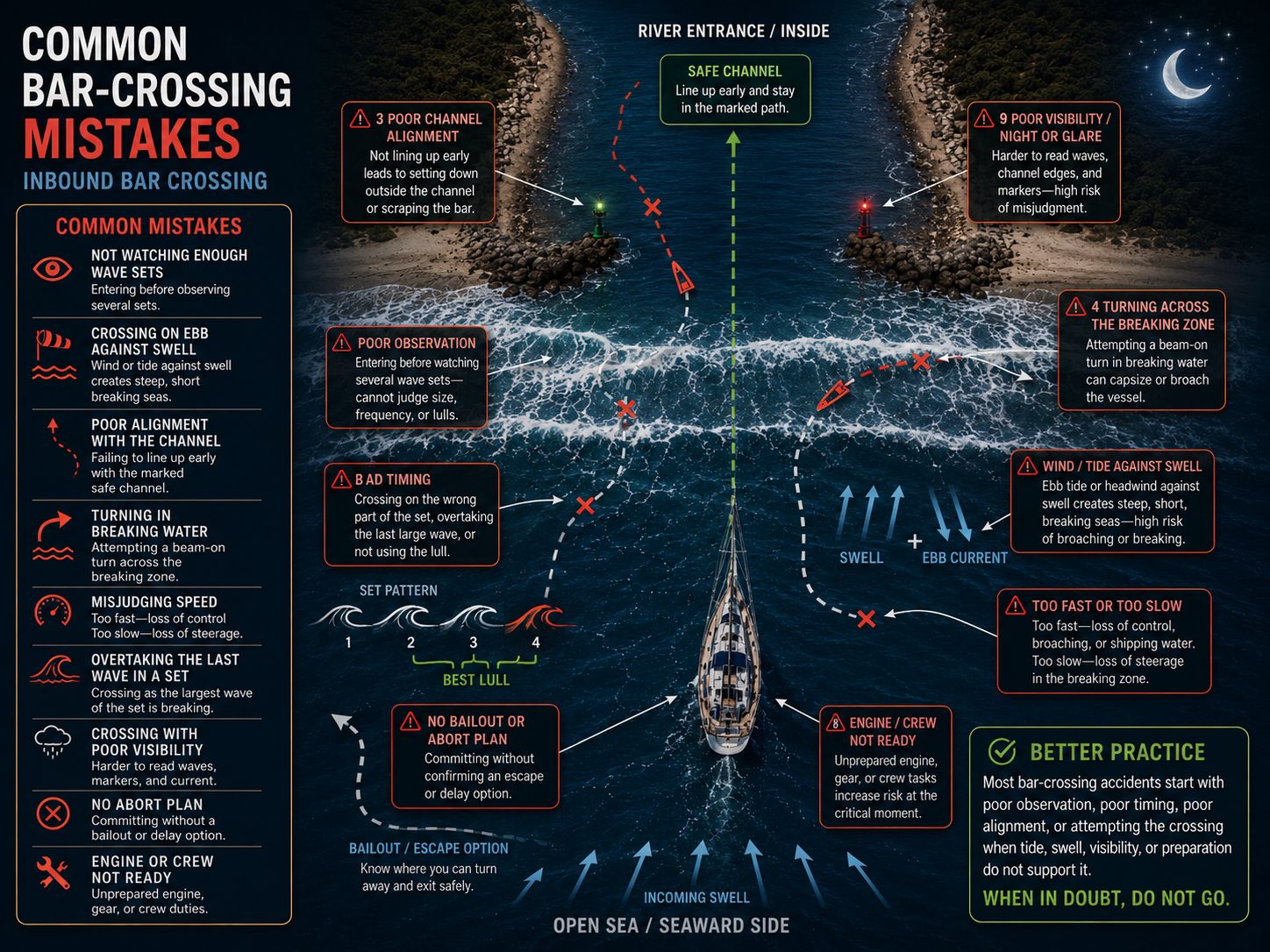
Most bar incidents are not caused by freak waves or unpredictable conditions; they come from predictable human errors made in predictable places. The most common mistake is approaching the bar without taking the time to study the rhythm of the sets. A skipper who rushes the observation phase enters the bar without understanding the timing of the lulls, the height of the breaking waves or the shape of the deeper channel. Another frequent mistake is attempting the crossing on the ebb, when the river outflow steepens the waves and removes the depth that would otherwise soften the break. Many skippers underestimate how quickly the ebb accelerates and how dramatically it changes the character of the bar.
Hesitation is another major cause of trouble. A skipper who commits and then second‑guesses the throttle loses the momentum needed to climb the backs of the waves. The vessel becomes vulnerable to the next crest, and the bow can bury or the boat can fall off the line. Some skippers attempt to steer around breaking sections instead of holding the deeper water, drifting toward the shoals where the waves are steepest. Others relax too early once inside the bar, unaware that many bars have a secondary break or a shallow inner bank that can be just as dangerous as the outer line. The most subtle mistake is psychological. A skipper who approaches the bar with anxiety or indecision often makes poor throttle choices, misreads the sets or commits at the wrong moment. A bar crossing demands calm, clarity and full commitment.
How to Cross a Coastal Bar Safely Night
Crossings
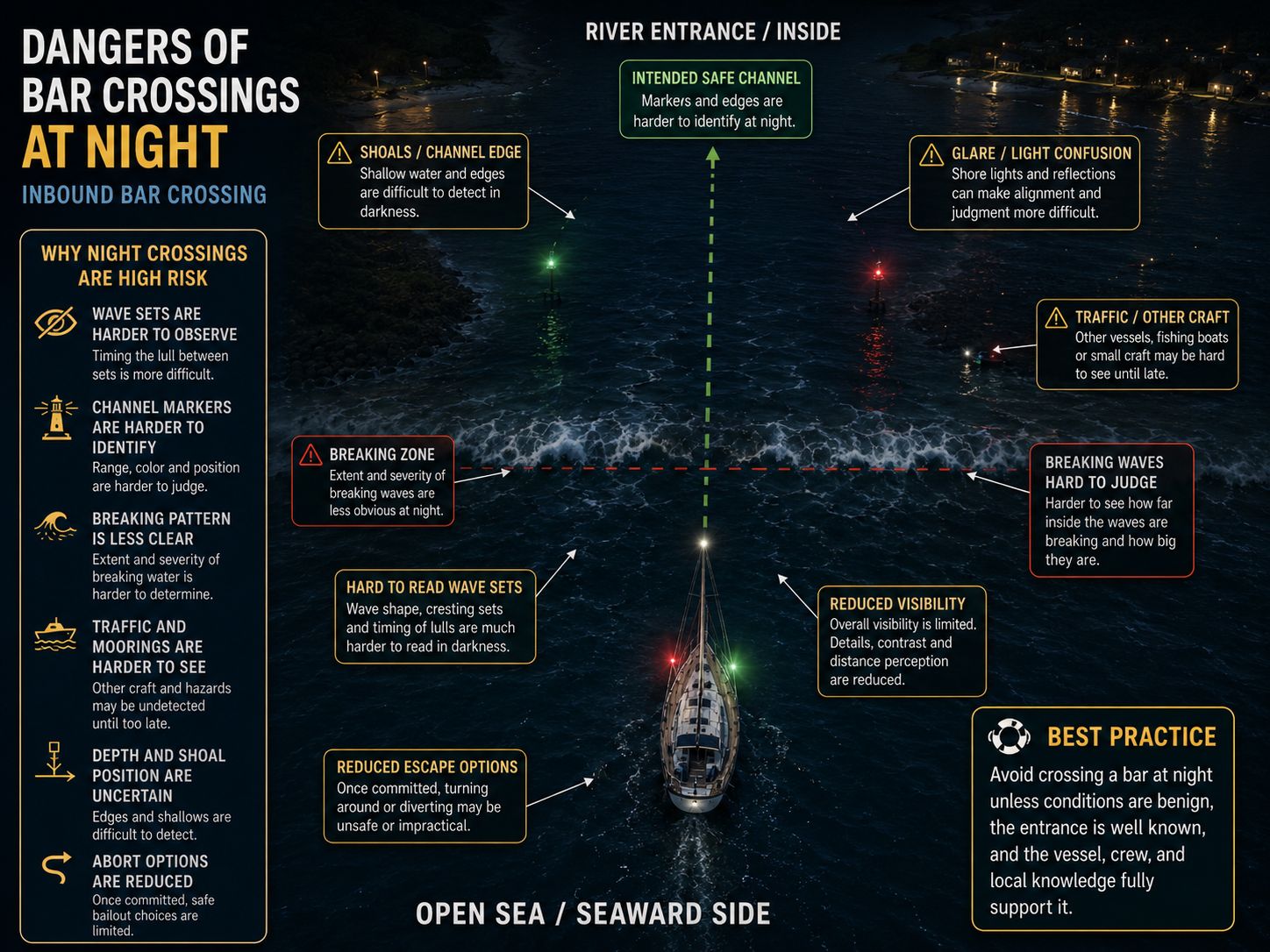
A night crossing is avoided whenever possible because the skipper loses the ability to read the water, judge the sets and identify the deeper channels. The colour contrast that reveals the gutters disappears, and the breaking line becomes a blur of white water with no clear indication of depth or timing. Even with moonlight, the swell can hide its true shape until it is too late to react. Navigation lights on the leads or beacons may show the general alignment, but they cannot reveal the height of the waves or the behaviour of the sets.
When a night crossing becomes unavoidable, the skipper treats it as a controlled, high‑consequence manoeuvre. The vessel is prepared with the same discipline as a daylight crossing, but the skipper relies more heavily on timing the tide, understanding the swell direction and committing only when the conditions are as benign as possible. The run is made on a rising tide, with the swell at its lowest and the wind settled. The skipper keeps the bow square to the swell and maintains firm, continuous power, knowing that visual cues are limited and reaction time is reduced. A night crossing is never routine. It is a last resort, approached with caution, discipline and absolute focus.
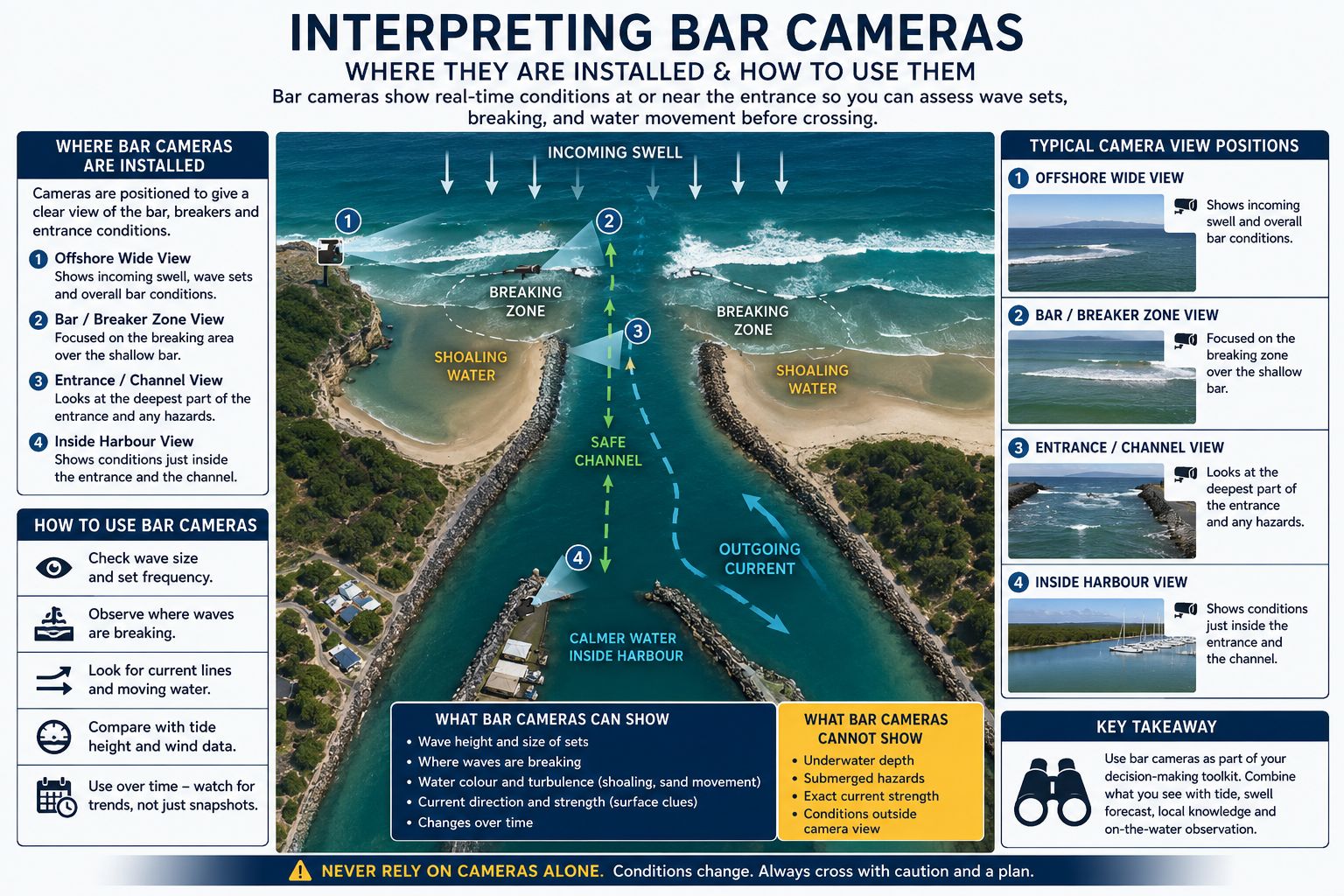
Interpreting Bar Cameras
Bar cameras are valuable tools when available, but they are only as useful as the skipper’s ability to interpret what they show. A camera provides a fixed perspective, often from high onshore, which can distort the apparent height and spacing of the waves. A wave that looks manageable from the camera may be far steeper at water level, and a lull that appears long on screen may be shorter in reality. The skipper uses the camera to understand the rhythm of the sets, the position of the breaking line and the general shape of the deeper channel, but never treats the image as a complete representation of the bar.
The skipper watches the camera long enough to identify the pattern: the length of the sets, the duration of the lulls and the areas where the waves consistently break. The darker, smoother patches between the white water often indicate the deeper water, but the skipper confirms this visually on approach rather than relying solely on the camera. A camera can show whether the bar is workable, marginal or unsafe, but it cannot replace on‑water observation. The skipper uses the camera to form a plan, then refines that plan by reading the water from outside the break. The camera is a tool, not a guarantee.
How to Cross a Coastal Bar Safely –
Crossing Psychology
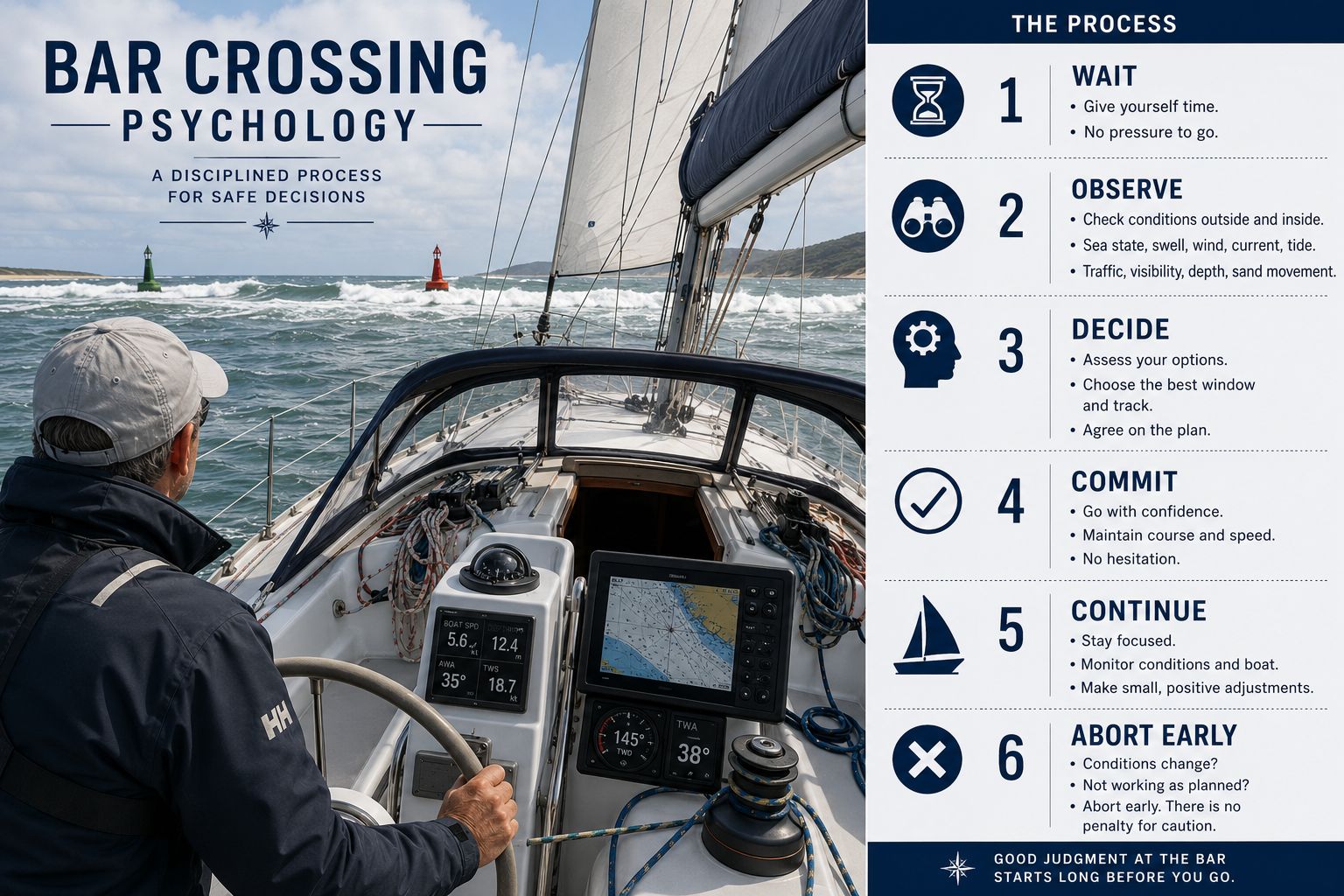
A bar crossing is as much a psychological exercise as it is a technical one. The skipper must manage their own state of mind as carefully as they manage the throttle. Confidence is essential, but it must be grounded in preparation, not bravado. Anxiety is natural, but it must not be allowed to influence throttle control or decision‑making. The skipper approaches the bar with a calm, deliberate mindset, knowing that clarity of thought is as important as the mechanical handling of the vessel.
The moment of commitment is where psychology matters most. A skipper who hesitates, doubts their line or questions their timing once the run begins is far more likely to make errors. The vessel needs continuous, decisive input, and the skipper must remain fully present, reading the water and adjusting power with purpose. A bar crossing demands focus, not fear; commitment, not aggression; and discipline, not instinct. The skipper who maintains a steady mind finds the crossing predictable and controlled. The skipper who lets emotion take the helm discovers how quickly a bar punishes indecision.
Mechanical
and Electrical Repairs Resource
If you are headed somewhere remote consider the need to expand your knowledge base or have an information resource on board. Why not get a copy of my book The Marine and Electrical and Electronics Bible 4th Edition. By and for yachties, with everything from batteries and charging, solar and wind, diesel engines and marine electronics and so much more. Your complete systems guide. 650 pages of practical advice. In Australia and New Zealand order a copy through Boat Books. UK and European boats can buy the UK Edition Here. US and Canadian boats can get the US Edition Order Here. Marine systems are my profession so let me help you. By a liveaboard boat owner for other boat owners


How to Cross a Coastal Bar Safely Summary
Crossing a bar is not an act of courage but an act of seamanship. It is a controlled, deliberate manoeuvre that relies on timing, observation, boat handling and communication. With the tide lifting the bar, the swell understood, the gutters identified and the vessel under firm control, a bar crossing becomes a predictable and manageable event. Without those elements, it becomes one of the most dangerous moments in coastal cruising. The sea rewards preparation and punishes impatience; the skipper chooses which outcome they receive. How to Cross a Coastal Bar Safely with useful advice.