Great Sandy Strait Sailing Guide
Great Sandy Strait Sailing Guide. The Great Sandy Strait is a shallow, technical waterway where timing, depth and disciplined routing matter more than anything else. It is not a scenic shortcut; it is a tide‑dependent passage that rewards preparation and punishes haste. The Strait changes character with every tide, and the skipper who treats it as a dynamic system rather than a fixed channel will find the transit predictable and controlled. A safe passage is built around the flood tide, which lifts the banks and fills the gutters, while the ebb drains the system, accelerates the flow and exposes the shoals.
A transit through the Strait is never approached casually. The skipper plans it around the tide, not the clock, and treats each section as a sequence of depth gates, gutters and bends that must be worked with precision. The Strait rewards the vessel that arrives with the flood lifting beneath the keel, the water colour understood and the route visualised before the engine is even engaged. It punishes the skipper who pushes the ebb, cuts corners or assumes yesterday’s depths still apply today. With the right timing and a disciplined approach, the Strait becomes a controlled, predictable passage; without that discipline, it becomes a narrowing, draining system that offers no forgiveness.
Great Sandy Strait
Sailing Guide – The System
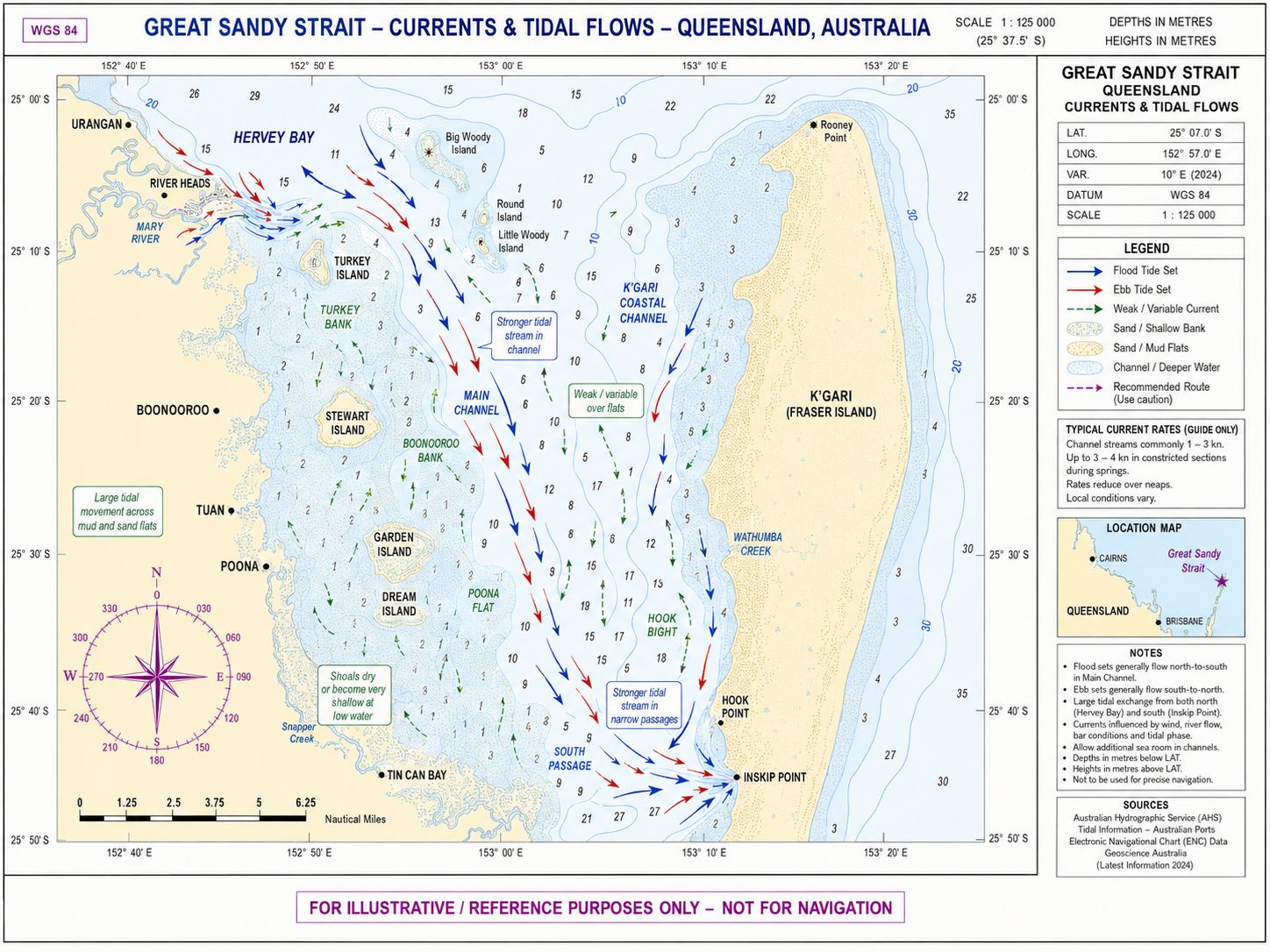
The Strait is a sequence of banks, gutters and tide‑driven channels that shift after strong weather. Charted depths give context, but the real information comes from the colour of the water and the behaviour of the surface. The gutters generally sit between 2.0 m and 3.5 m LAT, but several controlling points fall to around 1.4–1.6 m LAT, and the banks rise sharply to 0.3–1.0 m LAT. Tidal flow typically runs at 1–2 knots, increasing to 2.5 knots in the narrowest sections. The flood is the ally; the ebb is the enemy. Great Sandy Strait Sailing Guide has many complex elements to consider.
The Strait offers several anchorages that serve as tide‑waiting points rather than destinations. These are not recreational stops; they are operational pauses used to time the controlling depths. Each anchorage must be approached with the same discipline as the transit itself.
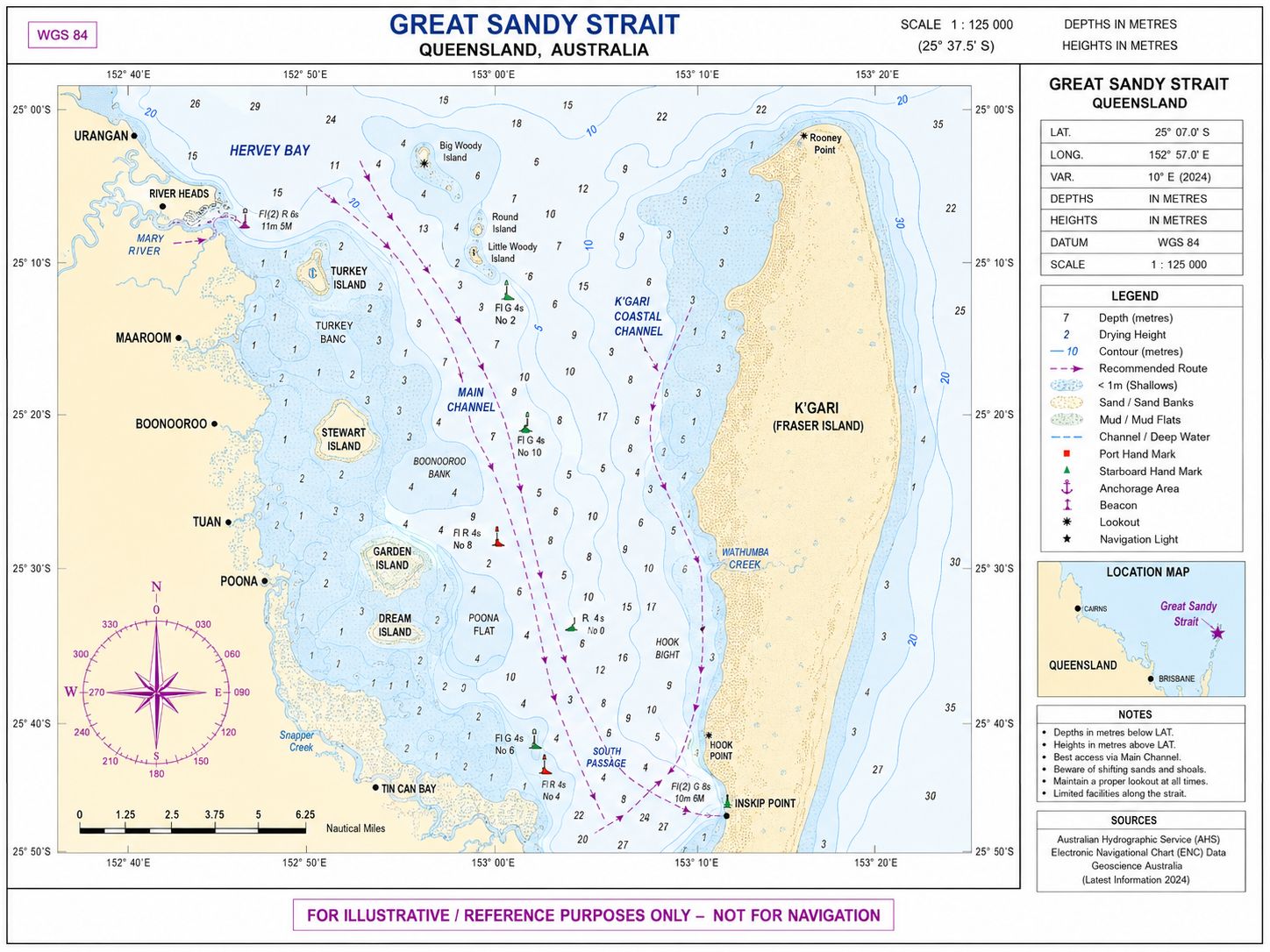
Chart Disclaimer. This chart is a schematic representation for illustrative purposes only and must not be used for navigation. Refer to official hydrographic charts for safe navigation. Be aware ENC charts may differ from official hydrographic charts. Both should be corrected and updated regularly. Also useful top use is the Beacon to Beacon Guide.
Great Sandy Strait Sailing Guide Navigation Resources
The Great Sandy Strait Northbound Transit Guide and the Great Sandy Strait Southbound Transit Guide are here to assist in your passage planning. It goes without saying that all this is for information purposes only and you should do your own passage plan and refer to or use properly corrected and correct charts (AUS 817 – Great Sandy Strait and Hervey Bay). AUS 817 is a planning‑scale chart, not a close‑quarters navigation chart. The Great Sandy Strait is covered by AU5‑series ENCs, which provide the most up‑to‑date depth and bank changes. Primary ENC Cells (Large‑Scale / Navigation‑Scale).
- AU5GSS01 – Great Sandy Strait (Southern Section). Covers: Wide Bay Bar approaches (small scale), Inskip Point, Pelican Bay, South White Cliffs, the southern depth gate.
- AU5GSS02 – Great Sandy Strait (Central Section). Covers: Tinnanbar, Turkey Island, Bookar Island, Ungowa, the mid‑Strait shoals and gutters.
- AU5GSS03 – Great Sandy Strait (Northern Section). Covers: North White Cliffs, South Head, Moonboom, River Heads, the northern exit into Hervey Bay.
The Beacon to Beacon Guide Great Sandy Strait Section is also a useful resource. Invest in the latest revision (was at 16th Edition 2025)
Great Sandy Strait Sailing Guide - Currents and Tidal Flows
Great Sandy Strait
Sailing Guide Transit Length and Fuel Requirements
A full transit of the Great Sandy Strait is roughly 36–40 nautical miles, depending on the exact line taken through the gutters and the staging anchorages used. Although the Strait itself is sheltered, the constant manoeuvring, tidal flow and periods of slow‑speed navigation mean the engine is working continuously, and the skipper must plan fuel carriage accordingly. A vessel should carry enough diesel to run the entire length of the Strait with a generous reserve, allowing for tide‑waiting, holding position, or diverting to anchor if the timing window closes. The Strait is not a place to run marginal fuel calculations; the skipper commits only when they have the range to complete the transit without relying on favourable tide or wind. With the engine as the primary means of control in the shallowest sections, fuel is treated as a safety margin, not a convenience.
Great Sandy Strait
Sailing Guide Fuel Planning for a Powered Transit
A powered transit of the Great Sandy Strait demands conservative fuel planning because the engine is working continuously from end to end. The full run is roughly 36–40 nautical miles, but the vessel rarely sits at a steady cruising RPM. The shallowest sections require slow, controlled movement; the bends demand short bursts of power to maintain steerage; and tide‑waiting or holding position can add unplanned engine hours. A skipper planning the Strait under power calculates fuel burn not on distance alone but on engine‑hours, assuming a full tide cycle may be used if the window closes or the vessel must pause at Ungowa or South White Cliffs. A typical diesel auxiliary burning 2–4 litres per hour at low RPM, or a heavier displacement motor cruiser burning 6–12 litres per hour, must carry enough fuel to complete the transit with a generous reserve. The Strait is not a place to run marginal numbers. The skipper commits only when they have the range to complete the passage without relying on favourable tide or wind, and with enough diesel to hold position or divert to anchor if the conditions change. Fuel is treated as a safety margin, not a convenience
Diesel
Availability – Tin Can Bay, Urangan and River Heads
Diesel availability along the approaches to the Strait is reliable but must be planned around tide and access. Tin Can Bay offers diesel at the marina fuel berth with all‑tide access for most vessels, making it the preferred fuelling point before approaching the southern entrance. Urangan Boat Harbour provides diesel on a sheltered, well‑maintained fuel wharf with straightforward access in all conditions, and is the primary fuelling point for northbound vessels preparing to enter the Strait. River Heads offers diesel via the barge terminal fuel facility, but access is tide‑dependent and exposed to wind‑against‑tide chop; it is workable for shallow‑draft vessels but not ideal for deeper yachts. A skipper planning a powered transit treats Tin Can Bay and Urangan as the reliable fuelling ports and uses River Heads only when conditions and draft allow. The vessel enters the Strait with full tanks, not because the distance demands it, but because the Strait offers no opportunity to refuel once committed.
Great Sandy Strait
Sailing Guide Weather
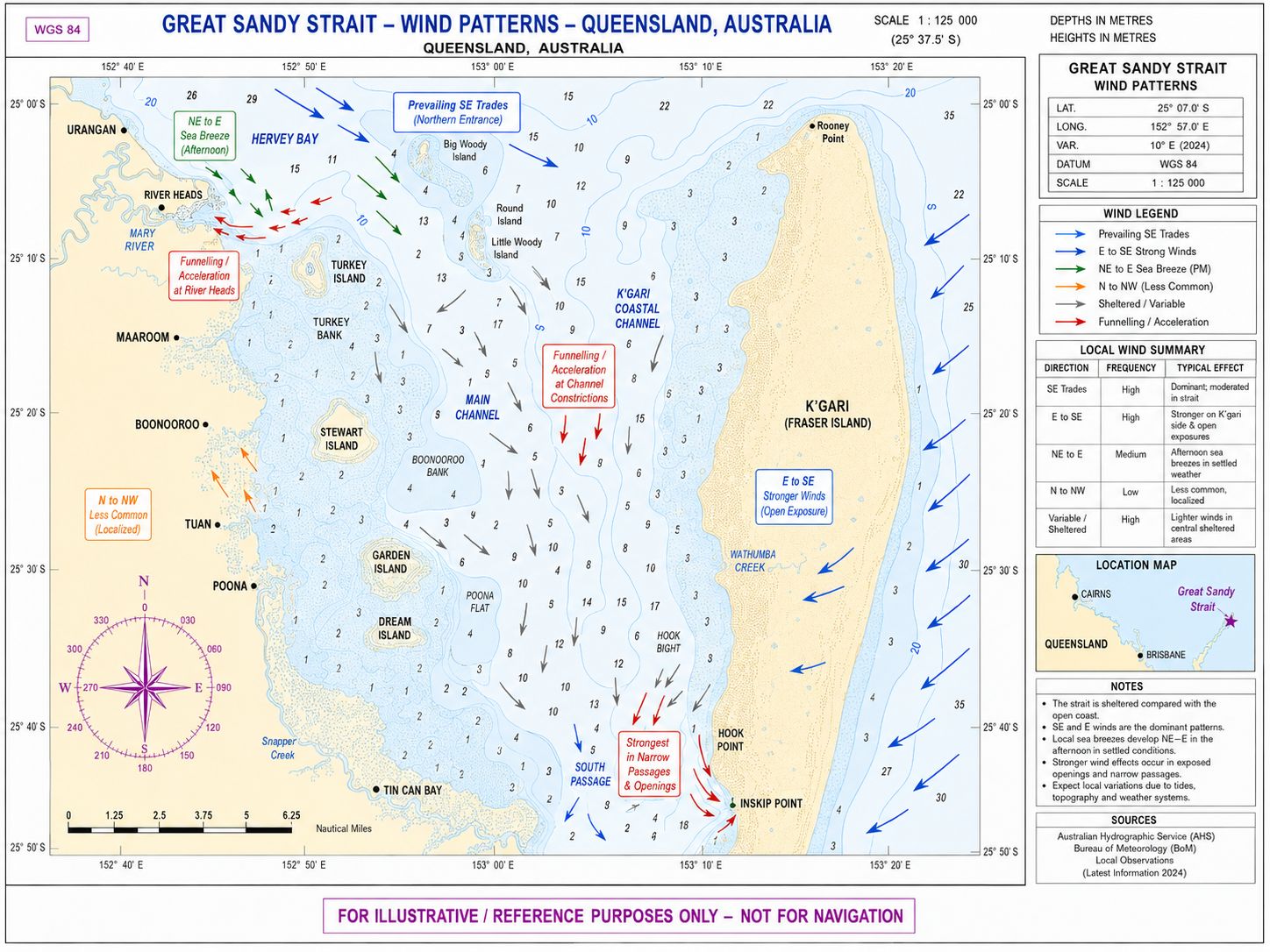
The Great Sandy Strait is sheltered from ocean swell, but it is not sheltered from weather. The system behaves like a long, shallow basin where wind direction, barometric pressure and tide combine to change the depth, the surface conditions and the handling requirements of a powered vessel. The south‑easterly trade pattern dominates much of the year, and when these winds freshen, they blow directly against the ebb in the northern exit near River Heads, creating short, steep chop that can make the final bends uncomfortable even in 3–4 m of water. The same wind‑against‑tide effect can appear in the Turkey Island narrows, where the ebb accelerates and the surface becomes confused under a strong SE breeze.
Northerlies are less common but far more disruptive. A fresh northerly pushes water out of the Strait, lowering the effective depth in the southern and central gutters and tightening the margins at the controlling points. A skipper who attempts the southern gate or the Tinnanbar Bend under a strong northerly finds the gutters shallower than the chart suggests, with the darker water narrowing and the banks rising earlier than expected. Northerlies also expose the Tinnanbar anchorage and make the South Head anchorage uncomfortable, reducing the number of safe tide‑waiting options.
Westerlies flatten the water but strip water out of the system, lowering depths across the flats and tightening the gutters. They are workable for visibility and handling but unforgiving for draft. A skipper running the Strait under a strong westerly must assume the controlling depths are reduced and treat every bend as a potential pinch point.
Great Sandy Strait
Sailing Guide Weather
Barometric pressure also plays a role. A deep low offshore or a passing trough can lift water levels slightly, giving a little more margin in the southern gate and the Bookar Island gutters, while a high‑pressure system can depress water levels and reduce the effective depth across the entire Strait. The difference is rarely dramatic, but in a system where the controlling depths are 1.4–1.6 m LAT, even a small change matters.
Rain and runoff reduce visibility of the water colour, which is the skipper’s primary tool for reading the gutters. After heavy rain, the surface becomes opaque, the colour contrast fades and the gutters are harder to identify. This is when the skipper must rely more heavily on tide timing, chart context and disciplined helm control.
The Strait is sheltered, but it is not weather‑neutral. The skipper treats wind direction, pressure and tide as a single system and times the transit accordingly. A powered vessel has the advantage of control, but only when the skipper respects the conditions that shape the water beneath the keel.
Southern Entrance
– South White Cliffs Depth Gate
The southern entrance near South White Cliffs is the first controlling depth and the point where most groundings occur. The main gutter here is often no deeper than 1.5–1.8 m LAT, with the adjacent banks rising abruptly to 0.5–1.0 m LAT. The channel shifts after strong weather, and the skipper must follow the MSQ marks precisely and stay in the darker water.
If the tide is not yet suitable, the skipper waits in the sheltered water off Pelican Bay, where depths of 3–4 m provide a secure holding area protected from the worst of the swell. This anchorage is used purely for timing; it offers no margin for complacency, but it allows the skipper to approach the southern gate on a rising tide.
The Tinnanbar Bend
– Tight Water and Falling Depths
The first major bend north of the southern gate is the Tinnanbar Bend, a section that catches skippers who drift wide or cut the corner. The inside of the bend rises to 0.8–1.0 m LAT, while the outer gutter holds around 1.6–1.8 m LAT. The ebb accelerates through this bend, tightening the turn and pushing the vessel toward the shoal.
If the skipper needs to pause before committing to the central Strait, the holding area off Tinnanbar provides workable depths of 3–4 m in settled weather. It is exposed to northerlies and unsuitable in strong winds, but in calm conditions it serves as a practical staging point before the shallowest sections.
Bookar Island
Gutters – Shifting Banks and Narrow Margins
The gutters around Bookar Island are some of the most changeable in the Strait. Depths in the main channel sit between 1.6–2.0 m LAT, but the banks rise sharply to 0.5–1.0 m LAT and shift after strong winds. The ebb runs strongly through this section, and the vessel can be pushed sideways into the shoals if the helm is not firm and deliberate.
North of Bookar Island, the anchorage off South White Cliffs (northern side) provides 3–5 m in a well‑protected pocket. This is one of the most reliable tide‑waiting anchorages in the Strait and is often used by skippers who prefer to break the transit into two tide windows rather than push through on a single cycle
Turkey Island
Narrows – Fast Water and Tight Gutters
The Turkey Island narrows are one of the most tide‑sensitive sections of the Strait. The gutters hold around 2.0–3.0 m LAT, but several pinch points fall to 1.5–1.7 m LAT. The tidal stream accelerates here, often reaching 2 knots on the ebb, and the water becomes confused when the south‑easterlies oppose the tide.
If the skipper needs to wait for the tide before entering the narrows, the anchorage off Ungowa provides 4–6 m in a sheltered basin beneath the high ground. This is the safest and most dependable anchorage in the central Strait, protected from most wind directions and offering a secure place to hold for the next flood.
Ungowa Flats –
Wide but Shallow
The Ungowa region gives the illusion of space, but the depth remains limited. The gutters hold around 2.0–3.2 m LAT, but the surrounding flats rise to 0.5–1.0 m LAT. The danger here is not the narrowness of the channel but the temptation to wander out of it.
If the skipper needs to pause before the northern exit, the anchorage off South Head provides 4–6 m in a well‑protected indentation. It is exposed to strong northerlies but otherwise reliable, and it allows the skipper to time the River Heads bends for slack or flood.
South Head and
River Heads – Wind‑Against‑Tide Hazards
The northern exit near South Head and River Heads is deeper but exposed to wind‑against‑tide chop. The gutters generally hold 3.0–4.0 m LAT, but the bends near River Heads can drop to 2.0–2.5 m LAT. When the south‑easterlies meet the ebb, the water becomes short and steep, and the vessel can pitch heavily even in the deeper sections.
If the skipper needs to wait for the tide before committing to the final bends, the anchorage off Moonboom provides 4–5 m in a sheltered pocket. Once clear of the final dog‑leg, the vessel enters Hervey Bay, where the depth increases and the Strait’s constraints fall away.
Tide Timing and
Draft Management
The Strait is workable for yachts with moderate draft, but only when the skipper respects the tide. A vessel drawing 1.6–1.8 m can transit on a half‑tide rising or better. A vessel drawing 2.0 m needs at least +0.8–1.0 m above LAT at the southern gate. Timing and discipline matter more than draft alone
Provisioning,
Fuel, and Marine Services
The Great Sandy Strait offers no provisioning or marine services. Yachts must rely on Tin Can Bay in the south or Urangan in the north for fuel, water, repairs, and supplies. Both towns provide everything required for routine resupply, and both serve as natural staging points for movements through the strait. Once inside, yachts must be self‑sufficient, carrying enough fuel, water, and provisions to complete the passage without support.
Mechanical and Electrical Repairs
Resource
If you are headed somewhere remote consider the need to expand your knowledge base or have an information resource on board. Why not get a copy of my book The Marine and Electrical and Electronics Bible 4th Edition. By and for yachties, with everything from batteries and charging, solar and wind, diesel engines and marine electronics and so much more. Your complete systems guide. 650 pages of practical advice. In Australia and New Zealand order a copy through Boat Books. UK and European boats can buy the UK Edition Here. US and Canadian boats can get the US Edition Order Here. Marine systems are my profession so let me help you. By a liveaboard boat owner for other boat owners


Great Sandy Strait
Sailing Guide - Skipper Mindset
The Strait is not dangerous when treated with respect, but it is unforgiving of casual navigation. The diligent skipper avoids shortcuts, resists the temptation to rely on old tracks and trusts the combination of tide, water colour and disciplined routing. A successful transit is not about speed but all about timing, observation and control. With the tide lifting the banks, the gutters understood and the vessel under firm command, the Great Sandy Strait becomes a technical but entirely workable passage for any well‑handled yacht. The key is discipline over assumption. Great Sandy Strait Sailing Guide is here to help.