Funchal Yacht Cruising
Guide
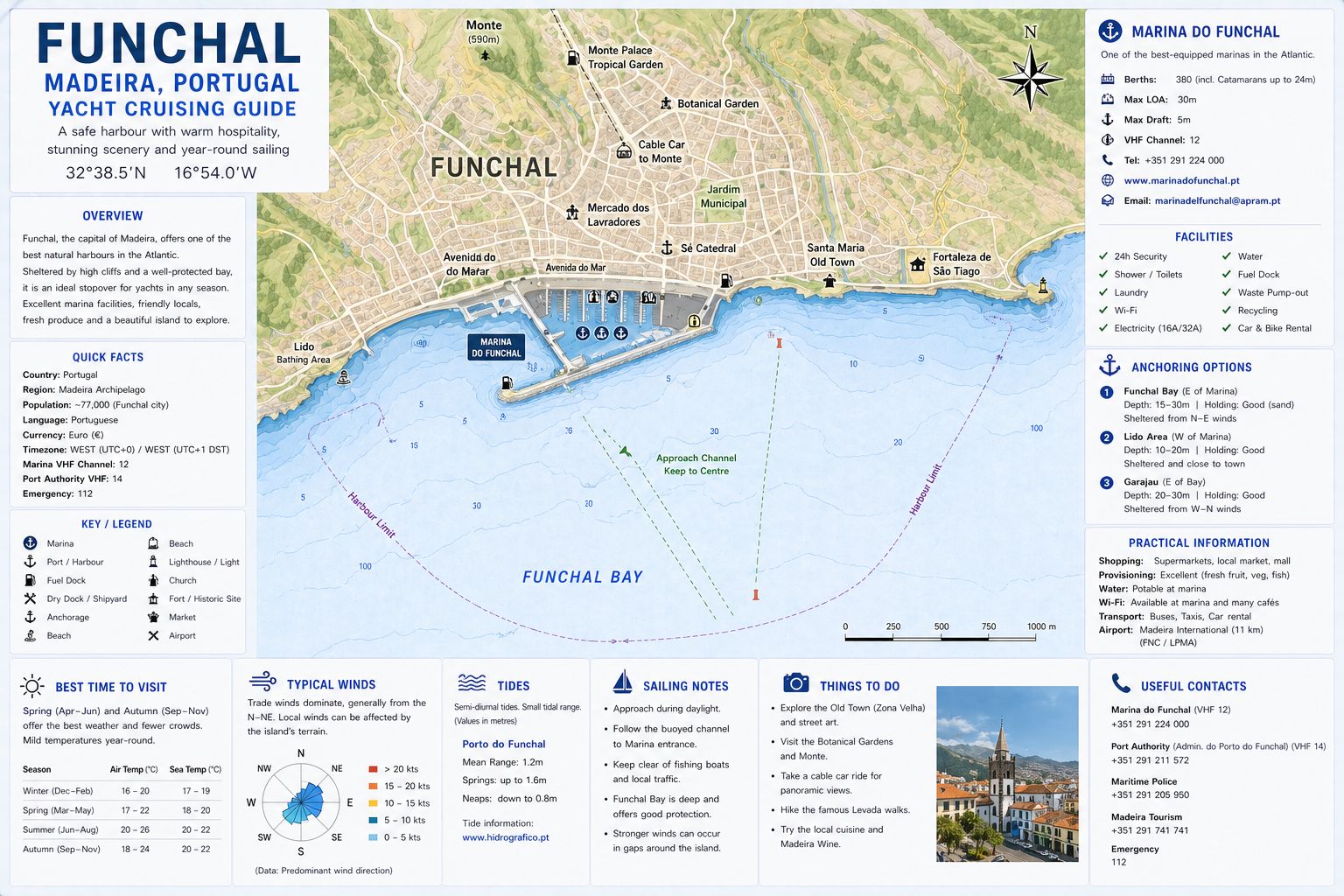
Funchal yacht cruising guide. Funchal is the principal harbour of Madeira and the island’s central operational base for yachts moving between the Canary Islands, the Azores and westbound Atlantic routes. The harbour occupies a broad, engineered bay on the island’s southern coast, protected by breakwaters that maintain workable conditions in most weather. Madeira rises steeply from deep water, and the coastline around Funchal reflects this, with abrupt depth contours, limited anchoring opportunities and a reliance on engineered harbour structures for shelter. The port combines a commercial harbour, cruise‑ship berths and a dedicated marina basin, creating a mixed‑use environment with predictable access, deep‑water approaches and consistent service availability. Funchal’s position, infrastructure and supply chain reliability make it the primary stop for yachts requiring rest, refuelling, provisioning or technical support before continuing north or west.
The marina sits inside the main harbour, with berths arranged along floating pontoons and fixed quays. The basin is sheltered from prevailing swell, though surge can occur during strong southerly systems. The surrounding city provides comprehensive provisioning, with large supermarkets, municipal markets and specialist outlets within walking distance. Marine services include mechanical and electrical workshops, rigging support and chandlery supply, supported by the island’s commercial port logistics. Funchal’s combination of infrastructure, accessibility and service density makes it the most dependable technical base in Madeira and a key waypoint for yachts transiting the mid‑Atlantic region. Other ports listed for Madeira. Machico, Calheta, Porto Moniz, Seixal, Caniçal are either commercial, fishing‑only, or unsuitable for yachts due to exposure, depth, or lack of facilities.
Funchal Yacht Cruising
Guide - Approaches
Approaches to Funchal are straightforward, with deep water exceeding 40–60 m close to the coast and a clear run‑in from the south and southwest. The commercial harbour provides full protection, and the marina sits inside the main basin with 8–12 m in the entrance channel and 3–5 m across the pontoons. Southerly swell can create surge inside the outer harbour, but access remains uncomplicated in all conditions. Traffic includes inter‑island ferries and cruise ships, and yachts should maintain separation when entering.
Approaches to Quinta do Lorde on the east coast are clean, with deep water over 30–50 m until close to the breakwater. The entrance carries 6–10 m, and the marina basin maintains 3–5 m throughout. The headland of Ponta de São Lourenço provides shelter from the prevailing NE trades, and the approach remains predictable even in fresh conditions. There are no hazards or off‑lying dangers on the final approach, and night entry is uncomplicated with clear lighting.
Funchal Yacht Cruising
Guide - Anchorage
Madeira has no reliable anchorages due to steep‑to coastline, deep water close to shore and exposure to swell from multiple quadrants. Depths drop from 20–30 m to over 50 m within short distances of the coast, and there are no bays or indentations offering protection suitable for yachts. Swell from the south and southeast affects the entire south coast, and the north coast is fully exposed to Atlantic swell. Yachts arriving at Madeira proceed directly to Funchal or Quinta do Lorde, as anchoring off either harbour is not viable.
Funchal Yacht Cruising
Guide - Entry Formalities
Entry procedures follow Portuguese and EU regulations. Yachts report to the marina office with vessel registration, passports and crew list. Schengen rules apply. Pets require EU‑compliant veterinary documentation. Waste‑management rules are enforced, and black‑water containment is required in some areas. Formalities are efficient, and staff are accustomed to handling yachts moving between the Canary Islands, Madeira and the Azores.
Funchal Yacht Cruising
Guide - Marina Facilities
Funchal Marina provides berths with 3–5 m across the pontoons, shore power, potable water, fuel, Wi‑Fi and controlled access. The marina sits inside the main commercial harbour, with the outer basin affected by surge during southerly swell. Technical support is limited to basic mechanical and electrical assistance, and chandlery stock is small. The commercial quays carry 10–12 m but are not normally used by yachts.
Quinta do Lorde Marina on the east coast offers 3–5 m throughout the basin, with sheltered berthing, shore power, potable water, fuel and reliable access in all conditions. Approaches are straightforward with deep water close to the breakwater. Technical services are minimal, and chandlery availability is limited. The marina functions as a secure arrival point for yachts approaching from Porto Santo or the Canaries.
Funchal Yacht Cruising
Guide - Local Weather
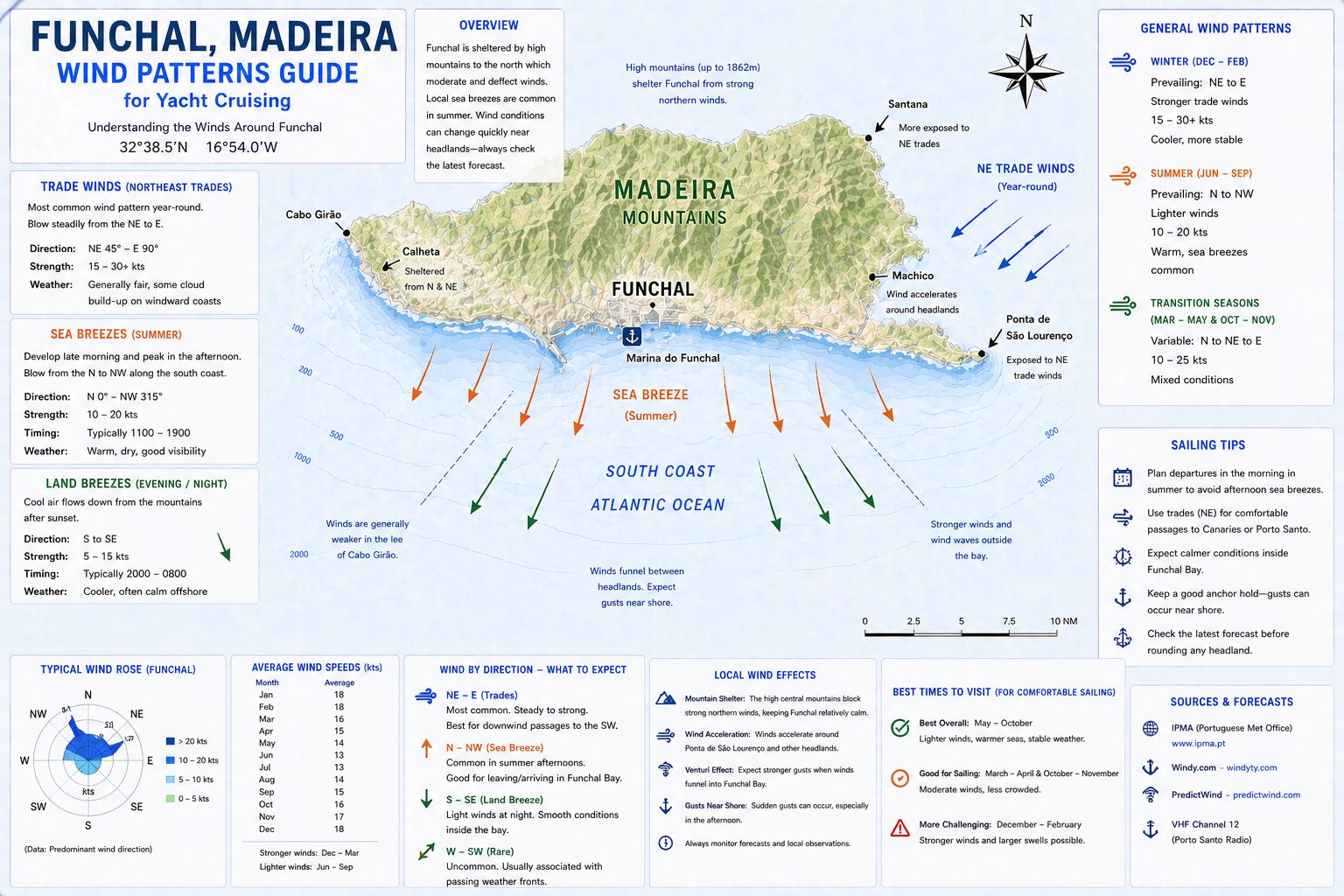
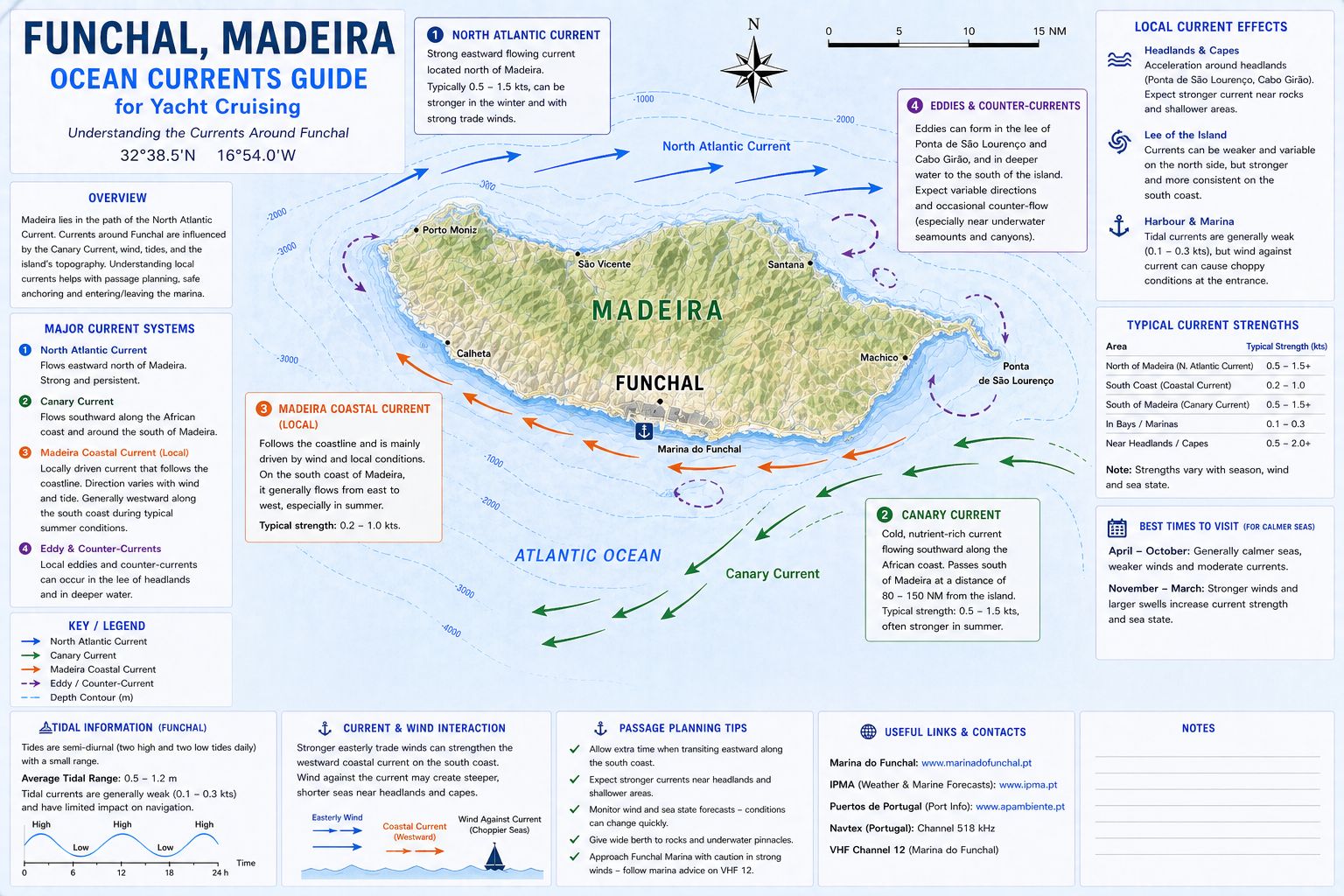
Weather in Funchal is shaped by Madeira’s high central massif, which creates strong wind gradients and localised gusting. The southern coast is generally more sheltered than the northern and eastern sides of the island, with more stable wind patterns and reduced swell. Long‑period swell from the south and southwest can affect the harbour, particularly during winter systems, though the breakwaters maintain workable conditions. Summer is dominated by the NE trade‑wind regime, with predictable patterns and moderate sea state. Winter introduces more variable winds and occasional southerly systems that can generate surge inside the harbour. Visibility is generally good, though haze can occur during periods of high humidity.
Funchal Yacht Cruising
Guide - Provisioning
Supermarkets. Primary provisioning is centred in Funchal, where Pingo Doce Avenida do Mar carries fresh produce, dairy, meat, bakery items, dry stores, long‑life goods and frozen products with stable turnover. Continente Modelo Funchal provides a wide range of dry goods, packaged foods, beverages and household items suitable for bulk restocking. Pingo Doce Anadia offers fresh produce, dairy, meat and dry stores for short‑range top‑ups. Yachts berthed at Quinta do Lorde rely on Funchal for full provisioning, as there are no supermarkets near the marina and only limited convenience‑store stock in the surrounding area.
Markets. The Funchal Mercado dos Lavradores supplies vegetables, fruit, herbs, pulses, cheeses, cured meats and regional produce including bananas, sweet potatoes, tropical fruit and local honey, with availability dependent on inter‑island transport and seasonal conditions. Smaller produce stalls operate in the city centre with variable stock levels. There are no markets near Quinta do Lorde, and crews berth there typically source all fresh produce from Funchal.
Fish Markets. Fish supply is concentrated in Funchal, where the fish hall at Mercado dos Lavradores sells tuna, espada, cherne, espada preta, mackerel, sardines and seasonal Atlantic species landed at the commercial port. Supply varies with weather and catch. There is no structured fish market near Quinta do Lorde, and crews source all fish from Funchal.
Funchal Yacht Cruising
Guide - Local Cuisine
Madeira cuisine is based on coastal fish, preserved staples and local meat dishes. Espada preta (black scabbardfish) is served grilled or with banana, using fillets cooked with minimal seasoning or light citrus. These weird fish come from very deep ocean and really delicious to try. Atum is prepared seared or stewed with onions, garlic and vinegar in the traditional atum de cebolada. Espetada uses beef cubes seasoned with garlic and salt, skewered on laurel branches and grilled; the island’s beef is known for its tenderness due to local husbandry (it is melt in the mouth and absolutely do try this). Carne de vinha d’alhos marinates pork in wine, garlic and spices before slow cooking. Caldo de peixe is a simple fish broth made from local coastal species with potatoes and onions. Milho frito uses fried maize cubes served as a staple side dish. Bolo do caco is a flatbread cooked on a hot stone and served with garlic butter.
All About Madeira
Wine
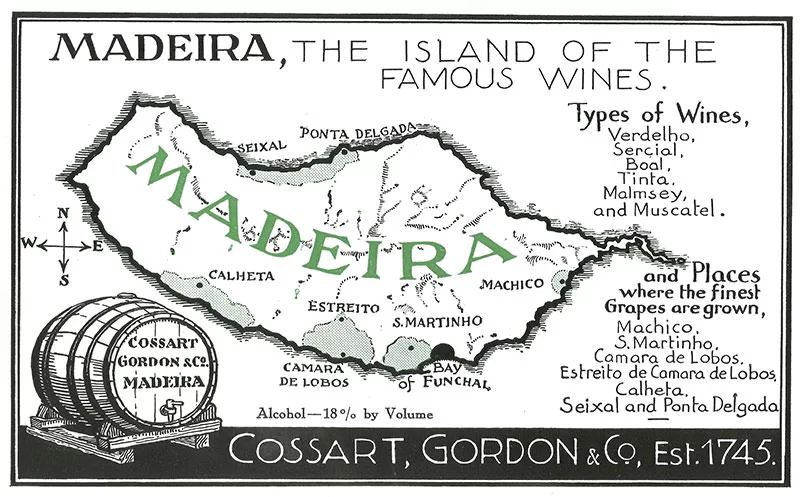
Madeira wine is a fortified wine produced on Madeira Island using white and red grape varieties including Sercial, Verdelho, Boal, Malvasia and Tinta Negra. Fermentation is halted with neutral grape spirit to stabilise the wine, and ageing is carried out either by estufagem, where the wine is heated in controlled tanks, or by the canteiro method, where barrels are stored in warm lofts for slow oxidative development. Heat exposure and oxidation create flavours of caramel, dried fruit, citrus peel, nuts and burnt sugar, with sweetness levels ranging from dry to sweet depending on the grape variety and residual sugar. The wine’s heat‑aged and oxidised structure gives it exceptional stability, allowing long storage and extended life after opening. Do stock up on some for the crossing.
Funchal Yacht Cruising
Guide - Fuel Supplies
Fuel is available at the marina fuel dock, with stable supply and straightforward access. Surge during strong southerly systems can affect fuelling operations, but the harbour remains operational in most conditions.
Funchal Yacht Cruising
Guide - Water Supplies
Potable water is available at all marina berths and fuel docks, with consistent quality and no rationing. Supply is reliable throughout the year.
Mechanical and Electrical Repairs
Resource
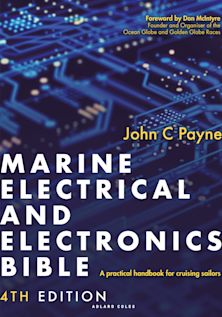
If you are headed somewhere remote consider the need to expand your knowledge base or have an information resource on board. Why not get a copy of my book The Marine and Electrical and Electronics Bible 4th Edition. By and for yachties, with everything from batteries and charging, solar and wind, diesel engines and marine electronics and so much more. Your complete systems guide. 650 pages of practical advice. In Australia and New Zealand order a copy through Boat Books. UK and European boats can buy the UK Edition Here. US and Canadian boats can get the US Edition Order Here. Marine systems are my profession so let me help you. By a liveaboard boat owner for other boat owners


Funchal Yacht Cruising Guide - Marine Services
Marine services in Funchal include mechanical and electrical workshops, rigging support, marine electronics technicians and chandlery supply. Haul‑out facilities are located in other ports on Madeira or Porto Santo, and yachts requiring lift‑out route accordingly. The harbour’s proximity to the commercial port ensures reliable access to parts and materials.
Funchal Yacht Cruising
Guide - Local Customs
Harbour operations are structured and predictable, with clear authority control and enforced waste‑management rules. Environmental restrictions apply in protected areas, and compliance checks are routine. Visiting yachts are expected to follow instructions precisely.
Funchal Yacht Cruising
Guide - Summary
Funchal is the primary operational base for yachts in Madeira, offering deep‑water access, reliable marina infrastructure, strong provisioning and consistent marine services. Approaches are straightforward, anchorages are limited by depth and exposure, and the marina provides the most reliable shelter. The port functions as a key waypoint for yachts moving between the Canary Islands, Madeira and the Azores or preparing for westbound Atlantic passages. The Funchal Yacht Cruising Guide for all you need to know.