Fraser Island Western Anchorage Guide
Fraser Island western anchorage guide. The western side of K’gari forms a long, shallow‑shelving lee that behaves predictably once the skipper understands how wind direction, tide height and seabed gradient interact. This coastline is sheltered from ocean swell but fully exposed to wind‑driven sea state, and the skipper must treat it as a system where comfort depends entirely on wind behaviour over the next tide cycle. The water is clear, the bottom is clean sand, and the navigation is simple, but the anchorage logic is unforgiving to anyone who anchors based on how the water looks at the moment rather than how it will behave in six hours.
From Rooney Point down past Wathumba and into the mid‑bay beaches, the anchorage pattern is consistent: the closer the vessel sits to the island, the more workable the conditions become under a south‑easterly or easterly, and the more exposed the anchorage becomes under any northerly. Depths along the western shoreline range from 3–6 m in the nearshore band, shoaling rapidly to 1.5–2.5 m close to the beach depending on tide height. The seabed is uniformly sand with excellent holding, but the long fetch of Platypus Bay means that even a moderate northerly will build a steep, uncomfortable chop that rolls straight into the shoreline. The skipper who anticipates this finds the coastline predictable; the skipper who reacts to it finds it punishing.
Fraser Island Western Anchorage Guide
- Weather Behaviour
The weather on the western side of K’gari is shaped by three dominant forces: the south‑easterly trade winds, the afternoon sea breeze, and the northerly patterns that arrive with seasonal changes or frontal systems. The trades are the most reliable and the most favourable. A settled south‑easterly lays the entire western coastline down, flattening the water from Rooney Point to Moon Point and creating the classic glassy conditions that define Hervey Bay. Under these winds, the dunes and tree line provide a clean wind shadow, and the fetch is short enough that the sea state remains gentle even several hundred metres offshore
The afternoon sea breeze behaves differently. It often arrives from the north‑east or east‑north‑east and can freshen quickly, especially on warm days. The skipper must anticipate this, because a calm morning anchorage can become lively by mid‑afternoon. The sea breeze rarely creates dangerous conditions, but it can produce a short, energetic chop that makes exposed anchorages uncomfortable. The skipper who plans to move south or return to the mainland must consider that the sea breeze will be on the bow for the return run.
The northerly is the true antagonist of the western side of K’gari. Even 10–12 knots of northerly wind builds a steep chop across the full fetch of Platypus Bay, and anything above 15 knots becomes untenable for anchoring. The water remains clear, but the comfort disappears quickly, and the skipper must always consider the overnight forecast. A northerly shift at 2 am will turn a previously calm anchorage into a rolling, uncomfortable lee shore. The coastline offers no natural protection from this direction, and the skipper must be prepared to move or avoid anchoring altogether when northerlies are forecast.
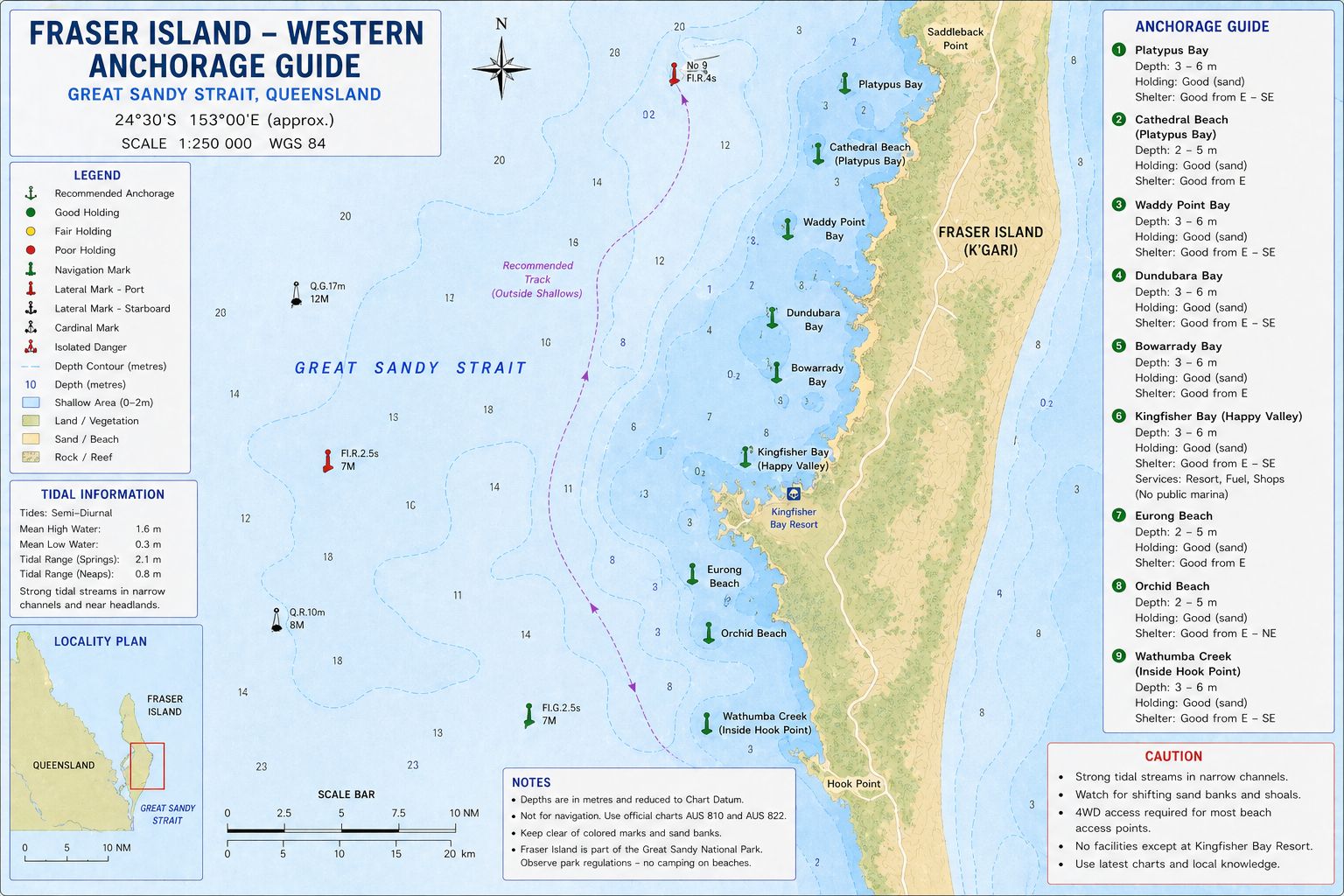
Chart Disclaimer. This chart is a schematic representation for illustrative purposes only and must not be used for navigation. Refer to official hydrographic charts for safe navigation. Be aware ENC charts may differ from official hydrographic charts. Both should be corrected and updated regularly.
Fraser Island Western Anchorage Guide
- Rooney Point
Rooney Point is the northernmost anchorage and the most exposed. Depths here range from 6–10 m in the approach, shoaling to 3–5 m in the anchoring zone. The bottom is clean sand with strong holding, but the anchorage is workable only under a settled south‑easterly or in calm conditions. A northerly of any strength builds a steep, short chop across the full width of Platypus Bay, and the vessel will roll beam‑to unless anchored very close to the beach. Even then, the shelter is minimal because the point offers height but not curvature, and the wind wraps around the headland easily.
Most boats treat Rooney as a pause point, not a secure overnight anchorage. It is ideal for staging before running south along the western beaches or north toward Sandy Cape, but only when the wind direction supports it. The water clarity is excellent, and the deeper patches are easy to identify by colour, but the skipper must remain aware that the anchorage deteriorates rapidly with any shift into the north‑west or north.
Fraser Island Western Anchorage Guide
- Wathumba
Wathumba Creek provides the most reliable anchorage on the western side of K’gari, but only when used with discipline. The outer anchorage sits in 3–5 m over firm sand, with the best shelter found by tucking in close to the beach where the dunes break the breeze. The inner creek offers depths of 1.5–2.5 m at high tide, but the entrance bar dries significantly and must be approached with caution; the controlling depth is often 0.5–1.0 m at low tide, and the skipper must time entry and exit carefully.
Under a south‑easterly or easterly, Wathumba becomes a calm, predictable anchorage where the island’s height and the curvature of the bight flatten the water. Under a light northerly, the skipper can still find workable shelter by positioning deep inside the bay, but once the breeze freshens from the north‑west or north, the anchorage collapses and the chop rolls straight in. The skipper must always consider the overnight forecast; Wathumba is excellent in the right conditions but unforgiving if the wind shifts unexpectedly.
Fraser Island Western Anchorage Guide
- The Western Beaches
South of Wathumba, the western beaches offer a long run of workable anchorages with depths of 3–6 m in the nearshore band and 1.5–3 m close to the beach. The seabed is clean sand with excellent holding, and the water clarity makes depth judgement easy. The skipper anchors close to the island, using the dunes and tree line to break the wind and flatten the water. Under a south‑easterly or easterly, these beaches provide comfortable, predictable conditions with minimal swell and gentle wind shadows.
A light westerly is workable, but the vessel will sit bow‑to the breeze with a slight roll from the residual fetch. Any northerly, however, exposes the entire coastline. The fetch from Rooney Point to the mid‑bay beaches is long enough that even 10–12 knots of northerly breeze will build a steep chop that makes the anchorage uncomfortable, and anything above 15 knots becomes untenable. The skipper must always consider the overnight wind shift; these beaches are excellent in the right conditions but offer no forgiveness under a northerly.
Fraser Island Western Anchorage Guide
- Platypus Bay
Platypus Bay is not an anchorage in the traditional sense; it is an open roadstead where a vessel can pause in calm weather but cannot rely on protection. Depths range from 8–20 m across the bay, shoaling gradually toward the island. The bay is sheltered from ocean swell by the full length of K’gari, but it is fully exposed to wind. A south‑easterly lays the bay down beautifully, creating the classic glassy conditions that define Hervey Bay, but a northerly turns the entire western face of the island into a long, rolling fetch.
The skipper uses Platypus Bay as a transit zone or a temporary stop, never as a secure overnight anchorage unless the conditions are stable and the wind is light. The holding is excellent on clean sand, but the exposure is absolute, and the skipper must always treat the bay as condition‑dependent rather than guaranteed.
Mechanical
and Electrical Repairs Resource
If you are headed somewhere remote consider the need to expand your knowledge base or have an information resource on board. Why not get a copy of my book The Marine and Electrical and Electronics Bible 4th Edition. By and for yachties, with everything from batteries and charging, solar and wind, diesel engines and marine electronics and so much more. Your complete systems guide. 650 pages of practical advice. In Australia and New Zealand order a copy through Boat Books. UK and European boats can buy the UK Edition Here. US and Canadian boats can get the US Edition Order Here. Marine systems are my profession so let me help you. By a liveaboard boat owner for other boat owners


Fraser Island Western Anchorage Guide
- Summary
The anchorage logic along the western side of K’gari is simple once understood: the island provides shelter from swell but not from wind, and the skipper anchors close to the beach only when the wind direction supports it. Depths are generous, holding is excellent, and the navigation is straightforward, but the coastline is unforgiving under any northerly. A south‑easterly or easterly creates comfortable, predictable conditions from Rooney Point to the western beaches, while a northerly removes the margin that makes these anchorages workable. The skipper who anticipates wind shifts, respects the fetch of Platypus Bay and treats each anchorage as condition‑dependent will find this coastline safe, comfortable and entirely predictable. Fraser Island Western Anchorage Guide for more useful navigation advice.