Edgecumbe Bay
Sailing Guide for Yachts
Edgecumbe Bay Sailing Guide. Edgecumbe Bay forms the broad, open stretch of water between Bowen and Cape Gloucester and provides a mix of semi‑protected anchorages, clear approaches and straightforward navigation in settled conditions. The bay is exposed to the north and north‑west but gains good shelter from the south‑east, making it a practical transit zone for vessels moving between Bowen, Cape Gloucester and the Whitsunday islands. The coastline is a combination of sandy beaches and rocky headlands, with generous depths and few obstructions, allowing the skipper to shape direct routes across the bay without complex pilotage
Although the bay is generally forgiving, the skipper must remain alert to wind‑driven sea state, particularly when the wind shifts north or north‑west. The bay can develop short, steep chop in these conditions, and the anchorages along the western shoreline become uncomfortable or untenable. In south‑easterlies, the bay is calm and predictable, with the mainland providing reliable shelter. Tidal flow is modest but can influence the vessel’s motion when crossing the entrance to Gloucester Passage. Edgecumbe Bay is not a difficult cruising area, but it rewards awareness of wind direction and an understanding of how exposure changes across the bay.
Edgecumbe Bay
Sailing Guide - Location
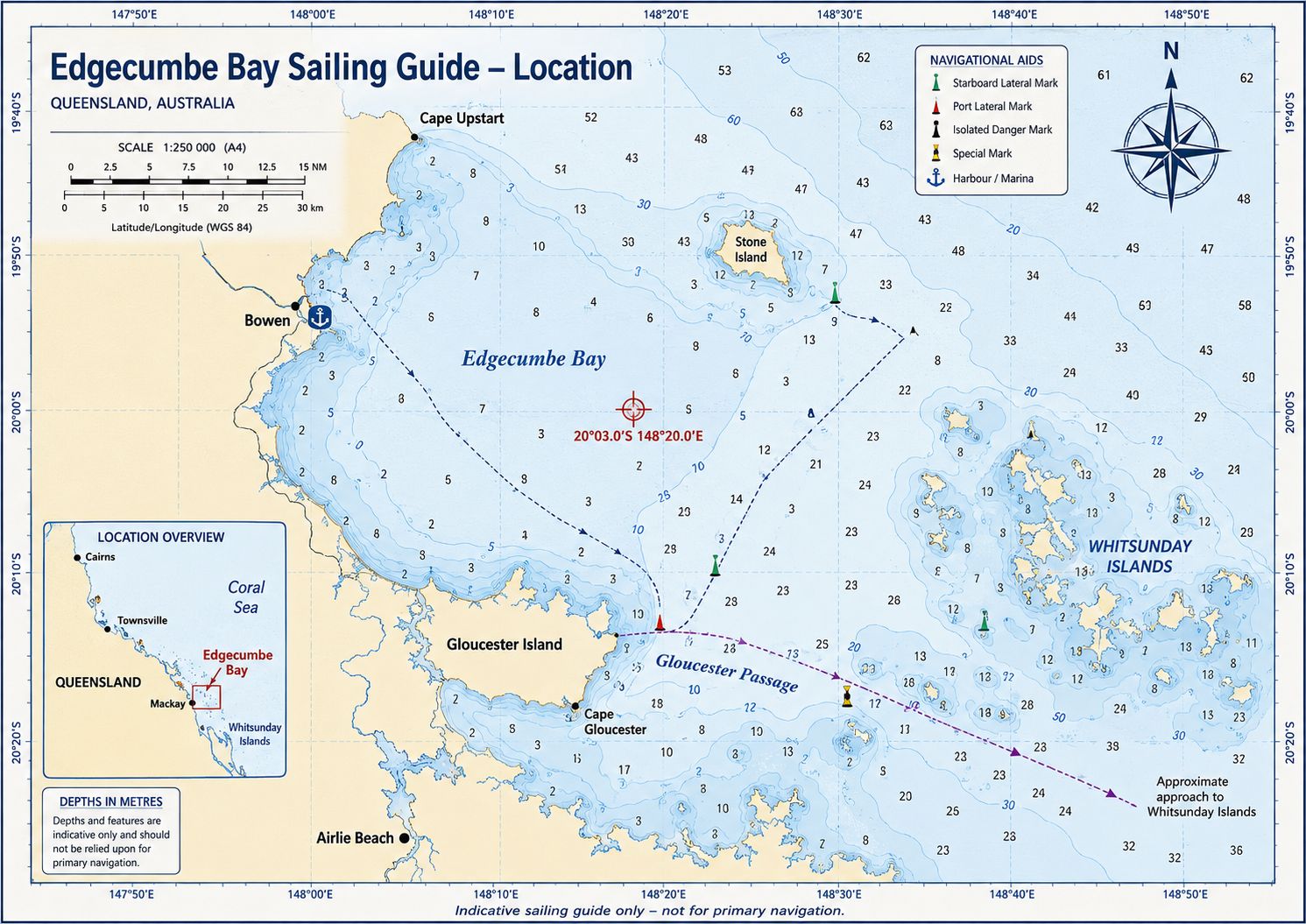
Edgecumbe Bay lies south of Cape Upstart and north of Airlie Beach, forming the western boundary of the Whitsunday region. Bowen occupies the northern end of the bay, while Cape Gloucester and Gloucester Passage define the southern entrance toward the islands. The bay opens westward toward the mainland and eastward toward the Whitsunday group, making it a natural transition zone for vessels moving between offshore islands and the mainland coast. Approximate centre position: 20°03.0’S 148°20.0’E
Edgecumbe Bay
Sailing Guide - Approach
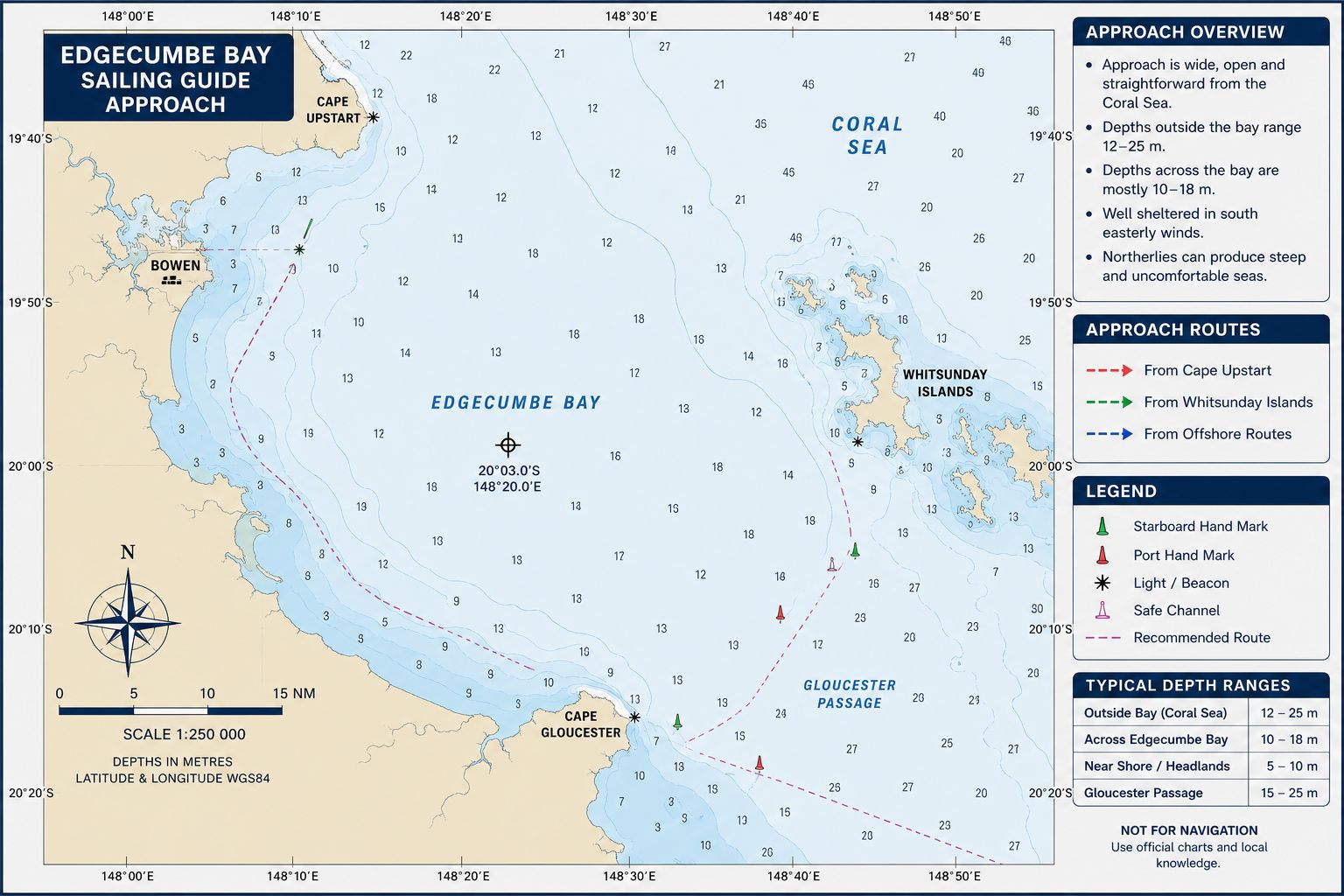
The approach to Edgecumbe Bay is clear and uncomplicated, with 12–25 m of water outside the bay and a wide, open entrance from the Coral Sea. The skipper can shape a direct approach from Cape Upstart, the Whitsunday islands or offshore routes, with depths remaining consistent at 10–18 m across the bay. The coastline is easy to identify, with Bowen’s headlands to the north and the distinctive shape of Cape Gloucester to the south. In strong south‑easterlies, the bay remains manageable due to the shelter provided by the mainland, but in northerlies the sea state can become steep and uncomfortable.
Edgecumbe Bay
Sailing Guide - Wind Patterns
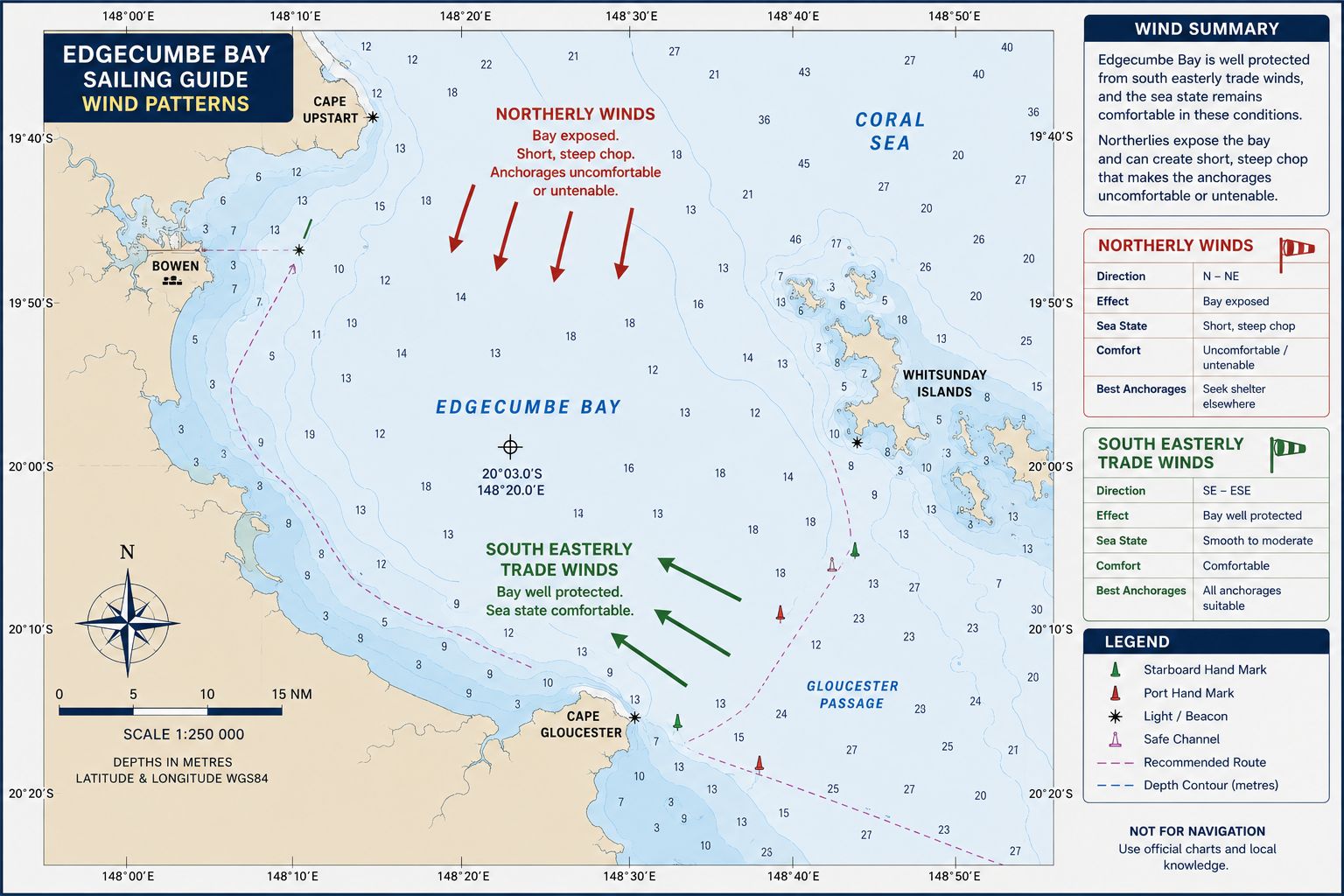
Edgecumbe Bay is generally sheltered from the prevailing south-easterly trade winds, with the mainland reducing wave development and providing comfortable conditions at many western anchorages. Northerly winds expose the bay and can produce short, steep chop, making open anchorages uncomfortable or unsafe. The drier cruising season typically brings more consistent south-easterlies, while summer has greater heat, humidity, thunderstorms, heavy rainfall and tropical cyclone risk. Skippers should monitor forecasts carefully, particularly during seasonal transitions when wind direction can change rapidly.
Edgecumbe Bay Sailing Guide - Currents and Tidal Flows
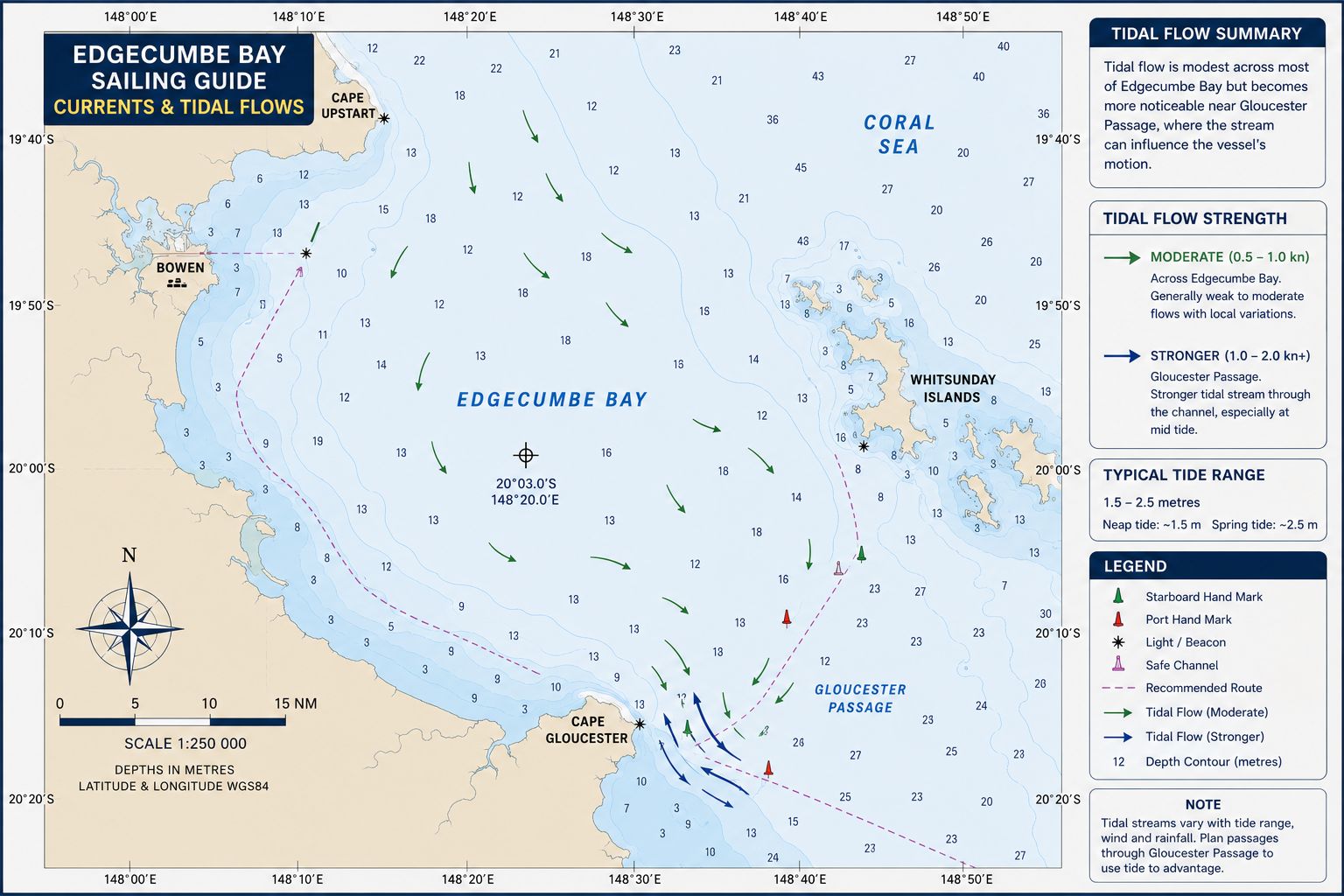
Currents across Edgecumbe Bay are generally weak to moderate and rarely create significant difficulty for cruising yachts. Tidal flow becomes more noticeable near Gloucester Passage, where the narrowing channel can accelerate the stream and influence steering, speed over ground and vessel swing at nearby anchorages. Wind direction may strengthen or oppose the tide, so skippers should check local predictions and allow for increased movement around mid-tide.
Edgecumbe Bay
Sailing Guide - Navigation
Hazards
The primary hazards in Edgecumbe Bay are exposure to northerly winds, variable holding in the anchorage areas and the tidal flow near Gloucester Passage. The coastline shelves gradually, and the skipper must avoid edging too close to the beaches. The bay is open and exposed, and the skipper must be prepared for a lumpy sea state in fresh northerlies. There are no significant underwater hazards, and navigation is straightforward in good visibility.
Edgecumbe Bay
Sailing Guide - Anchorages
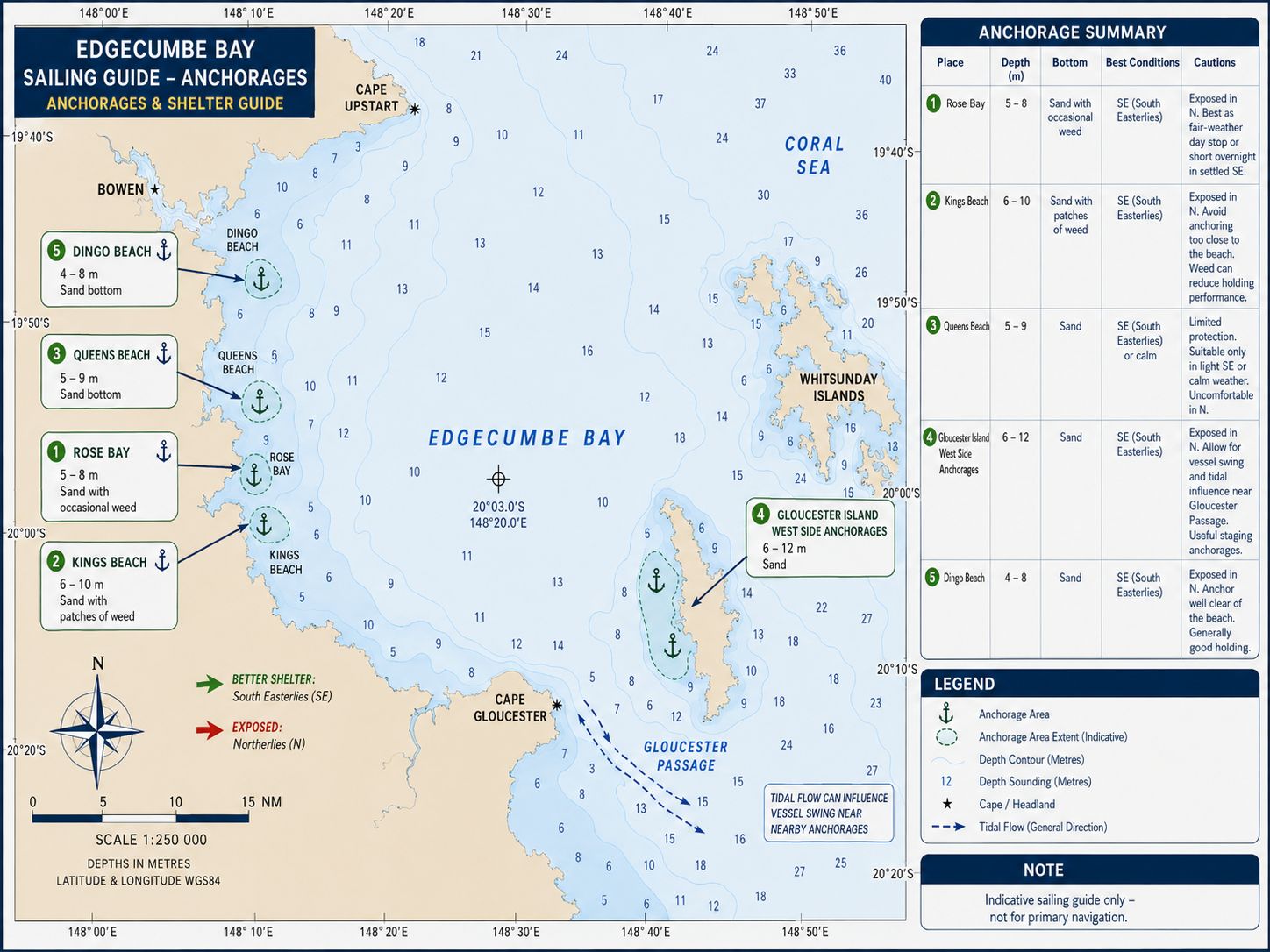
Edgecumbe Bay is not a formal harbour, and anchorage behaviour is dictated entirely by wind direction and exposure. Depths along the western shoreline range from 4–10 m, with sand and occasional weed patches providing variable holding. The anchorages are comfortable in south‑easterlies, with the mainland offering good protection, but become exposed in northerly winds, and the skipper should avoid overnighting in these conditions. The seabed is generally reliable, but setting the anchor firmly is essential due to occasional weed patches. The bay is best used as a fair‑weather anchorage or a daytime stop when conditions are favourable.
Several anchorage areas along the western shoreline provide practical stopping points in the right conditions. Rose Bay sits south of Bowen and offers 5–8 m of water over sand, with reasonable shelter from south‑easterlies but full exposure to northerlies. The seabed is mostly sand with occasional weed, and the skipper must ensure the anchor is well set. Rose Bay is best used as a fair‑weather daytime stop or a short overnight in settled south‑easterlies.
Kings Beach lies further south and provides 6–10 m of depth with sand and patches of weed. The anchorage is comfortable in south‑easterlies, with the mainland providing good protection, but becomes exposed in northerlies. The shoreline shelves gradually, and the skipper must avoid edging too close to the beach. Holding is generally reliable, but weed patches can reduce anchor performance. Kings Beach is a practical stop when moving between Bowen and Cape Gloucester in favourable conditions.
Queens Beach is a long, open stretch of coastline with 5–9 m of water and sand bottom. It provides broad anchoring options but limited protection, and is only suitable in light south‑easterlies or calm conditions. The bay becomes uncomfortable in any northerly component, and the skipper should avoid overnighting if the wind is expected to shift. The seabed is mostly sand with good holding when the anchor is set firmly. Queens Beach is best used as a temporary anchorage in settled weather.
The western side of Gloucester Island forms the eastern boundary of Edgecumbe Bay and offers several pockets of anchorage in 6–12 m of water over sand. These anchorages are comfortable in south‑easterlies, with the island providing good protection, but become exposed in northerlies. Tidal flow near Gloucester Passage can influence the vessel’s swing, and the skipper must allow adequate room. The seabed is generally reliable, and the anchorages are useful staging points when preparing to enter Gloucester Passage.
Dingo Beach sits on the north‑western edge of Edgecumbe Bay and provides 4–8 m of depth with sand bottom. The anchorage is comfortable in south‑easterlies but becomes exposed in northerlies. The shoreline shelves quickly, and the skipper must anchor well clear of the beach. Holding is generally good, and the anchorage is a convenient stop when moving between Bowen and Cape Gloucester in favourable conditions.
Edgecumbe Bay
Sailing Guide - Transit Routes
The bay provides a straightforward transit route between Bowen and Cape Gloucester, with 10–15 m of water across most of the central basin. The skipper can shape a direct line between the two points without hazards, but must remain aware of tidal flow near Gloucester Passage, which can create cross‑set when approaching from the north. The bay also serves as the western access route to the Whitsunday islands, with clear water and generous depths allowing easy passage toward the Molle Channel and the island group beyond.
Edgecumbe Bay
Sailing Guide - Provisioning
Supermarkets: Full provisioning for vessels operating in Edgecumbe Bay is available in Bowen through Woolworths Bowen, Coles Bowen and Drakes Bowen, all providing complete supermarket supplies including fresh produce, dry goods, bakery items and general essentials.
Markets: Fresh produce is available at the Bowen Community Markets and the Bowen Lions Markets, offering fruit, vegetables and local goods from regional growers.
Fish Markets: Bowen Fishermen’s Seafood supplies fresh local seafood including reef fish, prawns and seasonal catch landed from the Bowen fleet. This is the primary seafood provisioning point for vessels operating in Edgecumbe Bay.
Edgecumbe Bay
Sailing Guide – Local Fish Species
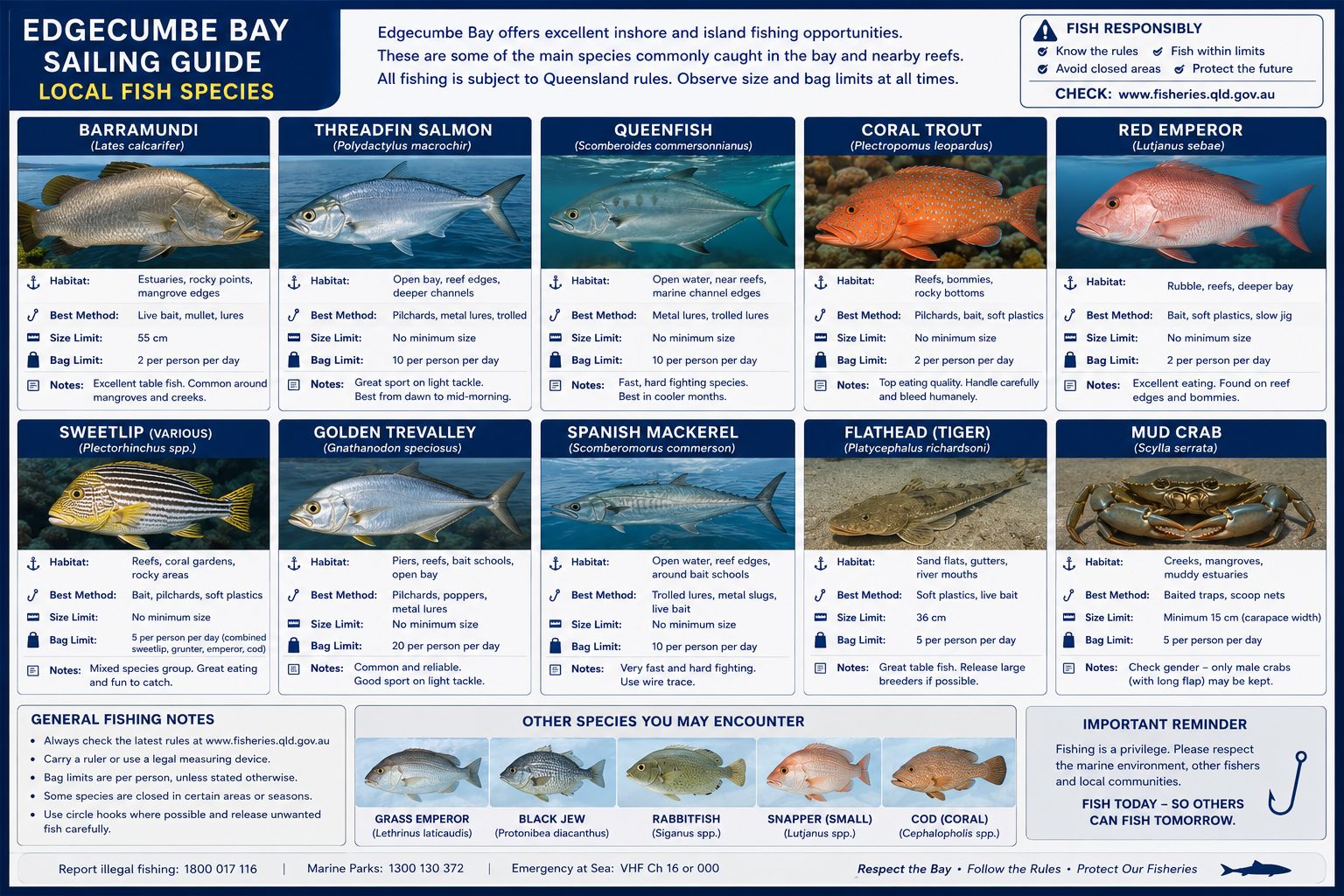
Edgecumbe Bay offers varied fishing around reefs, headlands, mangroves and open water. Common catches include barramundi, coral trout, queenfish, Spanish mackerel, golden trevally, sweetlip and mud crab. Conditions suit both lure and bait fishing, but Queensland size, possession, seasonal and marine park rules must always be observed.
Mechanical and Electrical Repairs Resource
If you are headed somewhere remote consider the need to expand your knowledge base or have an information resource on board. Why not get a copy of my book The Marine and Electrical and Electronics Bible 4th Edition. By and for yachties, with everything from batteries and charging, solar and wind, diesel engines and marine electronics and so much more. Your complete systems guide. 650 pages of practical advice. In Australia and New Zealand order a copy through Boat Books. UK and European boats can buy the UK Edition Here. US and Canadian boats can get the US Edition Order Here. Marine systems are my profession so let me help you. By a liveaboard boat owner for other boat owners


Edgecumbe Bay
Sailing Guide - Marina Services
Edgecumbe Bay itself has no marina facilities. Skippers use Bowen Marina at the northern end of the bay or Cape Gloucester Resort Marina at the southern end. Bowen provides fuel, water and essential services, while Cape Gloucester offers berthing, potable water and limited services. For full refuelling and repairs, Bowen is the primary service port for the bay.
Edgecumbe Bay Sailing Guide - Summary
Edgecumbe Bay is a broad, semi‑protected cruising area with straightforward navigation, generous depths and reliable shelter in south‑easterlies. The bay becomes exposed in northerly winds, and the skipper must choose conditions carefully when anchoring. Bowen and Cape Gloucester provide marina access and provisioning, making the bay a practical transit zone between the mainland and the Whitsunday islands. For vessels moving along the central Queensland coast, Edgecumbe Bay is a simple, predictable and well‑positioned cruising environment in the right weather. The Edgecumbe Bay Sailing Guide has useful information.