Banda Besar
Sailing Guide
Banda Besar sailing guide. Banda Besar forms the long western arc of the Banda Islands, lying inside the deep volcanic caldera that defines the Banda Sea’s central basin. The island has steep offshore contours, narrow reef shelves and several semi‑sheltered pockets suitable for anchorage, but no engineered harbour structures and no commercial port. Hydrodynamics are governed by semi‑diurnal tides, caldera‑edge compression, monsoon‑driven sea states and the steep volcanic topography that drops rapidly into deep water. Banda Besar functions as a secondary anchorage and cruising island for yachts operating out of Banda Neira, providing quieter bays and reef‑edge shelter along the western and southern coasts.
Banda Besar sits at the centre of the world’s original nutmeg heartland, forming one side of the volcanic ring that enclosed the only natural source of Myristica fragrans for centuries. Its slopes once held some of the most productive nutmeg groves in the archipelago, supplying the traders who moved through the Banda Sea long before European arrival. The island’s villages were part of a tightly connected maritime network, with boats, labour and produce circulating between Banda Neira, Ai, Run and the outer islands in a rhythm shaped entirely by the spice harvest.
Banda Besar
Sailing Guide – Spice History
During the Dutch conquest of 1621, Banda Besar became one of the principal sites of VOC plantation control, with surviving Bandanese communities displaced, coerced or absorbed into the new perken system. Nutmeg continued to grow on its fertile ridges under strict monopoly, and the island remained central to the Dutch strategy of maintaining global dominance over nutmeg and mace. Today, the terraces, old plantation walls and surviving trees on Banda Besar reflect a landscape shaped by centuries of spice cultivation and the island’s pivotal role in the Banda Sea’s trading history.
Banda Besar
Sailing Guide - Approaches
Approaches into Banda Besar are shaped by deep‑water caldera geometry, with 40–200 m offshore rising abruptly to 12–25 m near the reef line and 5–15 m inside the anchorage pockets. Coral heads rise sharply and require visual navigation in good light. The most consistent approaches are on the western and southern sides, where reef shelves are broader and fewer isolated bommies exist. Local traffic is light, dominated by inter‑island boats and fishing craft.
Banda Besar
Sailing Guide - Navigation
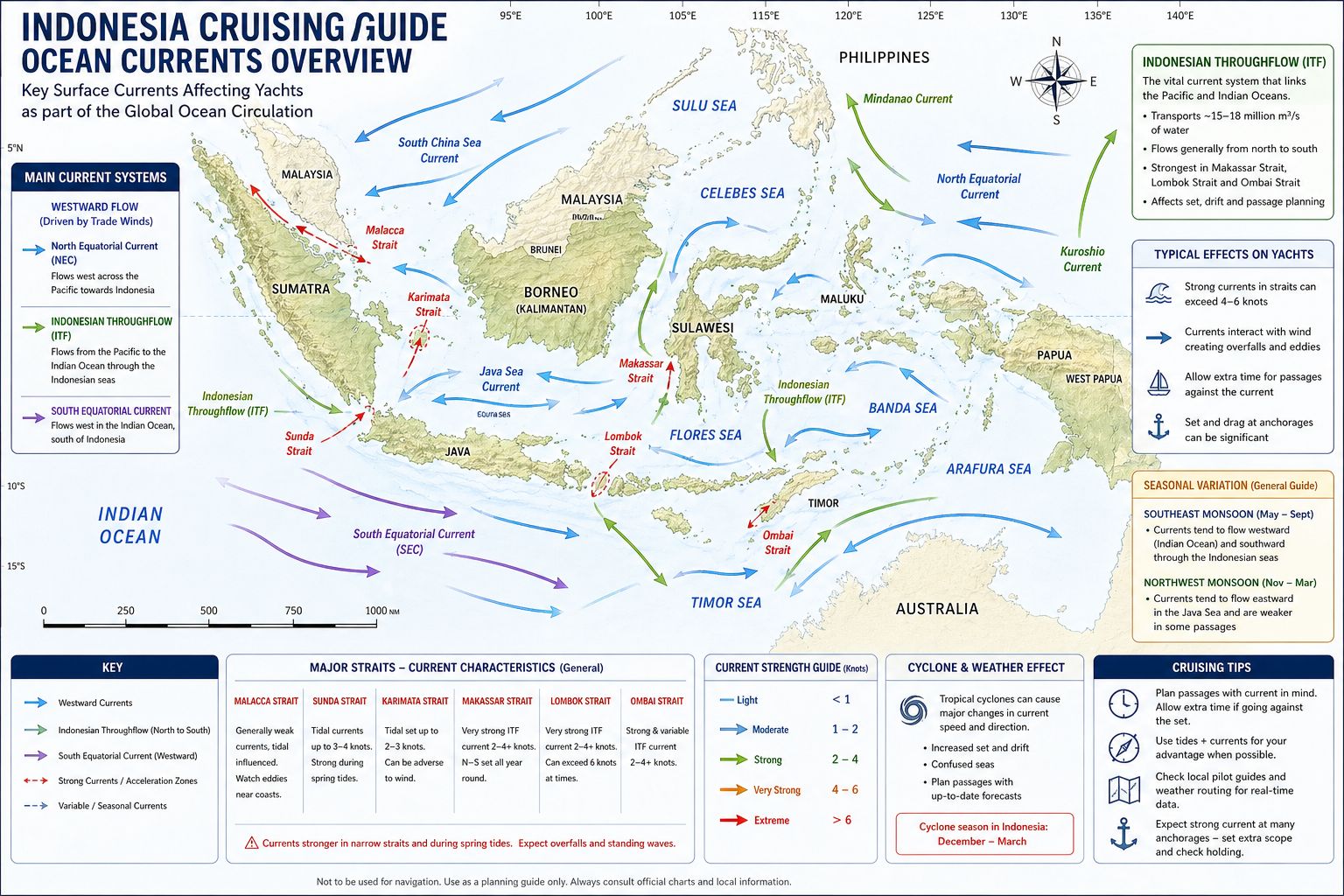
Navigation is governed by semi‑diurnal tides with 0.5–1 kn residual flow across the caldera and mild lateral movement near reef edges. Compression appears where depths rise from 20–30 m to 5–10 m, producing gentle set near anchorage entrances. Sea state varies with monsoon direction, with the southeast monsoon bringing more settled conditions and the northwest monsoon producing short‑period chop inside the caldera. Local traffic follows fixed tracks between Banda Neira, Lonthoir and the southern villages.
Chart Accuracy and
Source Disclaimer – Indonesia
Chart accuracy across Indonesia is inconsistent, with most non‑commercial regions still based on pre‑1970s lead‑line surveys that provide approximate depths, generalised reef edges, and sparse or single‑point soundings. Official ENC coverage improves only in major commercial ports, while offshore islands, reef systems, and remote bays across Sumatra, Java, Kalimantan, Sulawesi, Nusa Tenggara, Maluku, and Papua rely on outdated or incomplete data. Navionics and C‑Map offer reasonable coastline shape and usable macro‑routing but suffer from interpolated contours, missing shoals, and reef offsets of 20–150 m in many areas. Garmin BlueChart inherits the same limitations. Satellite imagery (Google, Bing, ESRI, SASPlanet) provides the most accurate depiction of reef and shoal edges, typically within 3–10 m, and is essential for anchorage selection and approach planning.
Skippers should treat all charted depths outside commercial ports as approximate and rely on a combination of ENC cross‑checking, satellite‑based reef reading, visual navigation, and drone reconnaissance for safe entry into anchorages. All chart information referenced in this guide is derived from publicly available Indonesian hydrographic products, international ENC datasets, and third‑party electronic chart packages. These sources vary in age, survey method, positional accuracy, and datum consistency. No guarantee is made regarding the completeness, reliability, or currency of any charted depth, contour, hazard, or navigational feature. Mariners are responsible for verifying all information against the latest official notices, updated charts, and on‑scene conditions. Electronic charts, satellite imagery, and user‑generated data must not be relied upon as sole sources of navigational information. Safe navigation requires continuous visual assessment, prudent seamanship, and independent confirmation of all charted features.
Banda Besar
Sailing Guide - Anchorage
Anchorages lie in 12–20 m over sand or sand‑and‑coral mix outside the reef, with shallow pockets offering 5–15 m on the western and southern sides. Holding is reliable where sand dominates, though coral patches require careful selection. The most consistent shelter is found at Lonthoir, Waer, and the southwestern bays. Tenders land at beach points or small jetties with 0.5–2 m depending on tide.
Banda Besar
Sailing Guide - Entry Formalities
Banda Besar is not a clearance island. All formalities for the Banda group are handled through Banda Neira (Harbourmaster, Immigration, Customs and Quarantine). Local village authorities may note vessel movements but do not process documentation.
Banda Besar
Sailing Guide - Berthing
Facilities
Banda Besar hosts small village jetties with 1–2 m depending on tide. Shore power is minimal, potable water is limited and fuel is obtained by jerry can transported from Banda Neira. No yacht‑specific berths or marina facilities exist.
Banda Besar
Sailing Guide - Local Weather
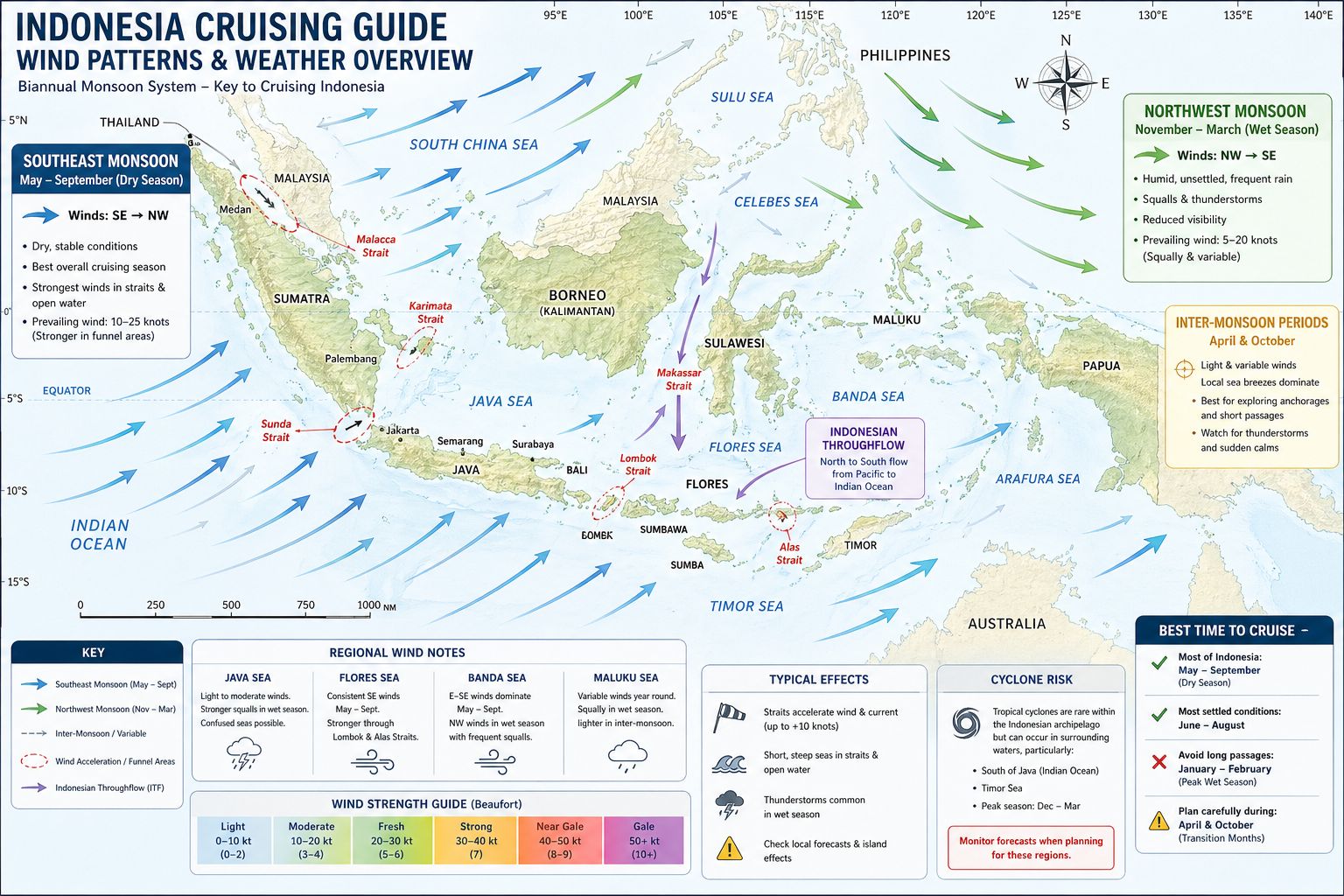
The Banda Sea region experiences the northwest monsoon from November to March with stronger wind, long‑fetch swell and reduced visibility, and the southeast monsoon from May to September with calmer seas and predictable tidal behaviour. Afternoon sea breezes develop but remain manageable in the western and southern pockets.
Banda Besar
Sailing Guide - Provisioning
Supermarkets. Banda Besar has no supermarkets. All major provisioning is routed through Banda Neira.
Markets. Village‑level markets provide limited fresh produce depending on local agriculture and supply runs from Banda Neira.
Fish Markets. Fish supply comes from shoreline landing points across the island, where coastal boats unload daily catches. Additional landings occur along the southern shoreline near the fishing districts.
Banda Besar
Sailing Guide - Local Cuisine
Local cuisine reflects Banda’s spice‑island heritage, with dishes centred on fish, nutmeg‑based broths and coastal staples. Ikan bakar Banda, gulai ikan, rica‑rica ikan, and nutmeg‑infused fish soups appear in village kitchens.
Banda Besar
Sailing Guide - Fuel Supplies
Banda Besar has no fuel dock, no wharf‑side hose service, and no petrol station. Villages may sell small quantities of diesel in bottles or drums, but this fuel is not suitable for yacht tanks due to contamination risk, uncertain storage, and low turnover. There are no reliable drum suppliers on the island.
All yacht‑suitable diesel provisioning for Banda Besar must be done in Banda Neira, using jerry cans from the Pertamina station in Banda Neira town. This is the only clean, reliable source in the Banda group. Yachts should arrive with adequate tankage, complete all refuelling in Banda Neira, and expect no dockside refuelling anywhere on Banda Besar.
Banda Besar
Sailing Guide - Water Supplies
Banda Besar does not provide potable water at any anchorage, and there is no dedicated hose point or public tap suitable for visiting yachts. Villages such as Lonthoir, Waer, and Selamon have small communal taps, but these are low‑pressure, limited‑supply, and not appropriate for loading yacht tanks. Water availability varies by season and is prioritised for village use. All water is non‑potable and must be filtered or boiled before consumption.
All yacht‑suitable water provisioning for Banda Besar must be done in Banda Neira, using the named public taps there (the market tap and the mosque‑road standpipe). Yachts should plan for multiple jerry‑can runs in Banda Neira before shifting to Banda Besar, and should expect no dockside water service anywhere on Banda Besar.
Mechanical and Electrical Repairs
Resource
If you are headed somewhere remote consider the need to expand your knowledge base or have an information resource on board. Why not get a copy of my book The Marine and Electrical and Electronics Bible 4th Edition. By and for yachties, with everything from batteries and charging, solar and wind, diesel engines and marine electronics and so much more. Your complete systems guide. 650 pages of practical advice. In Australia and New Zealand order a copy through Boat Books. UK and European boats can buy the UK Edition Here. US and Canadian boats can get the US Edition Order Here. Marine systems are my profession so let me help you. By a liveaboard boat owner for other boat owners


Banda Besar
Sailing Guide - Marine Services
Marine services are minimal, limited to basic mechanical and electrical support through small workshops. Major work requires transit to Banda Neira, Ambon or Sorong.
Banda Besar
Sailing Guide - Local Customs
Local customs reflect Banda’s island culture, with modest dress expected near village centres. Crews landing by tender move quietly through shoreline communities.
Banda Besar
Sailing Guide - Summary
Banda Besar offers 12–20 m offshore anchorages, shallow pockets with 5–15 m, predictable tidal behaviour and minimal provisioning, forming a secondary anchorage island supporting Banda Neira and providing sheltered pockets for vessels transiting the Banda Sea. Banda Besar Sailing Guide for all you need to know.