Bali Cruising Guide for Yachts
Bali Cruising Guide for Yachts. Bali is only safely approached via Benoa Harbour on the island’s southeast corner. All other coasts are exposed to continuous surf, long‑period swell, and strong lateral currents, with no protected entry points for yachts. Offshore depths remain very deep until close to the island, but the final approach requires strict adherence to the buoyed dredged channel due to rapid shoaling outside the fairway. Inside Benoa, navigation is constrained by narrow dredged sections, strong tidal flow, and dense small‑craft traffic. Manoeuvring room is limited, and the lagoon’s mudflats dry at low tide. All marina access, fuel, water, and provisioning are concentrated within the harbour precinct, with no alternative yacht facilities elsewhere on the island. Benoa Marina Bali is only exclusive marina for yachts. Eastern Anchorage is recommended for yachts east off the commercial wharf and cruise terminal.
Bali also functions as a natural staging point for onward passages east toward Lombok and the Nusa Tenggara chain, west toward Java, or north into the Bali Sea. Yachts arriving in Bali commonly continue to nearby cruising regions, including the Gili Islands, Nusa Penida, Nusa Lembongan, Nusa Ceningan, and the north Bali coast around Lovina and Pemuteran. Others use Bali as a base before longer passages toward Komodo, Flores, or the Java Sea. This guide focuses on practical, operational information for yachts using Bali as a port of entry or a resupply stop.
Bali Cruising Guide for Yachts - Approaches
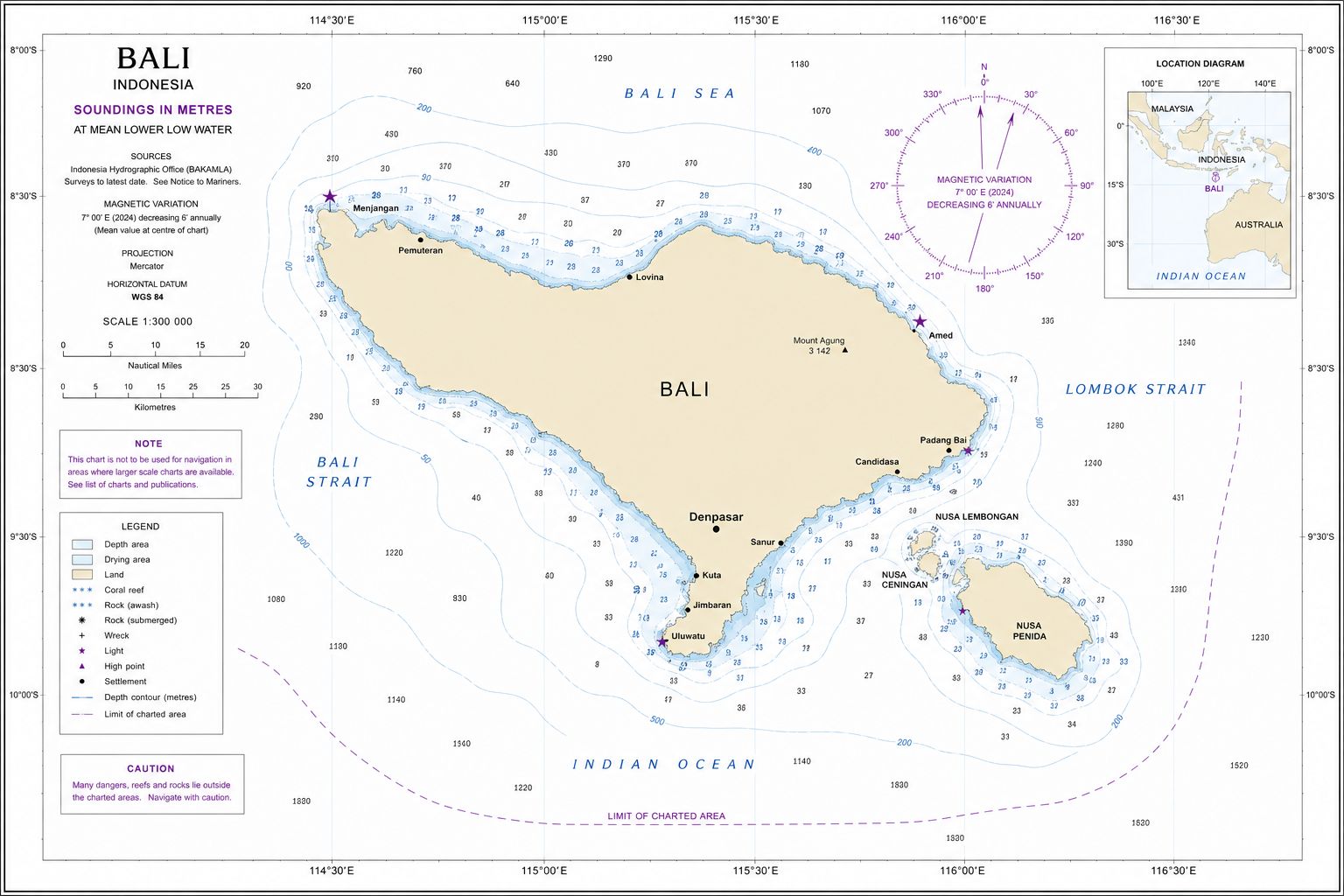
The only viable approach is from the east or southeast, shaping course directly for the Benoa Harbour entrance sector. Approaches from the south, southwest, west, and northwest are unsafe due to unbroken surf and strong coastal currents that run parallel to the beaches. These conditions extend well offshore and do not provide any navigable gaps.
Offshore depths remain greater than 50 m until close to the harbour approach. There are no offshore reefs obstructing the deep‑water approach, but swell refracting around the Bukit Peninsula can create roll if closing the coast too early. Maintain an offshore track until abeam of the entrance, then commit to the buoyed channel.
Bali Cruising Guide for Yachts - Navigation
Depths are chart‑derived ranges and vary with dredging cycles and tide. The outer approach sector from the sea buoy to the first lateral marks carries depths between 12 and 18 m over sand with no offshore hazards. Swell refracting around the peninsula can cause roll when approaching from the south. The entrance channel from the first buoys to the main bend carries 8 to 12 m within the dredged fairway, with margins shoaling abruptly to less than 3 m. This is the highest‑risk section for cross‑set on the ebb. The inner channel from the main bend to the lagoon mouth carries 6 to 9 m, with mudflats drying at low tide and increased tidal acceleration. The lagoon transit from the lagoon mouth to the marina basin carries 4 to 7 m, with margins shoaling to less than 2 m and limited passing room.
Chart Accuracy and
Source Disclaimer– Indonesia
Chart accuracy across Indonesia is inconsistent, with most non‑commercial regions still based on pre‑1970s lead‑line surveys that provide approximate depths, generalised reef edges, and sparse or single‑point soundings. Official ENC coverage improves only in major commercial ports, while offshore islands, reef systems, and remote bays across Sumatra, Java, Kalimantan, Sulawesi, Nusa Tenggara, Maluku, and Papua rely on outdated or incomplete data. Navionics and C‑Map offer reasonable coastline shape and usable macro‑routing but suffer from interpolated contours, missing shoals, and reef offsets of 20–150 m in many areas. Garmin BlueChart inherits the same limitations. Satellite imagery (Google, Bing, ESRI, SASPlanet) provides the most accurate depiction of reef and shoal edges, typically within 3–10 m, and is essential for anchorage selection and approach planning.
Skippers should treat all charted depths outside commercial ports as approximate and rely on a combination of ENC cross‑checking, satellite‑based reef reading, visual navigation, and drone reconnaissance for safe entry into anchorages. All chart information referenced in this guide is derived from publicly available Indonesian hydrographic products, international ENC datasets, and third‑party electronic chart packages. These sources vary in age, survey method, positional accuracy, and datum consistency. No guarantee is made regarding the completeness, reliability, or currency of any charted depth, contour, hazard, or navigational feature. Mariners are responsible for verifying all information against the latest official notices, updated charts, and on‑scene conditions. Electronic charts, satellite imagery, and user‑generated data must not be relied upon as sole sources of navigational information. Safe navigation requires continuous visual assessment, prudent seamanship, and independent confirmation of all charted features.
Bali Cruising Guide for Yachts - Tidal Behaviour
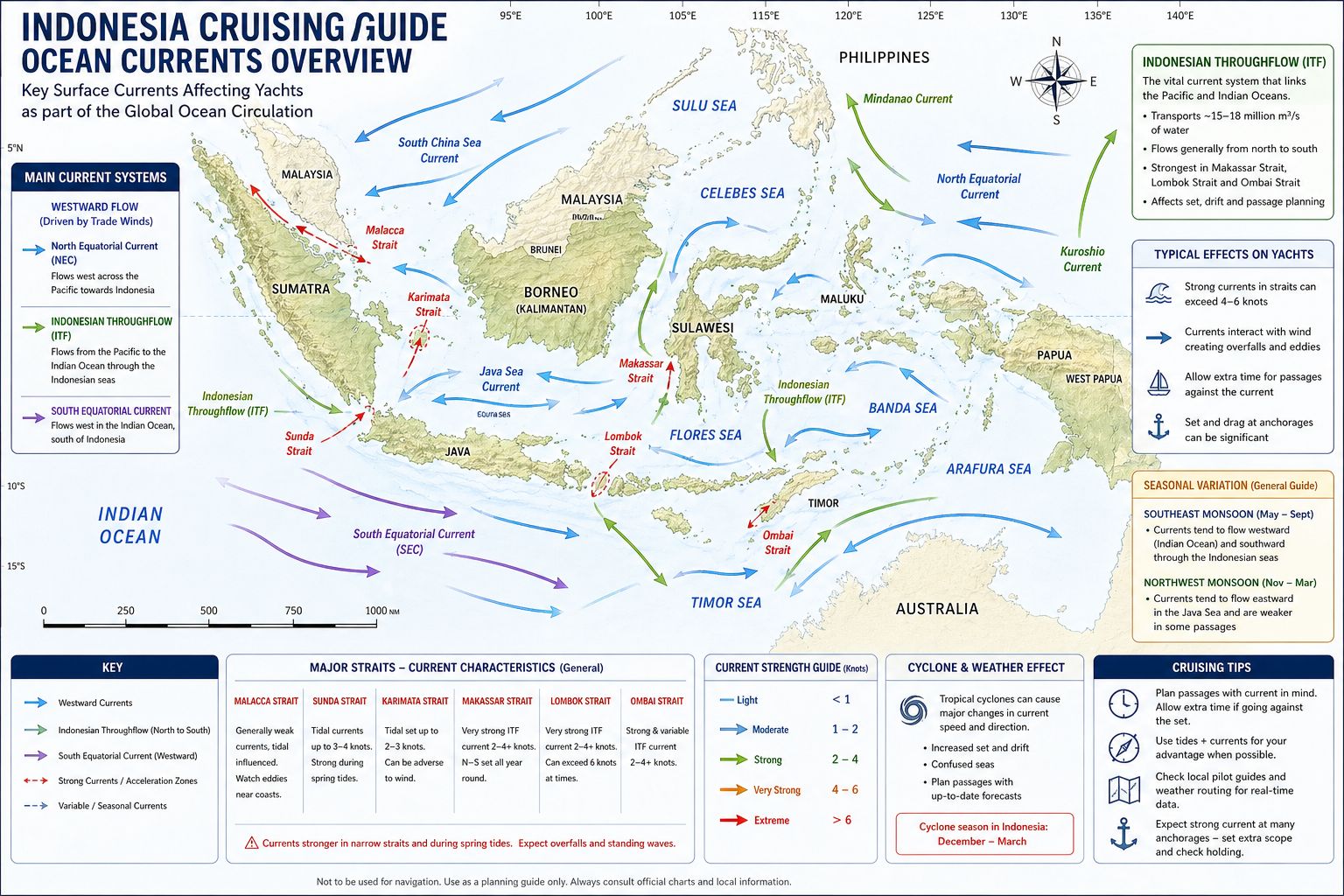
The ebb sets northwest across the entrance and pushes vessels toward the western bank, requiring early counter‑helm. Over‑correction risks drifting into the eastern shoal. This is the most challenging condition for entry. The flood sets southeast into the harbour, assisting entry but increasing speed over ground and reducing steering authority in the bends. Spring tides produce the strongest cross‑set and the most difficult handling inside the lagoon. Neaps provide the most forgiving conditions.
Bali Cruising Guide for Yachts - Helm Notes
The entrance alignment requires establishing a stable approach line early, as the ebb pushes vessels off centreline. The first bend, a port turn into the inner channel, requires an earlier turn than visual cues suggest due to accelerated flow; overshooting places the vessel on the drying western mudflat. The inner channel straight requires steady speed with awareness of overtaking ferries and unlit fishing boats at dawn and dusk. The second bend, a starboard turn into the lagoon mouth, is the tightest turn and vulnerable to ebb‑driven cross‑set pushing vessels wide into the shoal. The lagoon mouth to marina basin requires slow ahead with high traffic convergence and reduced buoy visibility at night due to background lighting.
Bali Cruising Guide for Yachts - Entry Formalities
Immigration requires passports valid for at least six months, arrival forms, and any pre‑arranged visas such as VOA or e‑VOA depending on nationality. All crew must be listed on the manifest and may be required to attend in person. Immigration stamps each passport with the permitted stay period, and no one may disembark until this is complete. Any crew joining or departing the vessel must be formally recorded with Immigration, and overstays incur penalties.
Customs requires vessel registration, crew passports, last‑port clearance, and a full declaration of all controlled items. They expect exact quantities of alcohol, tobacco, medicines, drones, firearms, ammunition, high‑value electronics, spare parts, and fuel carried in jerry cans. The yacht is entered into Indonesia’s temporary importation system, and the skipper becomes responsible for ensuring the vessel is formally exported when leaving the country. Customs may board the vessel and inspect lockers, bilges, and storage areas to verify declarations. No crew may go ashore until Customs authorises movement.
Preparing accurate paperwork makes Customs clearance far smoother, and skippers should maintain a complete written inventory of everything onboard, including spare parts, provisions, medical supplies, tools, and high‑value equipment. Multiple printed copies of each list should be ready for officials, and many long‑range crews find that carrying a small compact printer onboard is worthwhile for producing documents on demand.
Bali Cruising Guide for Yachts - Biosecurity
Biosecurity requires a declaration of all fresh food, meat, dairy, eggs, fruit, vegetables, seeds, plants, untreated wood, and animal products onboard. Officers may board the vessel or require the skipper to present declarations at their office. High‑risk items may be confiscated, and all garbage must remain onboard until authorised disposal at an approved facility. Pets require full pre‑arrival approval, vaccination records, microchip documentation, and import permits; without these, animals cannot go ashore and may be refused entry.
Bali Cruising Guide for Yachts - Communications Equipment
Indonesia allows normal marine VHF use without restriction, and HF/SSB radios are accepted provided they are used strictly on maritime frequencies. Satellite systems such as Iridium and Inmarsat are permitted as standard safety and navigation equipment. Starlink is widely used by visiting yachts, but it technically requires registration under Indonesian telecommunications rules, and although enforcement is inconsistent, skippers should be aware that regulations may tighten and they need to do some checks before arriving there. All radios, satellite terminals, and communication devices should be declared on arrival, as undeclared high‑power or encrypted systems can attract unnecessary attention during Customs inspection.
Bali Cruising Guide for Yachts - Local
Weather
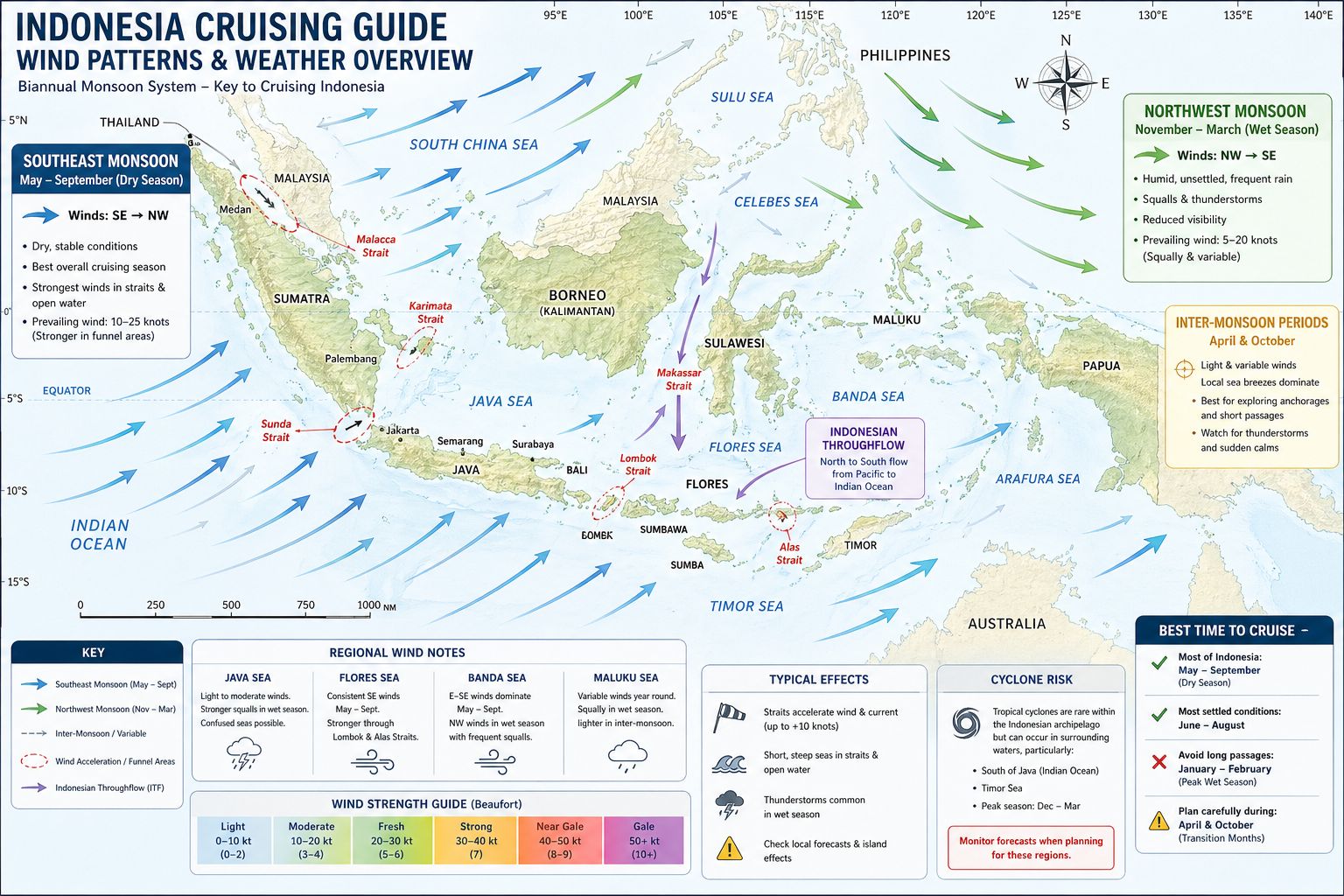
Bali sits under a tropical monsoon regime with two distinct seasons that shape local wind behaviour, visibility, and sea state. The dry season from May to October is dominated by southeast trade winds that typically hold between 10 and 20 knots, strengthening in the Lombok Strait where funneling can produce higher velocities. Seas are generally moderate, but the south coast of Bali carries increased swell throughout this period, and conditions remain exposed with no sheltered entry points. Skies are clearer and rainfall is low, giving more predictable passage windows.
The wet season from November to April brings light and variable winds with intermittent squalls. Heavy rain is common from December through March, reducing visibility and increasing humidity. Seas are often calmer than in the dry season, but thunderstorms can generate short‑lived gusts and confused surface conditions. These weather shifts can affect timing for arrivals and departures, particularly when visibility drops during heavy rain.
The Lombok Strait east of Bali is a critical factor for yachts moving between islands. Currents in the strait can exceed four knots and vary significantly with the monsoon cycle. Timing passages through this strait is essential, as adverse flow can slow progress or create steep standing waves when wind opposes current.
Bali Cruising Guide for Yachts – Provisioning
Supermarkets. Transmart Carrefour Denpasar provides full‑range provisioning. Pepito Supermarket Nusa Dua and Tanjung Benoa plus several locations with fresh produce, meats. Frestive Supermarket are located in Seminyak, Canggu and Pererenan, upmarket selection including organic produce, international brands. Lottemart Denpasar-Serangan are a wholesale type supermarket. Grand Lucky Supermarket is located in Seminyak/Kuta with a large selection. Papaya Supermarket is a Japanese-style supermarket with Sushi-grade fish, Japanese condiments, and premium produce.
Markets. Pasar Badung in Central Denpasar is Bali’s largest traditional market with vegetables, fruits, spices, and dry goods. Best visited early morning. Pasar Kumbasari is located adjacent to Pasar Badung and is best known for textiles and dry goods but also has food stalls and produce vendors. Traditional markets are best before 9 AM for freshness and selection. Vendors don’t accept cards so cash is king. Please negotiate politely, while bargaining is expected at traditional markets these folk have families to support.
Fish Markets: Seafood is sourced from Kedonganan Fish Market near Jimbaran, offering daily landings of reef fish, pelagics, and shellfish with early‑morning peak supply. The Benoa Fish Landing Centre provides direct‑from‑boat availability of local species with predictable morning activity. Both locations operate on a cash‑based system with variable pricing depending on catch volume.
Bali Cruising Guide for Yachts - Fuel Supplies
Serangan has no fuel dock for yachts and no wharf‑side hose service. Diesel is obtained by jerry can from the Pertamina station on Jalan Tukad Punggawa, a short ride from the Serangan causeway. The station supplies standard automotive diesel with high turnover. Yachts typically transport fuel using motorbike carriers or small pickups arranged at the Serangan village waterfront. Drum delivery to the shoreline is possible but inconsistent, and quality varies; fuel should be filtered during transfer.
No outlying anchorages around Sanur, Nusa Dua, or Padangbai offer yacht‑suitable diesel. Villages may sell small quantities in bottles or drums, but this fuel is not appropriate for yacht tanks due to contamination risk and uncertain storage. All refuelling for south‑Bali yacht operations must be done in Serangan, using jerry cans from the Pertamina station. Yachts should arrive with adequate tankage, plan for multiple jerry‑can runs, and expect no dockside refuelling anywhere in Serangan or Sanur.
Bali Cruising Guide for Yachts - Water Supplies
Bali Serangan does not provide potable water at the yacht anchorage, and there is no public hose point on the shoreline accessible to visiting yachts. Water is normally taken by jerry can from the public tap near the Serangan fishing harbour or from the standpipe beside the small market on the main village road. Both supply non‑potable municipal water that must be filtered or boiled before use. Several dive shops and small marinas on the island may allow filling from their storage tanks for a fee, but this is not guaranteed and must be confirmed on arrival. There is no reliable tanker delivery operating in Serangan.
No outlying anchorages around Sanur, Nusa Dua, or Benoa offer yacht‑suitable water. Village taps exist but are low‑pressure and unsuitable for tank loading. All water provisioning for the south‑Bali yacht area must be done in Serangan, using the named public taps above. Yachts should plan for multiple jerry‑can runs, carry adequate filtration, and expect no dockside water service anywhere in Serangan or Sanur.
Bali Cruising Guide for Yachts - Marinas
Benoa Marina (Primary Facility): Access is via the main dredged channel and lagoon. Depths at berths range from 3 to 5 m depending on tide. Manoeuvring space is limited, and tidal flow affects stern‑to and tight turns. Wake from passing ferries is common, and small‑craft traffic is unpredictable. Best entry is on flood or slack. Berth allocation should be confirmed before arrival.
Bali Marina (Older Facility): Located deeper inside the harbour precinct. Depths at berths range from 3 to 4 m, with some berths shoaling at low tide. Fairways are narrow with limited turning room for vessels over 15 m. Siltation occurs near inner berths, and congestion from local boats is common. Berth depth should be confirmed before committing.
Bali Cruising Guide for Yachts - Services
Bali does not have a major authorised Volvo Penta or Yanmar dealership within Benoa Harbour, and most yachts rely on independent diesel mechanics or general marine workshops based around the port. Routine servicing, troubleshooting, and minor repairs can be handled locally, but specialist work and brand‑specific diagnostics are limited. Parts for Volvo Penta, Yanmar, and other marine diesels are usually sourced from Jakarta, and delivery times vary depending on stock availability. Automotive diesel specialists in Denpasar can assist with injector servicing, fuel pump work, and general diagnostics, but they are not marine‑certified and may require guidance from the skipper regarding access and onboard systems. For major repairs, electronic diagnostics, or urgent parts, most yachts coordinate directly with authorised agents in Jakarta or Singapore and have components shipped to Bali. Local labour is reliable for straightforward tasks, but complex work should be planned with the limited support environment in mind.
Mechanical and Electrical Repairs
Resource
If you are headed somewhere remote in Indonesia then consider expanding your knowledge base or have an information resource on board for most DIY situations. Why not get a copy of my book The Marine and Electrical and Electronics Bible 4th Edition. By and for yachties, with everything from batteries and charging, solar and wind, diesel engines and marine electronics and so much more. Your complete boat systems guide. 650 pages of practical advice. In Australia or Southeast Asia go to Boat Books for a copy. By a yachtsman for other Yachtsmen and Yachtswomen. Marine systems are my profession so let me help you save money. If in the USA then head to Barnes and Noble and buy your copy there. UK based boats can order here.


Bali Cruising Guide for Yachts – Local
Cuisine
Bali offers a wide range of food options, from small local warungs to international restaurants, and most visiting crews find it easy to eat well ashore without relying heavily on onboard cooking. Local dishes are varied and generally inexpensive, with nasi campur providing a reliable option of rice served with assorted meats, vegetables, and sambal. Grilled fish, known locally as ikan bakar, is widely available along the coast and typically served with lime and chili. Babi guling, a Balinese roast pork specialty, is common in traditional eateries, while ayam betutu offers a slow‑cooked spiced chicken dish that is popular across the island. Simple staples such as mie goreng, a fried noodle dish with vegetables and egg, are available everywhere. Coastal areas, particularly Jimbaran, are known for seafood grills that offer fresh fish cooked over charcoal.
Street food is widely available, and hygiene standards are generally good in busy, high‑turnover establishments. For many crews, eating ashore is cheaper and easier than cooking onboard, especially when provisioning time is limited or when the vessel is preparing for onward passages.
Bali Cruising Guide for Yachts - Cultural
Norms
Bali is culturally distinct from much of Indonesia, with Hindu traditions shaping daily life and influencing how visitors are expected to behave. Modest clothing is required when visiting temples or rural areas, and shoulders and knees should be covered as a basic sign of respect. Ceremonial processions occur frequently and can temporarily close roads or restrict access, particularly during major religious periods, and yachts should allow extra time when arranging transport or provisioning runs. Small daily offerings known as canang sari are placed on sidewalks and entrances; stepping on them is considered disrespectful and should be avoided. Photography of people or ceremonies requires permission, and taking photos without asking is viewed as intrusive. Bargaining is normal in markets, but it is expected to be polite and good‑natured rather than confrontational. English is widely spoken in tourist‑oriented areas, though less so in local markets and government offices, so simple, clear communication is often more effective than complex explanations
Bali Cruising Guide for Yachts - Summary
Bali is a straightforward destination when approached via the Benoa Harbour channel and navigated with attention to tidal flow, buoyage, and heavy traffic. All other coasts are unsuitable for entry due to surf and strong currents. Once inside, marinas, fuel, water, and provisioning are concentrated and accessible. Weather follows the monsoon cycle, and cultural norms emphasise respect and awareness of local traditions. Bali Cruising Guide for Yachts is full of useful information.