Ambon Sailing
Guide Maluku
Ambon sailing guide Maluku. Ambon is the administrative and maritime centre of Maluku and the primary service hub for yachts in the region. The island forms a deep, protected bay system with Ambon Bay opening to the Banda Sea. The coastline is influenced by monsoon seasons, local wind systems and tidal currents. Yachts anchor in Ambon Bay or berth at small‑craft wharves when available. The region has coastal settlements, commercial port facilities and hillside districts. Ambon has supermarkets, markets, fish vendors, fuel stations and repair workshops. Road links connect Ambon City to Passo, Tulehu and the wider island.
Ambon became one of the earliest centres of European activity in the Moluccas, long before the Dutch conquest of the Banda Islands. Its deep, protected bay and established trading communities made it a natural base for regional exchange, and Ambon’s role in the spice world grew from its position as a secure harbour on the routes linking Seram, Banda and the wider archipelago. While Ambon itself was not a major nutmeg‑producing island, it sat at the crossroads of the trade, handling movement, negotiation and maritime support for the surrounding spice‑rich islands.
Ambon Sailing
Guide Maluku – Spice History
When the Dutch established their monopoly in the seventeenth century, Ambon became the administrative and military anchor for VOC operations across the southern Moluccas. Fort Victoria and the town’s waterfront formed the command centre from which the Dutch controlled access to the Banda plantations and enforced their grip on nutmeg and mace. Ambon’s colonial buildings, harbour layout and long history of inter‑island movement still reflect its role as the strategic gateway to the Banda Sea spice world and the operational heart of Dutch power in the region.
Ambon Sailing
Guide Maluku - Approaches
Approaches to Ambon use the main bay entrance between Latuhalat and Poka. Depths offshore are 50–200 m. Depths reduce to 20–50 m inside the bay. The approach channel has 20–40 m depending on position. Commercial shipping uses the main port area near Ambon City. Local ferries operate between Ambon, Seram and the outer islands. Fishing vessels operate near reefs and shoreline structures. Marker buoys indicate the commercial channel. Swell is minimal inside the bay. Visibility varies with rain and haze. Yachts must maintain a clear track when approaching the anchorage.
Ambon Sailing
Guide Maluku - Navigation
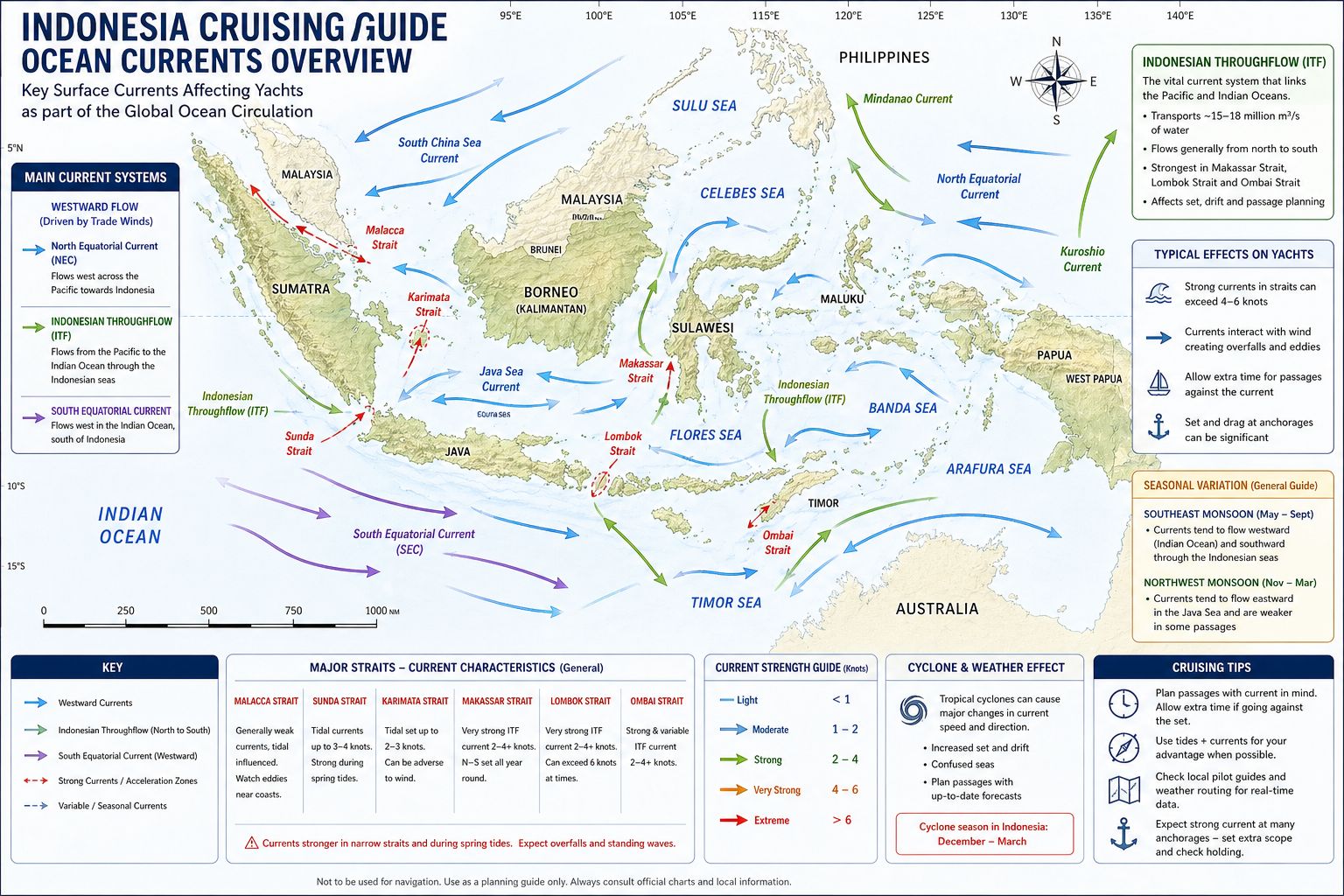
Ambon Bay is deep and narrow with strong tidal currents near constrictions. Currents reach 1–3 kn during spring tides. Currents affect vessel alignment when entering the inner bay. Local fishing vessels operate near reefs and coastal villages. Nets and marker floats are common. Radar returns are affected by steep terrain and anchored vessels. AIS targets are numerous near the port. Visibility reduces during heavy rain. Visibility can fall to 1–2 NM. Yachts must maintain separation from ferries and commercial vessels when navigating to Ambon City or Amahusu.
Chart Accuracy –
Eastern Indonesia
Official Hydrographic Charts (Indonesian Navy – Pushidrosal). Accuracy level: LOW to MODERATE depending on the sub‑region. Operational reality. Most charts for Flores, Alor, Lembata, Pantar, Wetar, Aru, Kei, Tanimbar, Babar, Sermata, Leti are based on pre‑1970s lead‑line surveys. Depths are approximate, not modern multibeam. Reef edges are generalised, not precise. Many anchorages show no soundings or single‑point soundings only. LAT datum is not consistently applied across older sheets. Where accuracy improves. Kupang has modern survey, good accuracy in commercial approaches. Ambon has moderate accuracy in the main harbour. Sorong has fair accuracy in the commercial basin only. Where accuracy collapses. Alor & Pantar. Lembata & Lamalera coast. Flores north coast (Maumere–Larantuka). Wetar & Babar. Kei Islands. Tanimbar & Aru and Raja Ampat outer reefs. These areas require visual navigation, drone recon, and satellite‑based reef reading.
Navionics (SonarChart + Government ENC Blend). Accuracy level: MODERATE in commercial zones, LOW in offshore islands. Good for general coastline shape. Good for major approaches (Kupang, Ambon, Sorong). SonarChart layer sometimes shows user‑generated depth contours in popular anchorages (Labuan Bajo, Alor, Banda). Weaknesses. Reef edges in Alor, Pantar, Kei, Tanimbar, Aru are offset by 20–150 m. Depth contours are interpolated, not surveyed. Many shoals are missing. Some islands are mis‑shaped or shifted slightly. Operational rule. Use Navionics for macro routing, never for micro pilotage.
C‑Map (NT+ / Reveal / 4D). Accuracy level: MODERATE in shipping areas, LOW in remote islands. Strengths. Better contour smoothing than Navionics. Good depiction of Ambon and Sorong commercial approaches. Slightly more accurate around Kupang and Labuan Bajo. Weaknesses. Reef edges in Alor, Kei, Tanimbar are incomplete. Some anchorages show blank areas with no detail. Depths often copied from old Indonesian charts. Operational rule. C‑Map is no more accurate than Navionics in the offshore island groups.
Garmin BlueChart. Accuracy level: LOW to MODERATE. Garmin uses a blend of Old Indonesian hydrographic data. C‑Map sources. Satellite‑derived coastline vectors. Operational notes. Good for coastline shape. Poor for reef detail. Depths are not reliable in Alor, Kei, Tanimbar, Aru, or outer reef systems.
Satellite‑Derived Navigation (Google / Bing / SASPlanet / ESRI). Accuracy level: HIGH for reef edges, LOW for depth. Strengths. Best method for reef reading in Alor, Pantar, Kei, Tanimbar, Aru, Raja Ampat. Reef edges visible to within 3–10 m accuracy. Ideal for anchorage selection and approach planning. Weaknesses. No depth information. Cloud cover can obscure detail. Requires visual confirmation on arrival. Operational rule. Satellite imagery is mandatory for safe entry into remote anchorages.
Operational Summary. Official Indonesian charts: old, generalised, inconsistent. Navionics: good for routing, unreliable for reef edges. C‑Map: similar limitations, slightly better smoothing. Garmin: coastline OK, depths unreliable. Satellite imagery: essential for reef navigation. Drone recon: highly recommended in Alor, Kei, Tanimbar, Aru. Rule for this region - use paper/ENC charts for macro routing, Navionics/C‑Map for cross‑checking, and satellite imagery for every anchorage approach.
Ambon Sailing
Guide Maluku - Anchorage
Anchoring is possible at several points inside Ambon Bay.
- Amahusu: Depths 15–25 m. Holding in mud. Sheltered from swell.
- Lateri / Passo: Depths 20–40 m. Holding in mud. Local traffic produces wake.
- Ambon City waterfront: Depths 20–30 m. Holding in mud. Not recommended due to traffic and port restrictions.
Anchorage is not permitted inside commercial port limits. Most yachts anchor at Amahusu or Passo.
Ambon Sailing
Guide Maluku - Entry Formalities
Ambon is a designated port of entry. Clearance offices are located within the port area. Passports, vessel registration and crew list are required. Indonesia requires arrival reporting to Immigration, Customs and Quarantine. Firearms must be declared and secured. Drones may require declaration. Starlink terminals may require local compliance. Local authorities may request intended vessel movements. Clearance procedures follow Indonesian Directorate General of Sea Transportation regulations.
Ambon Sailing
Guide Maluku - Berthing
Facilities
Ambon does not have a dedicated yacht marina.
- Amahusu: Small‑craft wharves with 3–6 m depth depending on tide.
- Ambon City: Limited berthing at commercial jetties when available.
- Passo: Occasional small‑craft berths.
Potable water is available at selected points. Fuel is obtained by jerry can from nearby fuel stations. Waste disposal is available. Haul‑out facilities operate at commercial yards in Ambon. Larger haul‑out facilities operate in Sorong and Tual.
Ambon Sailing
Guide Maluku - Local Weather
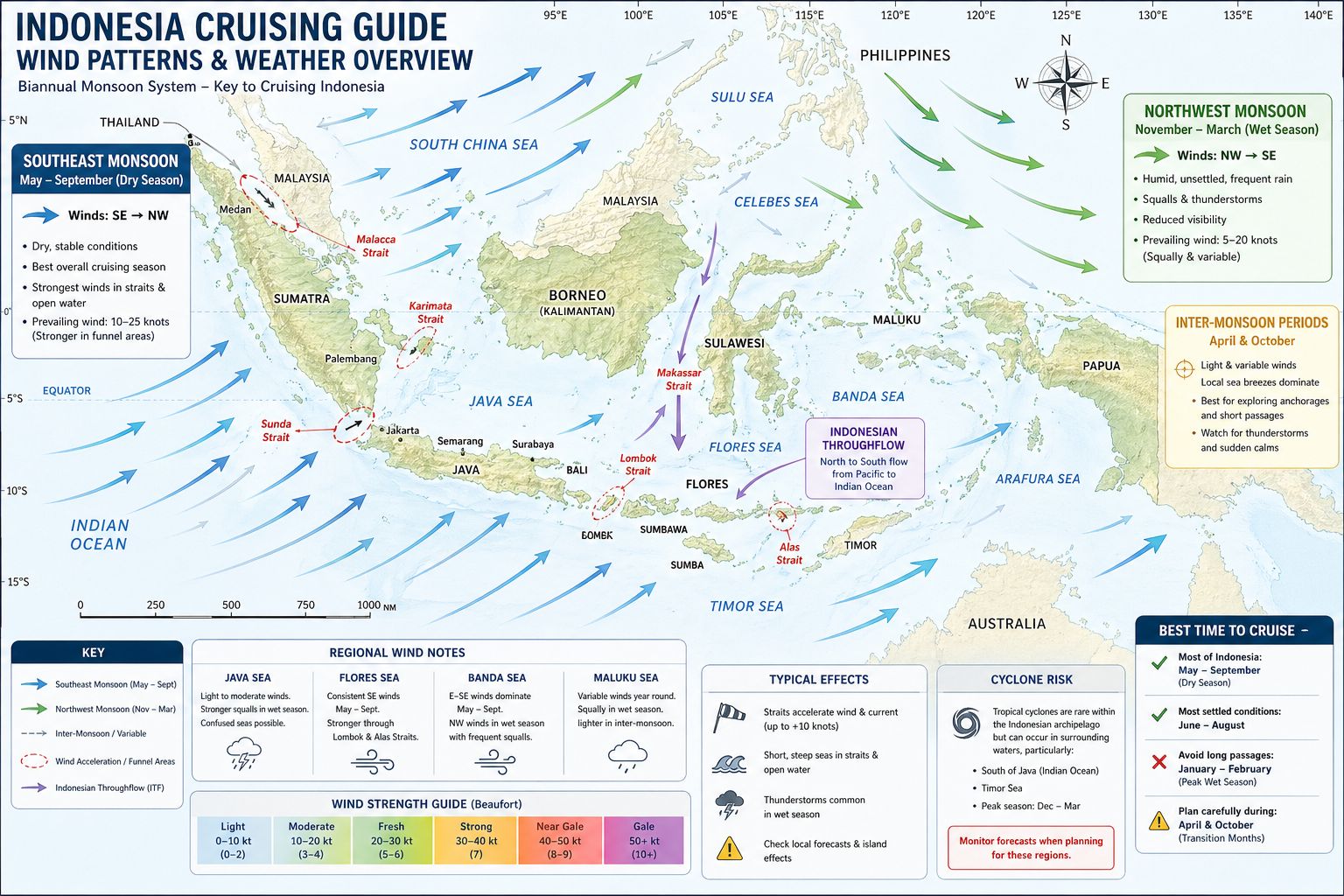
The region has two rainfall peaks: the southeast trade season from May to September brings lower rainfall and steadier winds; the northwest monsoon from November to March brings heavy rainfall and reduced visibility. Squalls occur year‑round. Visibility reduces during heavy rain. Visibility can fall to 1–2 NM. Afternoon sea breezes develop inside the bay. Localised gusts occur near steep terrain.
Ambon Sailing
Guide Maluku - Provisioning
Ambon is a major freight hub for the Maluku Islands. Regular shipments arrive from Surabaya, Makassar, and Jakarta. Cold chain infrastructure is present in Hypermart and Indogrosir, making Ambon ideal for sourcing perishables before heading to remote islands.
Supermarkets. Indogrosir Ambon, Jl. Y. Syaranamual, Hunuth/Durian Patah, Teluk Ambon with bulk packaged goods, dry staples, snacks, and beverages. Ideal for stocking up on rice, noodles, canned goods, and household items. Ambon City Center (ACC) Jln. Wolter Monginsidi also has the Matahari Department Store and various grocery outlets. Good for general shopping and dry goods. Hypermart Ambon (inside Ambon Plaza) Jl. Dr. Sam Ratulangi with packaged foods, beverages, and some imported items. Cold chain infrastructure is better than in smaller towns. Gelael Ambon, which carries fresh produce, dry goods, frozen foods and household supplies. Additional provisioning is available at Indomaret and Alfamidi outlets across Ambon City and Passo, which stock imported items, dairy, cereals and general groceries.
Markets. Pasar Mardika, Terminal Mardika, Kelurahan Rijali, Sirimau District and largest wet market in Ambon. Has fresh vegetables, tropical fruits (bananas, papayas, pineapples), seafood, and local snacks. Starts at 05:00 to 09:00 for peak freshness. Pasar Batu Merah is a smaller market known for fish, leafy greens, and cassava and located near Batu Merah village. Pasar Wayame serves the Teluk Ambon area with seasonal produce, dried fish, and basic staples. Fresh produce is available at Passo Market.
Fish Markets. Mardika Fish Market. Species include tuna, mackerel, trevally and reef fish. Additional seafood is sold by small coastal vendors along the shoreline.
Ambon Sailing
Guide Maluku - Local Cuisine
Ikan bakar Ambon is grilled fish served with sambal. The dish uses charcoal grilling and local fish species. Papeda is a sago‑based dish served with fish broth. The dish uses sago starch and souring agents. Kuah kuning Ambon is a yellow fish soup with turmeric and herbs. The broth uses turmeric, lemongrass and ginger. Udang rica‑rica is prawns cooked with chilli paste. The dish uses fresh prawns and fermented condiments. Sagu lempeng is a baked sago cake served with fish dishes.
Ambon Sailing
Guide Maluku - Fuel Supplies
Ambon has no fuel dock for yachts and no wharf‑side hose service. Diesel is obtained by jerry can from the Pertamina station at Lateri or the Pertamina station near Mardika Market, both of which supply standard automotive diesel with good turnover. These are the cleanest and most reliable sources in Ambon. Yachts typically transport fuel using motorbike carriers or small pickups arranged at the Galala–Lateri waterfront. Drum delivery to the shoreline is possible but inconsistent, and quality varies; all fuel should be filtered during transfer due to the risk of water and sediment in locally stored drums.
No outlying anchorages around Amahusu, Hative Besar, Lateri, Galala, or Baguala Bay offer yacht‑suitable diesel. Villages may sell small quantities in bottles or drums, but this fuel is not appropriate for yacht tanks due to contamination risk and uncertain storage. All refuelling for Ambon must be done in Ambon City / Lateri, using jerry cans from the named Pertamina stations. Yachts should arrive with adequate tankage, plan for multiple jerry‑can runs, and expect no dockside refuelling anywhere in Ambon Bay.
Ambon Sailing
Guide Maluku - Water Supplies
Ambon does not provide potable water at the yacht anchorage, and there is no dedicated hose point on the public waterfront used by visiting yachts. Yachts normally fill by jerry can from the public tap behind the Mardika Market or from the standpipe near the Galala–Lateri waterfront, both supplying non‑potable municipal water that must be filtered or boiled before use. Several small hotels and guesthouses along the Ambon Bay waterfront may allow filling from their storage tanks for a fee, but this is not guaranteed and must be confirmed on arrival. There is no reliable tanker delivery operating for yachts in Ambon.
No outlying anchorages around Amahusu, Lateri, Galala, Hative Besar, or the Baguala Bay area offer yacht‑suitable water. Village taps exist but are low‑pressure, limited‑supply, and unsuitable for tank loading. All water provisioning for Ambon must be done in Ambon City / Galala–Lateri, using the named public taps above. Yachts should plan for multiple jerry‑can runs, carry adequate filtration, and expect no dockside water service anywhere in Ambon Bay.
Mechanical and Electrical Repairs
Resource
If you are headed somewhere remote consider the need to expand your knowledge base or have an information resource on board. Why not get a copy of my book The Marine and Electrical and Electronics Bible 4th Edition. By and for yachties, with everything from batteries and charging, solar and wind, diesel engines and marine electronics and so much more. Your complete systems guide. 650 pages of practical advice. In Australia and New Zealand order a copy through Boat Books. UK and European boats can buy the UK Edition Here. US and Canadian boats can get the US Edition Order Here. Marine systems are my profession so let me help you. By a liveaboard boat owner for other boat owners


Ambon Sailing Guide Maluku - Marine Services
Mechanical workshops operate in Ambon. Electrical workshops operate in Ambon. Electronics workshops operate in Ambon. General repair workshops operate in Ambon. Haul‑out facilities operate at commercial yards in Ambon. Larger haul‑out facilities operate in Sorong and Tual. Volvo agents operate in major Indonesian ports. Yanmar agents operate in major Indonesian ports.
Ambon Sailing
Guide Maluku - Local Customs
Maluku follows mixed Christian and Muslim norms. Modest dress is expected in public areas. Alcohol is available in licensed premises. Photography of government facilities is restricted. Sunday services affect business hours. During Ramadan, eating and drinking in public during daylight hours should be avoided in Muslim districts.
Ambon Sailing
Guide Maluku - Summary
Ambon is the primary maritime and administrative centre of Maluku with anchorage, limited berthing and commercial port facilities. The region has coastal settlements, hillside districts and commercial services linked to the wider Maluku transport network. Yachts anchor at Amahusu or Passo and use small‑craft wharves for access. The location is a lower‑cost alternative to larger Indonesian ports. Ambon Sailing Guide Maluku for all you need to know.