Town of 1770 Sailing Guide for Yachts
1770 Sailing Guide. The Town of 1770 is the final all‑weather coastal anchorage before the offshore jump to the Bunker Group, and it functions as a practical staging point rather than a protected harbour. Round Hill Creek is a shallow, tide‑dependent entrance with shifting sandbanks, strong tidal flow and a narrow channel that behaves more like a bar than a creek mouth. The skipper must treat 1770 as a tidal system with limited margin, where timing, visibility and disciplined navigation matter more than convenience. It is a useful stop for vessels heading to Lady Musgrave, Fitzroy, Lamont or Pancake Creek, but it is not a place to force an entry in marginal conditions.
Inside the creek, the anchorage is workable in settled weather, but the tidal stream is strong, the swing room is limited and the holding varies from good sand to patches of mud and weed. The creek edges shelve abruptly, and the vessel will lie to the current rather than the wind. The skipper must plan arrival and departure around the tide, not the clock, and must understand how the entrance behaves under different wind and tide combinations. 1770 is a functional, practical stop, but it demands respect and conservative judgement.
1770 Sailing Guide Approach
The approach to 1770 is straightforward in deep water, with depths of ten to twenty metres until close to the entrance. The creek mouth sits between the headland and the sand spit extending from the southern side, and the channel is narrow, shallow and prone to seasonal movement. Depths in the entrance range from two to four metres depending on tide and recent shoaling, and the charted contours should be treated as indicative rather than precise. The skipper must rely on the leads, beacons and real‑time depth rather than assuming the chart is accurate. A fresh south‑easterly can push swell into the entrance, creating a short, steep chop that breaks across the shoals, while a northerly wind can blow water out of the creek and reduce depth by up to half a metre below the predicted tide. The skipper must avoid entering in strong wind‑against‑tide conditions, which can create standing waves in the channel.
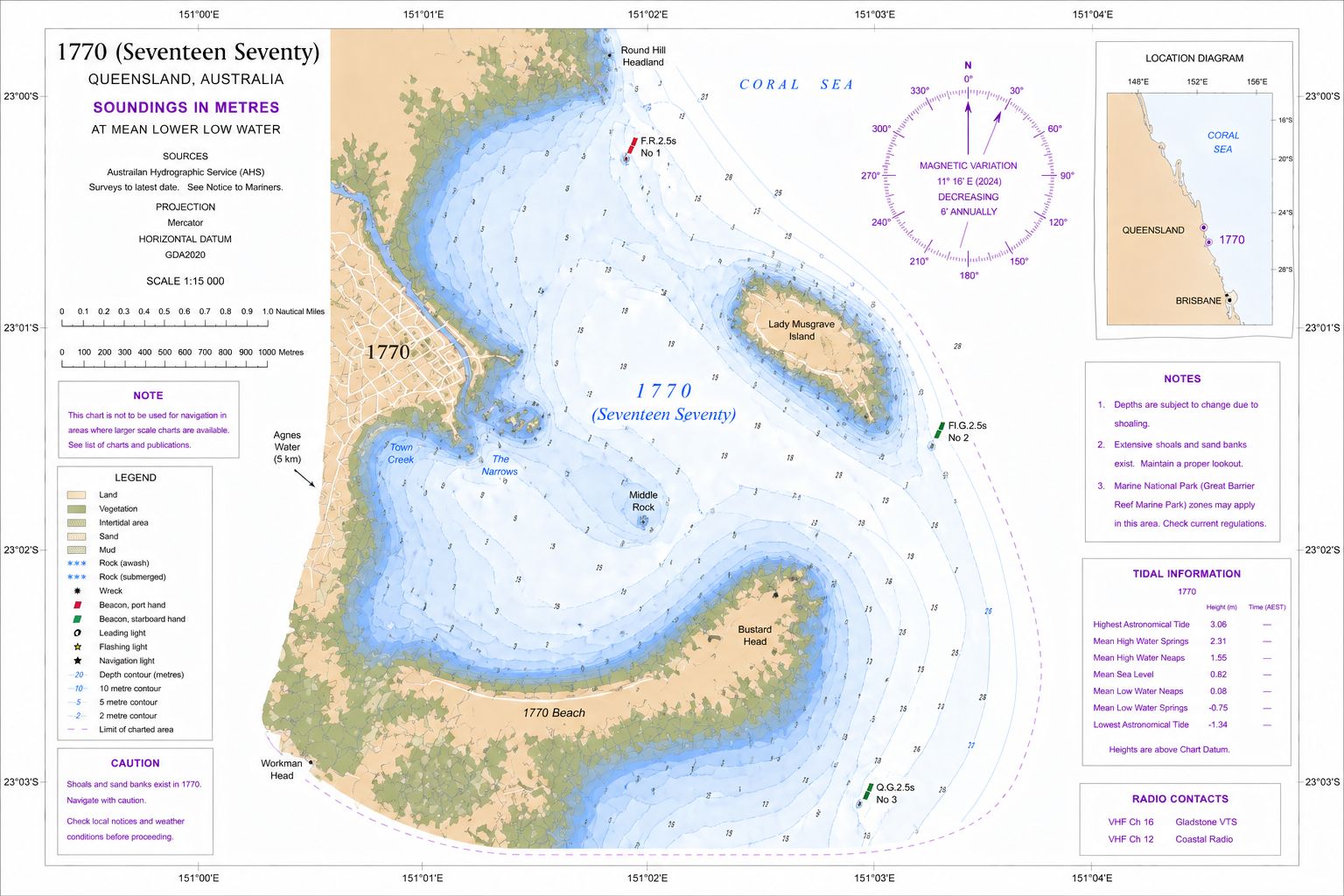
Chart Disclaimer. This chart is a schematic representation for illustrative purposes only and must not be used for navigation. Refer to official hydrographic charts for safe navigation. Be aware ENC charts may differ from official hydrographic charts. Both should be corrected and updated regularly.
1770 Sailing Guide Entrance
Channel and Bar
Round Hill Creek behaves like a bar even though it is not formally classified as one. The outer shoals shift with every season, and the channel can narrow or deepen depending on recent swell. Depths in the entrance range from two to four metres at low water, with deeper pockets up to five or six metres on the bends. The shoals on either side can dry at low tide, and the skipper must follow the marked channel precisely. The tidal stream is strong, running two to three knots on springs, and the outflow on a falling tide meets the incoming swell to create a short, steep chop. On a rising tide, the inflow can push the vessel sideways toward the sand spit. The skipper must maintain enough power to hold the line and avoid being set into the shallows. Entry should be made on a rising tide, ideally in the top half of the tide, with the sun behind the skipper for best visibility. The channel is narrow, and there is limited room to turn around if conditions deteriorate.
1770 Sailing Guide - Inside
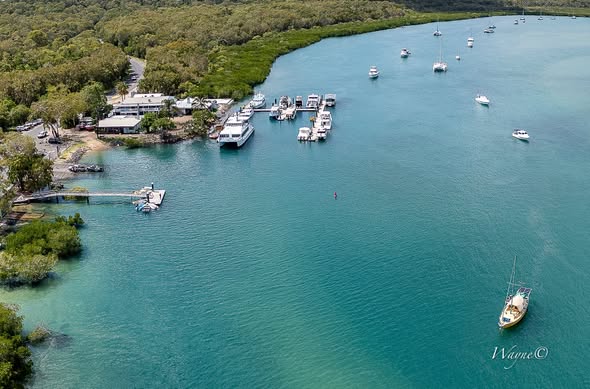
Once inside, the creek widens slightly, with depths of three to six metres in the main channel. The anchorage lies upstream of the headland, opposite the town foreshore, and the holding is generally good in sand, though patches of mud and weed exist. The tidal stream remains strong, and the vessel will lie to the current rather than the wind. Swing room is limited, and the skipper must allow for a full one‑hundred‑and‑eighty‑degree tidal swing. The creek edges shelve quickly, and depths can reduce from four metres to one metre within a few metres. The skipper must anchor in the centre of the channel rather than along the edges. Northerly winds can create chop in the anchorage and blow water out of the creek, reducing depth and increasing the risk of grounding.
1770 Sailing Guide - Tides,
Currents and Wind
Round Hill Creek is a tidal system with a strong stream that can reach three knots on springs. The vessel will lie to the current, and the swing can be abrupt at slack water. A strong south‑easterly pushes swell into the entrance and makes the approach uncomfortable, while a strong northerly lowers water levels and increases the risk of grounding. Westerlies flatten the sea state but can create gusty conditions inside the creek. The skipper must avoid entering or exiting in wind‑against‑tide conditions, which can create steep, breaking waves in the entrance channel.
1770 Sailing Guide - Navigation
Hazards
The primary hazards at 1770 are the shifting shoals at the entrance, the strong tidal stream inside the creek, the narrow channel with limited room to manoeuvre, the drying sandbanks on both sides of the entrance, the wind‑against‑tide chop in the channel, the reduced depth during strong northerlies and the limited swing room in the anchorage. The skipper must maintain situational awareness and avoid entering in marginal conditions.
1770 Sailing Guide - Anchoring
The anchorage lies in three to six metres of water depending on tide, and the holding is generally good in sand. The skipper must ensure the anchor is well set before relaxing, as the tidal stream can pull the vessel off a poorly set anchor. The tidal swing is significant, and the vessel will lie to the current. The skipper must allow for a full swing arc and avoid anchoring too close to the edges, where depths reduce quickly. The anchorage is comfortable in light to moderate south‑easterlies but can become choppy in northerlies, and the skipper must be prepared to move if conditions deteriorate.
1770 Sailing Guide - Departure
and Exit Logic
Exiting the creek requires the same discipline as entry. The skipper must time the exit for a rising tide or slack water, with good visibility and settled conditions. The channel is narrow, and the tidal stream can push the vessel sideways. The skipper must maintain enough power to hold the line and avoid being set into the shoals. Once outside, the sea state becomes more predictable, and the skipper can shape a course toward Pancake Creek, Lady Musgrave or the next offshore leg.
1770 Sailing Guide - Offshore
Routing from 1770
The offshore routes from 1770 are straightforward in settled conditions. Pancake Creek is a short coastal hop in ten to twenty metres of water. Lady Musgrave is a thirty‑two to thirty‑five nautical mile offshore leg that requires a daylight reef entry. Fitzroy Reef is a forty‑five to fifty nautical mile offshore leg that demands good visibility. Lamont Reef is a thirty‑eight to forty‑two nautical mile offshore leg with a shallow entrance that must be approached with caution. The skipper must plan departure times to ensure daylight arrival at any reef pass.
1770 Sailing Guide Provisioning,
Fuel, Water and Marina
1770 has a small but fully operational marina inside Round Hill Creek, with floating pontoons, short‑stay and overnight berths, and tidal access suitable for cruising yachts. Depths alongside vary with tide and berth position, and skippers should confirm suitability in advance, as the marina is compact and the creek is shallow at low water. Potable water and shore power are available on the pontoons, and access to shore facilities is straightforward once berthed. There is a dedicated fuel dock. Agnes Water provides supermarkets, gas refills, hardware and general supplies, but it is not a full chandlery or technical port. For major provisioning, bulk fuel, water loading or marine repairs, Bundaberg or Gladstone remain the primary service centres, with 1770 functioning as a convenient staging point rather than a comprehensive service hub.
Mechanical and Electrical Repairs
Resource
Why not get a copy of my book The Marine and Electrical and Electronics Bible 4th Edition. In Australia order a copy through Boat Books. UK based boats can Order Here. US based boats can get the US edition Order Here. Marine systems are my profession so let me help you.


1770 Sailing Guide - Summary
1770 is a practical and valuable staging point for offshore passages to the Bunker Group, but it is a tidal creek with a narrow, shifting entrance that behaves like a bar. The anchorage is workable, the holding is generally good and the location is convenient, but the skipper must treat the entrance, the tidal stream and the shoaling patterns with respect. With disciplined timing, good visibility and conservative judgement, 1770 is a reliable stop on the Queensland coast. Treated casually, it becomes a place where the margin for error disappears quickly. The 1770 Sailing Guide should help your passage planning.