Starlink for Boats
Starlink for boats has rapidly become the preferred broadband communications solution for cruising sailors, offering unprecedented global coverage, high throughput, and simple installation compared with legacy satellite systems. I have installed Starlink on my boat and it is really very good. While not perfect and still evolving, Starlink dramatically improves offshore connectivity for weather routing, navigation data, safety communications, and onboard life such as streaming TV. Many friends are work from boat (home) liveaboards and it is very reliable.
Starlink for boats is just as important for onboard systems and allows the downloading of updates on my Navionics chart software and all my other Raymarine equipment such as MFD;s instruments, radar and so on. Installing and operating the system on a sailing yacht requires understanding both the hardware’s physical needs and the operational constraints posed by a marine environment. It is however very simple plug and play stuff and the phone app allows easy boot up and software update capability.

Starlink for Boats - Roaming Plans UK and Europe

Starlink for Boats - Roaming Plans USA and Caribbean

Starlink for Boats - Hardware
Most cruising sailors install either the Standard (Residential/Roam) dish (which is what I have) or the Flat High-Performance terminal. The standard dish is the least expensive and offers very good speeds, but it has moving motors for self-aiming. These motors are not marinised and may be more vulnerable to failure from vibration, salt, and water ingress. The high-performance dish is physically larger, draws more power, has no moving parts, and is better suited to motion and temperature extremes. It remains the most robust option for offshore yachts, especially monohulls that heel significantly.

Starlink for Boats - Power Consumption
For power-constrained yachts, the standard dish’s lower power consumption may be attractive, which is in the range 35–70 W in typical use. The high-performance version typically draws 80–110 W. You should factor this into their energy budget alongside solar, alternator, and battery capacity.

Starlink On My Boat
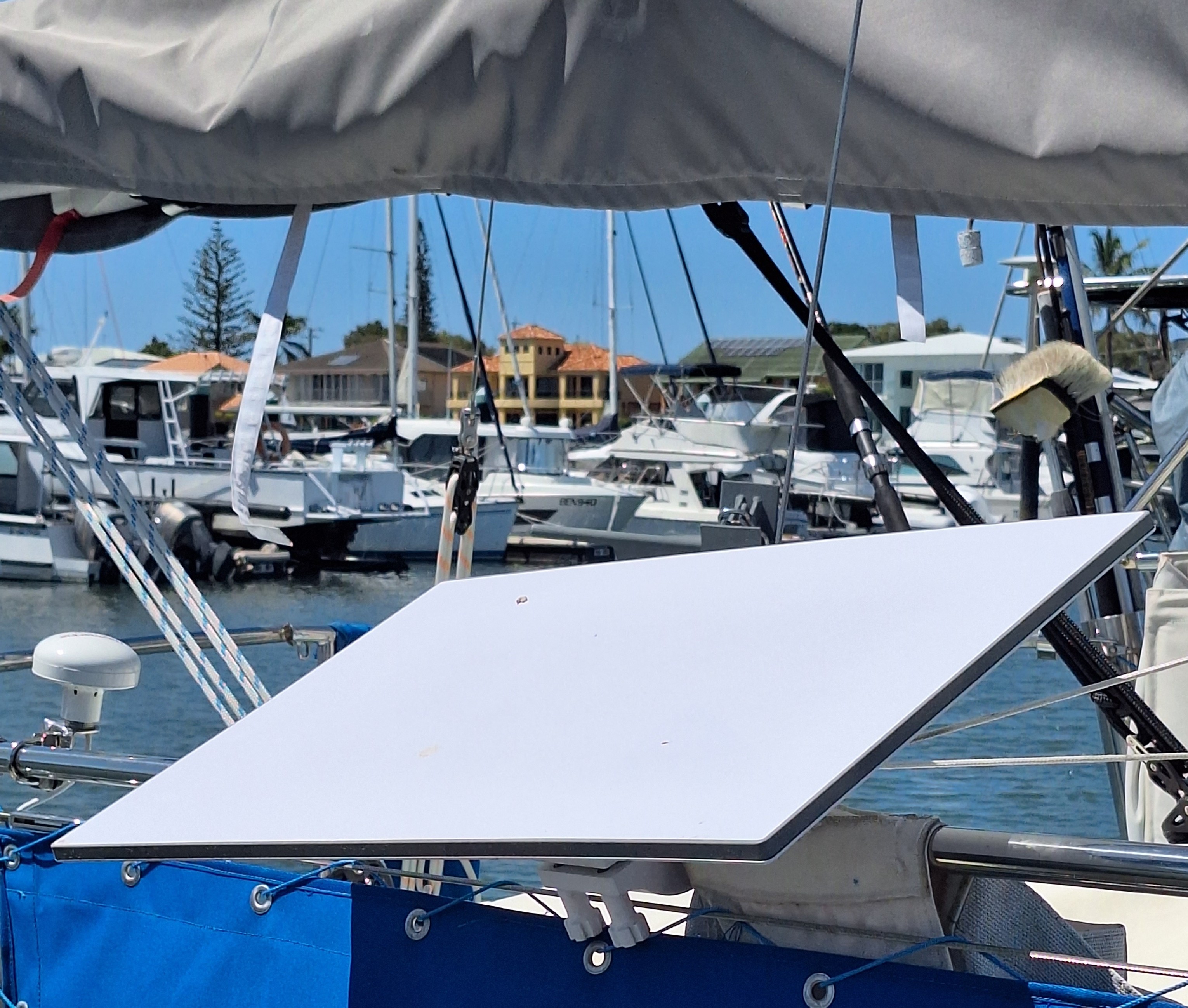
Starlink for Boats - Mounting Options
for Sailboats
Starlink antennas require a clear view of as much sky as possible. While the original system required fixed pointing, modern terminals electronically steer the beam, making mounting orientation less demanding. Nevertheless, physical installation must consider several practical constraints:
Stern Rail or Pushpit Mount. This is the most common solution and I currently have mine on a rail with mount, and it works okay. A stainless pole or rail mount places the dish clear of deck traffic and can be angled slightly outboard to reduce mast shading. Quick-release clamps allow removal before heavy weather or when leaving the boat.
Radar Tower or Arch. Ideal for yachts with an aft arch, this keeps the dish high and unobstructed. The arch also provides room for cable runs and power supplies, but the higher location increases movement at sea and the arches are somewhat prone to vibration.
Coachroof or Hardtop. On catamarans, the coachroof or bimini top provides an excellent flat platform and I have seen the combination stern arch solar panel and davit arrangement with a dish installed. Many catamarans report the most consistent performance thanks to minimal heeling and motion.
Temporary Deck Mounting for Offshore Voyages. Some sailors stow the dish below when in port and deploy it on deck for offshore communications only. This reduces UV and salt exposure but is less convenient. You can get a canvas cover made for this or wrap an unused sail bag over the dish which works for me.
When mounting the dish, ensure strong mechanical support. Standard dishes are not designed for constant shock loading. Many fabricate aluminium or stainless brackets with rubber isolation pads to absorb vibration.

Mechanical
and Electrical Repairs Resource
Why not get a copy of my book The Marine and Electrical and Electronics Bible 4th Edition. In Australia and New Zealand order a copy through Boat Books. UK and European boats can buy the UK Edition Here. US and Canadian boats can get the US Edition Order Here. Marine systems are my profession so let me help you.

Starlink Cable Routing and
Power Considerations
Starlink’s power supply and modem require 48-V DC. Many sailors modify the system to run directly from the yacht’s 12- or 24-V battery bank using a DC-DC converter, eliminating the inefficiency of an inverter. However to be fair an inverter is around 98% efficient these days and I run mine through that. There are marine-grade DC-power kits are available commercially (mostly for the Starlink Mini), and many have built reliable DIY versions, but all installations should use the basic electrical practices:
- Tinned marine cable for corrosion resistance
- Proper fusing near the source
- Waterproof cable glands
- Adequate strain relief where the cable passes through deck or bulkhead
Cable length matters. Longer cables can cause voltage drop, so oversizing conductors by at least one gauge is advisable.
Waterproofing all connectors is critical. Wrap external intermediate connectors with self-amalgamating tape and place them in protected locations. The Starlink router should be installed in a dry, ventilated space such as the nav station which is exactly where I have mine

Starlink Network Setup
Onboard
Starlink’s default router is adequate for simple use, but many sailors integrate Starlink into a larger onboard network with:
- A dedicated marine Wi-Fi router
- A VLAN for navigation instruments
- External long-range Wi-Fi booster for marina networks
- 4G/5G failback via a SIM router
A common setup is to run Starlink in bypass mode, feeding an onboard router that manages multiple WAN sources. This allows seamless switching between cellular data, Starlink, and marina Wi-Fi depending on location and power availability.
For redundancy offshore, some cruisers maintain an Iridium GO! or Iridium Certus device for guaranteed emergency connectivity. While Starlink is highly reliable, it is not yet considered a GMDSS-grade system. That is important to note, it is not part of GMDSS the same as acell phone isn’t.

Operating Starlink
on a Sailing Yacht
Starlink performs differently depending on sea state, vessel motion, latitude, and network congestion.
Motion Effects. The standard dish motors compensate for tilt, but excessive rolling can momentarily reduce performance. Flat high-performance dishes, designed for mobility, maintain a more stable link in swell and when heeled over. Catamarans again benefit from inherently reduced motion.
Obstructions. The mast, boom, sails, and rigging can partially block the sky view. Boats with in-mast furling, large roaches, or twin backstays may experience brief service interruptions on certain headings. A stern-mounted pole angled outboard helps reduce these shadows.
Power Management. Long passages require careful balancing of power draw. Many sailors run Starlink only during scheduled weather downloads or communications windows, and shut it down overnight to save battery capacity. App-based control allows remote power cycling. This is my preferred option as well, so I don’t use battery capacity.
Weather and Environment. Rain and heavy cloud cover can slightly degrade performance, but modern dishes perform far better in adverse weather than earlier versions. Ice buildup is unlikely in typical cruising regions but will activate the dish’s power-intensive heating mode.

Data Speeds and
User Expectations
Speeds vary widely depending on service plan, region, and network load. Typical real-world performance reported by cruisers:
- 50–250 Mbps downlink
- 10–30 Mbps uplink
- 20–60 ms latency
This is far superior to legacy marine satellite systems and more than adequate for streaming, cloud backups, video calls, and high-speed GRIB downloads. In densely populated areas, speeds may slow during evening peaks, so marina’s in large cities do have issues as I have found out. For offshore passages under the Maritime or Mobile Priority plan, speeds remain stable but costs increase substantially. Many cruisers switch between plans as needed.

Starlink for boats - Maintenance
Marine environments are harsh due to salt laden atmosphere and actual seawater spray, UV exposure, vibration, and humidity always shorten the life of consumer electronics. To maximise dish longevity perform the following:
- Rinse the dish with fresh water regularly, rinse not high pressure wash that is,
- Protect connectors with dielectric grease, around the rubber boot but I prefer to keep connector contacts clean and dry.
- Remove and stow the dish before severe storms, sometimes this is a challenge
- Shade or cover the dish when not in use to limit UV degradation
- Periodically inspect mounts for corrosion or fatigue
Some users report two-plus years of continuous service with minimal issues, particularly with the high-performance model.


Starlink for Boats Summary
Starlink is transforming cruising by making high-bandwidth connectivity possible almost anywhere. For liveaboards, remote workers, and passage-making sailors, it provides a level of communication once unimaginable without large, expensive marine antennas. While it requires thoughtful installation and careful power budgeting, its reliability and performance more than justify the effort. As coverage expands and hardware evolves, Starlink is likely to become a standard fixture on modern cruising yachts. Starlink for boats is really a gamechanger.