Boat Diesel Engine Exhaust Water Trap
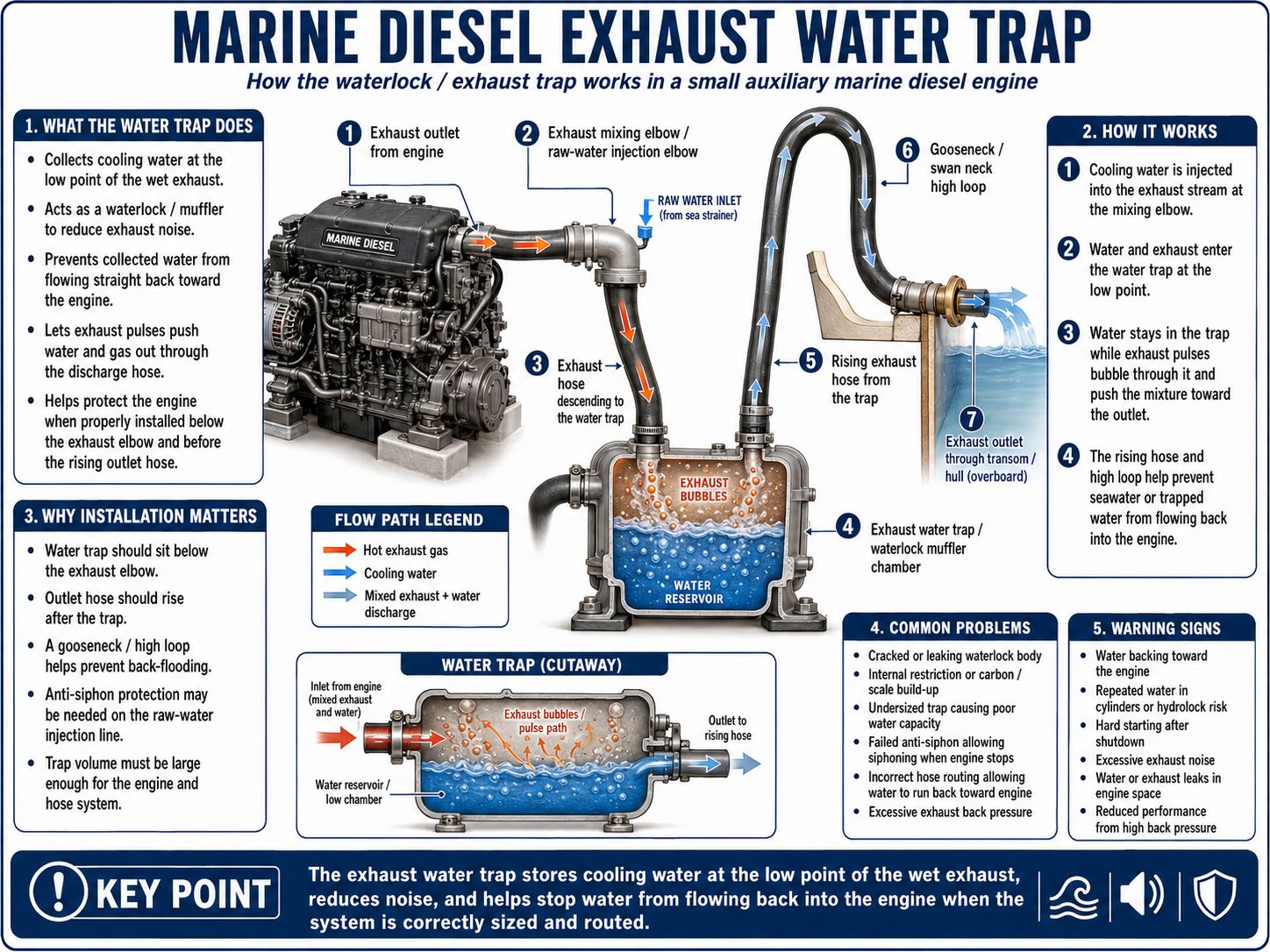
The exhaust water trap, also called a waterlock, muffler, silencer is a critical component of the wet exhaust system used in most small marine diesel engines. Its primary function is to collect, store, and control seawater injected into the exhaust stream while simultaneously reducing noise and preventing back-flow of water into the engine. Although it appears simple, the waterlock plays an essential role in protecting the engine from hydrolock, improving exhaust system performance, and maintaining safe operation under varying vessel trim and sea conditions.
The exhaust water trap are standard on engines from Yanmar, Volvo Penta, Nanni, Beta, Vetus, and Westerbeke, particularly on installations where the exhaust run includes rises or long horizontal sections. Their performance depends heavily on correct sizing, positioning, and hose routing.
Exhaust Water Trap Function
A marine diesel’s wet exhaust system injects seawater into the exhaust elbow to cool the hot gases and reduce hose temperature. Because this mixture is heavy and subject to gravity, a water trap is required to prevent water traveling backwards into the engine. The waterlock serves several critical functions:
- Water Trap: Creates a low point where mixed exhaust water collects, preventing reverse flow.
- Backflow Protection: Limits the risk of water reaching the exhaust elbow and entering cylinders.
- Noise Attenuation: Quietens the exhaust by absorbing pulse energy.
- Flow Regulation: Provides a temporary reservoir for seawater during engine off cycles.
- Thermal Buffer: Allows exhaust gases to cool and expand safely.
Without a properly installed waterlock, even a moderate stern wave or excessive cranking could push water into the engine, causing catastrophic hydrolock.
Boat Exhaust Pulsing
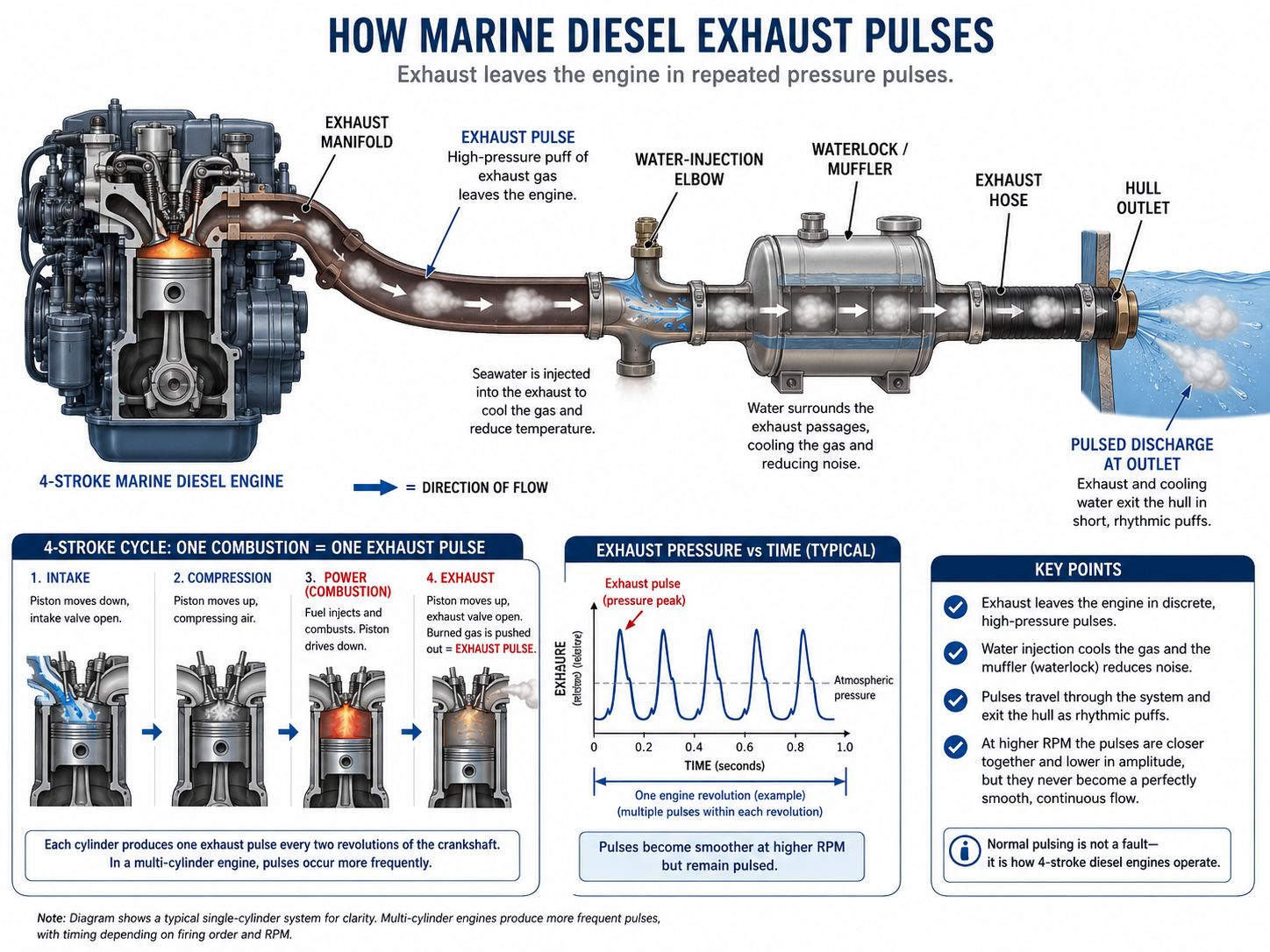
Ever wondered why the exhaust pulses as it exists your transom. Exhaust pulsing in small marine diesel engines is caused by the cyclic firing of cylinders, uneven exhaust gas flow, and the natural pressure waves created as each cylinder expels combustion gases. It’s a normal characteristic of small diesels, though excessive pulsing can indicate issues with injectors, valve timing, or exhaust restrictions.
Mechanical
and Electrical Repairs Resource
If you are headed somewhere remote consider the need to expand your knowledge base or have an information resource on board. Why not get a copy of my book The Marine and Electrical and Electronics Bible 4th Edition. By and for yachties, with everything from batteries and charging, solar and wind, diesel engines and marine electronics and so much more. Your complete systems guide. 650 pages of practical advice. In Australia and New Zealand order a copy through Boat Books. UK and European boats can buy the UK Edition Here. US and Canadian boats can get the US Edition Order Here. Marine systems are my profession so let me help you. By a liveaboard boat owner for other boat owners


Exhaust Water Trap
- Construction
Exhaust Water Trap come in several construction styles, with manufacturers such as Vetus, Centek, Halyard, and Volvo Penta offering models in various materials and configurations.
Common Materials.
- GRP (Glass Reinforced Plastic)
- Excellent heat tolerance
- Corrosion proof
- Very long service life
- Common in Centek and Halyard mufflers
Polypropylene or High-Density Plastic
- Lightweight and inexpensive
- Resistant to seawater and coolant mix
- Used by Vetus and many OEM suppliers
Stainless Steel
- Durable but prone to corrosion if poorly drained
- Less common on smaller yachts
- Sometimes custom-fabricated for tight spaces
Internal Design Features
Most waterlocks contain:
- Internal baffles to disrupt exhaust pulses and reduce noise
- A water collection chamber forming the “trap”
- An inlet pocket positioned low to prevent back-siphoning
- A high-mounted outlet spigot to encourage vertical lift to the gooseneck
The design supports one-way flow while still allowing exhaust pressure to drive water out easily when the engine is running.
Exhaust Water Trap
- Location
Correct positioning is essential for waterlock functionality.
Typical Location
- Installed below the exhaust elbow, usually 20–50 cm lower
- Positioned at the lowest point of the system
- Before the exhaust hose rises to the gooseneck / anti-siphon loop
Locational Factors
- Prevent water from reaching engine when stopped
- Ensure backpressure remains within manufacturer limits
- Maximise noise reduction
- Allow full draining via gravity when engine stops
Manufacturers such as Vetus provide explicit installation height and distance guidelines to ensure correct operation with their units.
Exhaust Water Trap
and Backpressure
A Exhaust Water Trap must be selected and installed to avoid excess exhaust backpressure—one of the most common installation errors.
Backpressure Considerations
- Too small a waterlock increases restriction
- Excessively long hose runs elevate pressure
- Incorrect height relative to the engine encourages water stacking
- Sharp bends add resistance and turbulence
Manufacturers typically specify maximum backpressure values (often 600–1500 mm H₂O, depending on the engine). Selecting a waterlock with adequate volume and flow capacity is essential to remain below these limits.
Exhaust Water Trap
- Maintenance
Exhaust Water Trap are low-maintenance components but still require periodic inspection to ensure long-term reliability.
Routine Maintenance
- Inspect for cracks or deformation. Plastic waterlocks can soften or deform if dry exhaust enters, usually during raw-water pump failure.
- Check hose connections. Ensure clamps are tight and hoses have no splits or delamination.
- Confirm free drainage. Waterlocks must completely drain when the engine stops. Blockage can cause water accumulation and backflow.
- Look for internal residue. Soot, scale, and biological growth can accumulate over time.
- Check mounting integrity. Loose mounts cause vibration, noise, and potential hose strain.
Failures to Watch For
- Internal baffle collapse
- Melt damage from overheating
- Water accumulation due to downstream blockage
- Backflow caused by poor anti-siphon operation
Troubleshooting
Common Waterlock Issues
Overheating of Exhaust Hose. Likely causes:
- Raw water pump failure
- Blocked elbow
- Waterlock flooded due to backflow restriction
Water Dripping From Exhaust Outlet When Stopped. Indicates siphon action or incorrect hose routing. The waterlock may be too high or the anti-siphon loop ineffective.
Excessive Exhaust Noise. Often caused by:
- Internal baffle damage
- Loose waterlock mounting
- Undersized waterlock
Water Reaching the Engine. This is among the most dangerous exhaust system failures, requiring immediate correction. A critical issue indicating:
- Incorrect vertical separation
- Oversized water volume in the waterlock
- Missing or failed anti-siphon valve
- Excessive cranking without start
Replacement
Practices and Recommendations
Sizing. Follow manufacturer charts to match engine
displacement and exhaust diameter.
Vetus, Centek, and Halyard publish recommended volumes based on:
- Engine horsepower
- Exhaust gas temperature
- Vertical height to gooseneck
- Backpressure targets
Hose Routing. Avoid sags that can collect water
Tight radius bends. Hose runs above recommended lengths and maximum bend radii
Mounting. Use the following:
- Rigid, vibration-isolated brackets
- Accessible positioning for inspection
- Fire-retardant mounting surfaces
When to Replace. Replace if any of the following occur:
- Visible distortion or cracking
- Persistent water backflow symptoms
- Major overheating event
- Hose spigots weakening or detaching
Exhaust Water Trap
Summary
The Exhaust Water Trap is a deceptively simple yet critically important part of a small marine diesel exhaust system. By providing a controlled water trap, reducing noise, and preventing catastrophic backflow into the engine, it ensures the safe and reliable operation of the entire exhaust path. Correct sizing, positioning, and inspection are essential to prevent hydrolock, maintain low backpressure, and ensure dependable cooling water discharge. Check your Exhaust Water Trap, it is not a fit and forget item.