Engine Oil Pressure Sensor
The engine oil pressure sensor is among the most critical monitoring devices on a small marine diesel engine. They provide the operator with essential feedback on the engine’s lubrication system, alerting them to dangerous conditions such as low oil pressure, pump failure, blocked oil passages, or severe bearing wear. In small yacht engines from Yanmar, Volvo Penta, Beta Marine, Nanni, Westerbeke, and others, oil pressure sensors typically take one of two forms: analogue pressure senders and low-pressure switches. Many engines use both, one for a gauge and one for the alarm system, to provide redundancy and immediate warning.
Marine diesel lube oil pressure sensors are vital for monitoring lubrication systems. Their construction involves mechanical diaphragms or strain gauges converting pressure into electrical signals. Operation ensures bearings receive proper lubrication, while diagnostics detect faults like leaks, blockages, or pump failures. Mastering design, function, and troubleshooting safeguards engines, prevents wear, and supports reliable, efficient marine diesel maintenance practices
Engine Oil
Pressure Sensor Types
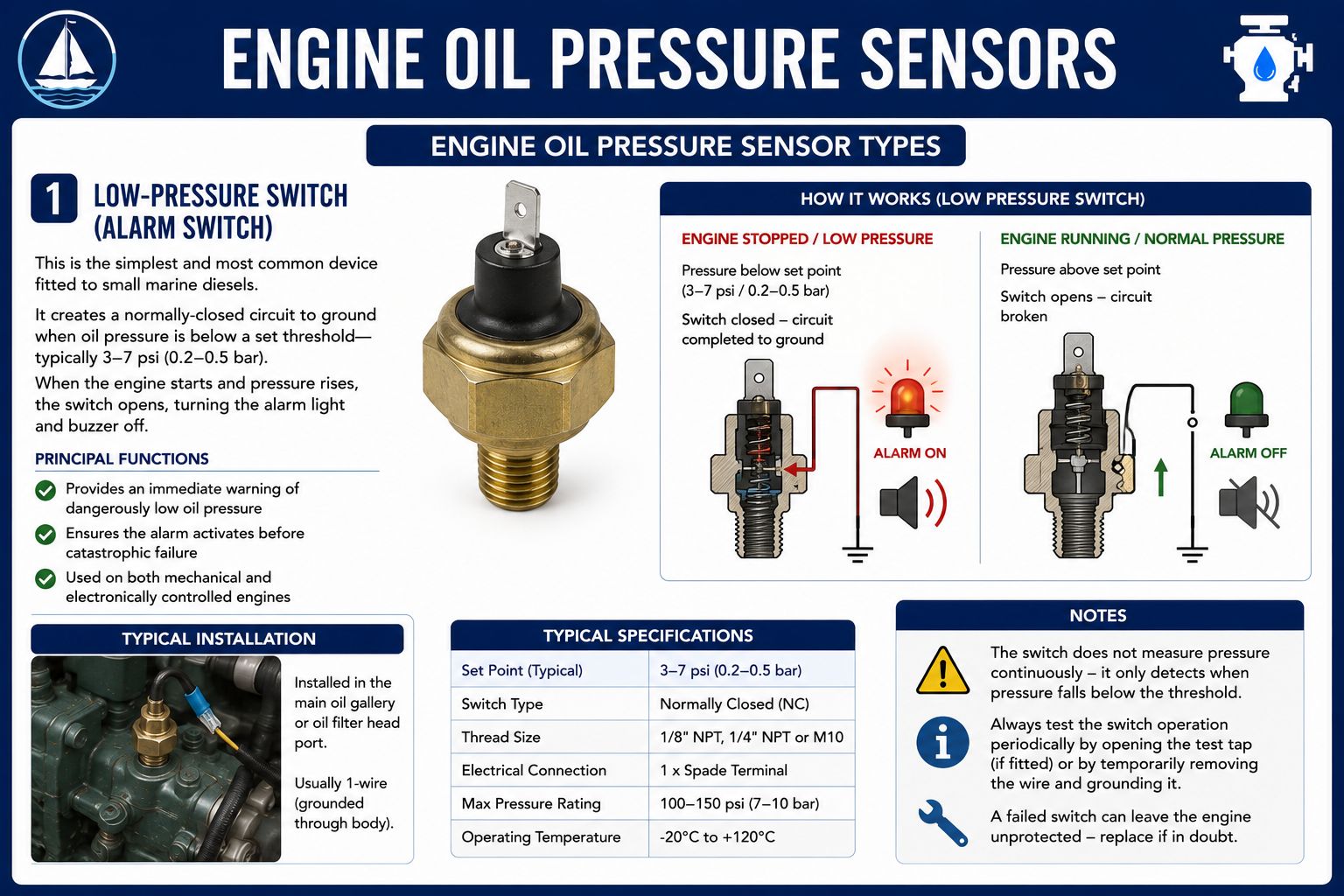
Low-Pressure Switch (Alarm Switch). This is the simplest and most common device fitted to small marine diesels. It creates a normally-closed circuit to ground when oil pressure is below a set threshold—typically 3–7 psi (0.2–0.5 bar). When the engine starts and pressure rises, the switch opens, turning the alarm light and buzzer off. The principal functions are:
- Provides an immediate warning of dangerously low oil pressure
- Ensures the alarm activates before catastrophic failure
- Used on both mechanical and electronically controlled engines
Engine Oil Pressure Sensor Types
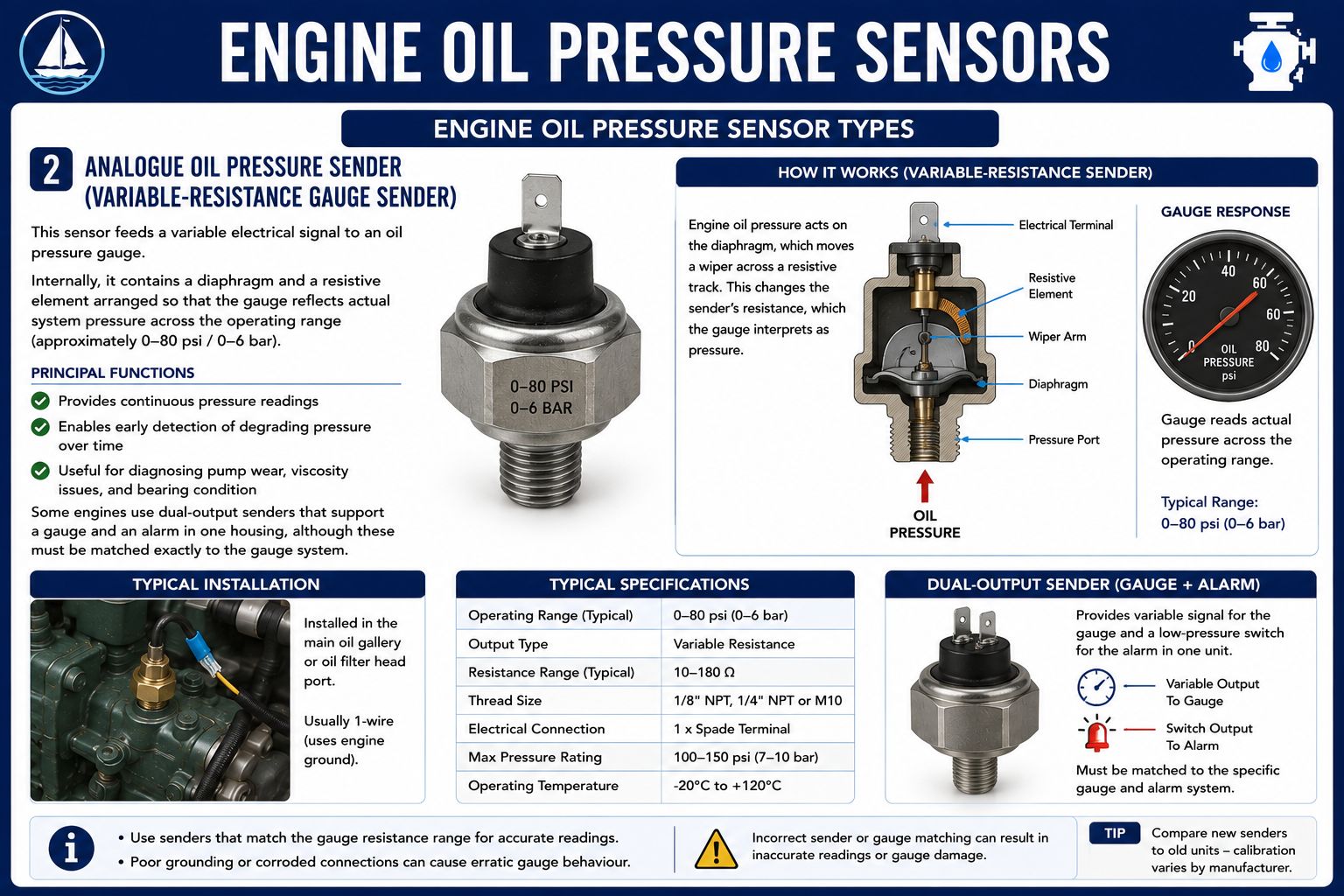
Analogue Oil Pressure Sender (Variable-Resistance Gauge Sender). This sensor feeds a variable electrical signal to an oil pressure gauge. Internally, it contains a diaphragm and a resistive element arranged so that the gauge reflects actual system pressure across the operating range (approximately 0–80 psi / 0–6 bar). The principal functions are:
- Provides continuous pressure readings
- Enables early detection of degrading pressure over time
- Useful for diagnosing pump wear, viscosity issues, and bearing condition
Some engines use dual-output senders that support a gauge and an alarm in one housing, although these must be matched exactly to the gauge system.
Low Oil
Pressure Switch Construction
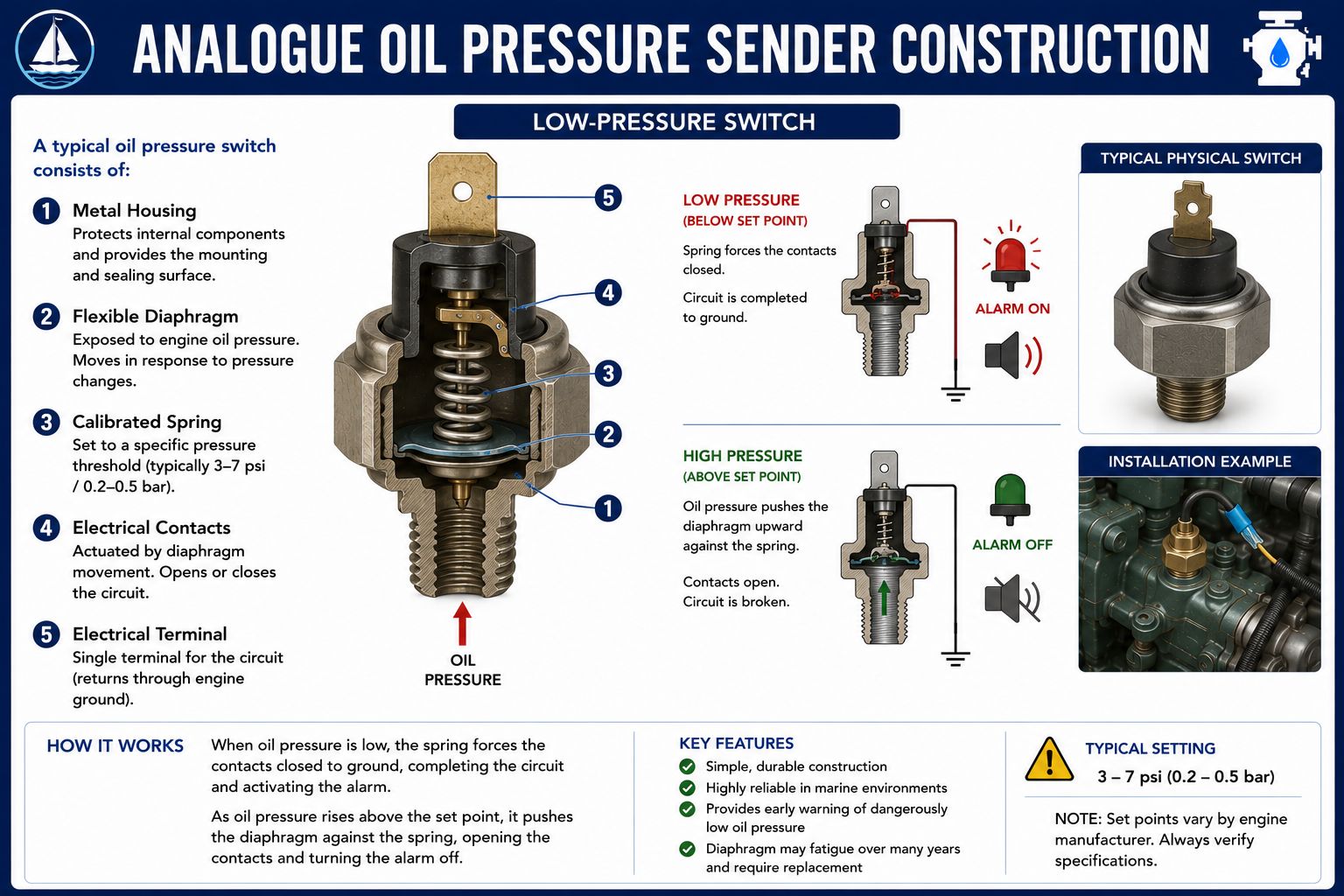
Low-Pressure Switch. A typical oil pressure switch consists of the following parts:
- A metal housing
- A flexible diaphragm exposed to engine oil pressure
- A spring calibrated to a specific pressure threshold
- A set of electrical contacts actuated by diaphragm movement
- A single electrical terminal (returning through the engine ground)
When oil pressure is low, the spring forces the contacts closed. Rising pressure pushes the diaphragm against the spring, opening the circuit. This simple construction makes switches durable and highly reliable, though somewhat susceptible to diaphragm fatigue over many years.
Oil Pressure Gauge Sensor Construction
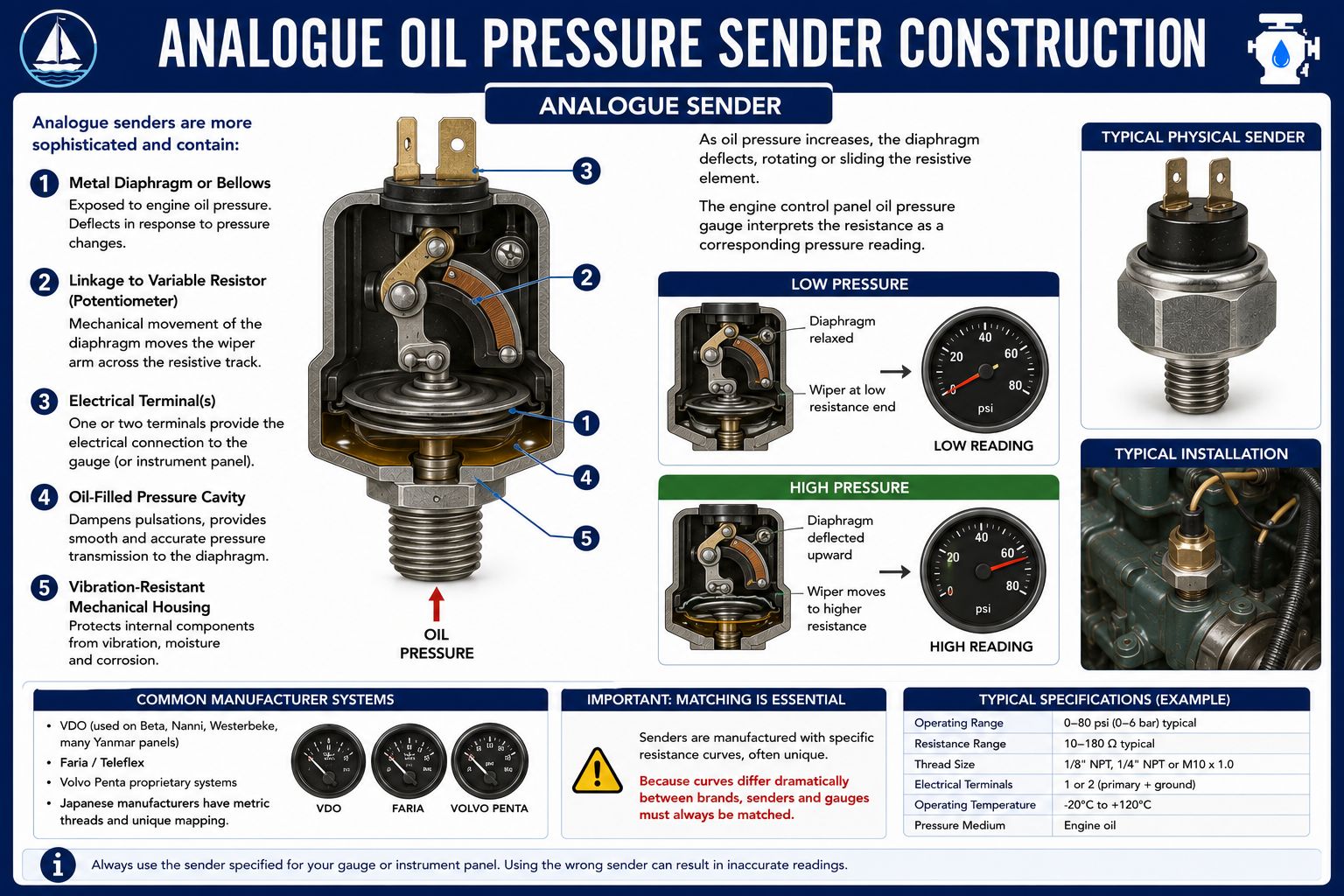
Analogue Sender. Analogue senders are more sophisticated and contain the following parts:
- A metal diaphragm or bellows
- A linkage connected to a variable resistor (potentiometer)
- One or two electrical terminals
- An oil-filled pressure cavity
- A vibration-resistant mechanical housing
As oil pressure increases, the diaphragm deflects, rotating or sliding the resistive element. The engine control panel oil pressure gauge interprets the resistance as a corresponding pressure reading.
Senders are manufactured with specific resistance curves, often unique:
- VDO (used on Beta, Nanni, Westerbeke, many Yanmar panels)
- Faria / Teleflex
- Volvo Penta proprietary systems
Japanese manufacturers have metric threads and unique mapping. Because curves differ dramatically between brands, senders and gauges must always be matched.
Variations Between Engine Manufacturers
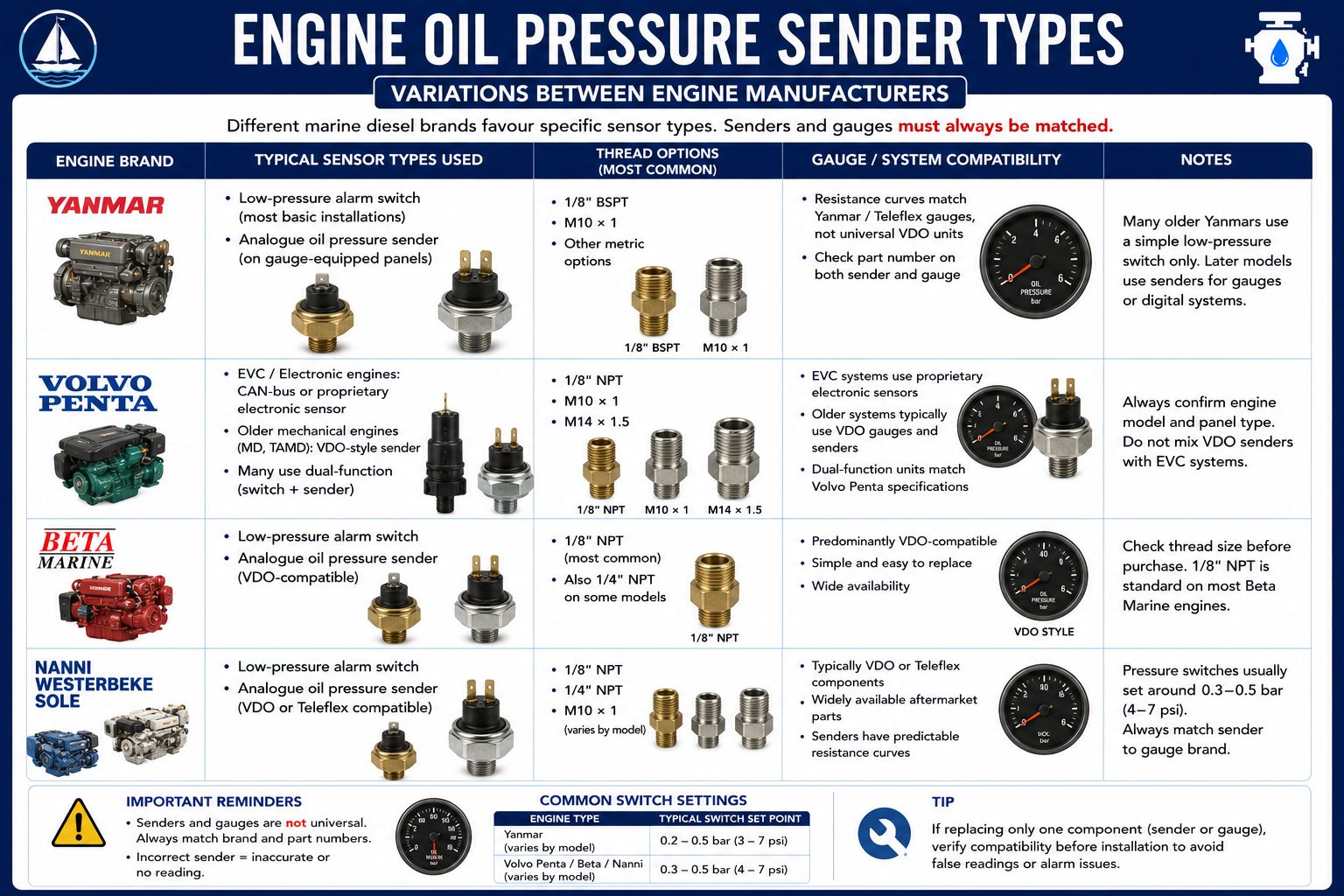
Different marine diesel brands favour specific sensor types:
Yanmar: Uses both alarm switches and senders depending on panel type. Many older Yanmars use a simple low-pressure switch only. Thread types vary: 1/8" BSPT, M10 × 1, and others. Resistance curves match Yanmar/Telflex gauges, not universal VDO units
Volvo Penta. EVC-equipped engines use CAN-bus or proprietary electronic sensors. Older mechanical engines (MD, TAMD) use VDO-style senders. Many engines combine switch and sender into a dual-function unit
Beta Marine. Predominantly VDO-compatible senders and switches, the commonly have a 1/8" NPT thread, and they are simple and easy to replace
Nanni, Westerbeke, Sole. Typically use VDO or Teleflex components, which are widely available. Pressure switches afre around 0.3–0.5 bar. Gauge senders have predictable resistance curves
Installation and
System Integration
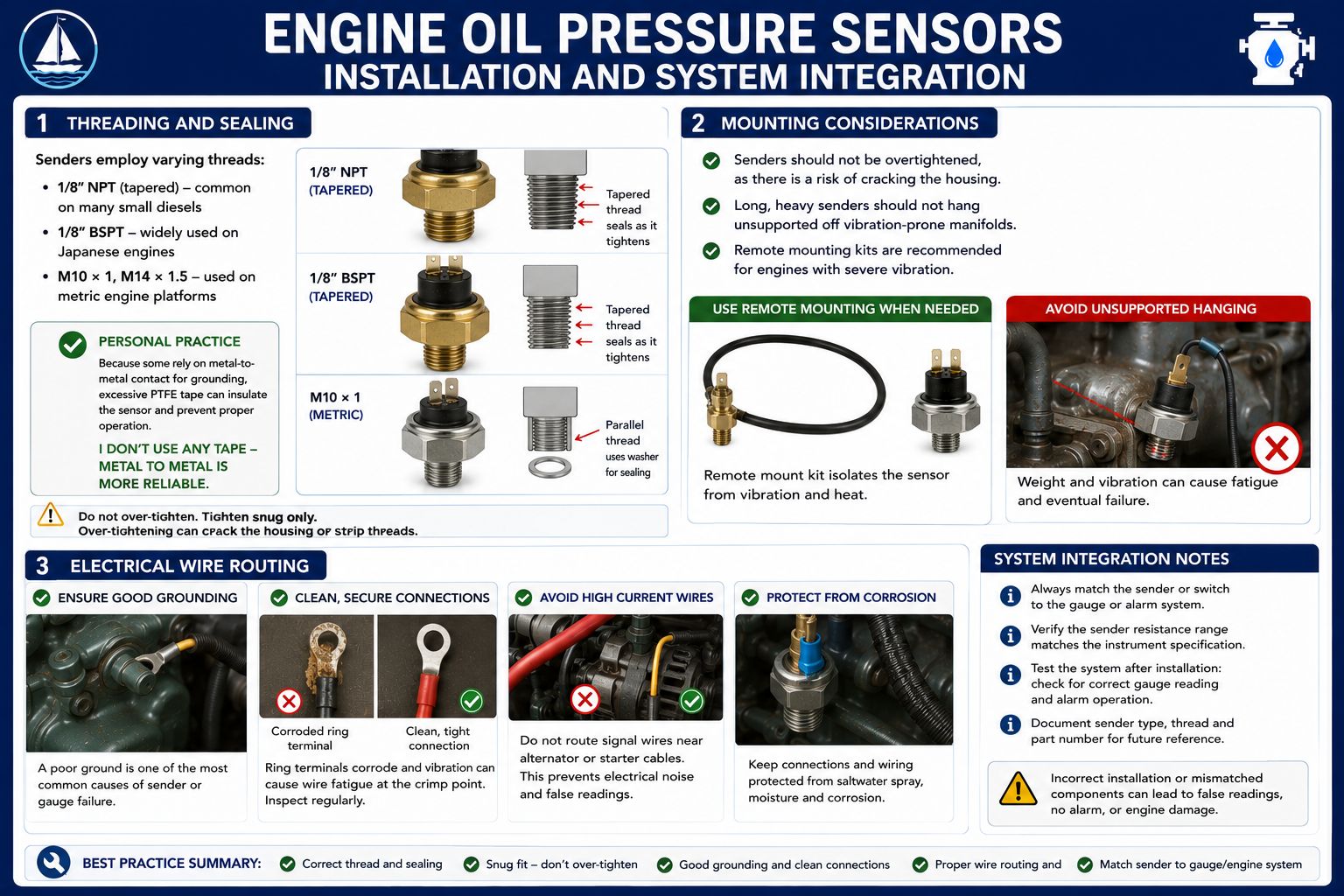
Threading and Sealing. Senders employ varying threads:
- 1/8” NPT (tapered) – common on many small diesels
- 1/8” BSPT – widely used on Japanese engines
- M10 × 1, M14 × 1.5 – used on metric engine platforms
Because some rely on metal-to-metal contact for grounding, excessive PTFE tape can insulate the sensor and prevent proper operation. Personally I don't use any tape, metal to metal is more reliable.
Mounting Considerations
- Senders should not be overtightened, as there is a risk of cracking the housing
- Long, heavy senders should not hang unsupported off vibration-prone manifolds
- Remote mounting kits are recommended for engines with severe vibration
Electrical Wire Routing
- Ensure clean grounding points ( a common failure cause)
- Ensure that electrical connections are clean, often ring terminals corrode, and also engine vibration causes wire fatigue and failure in the ring or spade terminal crimp point.
- Avoid routing signal wires near alternator charging cables
- Protect from any saltwater spray and corrosion
Mechanical
and Electrical Repairs Resource
If you are headed somewhere remote consider the need to expand your knowledge base or have an information resource on board. Why not get a copy of my book The Marine and Electrical and Electronics Bible 4th Edition. By and for yachties, with everything from batteries and charging, solar and wind, diesel engines and marine electronics and so much more. Your complete systems guide. 650 pages of practical advice. In Australia and New Zealand order a copy through Boat Books. UK and European boats can buy the UK Edition Here. US and Canadian boats can get the US Edition Order Here. Marine systems are my profession so let me help you. By a liveaboard boat owner for other boat owners

Failure Modes and Symptoms
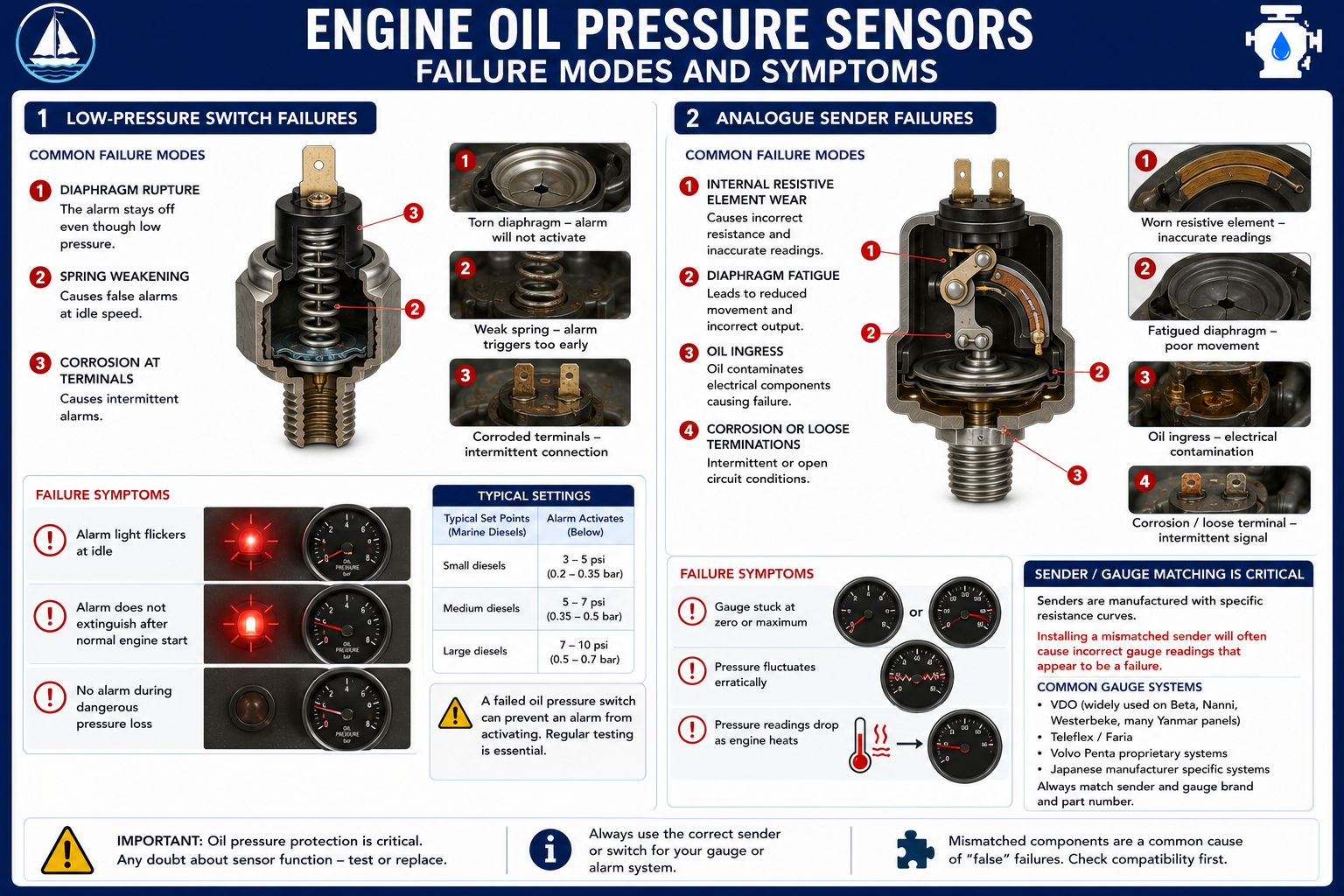
Low-Pressure Switch Failures. Common issues include the following:
- Diaphragm rupture - the alarm stays off even though low pressure
- Spring weakening - causes false alarms at idle speed
- Corrosion at terminals - causing intermittent alarms
Failure Symptoms:
- Alarm light flickers at idle
- Alarm does not extinguish after normal engine start
- No alarm during dangerous pressure loss
Analogue Sender Failures. Most common faults involve the following:
- Internal resistive element wear
- Diaphragm fatigue
- Oil ingress contaminating electrical components
- Corrosion of terminals
Failure Symptoms:
- Gauge stuck at zero or maximum
- Pressure fluctuates erratically
- Pressure readings drop as the engine heats (internal resistance drift)
Because gauges and senders must be paired, installing a mismatched sender frequently appears as a failure even though both components are working.
Testing and
Troubleshooting
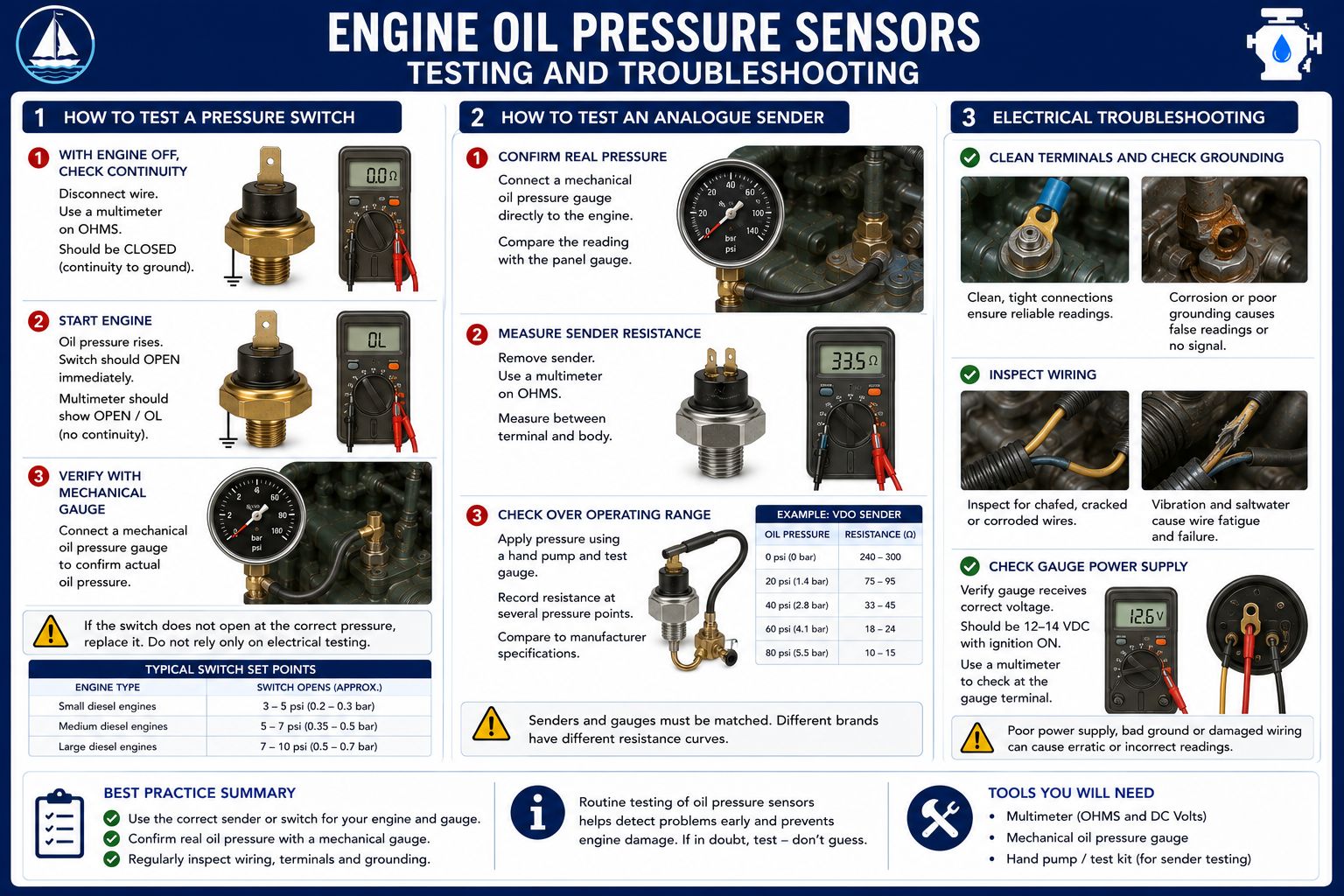
Testing a Pressure Switch
With engine off, check continuity - should be closed.
Start engine - should open immediately.
Use a mechanical test gauge for verification.
Testing an Analogue Sender
- Connect a mechanical oil pressure gauge to confirm real pressure.
- Measure sender resistance through its operating range.
- Compare values to manufacturer specifications.
Electrical Troubleshooting
- Clean terminals and check the grounding
- Inspect for chafed or corroded signal wires
- Confirm the gauge receives correct voltage (12 volts)
Maintenance and
Reliability Practices
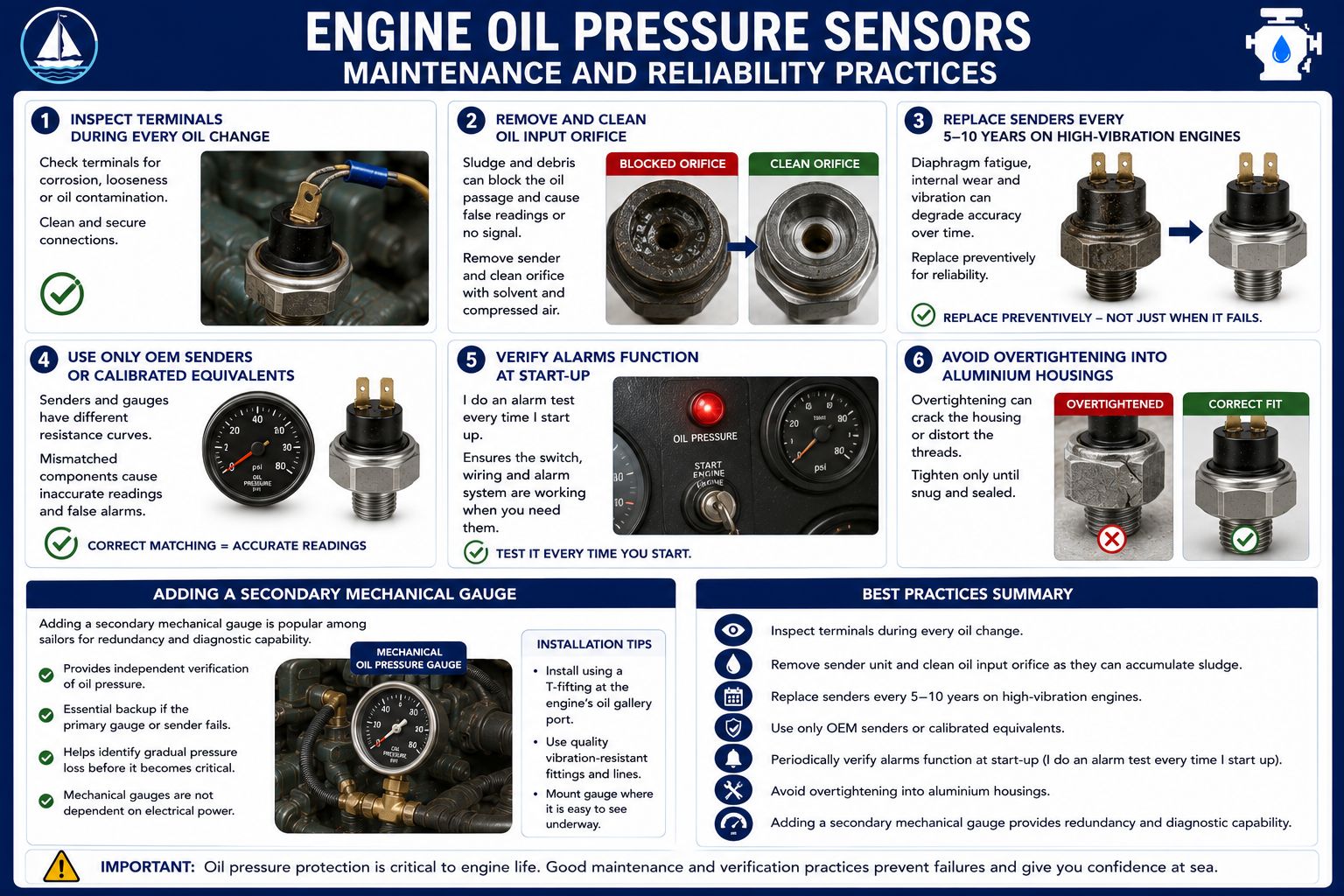
- Inspect terminals during every oil change
- Remove sender unit and clean oil input orifice as they can accumulate sludge
- Replace senders every 5–10 years on high-vibration engines
- Use only OEM senders or calibrated equivalents
- Periodically verify alarms function at start-up (I do an alarm test every time I start up)
- Avoid overtightening into aluminium housings
Adding a secondary mechanical gauge is popular among sailors for redundancy and diagnostic capability.


Engine Oil
Pressure Sensor
Oil pressure sensors, both switches and analogue senders, form a vital part of the monitoring system in small marine diesel engines. They provide early warning of lubrication failures and allow owners to track engine health over time. Understanding the differences among sensor types, their mechanical construction, and how various manufacturers apply them is essential for correct maintenance and troubleshooting. Reliable oil pressure monitoring greatly reduces the risk of catastrophic engine damage and enhances operational confidence at sea. Engine oil pressure sensor checks pay dividends in reliability and trusting what the gauge is reading.