Diesel Compression
Test
The diesel compression test is one of the most informative diagnostic procedures for assessing the internal health of small marine diesel engines. It provides a direct indication of the sealing condition of piston rings, cylinder walls, valves, and on some engines, the head gasket. In the marine environment, where reliability is critical and engines often operate intermittently, compression testing becomes an indispensable tool for troubleshooting hard starting, smoke issues, power loss, and uneven running.
This article outlines the technical principles involved, the equipment and methodology, and the practical considerations unique to marine diesels used on sailing yachts and small motor vessels. A diesel compression test on a small marine engine should be performed when starting becomes difficult, power output drops, or excessive smoke appears. It’s also recommended during routine overhauls or after prolonged use to assess cylinder health. Testing helps identify worn rings, valves, or head gasket issues early, ensuring reliability, efficiency, and preventing costly failures at sea.
Diesel Compression
Test Principles
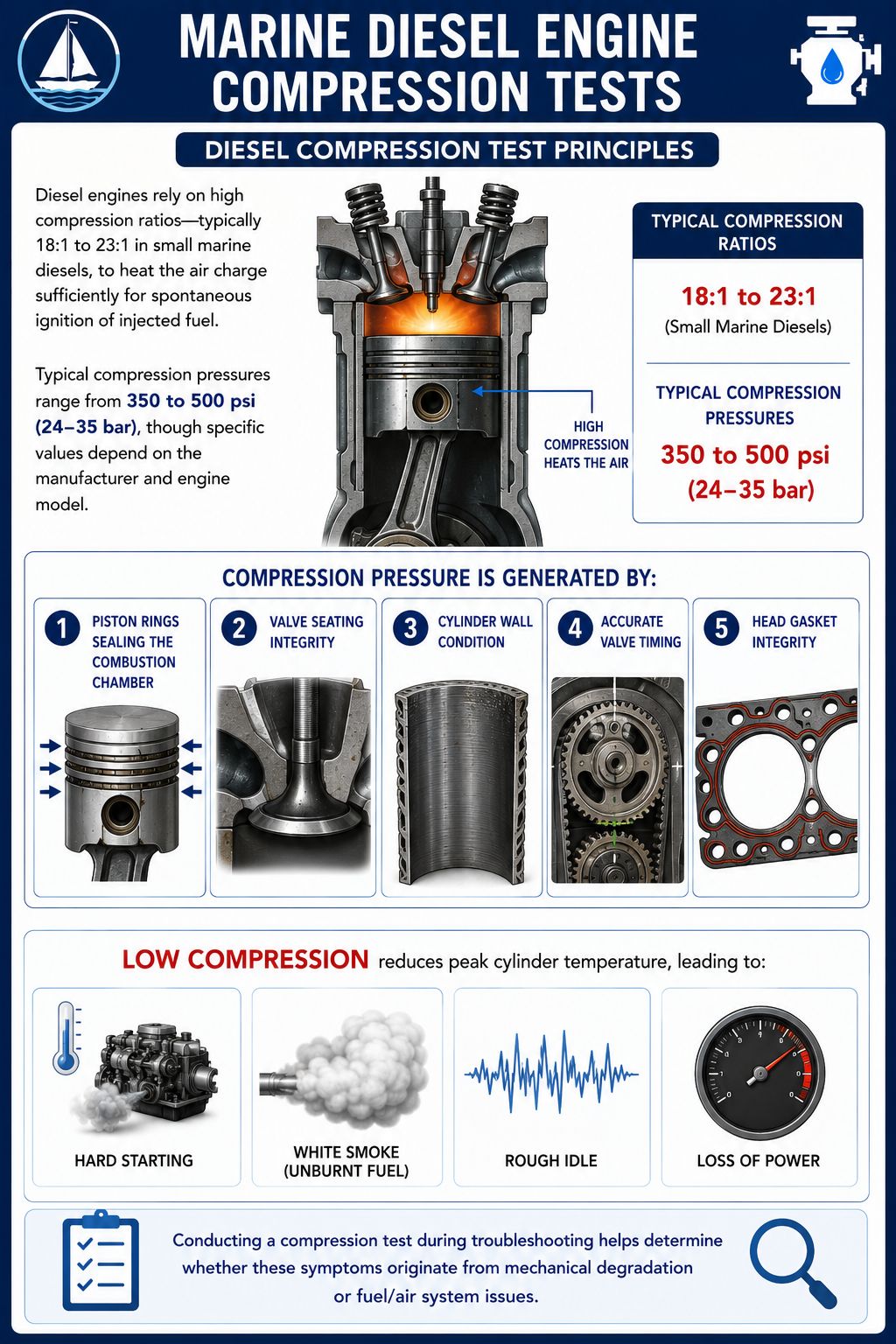
Diesel engines rely on high compression ratios—typically 18:1 to 23:1 in small marine diesels, to heat the air charge sufficiently for spontaneous ignition of injected fuel. Typical compression pressures range from 350 to 500 psi (24–35 bar), though specific values depend on the manufacturer and engine model. Compression pressure is generated by:
- Piston rings sealing the combustion chamber
- Valve seating integrity
- Cylinder wall condition
- Accurate valve timing
- Head gasket integrity
Low compression reduces peak cylinder temperature, leading to hard starting, white smoke (unburnt fuel), rough idle, and loss of power. Conducting a compression test during troubleshooting helps determine whether these symptoms originate from mechanical degradation or fuel/air system issues.
Types of Diesel
Compression Test
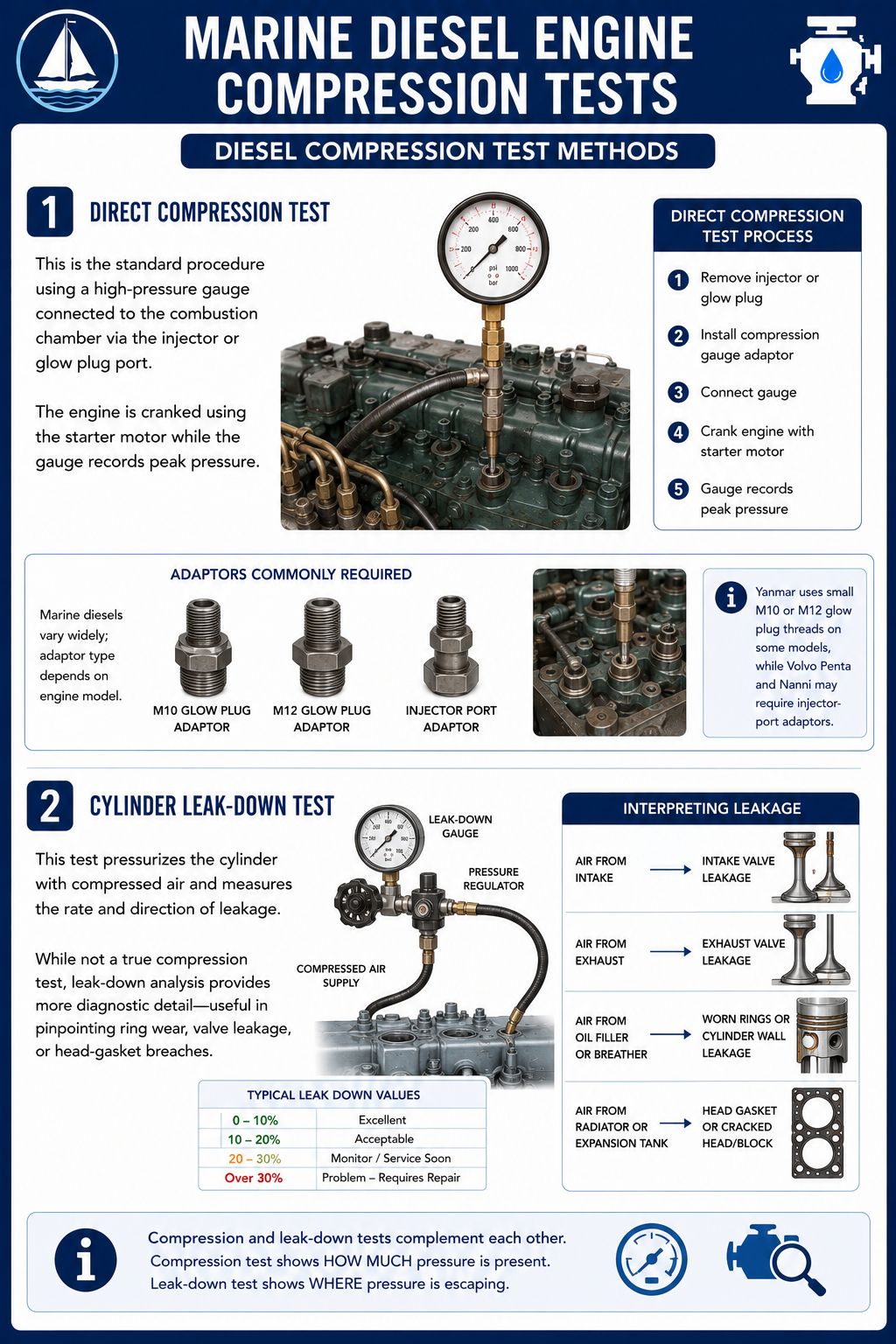
Direct Compression Test. This is the standard procedure using a high-pressure gauge connected to the combustion chamber via the injector or glow plug port. The engine is cranked using the starter motor while the gauge records peak pressure.
Cylinder Leak-Down Test. This test pressurizes the cylinder with compressed air and measures the rate and direction of leakage. While not a true compression test, leak-down analysis provides more diagnostic detail—useful in pinpointing ring wear, valve leakage, or head-gasket breaches.
Marine diesels vary widely; Yanmar uses small M10 or M12 glow plug threads on some models, while Volvo Penta and Nanni may require injector-port adaptors.
Preparation Before
Testing
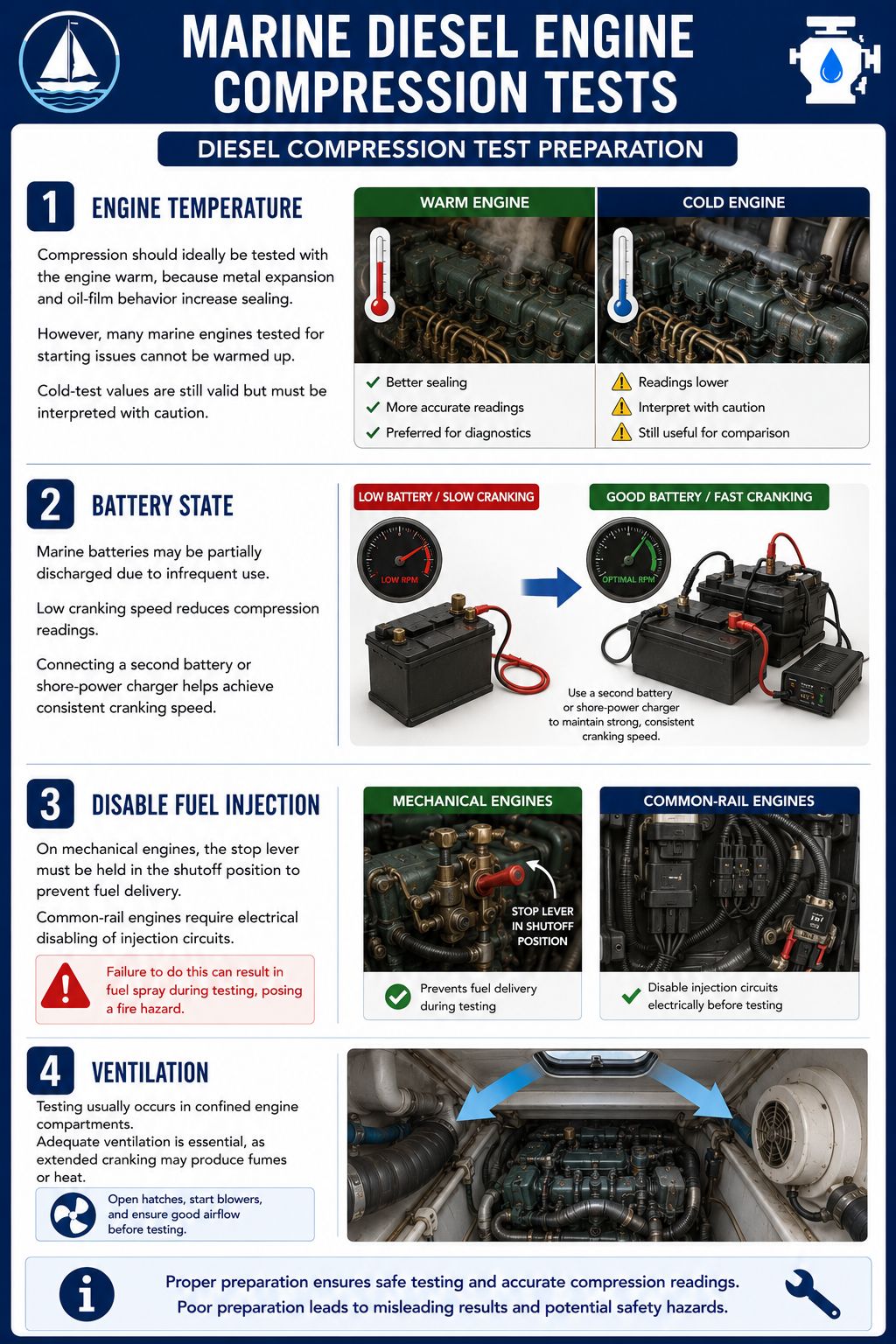
Engine Temperature. Compression should ideally be tested with the engine warm, because metal expansion and oil-film behavior increase sealing. However, many marine engines tested for starting issues cannot be warmed up. Cold-test values are still valid but must be interpreted with caution.
Battery State. Marine batteries may be partially discharged due to infrequent use. Low cranking speed reduces compression readings. Connecting a second battery or shore-power charger helps achieve consistent cranking speed.
Disable Fuel Injection. On mechanical engines, the stop lever must be held in the shutoff position to prevent fuel delivery. Common-rail engines require electrical disabling of injection circuits. Failure to do this can result in fuel spray during testing, posing a fire hazard.
Ventilation. Testing usually occurs in confined engine compartments. Adequate ventilation is essential, as extended cranking may produce fumes or heat.
Mechanical
and Electrical Repairs Resource
If you are headed somewhere remote consider the need to expand your knowledge base or have an information resource on board. Why not get a copy of my book The Marine and Electrical and Electronics Bible 4th Edition. By and for yachties, with everything from batteries and charging, solar and wind, diesel engines and marine electronics and so much more. Your complete systems guide. 650 pages of practical advice. In Australia and New Zealand order a copy through Boat Books. UK and European boats can buy the UK Edition Here. US and Canadian boats can get the US Edition Order Here. Marine systems are my profession so let me help you. By a liveaboard boat owner for other boat owners

How to do a Diesel Compression Test
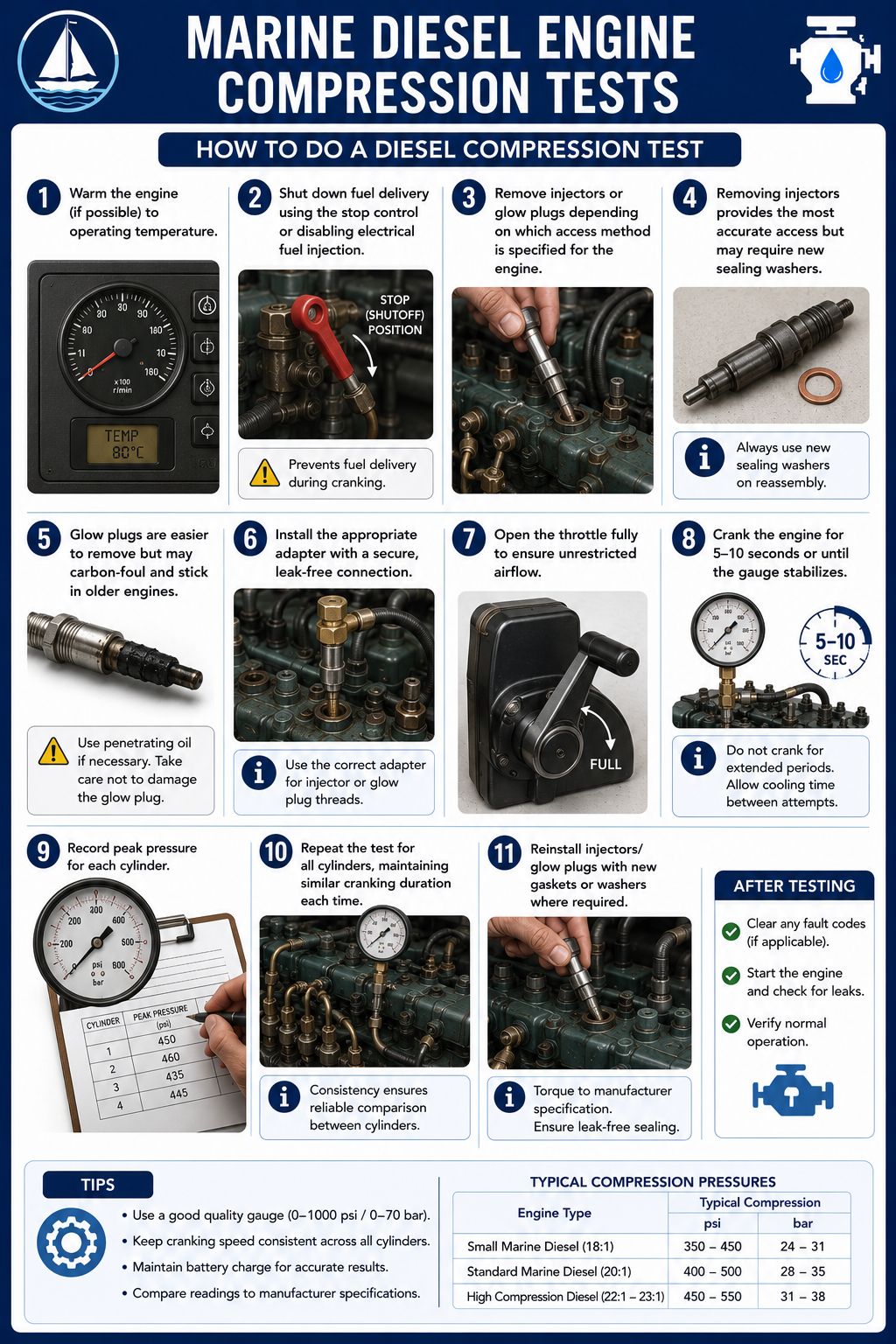
- Warm the engine (if possible) to operating temperature.
- Shut down fuel delivery using the stop control or disabling electrical fuel injection.
- Remove injectors or glow plugs depending on which access method is specified for the engine.
- Removing injectors provides the most accurate access but may require new sealing washers.
- Glow plugs are easier to remove but may carbon-foul and stick in older engines.
- Install the appropriate adapter with a secure, leak-free connection.
- Open the throttle fully to ensure unrestricted airflow.
- Crank the engine for 5–10 seconds or until the gauge stabilizes.
- Record peak pressure for each cylinder.
- Repeat the test for all cylinders, maintaining similar cranking duration each time.
- Reinstall injectors/glow plugs with new gaskets or washers where required.
Diesel Compression
Test Results
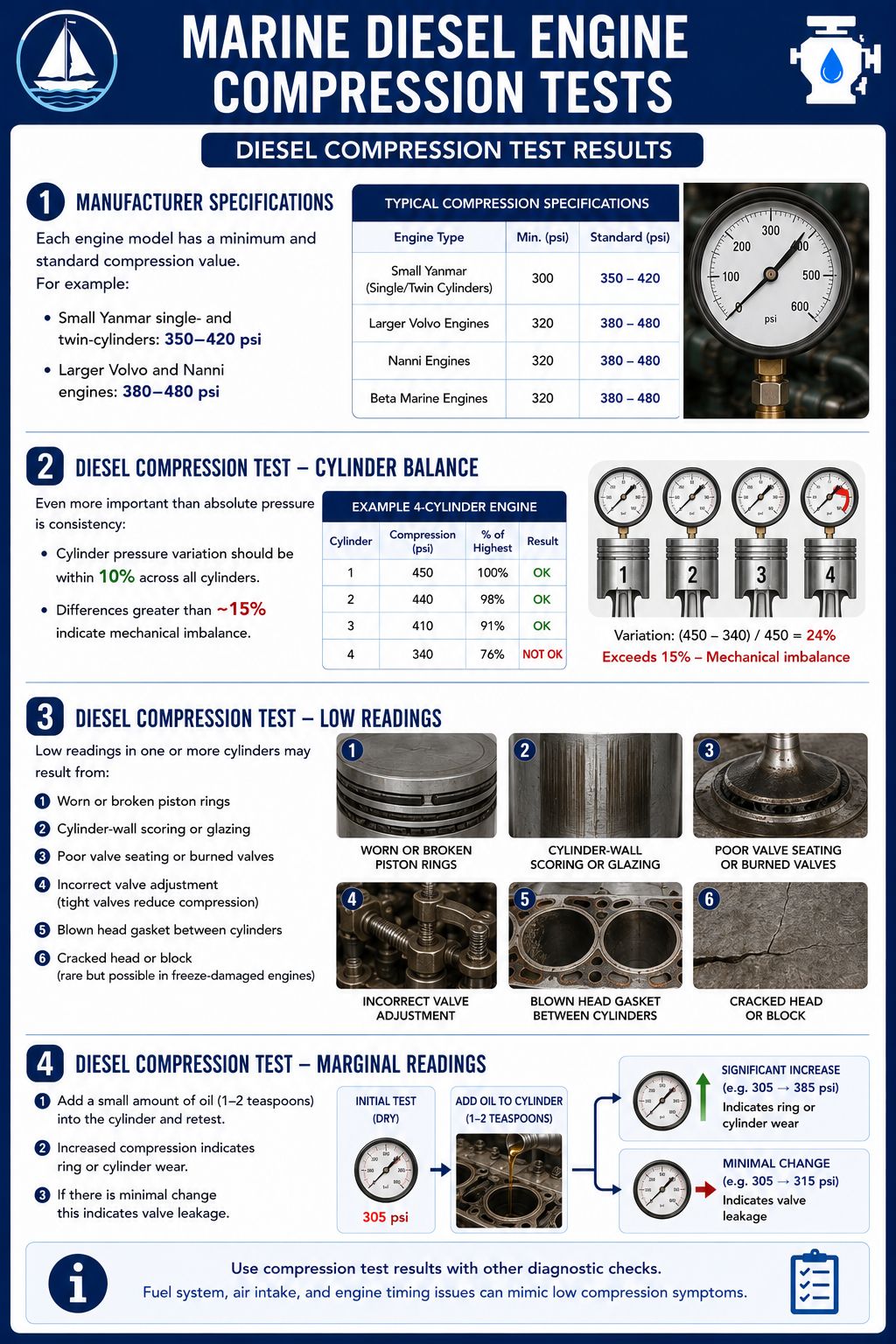
Manufacturer Specifications. Each engine model has a minimum and standard compression value. For example:
- Small Yanmar single- and twin-cylinders: 350–420 psi
- Larger Volvo and Nanni engines: 380–480 psi
Diesel Compression
Test - Cylinder Balance
Even more important than absolute pressure is consistency:
- Cylinder pressure variation should be within 10% across all cylinders.
- Differences greater than ~15% indicate mechanical imbalance.
Diesel Compression
Test - Low Readings
Low readings in one or more cylinders may result from:
- Worn or broken piston rings
- Cylinder-wall scoring or glazing
- Poor valve seating or burned valves
- Incorrect valve adjustment (tight valves reduce compression)
- Blown head gasket between cylinders
- Cracked head or block (rare but possible in freeze-damaged engines)
Diesel Compression
Test - Marginal Readings
If readings appear borderline:
- Add a small amount of oil (1–2 teaspoons) into the cylinder and retest.
- Increased compression indicates ring or cylinder wear.
- If there is minimal change this indicates valve leakage.
Diesel Compression
Test Practical Considerations
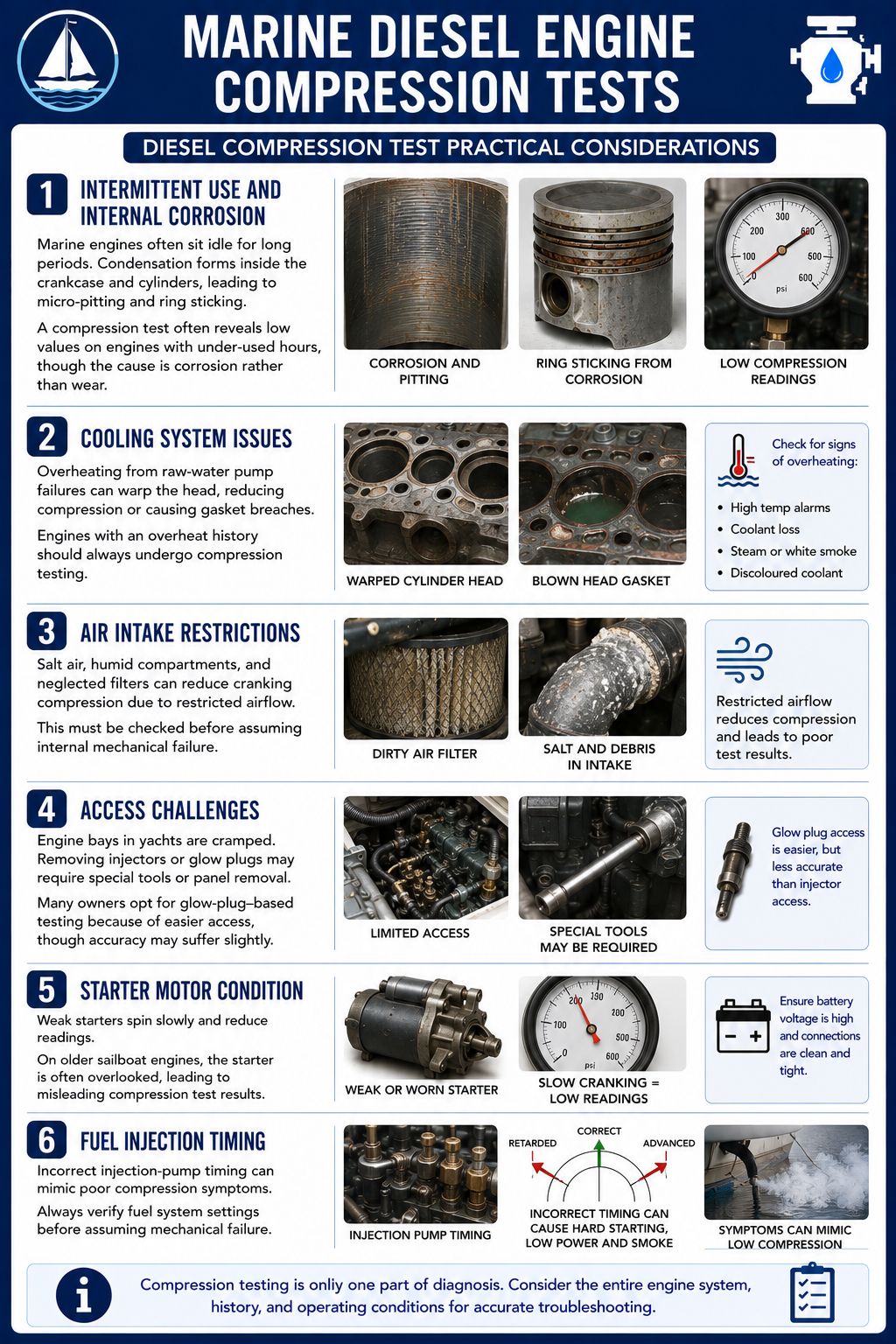
Intermittent Use and Internal Corrosion. Marine engines often sit idle for long periods. Condensation forms inside the crankcase and cylinders, leading to micro-pitting and ring sticking. A compression test often reveals low values on engines with under-used hours, though the cause is corrosion rather than wear.
Cooling System Issues. Overheating from raw-water pump failures can warp the head, reducing compression or causing gasket breaches. Engines with an overheat history should always undergo compression testing.
Air Intake Restrictions. Salt air, humid compartments, and neglected filters can reduce cranking compression due to restricted airflow. This must be checked before assuming internal mechanical failure.
Access Challenges. Engine bays in yachts are cramped. Removing injectors or glow plugs may require special tools or panel removal. Many owners opt for glow-plug–based testing because of easier access, though accuracy may suffer slightly.
Starter Motor Condition. Weak starters spin slowly and reduce readings. On older sailboat engines, the starter is often overlooked, leading to misleading compression test results.
Fuel Injection Timing. Incorrect injection-pump timing can mimic poor compression symptoms. Always verify fuel system settings before assuming mechanical failure.
When to Perform a
Compression Test
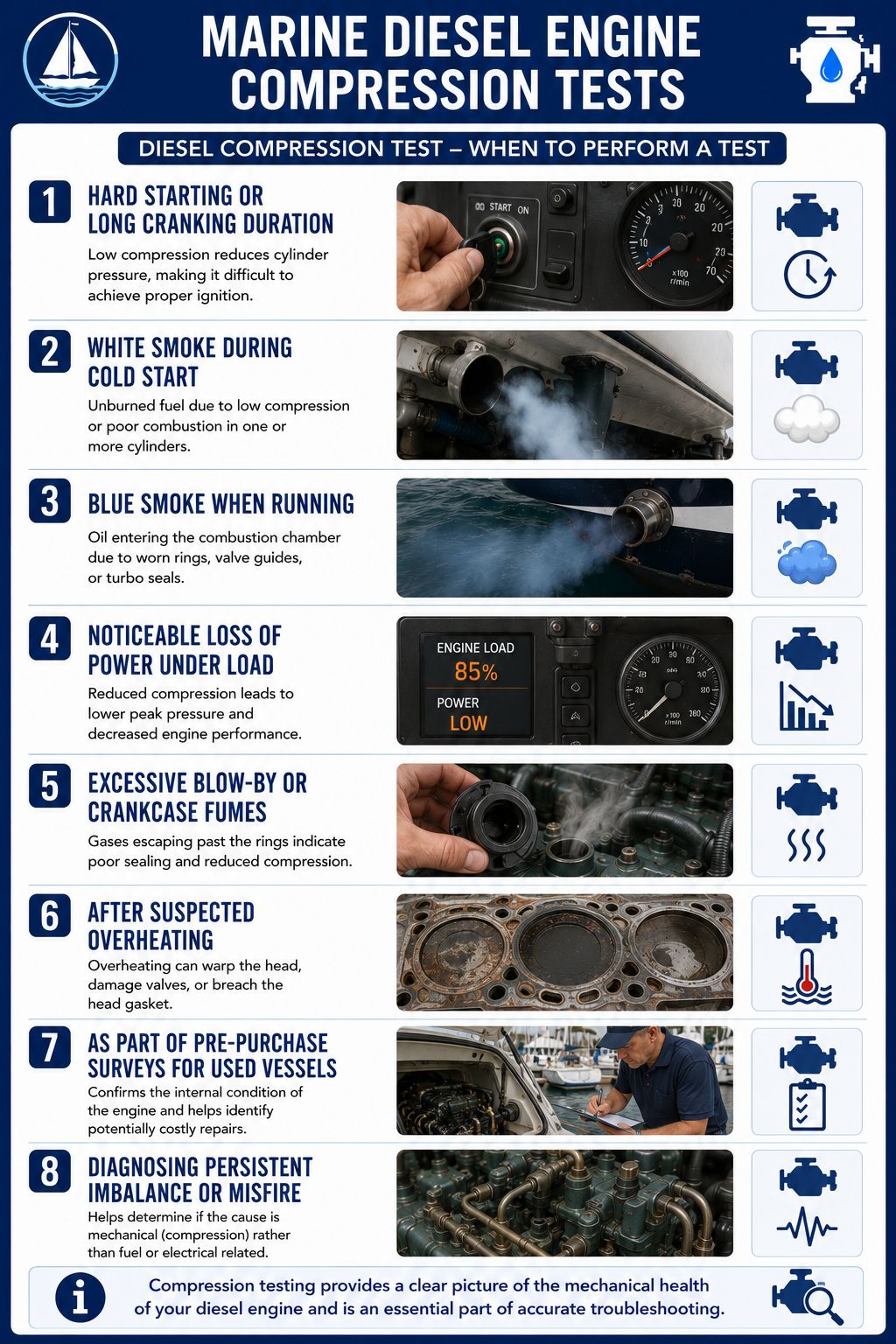
- Hard starting or long cranking duration
- White smoke during cold start
- Noticeable loss of power under load
- Excessive blow-by or crankcase fumes
- After suspected overheating
- As part of pre-purchase surveys for used vessels
- Diagnosing persistent imbalance or misfire


Diesel Compression
Test Summary
Compression testing is a vital diagnostic procedure for assessing the mechanical condition of small marine diesel engines. By accurately measuring combustion pressure, operators can distinguish between problems caused by internal wear, valve leakage, gasket failure, or external factors such as fuel delivery or air restrictions. In the marine environment, where engines see low operating hours, extended idle periods, and harsh thermal cycles, compression testing provides invaluable insight, helping prevent unexpected failures offshore and guiding maintenance decisions. Diesel compression test is for diagnosing major issues in boat engines.