Cooking on the Boat
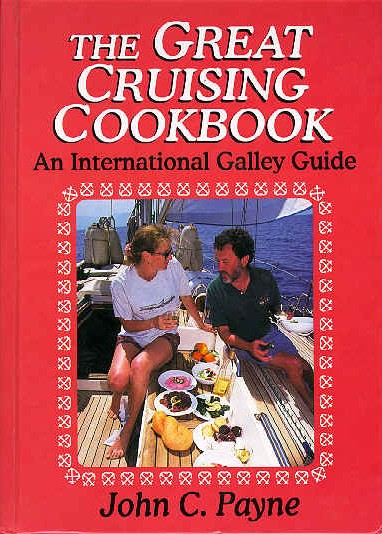
Cooking on the boat requires a unique balance of practicality, creativity, and seamanship. Whether you’re out for a weekend trip or living aboard long-term, galley cooking is not simply scaled-down household cooking. Cooking on board is defined by space limitations, movement, power and gas constraints, storage capacity, weather, and safety. The smell of baking bread, the shared ritual of cooking together at anchor, or a calm morning cup of coffee on deck connects crew and resets morale. Cooking projects, catching fish and preparing sashimi, grilling on a cockpit barbecue, or baking cakes on a small oven become stories as memorable as any sailing achievement. We love cooking on the boat. Many years ago, I wrote and published The Great Cruising Cookbook. This website encompasses some of that book.
Given that, far from being a compromise, many sailors find the galley to be one of the most rewarding and social spaces afloat. With the right practical knowledge and habits, you can turn even the smallest boat galley into a functional kitchen capable of producing satisfying meals at anchor or underway. Eating well makes crews happier, healthier, and more resilient. Proper nutrition supports fatigue management, especially on passages, and warm meals lift spirits in cold conditions. Successful boat cooks learn adaptability: substituting ingredients, using what is available, and embracing compact techniques. You can buy your copy of The Great Cruising Cookbook here.
Cooking on the
Boat - Galley Layout
Most boat galleys are compact for good reason, reducing movement and providing bracing points and hand holds improves safety in a seaway. Common layouts include L-shaped, U-shaped, or corridor galleys, all designed so the cook can brace themselves while working. Space efficiency becomes a design philosophy. Cupboards are shallow to prevent items shifting, fiddled edges stop plates sliding, and lockers use positive latches, so doors stay shut underway. For most of us the galley layout is a legacy and beyond rearrangement.
Every inch or centimetre matters, so storage planning is an art but also about managing what you have. Heavy items should be stowed low down to avoid toppling, plates and cups are often stacked upright with retaining bars or stored in custom racks. The smallest boats may rely on portable cookers, while larger cruising yachts often have dedicated stoves, refrigeration, and even microwave ovens or induction plates if power capacity allows.
Cooking on the
Boat - Equipment and Fuels
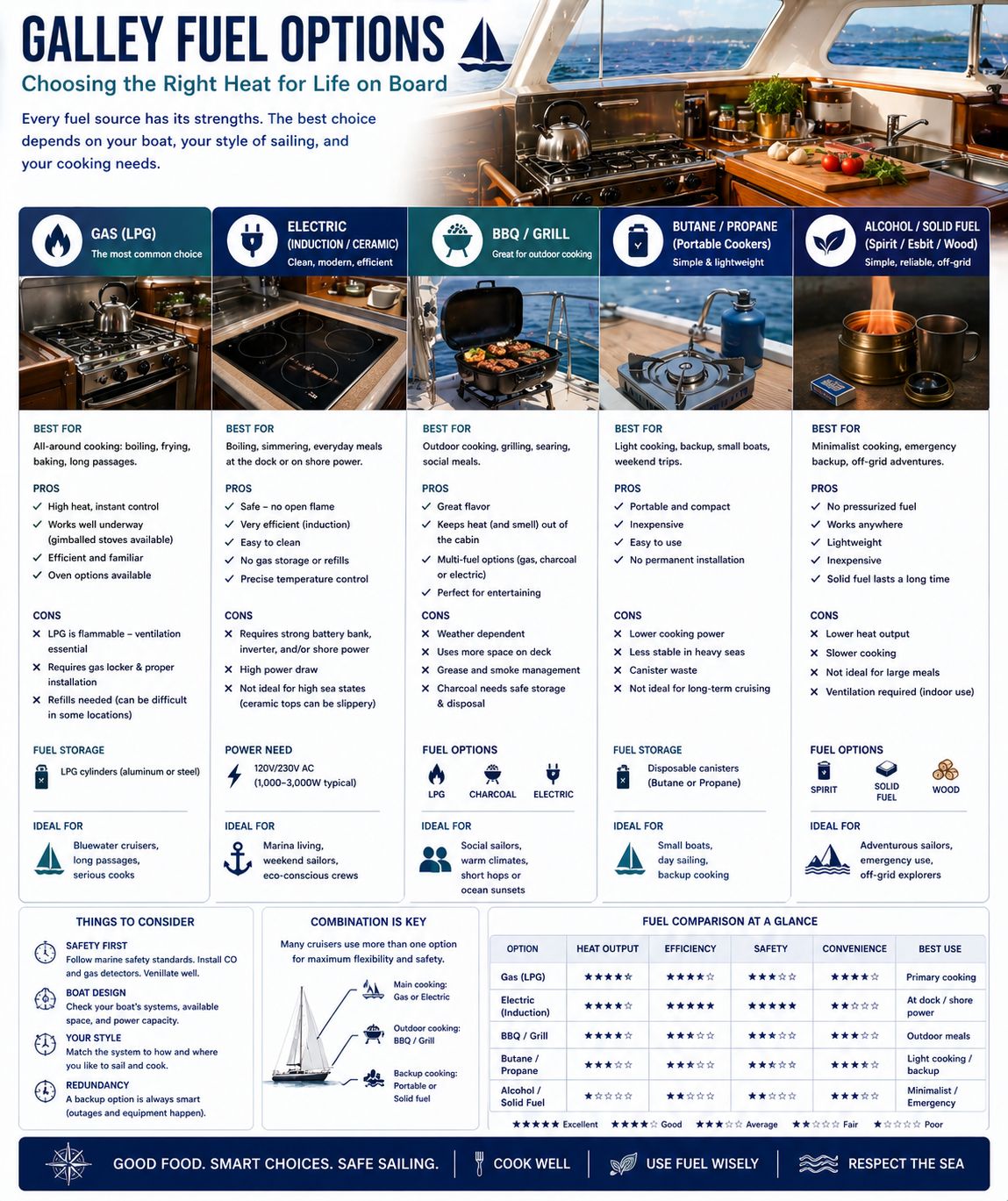
Marine cooking appliances are engineered around movement and ventilation. The Propane (LPG) boat cooker remains the most common fuel aboard cruising yachts because it burns hot and efficiently. Gimballed two- or three-burner stoves with ovens allow safe cooking at most heel angles, along with fiddles and pan clamps or pot retainers to prevent spills. Metho and Alcohol stoves are less common today but still found on small craft because they are safer in some installations, although lower heat output and slower boil times are the trade-offs. Electric induction cooking is increasingly popular, especially on larger catamarans and motor yachts equipped with a generator or large inverter and lithium-ion battery banks, and solar power extends capability at anchor. We use a small single pot induction unit when in the marina.
Cooking on the
Boat – Cookware
When selecting cookware, some choose nesting pots, lightweight pans, and durable utensils. Non-stick surfaces save water and fuel, but you need to get high-quality non-stick pans. Like many we use silicone cooking utensils to reduce non-stick pan scratching. A pressure cooker is my favourite item aboard like many ocean-going boats, they cut cooking time, saves gas, and reduces and fumes steam in the cabin. There are also useful electrical and other appliances, these vary from small icemakers and water kettles to air fryers and rice makers.
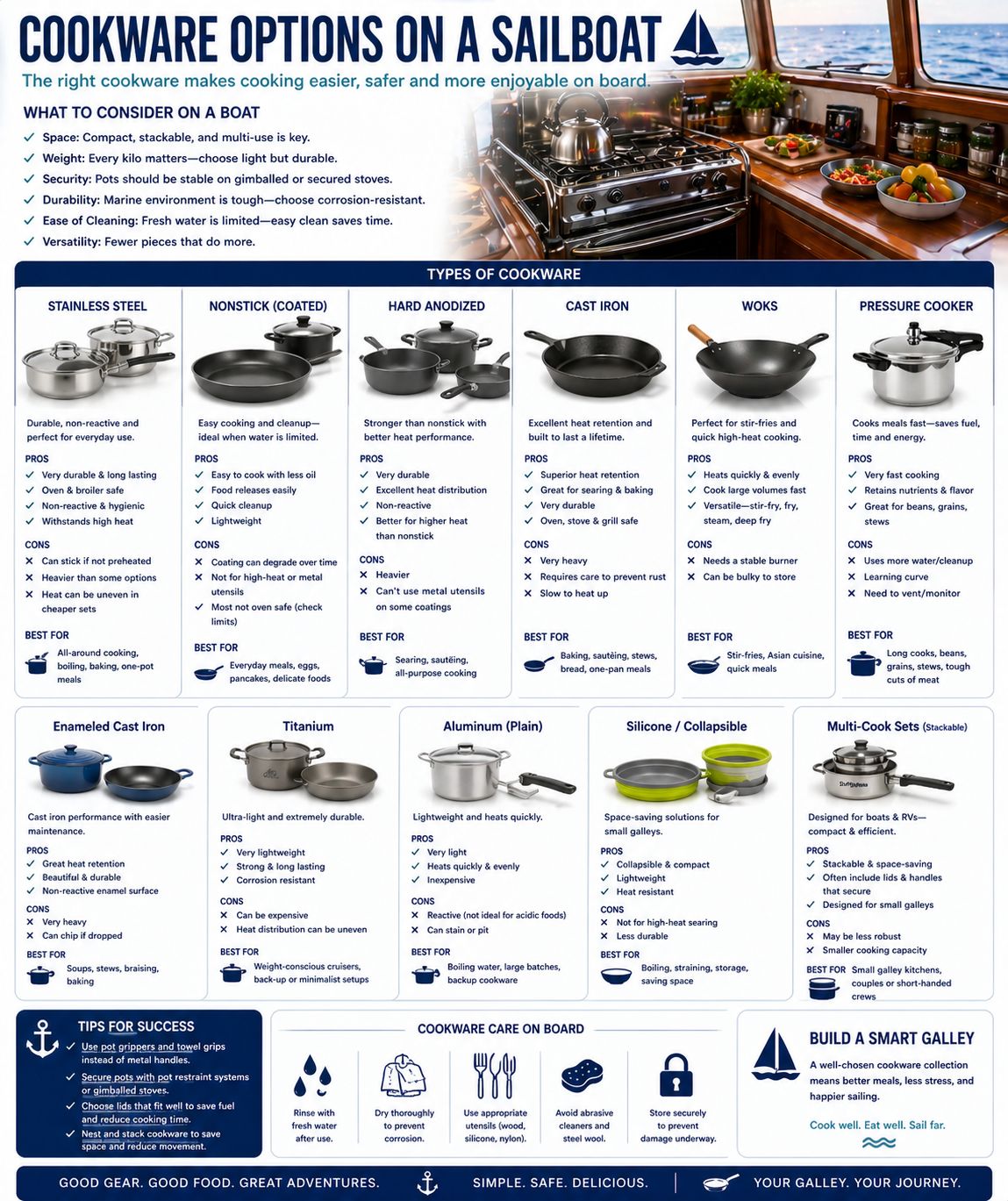 There are so many cookware options on a sailboat, and choosing the right gear to suit is challenging
Cooking on the
Boat - Provisioning
The floating pantry strategy is popular. Provisioning for a voyage demands forethought and a lot of planning. Storage spaces are limited, refrigeration may be modest, and resupply uncertain. Successful provisioning focuses on shelf-stable staples such as rice, pasta, beans, canned vegetables, sauces, and baking ingredients, augmented by fresh produce selected for longevity. Hardy vegetables such as carrots, cabbage, pumpkins, and potatoes keep well, apples and citrus fruits hold longer than soft berries. Perishables like lettuce and tomatoes should be eaten early. Vacuum-sealing, freeze-drying, and pre-packing meals increase durability and reduce space. Labelling tins and jars is essential since locker stacking often hides original markings. Maintaining clear meal plans not only reduces waste but also supports morale, especially on extended passages.
Cooking on the
Boat - Provisioning Destinations
If you are cruising foreign then the important question is what is eaten there, where do I reprovision, and what is available there. This is my cruising destination guide and some is extracted from The Great Cruising cookbook and some is new information. It is about local foods, farmers markets and major supermarkets.
- The Pacific Islands: Where to provision in New Caledonia: Vanuatu: Tonga: Fiji: Solomon Islands: Cook Islands: Wallis and Futuna: Marquesas: Tahiti: Austral Islands: Gambier Islands: and more coming!
- The Caribbean: Bermuda: Bahamas: Jamaica: Cayman Islands: British Virgin Islands: Trinidad and Tobago: St Lucia: Bequia: St Barths; Guadeloupe: Curacao: St Vincent and The Grenadines: St Maarten: Martinique: Tueks and Caicos: and more coming
- The Mediterranean: France: Italy: Greece: Spain: Turkiye: Malta: and more coming!
- South East Asia: Indonesia: Thailand: Malaysia: Singapore: and more coming!
- Indian Ocean: Mauritius: Reunion: South Africa: and more coming!
- Atlantic Ocean: Canary Islands: Cape Verde Islands: Madeira: Azores: and more coming!
Cooking on the
Boat – Fresh Fruit and Vegetable Guide
If you are cruising foreign, then you are also going to wonder about what the various exotic fruits and vegetables are. Click on the links to check out what each is about and some history behind them as well. Some is extracted from The Great Cruising cookbook and some is new information.
Tropical A to Z Fruit Guide. – A comprehensive tropical fruit guide, from Acerola to Sapodilla and Ugli. Understand what you are looking at in the markets and what you can do with it or how to eat it and what does it taste like?. Great recipes for pineapples, papaya, mangoes, avocados, coconuts and bananas. I spent some time in Brazil and got addicted to their Amazonian fruit smoothies known as Fruto da Amazonas Sucos and Vitaminas Naturais. Try Guarana, açaí and banana! This curated list is extensive and covers around 150 fruits, some may appear duplicated due to overlapping names. I am sure there are many that I have missed but eventually they will get "discovered" and added to the respective lists. This list is for cruising yachties who want more information, but also for travelers, tourists and adventurers without boats who are headed for tropical places with tropical food. “Bon appétit” has equivalents across tropical fruit–rich regions. For example: ¡Buen provecho! (Spanish, Latin America), Selamat makan! (Indonesian/Malay), Bom apetite! (Portuguese, Brazil), Than hai aroi (Thailand), Ai pono! (Polynesia),
- Part 1 - (A-B) Abiu - Burmese Grape
- Part 2 - (C-D) Cacao - Date Palm Fruit
- Part 3 - (E-L) Elderberry - Limes
- Part 4 - (M-N) Mangabe - Nutmeg Fruit
- Part 5 - (O-P) Otaheite Apple - Pulasan
- Part 6 - (Q- Y) Quince - Yuzu
Vegetable A to Z Guide. This is useful information on the plethora of vegetables available around the world. This includes tubers and leaf vegetables. There are many great vegetarian recipes for corn, potato, tomatoes, okra, sweet potato, yams, breadfruit, zucchini, taro and pumpkins. Serious cruisers always head for the nearest public market to replenish with and many of these seasonal and relatively cheap foods. Again, shopping for fresh becomes a daily routine when anchored somewhere nice. Fresh works well when cooking on a yacht.
Cooking on the
Boat – Seafood Guide
It goes without saying that seafood is a major player when cruising and this has lots of useful information on how to catch them and many really great recipes for fish, octopus, squid, shrimp and prawns, lobster, mussels, oysters, conch, canned fish and more. If you cruise foreign you will like me head to the nearest seafood market and buy fresh local caught fish and shellfish. This is my cruising seafood guide and some is extracted from The Great Cruising cookbook and some is new information. Catching Fish. Sailboat fishing is a worthwhile pursuit Check out these fishing from a sailboat tips. Also read up on how to catch crabs. Catching fish is great but be aware about ciguatera poisoning and ciguatera poisoning treatment.
Cooking Safely at
Sea
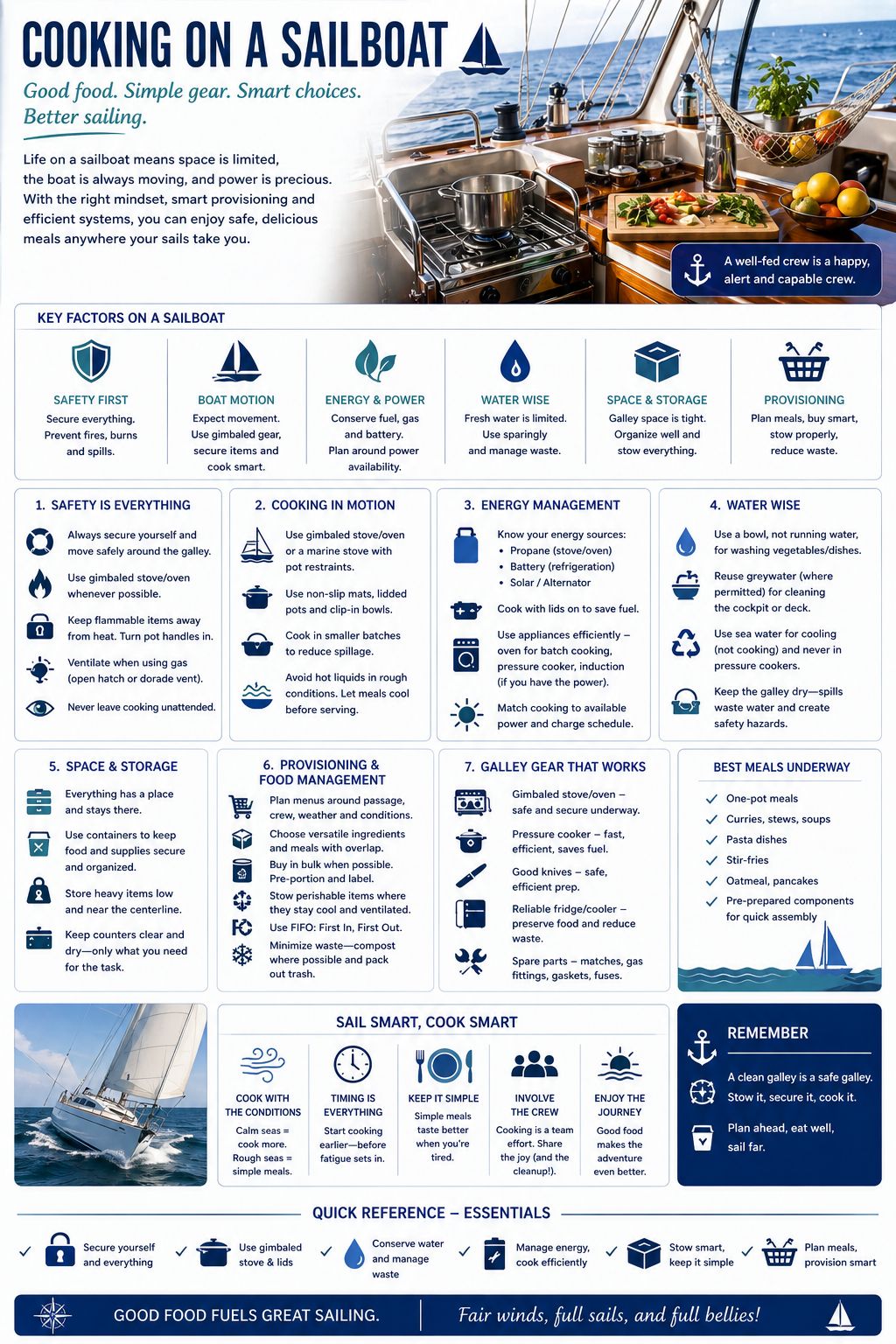
Safety is paramount in galley life. Burns, scalds, and knife injuries are more likely when the boat is rolling. Always secure pans with clamps, keep stovetop lids closed when not in use, and brace yourself with one hand free. Many experienced sailors follow the rule, never try to catch a falling pot, step aside and let it go.
Gas systems require particular respect. Cylinders should be stowed in vented lockers away from the interior, regulators inspected regularly, and lines leak-checked frequently. Always shut off fuel at the cylinder when not cooking. Fire blankets, extinguishers near the galley, and knowledge of how to shut down gas and electrical systems are essential. Check out these important boating safety tips.
Cooking Safely at Sea – The Recipes
Every boat has favorite recipes and in the Great Cruising Cookbook I included many, this section extracts some of those and some new ones broken down into the various food groups
Vegetable Recipes. There are many to choose from.
Seafood Recipes. Our favorite on board. So many options to try
Rice and Pasta. Rice and Pasta are the backbone and mainstay of cruising food and here is some good information on rice types and cooking methods, as well as many great rice and pasta based recipes. There are so many pasta types as well as many delicious recipes and pasta sauces ideas. Legumes are also a mainstay food. There is some very practical information and cooking methods, as well as many quick and easy to make recipes on your boat. This is all about the various bean types such as red beans, navy beans, lentils, chickpeas and more and how to make quick, low cost and nutritious meals. Cooking on a yacht always has a budget and making low cost meals is a challenge.
Cooking Underway
Versus at Anchor
The galley experience changes dramatically depending on whether the boat is moving or still. At anchor or in calm weather, cooking comfortably resembles home life, a full meal can be prepared, oven baking is easier, and cleanup is less stressful. Underway, practicality rules. Many crews rely on one-pot dishes such as stews, curries, and pasta bakes. Pre-prepared meals reheated in a single pan are favourites for night watches or rough conditions.
Heaving-to or slowing the vessel temporarily to cook may be worthwhile on long passages but always ensure someone is at the helm or on watch. It is also wise to prepare food before departing so meals can be warmed easily if seas build.
Cooking Underway
Baking - Breakfast Ideas - Rough Weather Cooking Foods - Sauces, Dips and Marinades – Pickles and Curries. There is much practical information and recipes on making breads, muffins, scones, waffles, puddings, cookies, biscuits, cakes and tarts if you are that way inclined. Some really useful and quick breakfast ideas and recipes to keep the crew happy and content. Cooking on a yacht and rough weather cooking is a challenge, with practical information and recipes to keep the energy levels up when the going gets rough. All about my favorite food, and some foolproof ways to make delicious Indian food, seafood, meat and vegetarian. There are recipes for some great salsas and marinades to pep up things. Also how to make pickles from that cheap market fruit and vegetables.


Water Use and
Waste Management
Fresh water is finite aboard most boats, so galley routines adapt to conservation. Washing dishes in saltwater and rinsing briefly with fresh is common. Paper towels can be used to wipe pans before washing to reduce effort. Water is a key commodity and it is scarce. Some boats have watermakers, but higher electrical demands mean owners remain careful. Keeping water clean using filters is the norm. See the pages on water systems
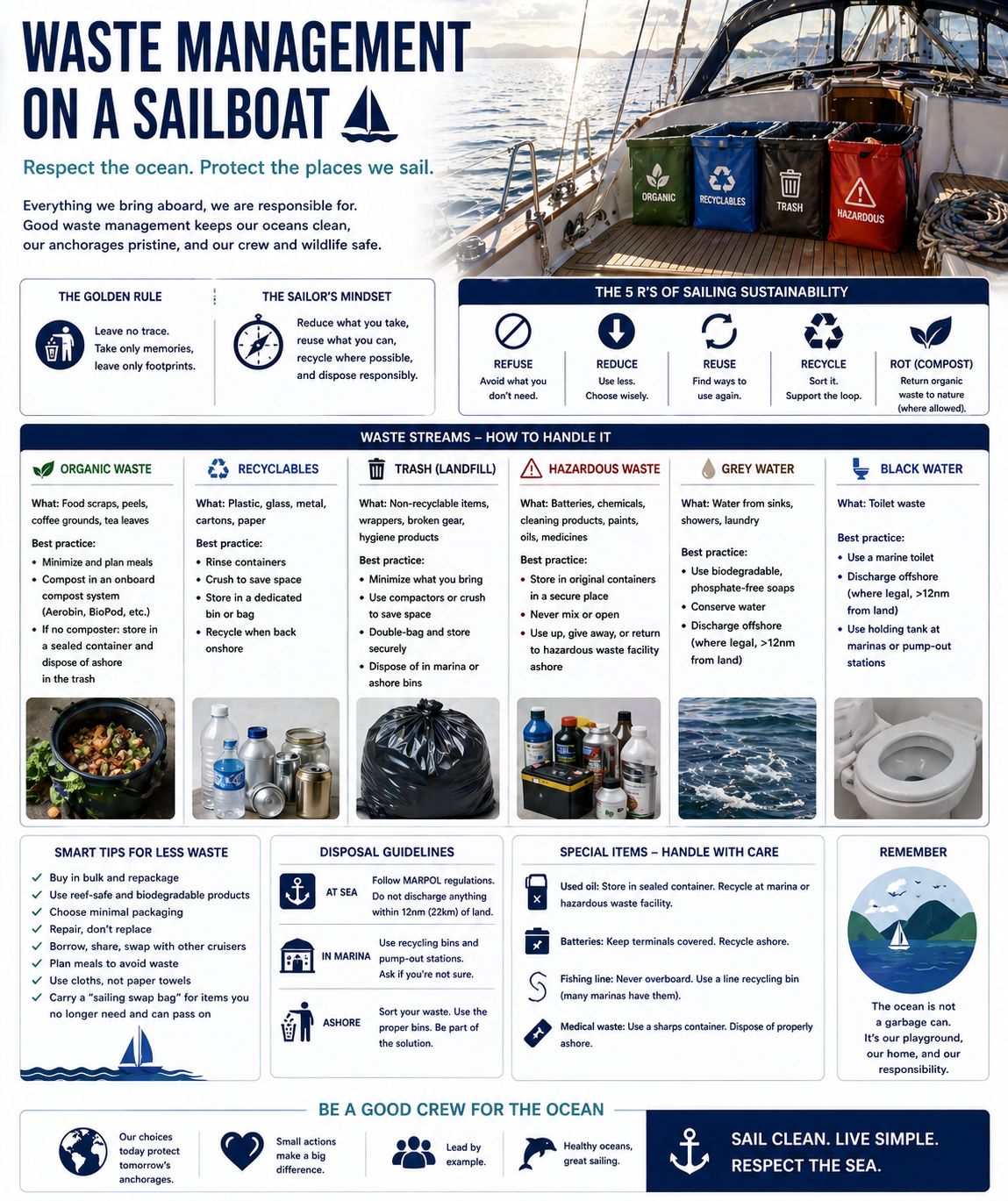
Managing rubbish onboard requires planning. Separate wet waste, compress packaging, and store securely so it cannot blow overboard. Organic scraps can sometimes be composted ashore, or securely wrapped and retained until landfall, depending on local regulations.
Mechanical
and Electrical Repairs Resource
If you are headed somewhere remote consider the need to expand your knowledge base or have an information resource on board. Why not get a copy of my book The Marine and Electrical and Electronics Bible 4th Edition. By and for yachties, with everything from batteries and charging, solar and wind, diesel engines and marine electronics and so much more. Your complete systems guide. 650 pages of practical advice. In Australia and New Zealand order a copy through Boat Books. UK and European boats can buy the UK Edition Here. US and Canadian boats can get the US Edition Order Here. Marine systems are my profession so let me help you. By a liveaboard boat owner for other boat owners
Great
Cruising Cookbook Reviews
"Here's
a book to hurl at the culinary barbarian on your crew, though it's a lot more
than a simple defense against indigestion....John Payne, who writes with wit
and clarity, makes the business of learning to be a good sea cook much more
entertaining than it might otherwise be....All in all, this is an excellent
guide to the task of providing good food afloat. Payne includes a lot of
basic-but-need-to-know stuff, like, what kind of fruits and vegetables keep and
how long, how to (really!) catch fish, galley equipment, safety, on board
gardening (sprouting), and hundreds of really excellent recipes. I've tried a
number of them, and I haven't hit a dud yet. In fact, I'd go so far as to
recommend this cookbook to folk who never go cruising at all; it's that good." Living
Aboard Magazine. Buy it here.
"Written to keep the cruiser away from a life of cans and processed food,
with over 350 recipes, a worldwide provisioning guide, rough weather cooking,
and a tropical fruit guide, his cookbook is the cookbook to have onboard. It
addresses nutrition and provides methods for improvising and provisioning in
strange places." Latitudes & Attitudes
Magazine
Cooking on a boat is far more than reheating tins in tight quarters. It is a skill that blends culinary practice with seamanship, planning, and safety awareness. With thoughtful provisioning, efficient galley habits, suitable equipment, and a willingness to adapt, onboard cuisine can be remarkably diverse and satisfying. Whether anchored in a quiet bay or crossing open ocean, a functioning and well-managed galley and food strategy keeps everyone happy and healthy, cooking on the boat isn’t as hard as it seems, just be well organised. All you need to know about food on board your boat is here, cooking on a boat is rewarding so bon appetite and bon voyage.