Cooking on a Boat
Cooking on a boat presents many problems, and this is encountered whether in a marina, swinging on the anchor or on a mooring, or sailing under way on passage. Most yachts and boats it must be said, travel on their stomachs. When the cook or food goes bad so does most other things that include morale and even relationships. So even if you are a liveaboard in the marina or sailing to exotic and warm tropical places, the challenges will confront you.
Cooking aboard a yacht is a rewarding but uniquely challenging experience. Unlike a spacious kitchen ashore, the galley is compact, every inch of counter space is precious, and the boat’s motion constantly tests balance and technique. The heart of yacht cooking is the marine stove or cooker, designed to gimbal and swing with the waves, keeping pots level even when the vessel heels. Yet these systems come with limitations: burners are smaller, fuel supply is finite, and heat output can be inconsistent compared to household ranges. Safety is paramount, open flames in a confined cabin demand vigilance, and ventilation must be carefully managed. Timing meals around weather and sea state adds another layer of complexity. Despite these hurdles, yacht cooking fosters creativity, efficiency, and resourcefulness. With thoughtful provisioning and a respect for the galley’s quirks, preparing meals at sea becomes not just possible, but a memorable part of the voyage.
Cooking on a Boat - Maintaining
Balance
The second problem is that of movement. Movement directly impacts on galley safety. The constant movement besides being largely resultant on the prevailing sea conditions, is also very much to do with the sea kindliness of particular vessels. A light weight racer cruiser may be very tender and bounce around, while a heavy displacement vessel will be more stable and sea kindly. Of course a boat will move around in a marina as well, as the wash of passing craft create movement, as do windy days as the gusts heel the boat over.
Maintaining balance with the continuous gyrating three-dimensional movement of a boat is a challenge and a major source of difficulties. It is not easy being a one-armed cook. Shoulder injuries are common and rotator cuff injuries that occur when one tries to stop a fall is a common cause, both up on deck and down below. Handling sharp knives is a risk when moving, it is easy to slice a finger when prepping food so consider how to do so safely. Galley design plays a big part in any activity and most of us get stuck with the design whether it be U shaped or L shaped.
- Galley Straps. Install a galley strap or "buttstrap" so that you can lean back into it and leave both hands free to cook. They are of adjustable polyester webbing construction with snap hooks at each end. Westmarine stock them and in the UK Jimmy Green has them. Some say they create risks in front of the stove and increase the risk of burns and scalds, others do not, so it is a case of experimenting with what works best for you.
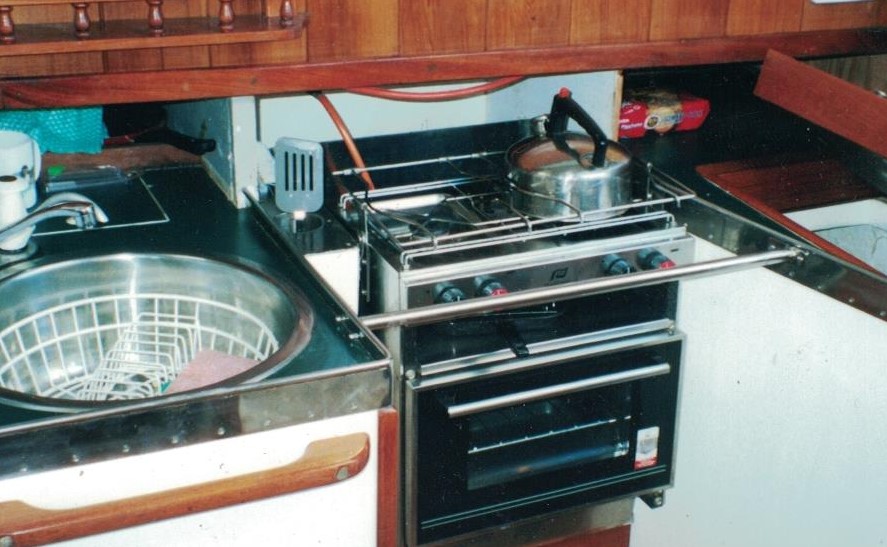
- Grab Bars. The cooker should have a strong bar mounted in front of the cooker to grab onto. This is an easy item to install and look at other locations where a hand hold can be installed. The image shows same installed on a previous boat of mine.
Cooker Stability
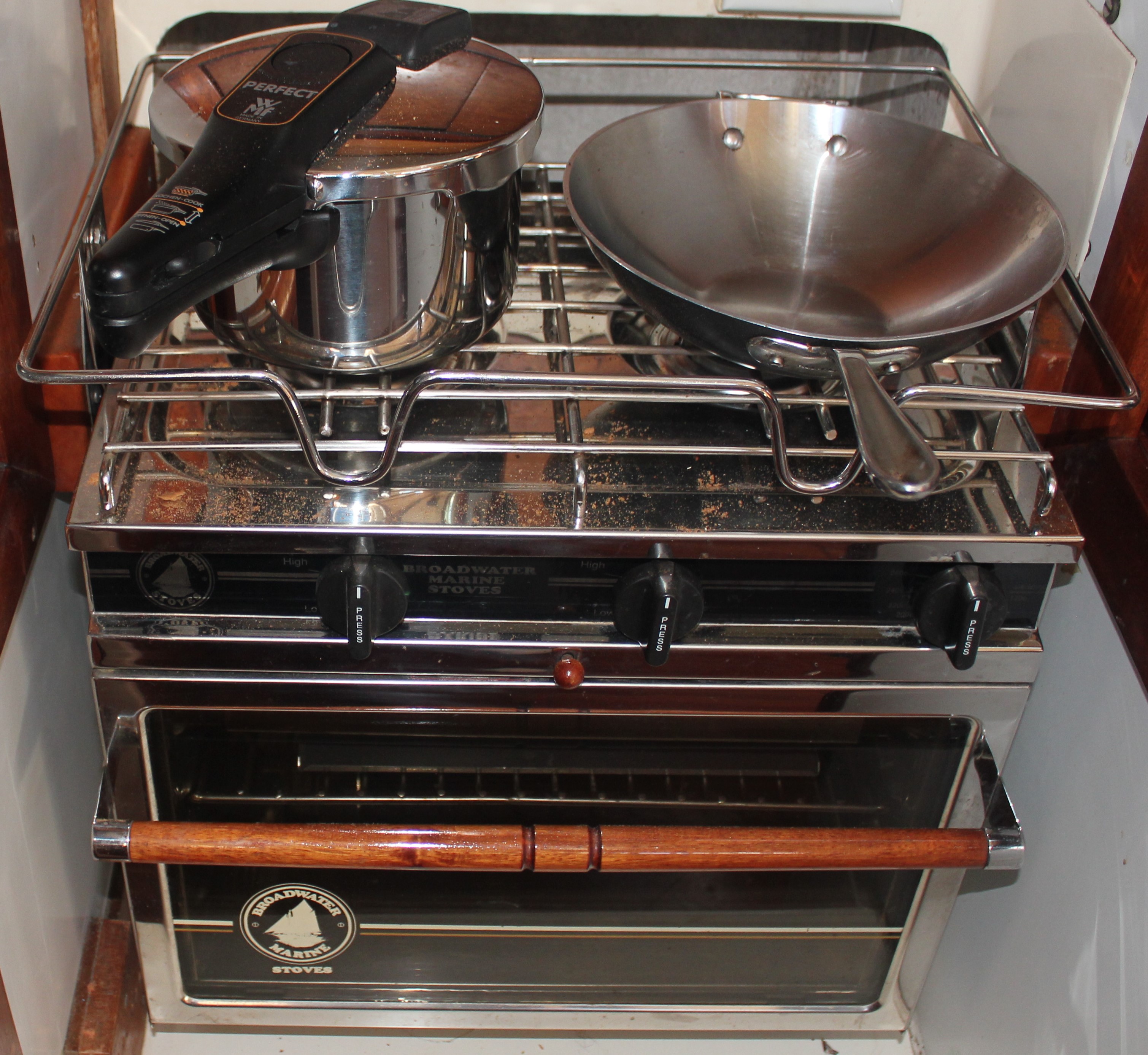
The more weight you put on a cooker the more unstable it becomes, and regrettably many cookers are not properly balanced. On most cookers, you open the oven door and the oven tilts considerably. This is unfortunate as you cannot remove a baking tray or whatever onto the door to rest with risking serious injury. This stability problem also has implications when cooking at sea with a heavy pot or two on the top. My own solution on my previous boats was to secure some lead to the bottom, in fact a few divers weights. You will need to experiment with this.
- Cooker Risk Assessment. Check how your cooker behaves when fully loaded. Fill a kettle with water, and fill a large pot with water to simulate maximum loading. See how well balanced the cooker is on the gimbals.
- Cooker Installation. Ensure that the cooker has properly installed fiddle rails and pot clamps to hold everything in place, in addition to gimballing. There are still many who do not have them.
Mechanical
and Electrical Repairs Resource
If you are headed somewhere remote consider the need to expand your knowledge base or have an information resource on board. Why not get a copy of my book The Marine and Electrical and Electronics Bible 4th Edition. By and for yachties, with everything from batteries and charging, solar and wind, diesel engines and marine electronics and so much more. Your complete systems guide. 650 pages of practical advice. In Australia and New Zealand order a copy through Boat Books. UK and European boats can buy the UK Edition Here. US and Canadian boats can get the US Edition Order Here. Marine systems are my profession so let me help you. By a liveaboard boat owner for other boat owners


Cooking on a Boat Summary
Cooking in a yacht galley presents constant challenges of space, motion, and safety. Limited counter area forces efficiency, while compact two‑burner cookers restrict menu options and require careful sequencing of dishes. Heat output is often lower than household stoves, demanding patience and adaptation. The yacht’s motion adds complexity, pots must be secured, gimbaled cookers balanced, and hot liquids handled with caution. Safety is paramount, open flames in confined cabins require ventilation, fire awareness, and strict fuel management. Successful galley work blends creativity with vigilance, turning constraints into opportunities for resourceful, safe, and satisfying meals at sea when cooking on a boat.