Boat Transmission
Oil
Boat transmission oil and the monitoring of the transmission oil is essential for reliable marine operation. Regular checks of oil level, colour, and viscosity provide early warning of wear, overheating, or contamination. Milky oil indicates water ingress, while dark or burnt oil suggests oxidation and gear stress. Laboratory analysis adds precision, detecting metal particles from gears and bearings, oxidation products, and additive depletion. Tracking of analysis trends helps identify misalignment, bearing failure, or seal damage before costly breakdowns occur. Consistent oil monitoring and analysis extend gearbox life, improve safety, and ensure smooth propulsion in demanding marine environments.
Neglecting regular boat transmission oil checks risks hidden wear, overheating, and water contamination. Undetected issues accelerate gear and bearing failure, compromise seals, and reduce propulsion efficiency. Small problems escalate into costly repairs or breakdowns at sea. Routine monitoring safeguards reliability, extends service life, and prevents dangerous operational surprises.
Boat Transmission
Oil Troubleshooting
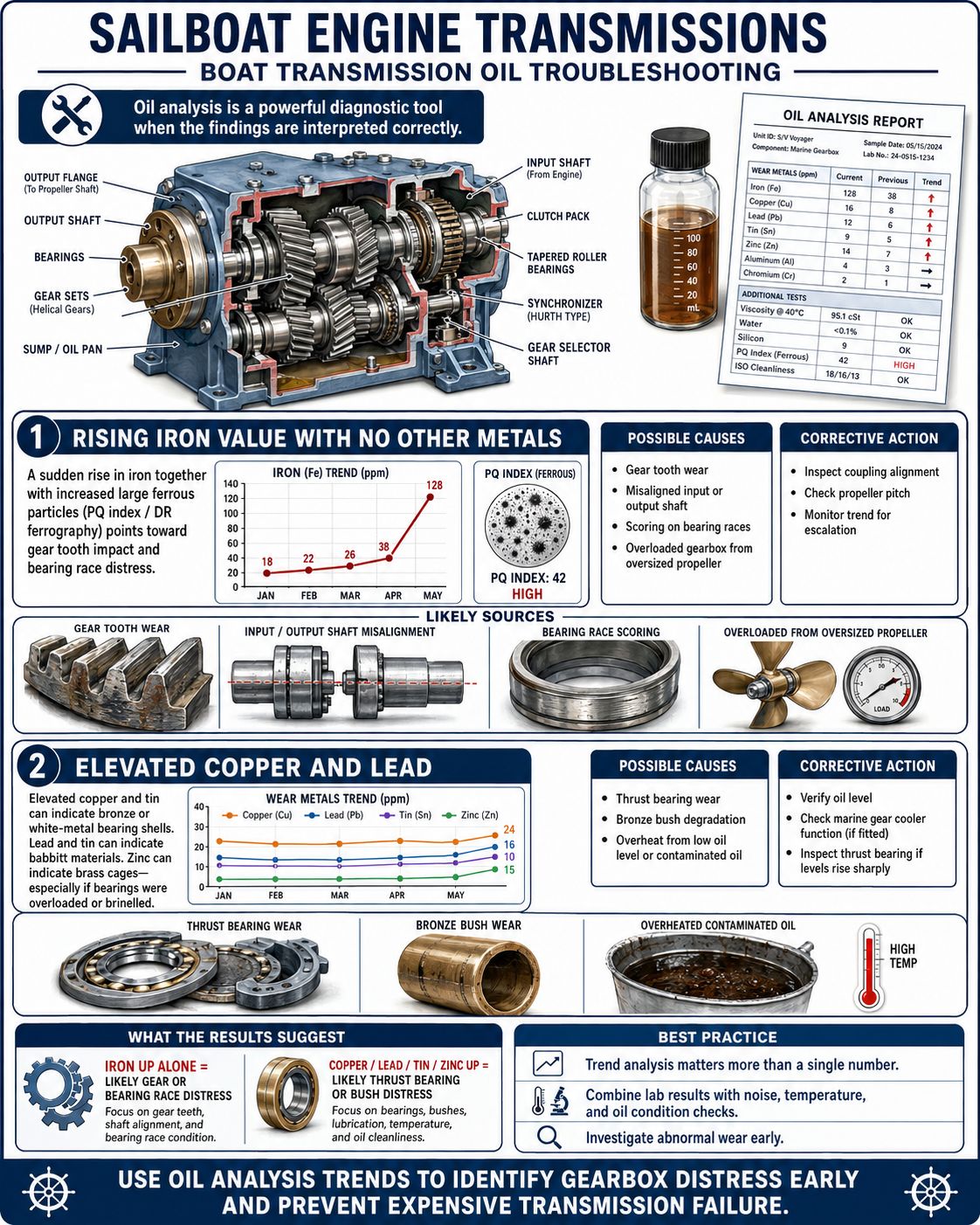
Oil analysis becomes a powerful diagnostic tool when the lab findings are interpreted correctly.
Rising Iron Value with No Other Metals. A sudden rise in iron with increased large ferrous particles (PQ index/DR ferrography) from gear tooth impact and bearing race distress. The possible causes are:
- Gear tooth wear
- Misaligned input or output shaft
- Scoring on bearing races
- Overloaded gearbox from oversized propeller
Corrective Action:
- Inspect coupling alignment
- Check propeller pitch
- Monitor trend for escalation
Elevated Copper and Lead. Elevated copper and tin (bronze/white-metal bearing shells), lead and tin (babbitt), and zinc (brass cages) if bearings were overloaded or brinelled. The possible causes are:
- Thrust bearing wear
- Bronze bush degradation
- Overheat from low oil level or contaminated oil
Corrective Action:
- Verify oil level
- Check marine gear cooler function (if fitted)
- Inspect thrust bearing if levels rise sharply
High Water Content (Saildrives): The possible causes are:
- Failed shaft seals
- Selector rod seal leak
- Electrolysis pinholes in casing
- Water ingress during haul-out or weather helm
Corrective Action:
- Immediate oil change
- Replace seals
- Inspect for corrosion
- Resample after 10 hours of use
Persistent water signals imminent mechanical failure.
Mechanical
and Electrical Repairs Resource
If you are headed somewhere remote consider the need to expand your knowledge base or have an information resource on board. Why not get a copy of my book The Marine and Electrical and Electronics Bible 4th Edition. By and for yachties, with everything from batteries and charging, solar and wind, diesel engines and marine electronics and so much more. Your complete systems guide. 650 pages of practical advice. In Australia and New Zealand order a copy through Boat Books. UK and European boats can buy the UK Edition Here. US and Canadian boats can get the US Edition Order Here. Marine systems are my profession so let me help you. By a liveaboard boat owner for other boat owners

Boat Transmission
Oil Troubleshooting
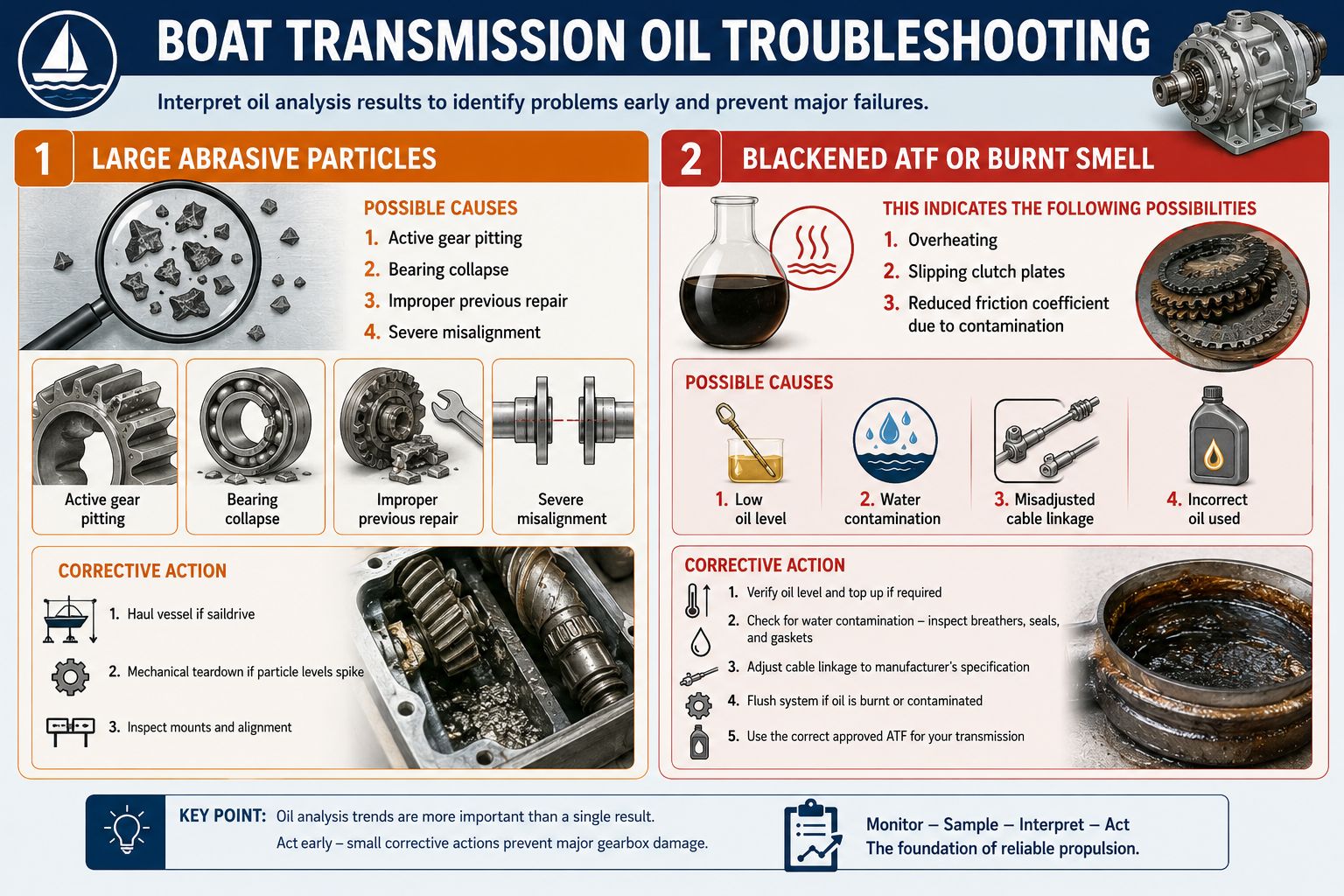
Large Abrasive Particles. The possible causes are:
- Active gear pitting
- Bearing collapse
- Improper previous repair
- Severe misalignment
Corrective Action:
- Haul vessel if saildrive
- Mechanical teardown if particle levels spike
- Inspect mounts and alignment
Blackened ATF or Burnt Smell. This indicates the following possibilities:
- Overheating
- Slipping clutch plates
- Reduced friction coefficient due to contamination
Causes may also include:
- Low oil level
- Water contamination
- Misadjusted cable linkage
- Incorrect oil used
Boat Transmission
Oil
Rising Aluminium & Chromium Together. Chromium, nickel, and molybdenum can rise if rolling elements or case-hardened surfaces scuff or spall; stainless components (couplings/shaft sleeves) may contribute chromium and nickel. This indicates housing wear AND hard gear surface wear. This is a classic signature of shaft instability.
Boat Transmission
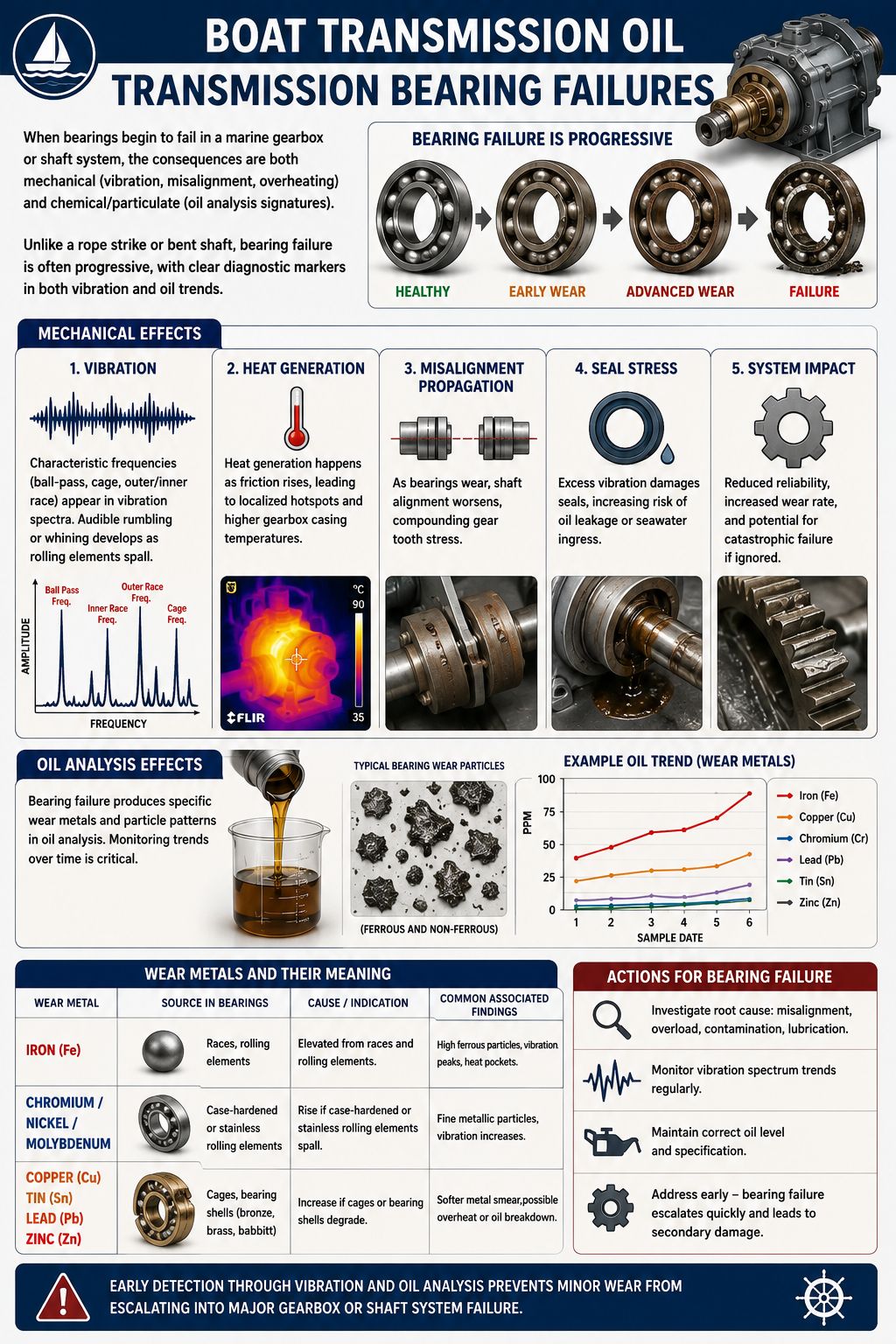
Oil - Failing Bearings.
When bearings begin to fail in a marine gearbox or shaft system, the consequences are both mechanical (vibration, misalignment, overheating) and chemical/particulate (oil analysis signatures). Unlike a rope strike or bent shaft, bearing failure is often progressive, with clear diagnostic markers in both vibration and oil trends. Characteristic frequencies (ball-pass, cage, outer/inner race) appear in vibration spectra. Audible rumbling or whining develops as rolling elements spall. Heat generation happens as friction rises, leading to localized hotspots and higher gearbox casing temperatures. Misalignment propagation as bearings wear, shaft alignment worsens, compounding gear tooth stress. Seal stress as excess vibration damages seals, increasing risk of oil leakage or seawater ingress. The oil analysis effects and wear metals are Iron: Elevated from races and rolling elements. Chromium/Nickel/Molybdenum: Rise if case-hardened or stainless rolling elements spall. Copper/Tin/Lead/Zinc: Increase if cages or bearing shells (bronze/brass/babbitt) degrade.
Boat Transmission
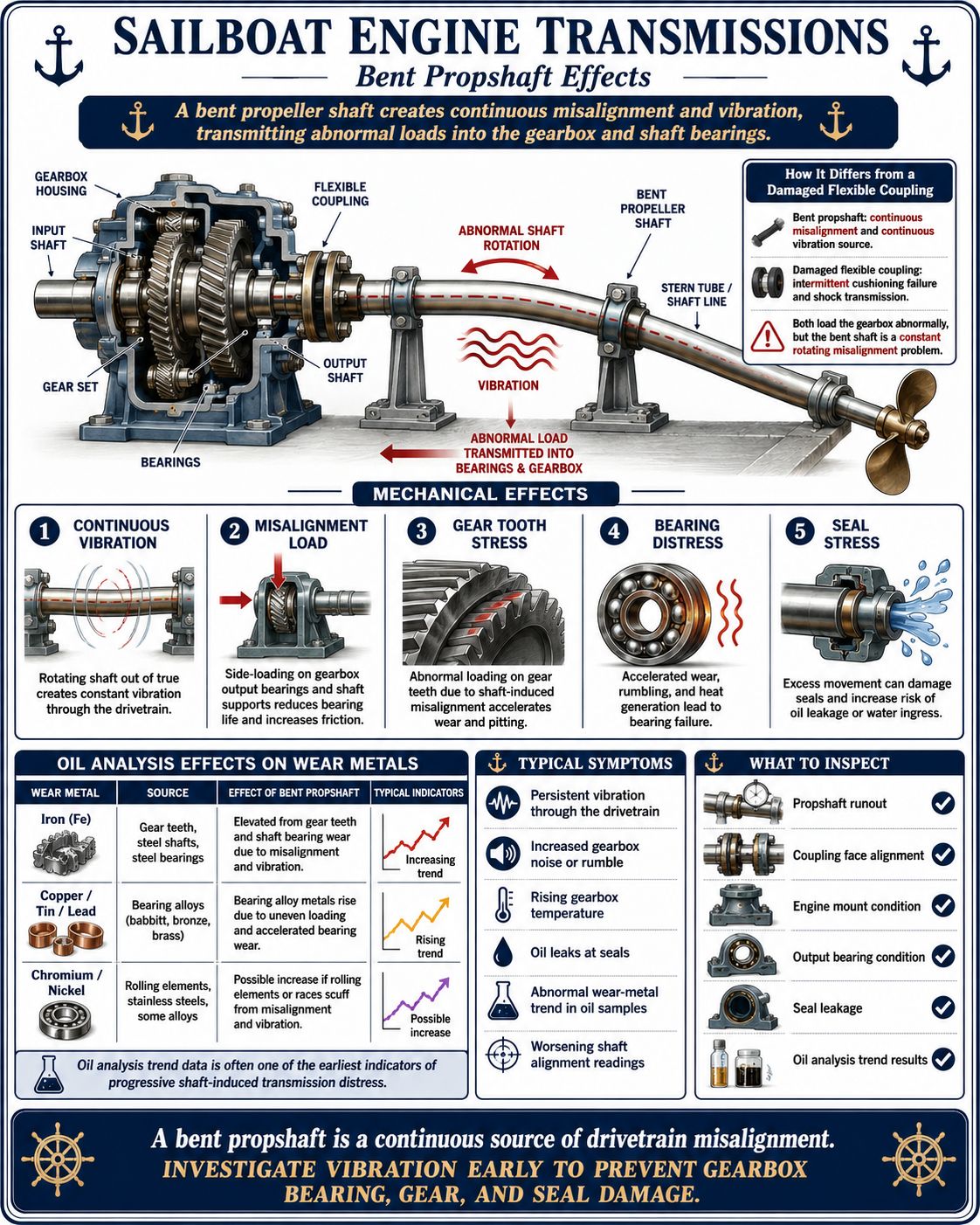
Oil - Bent Propshaft
A bent propeller shaft produces very similar downstream effects to a damaged flexible coupling, but with some important distinctions. Both conditions transmit abnormal loads into the gearbox, yet the bent shaft tends to create a continuous misalignment and vibration source, rather than the intermittent cushioning failure of a coupling. Oil analysis effects on wear metals Iron: Elevated from gear teeth and shaft bearing wear. Copper/Tin/Lead: Bearing alloy metals rise due to uneven loading. Chromium/Nickel: Possible increase if rolling elements scuff.
Boat Transmission
Oil - Damaged Flexible Coupling.
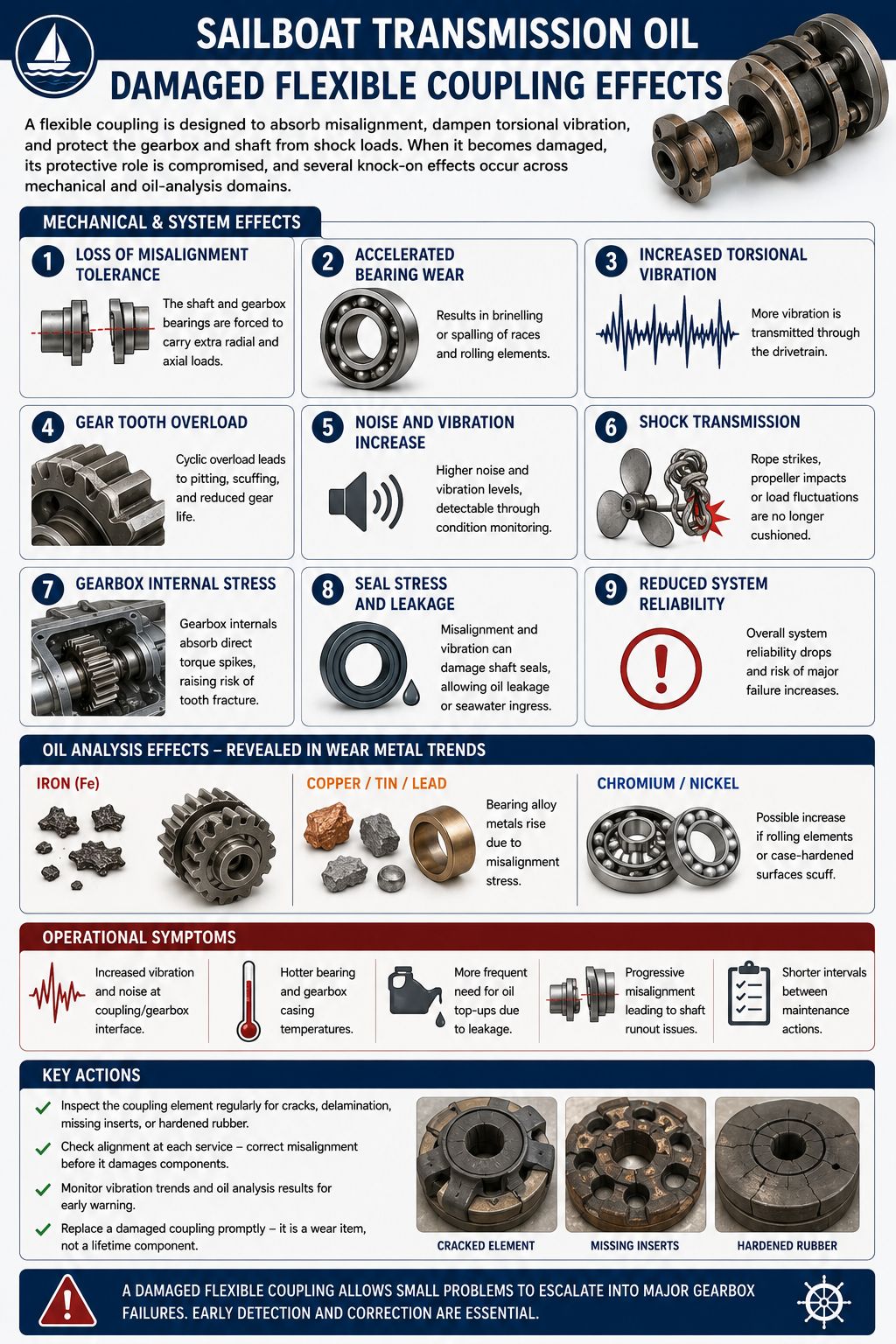
A flexible coupling is designed to absorb misalignment, dampen torsional vibration, and protect the gearbox and shaft from shock loads. When it becomes damaged, its protective role is compromised, and several knock-on effects occur across mechanical and oil-analysis domains. Loss of misalignment tolerance and the shaft and gearbox bearings are forced to carry extra radial and axial loads. There is accelerated bearing wear and possible brinelling or spalling and increased torsional vibration. Gear teeth experience cyclic overload, leading to pitting and scuffing. Noise and vibration levels rise, sometimes detectable through condition monitoring. Shock transmission such as rope strikes, propeller impacts, or load fluctuations are no longer cushioned. Gearbox internals absorb direct torque spikes, raising risk of tooth fracture. Seal stress occurs due to misalignment and vibration can damage shaft seals, allowing oil leakage or seawater ingress. The Oil analysis effects are revealed in the wear metal trends. Iron: Elevated from gear tooth and shaft wear. Copper/Tin/Lead: Bearing alloy metals rise due to misalignment stress. Chromium/Nickel: Possible increase if rolling elements or case-hardened surfaces scuff. The operational symptoms are increased vibration and noise at coupling/gearbox interface. Hotter bearing and gearbox casing temperatures. More frequent need for oil top-ups due to leakage. Progressive misalignment leading to shaft runout issues.
Boat Transmission
Oil - Rope/line Strike Shaft Damage
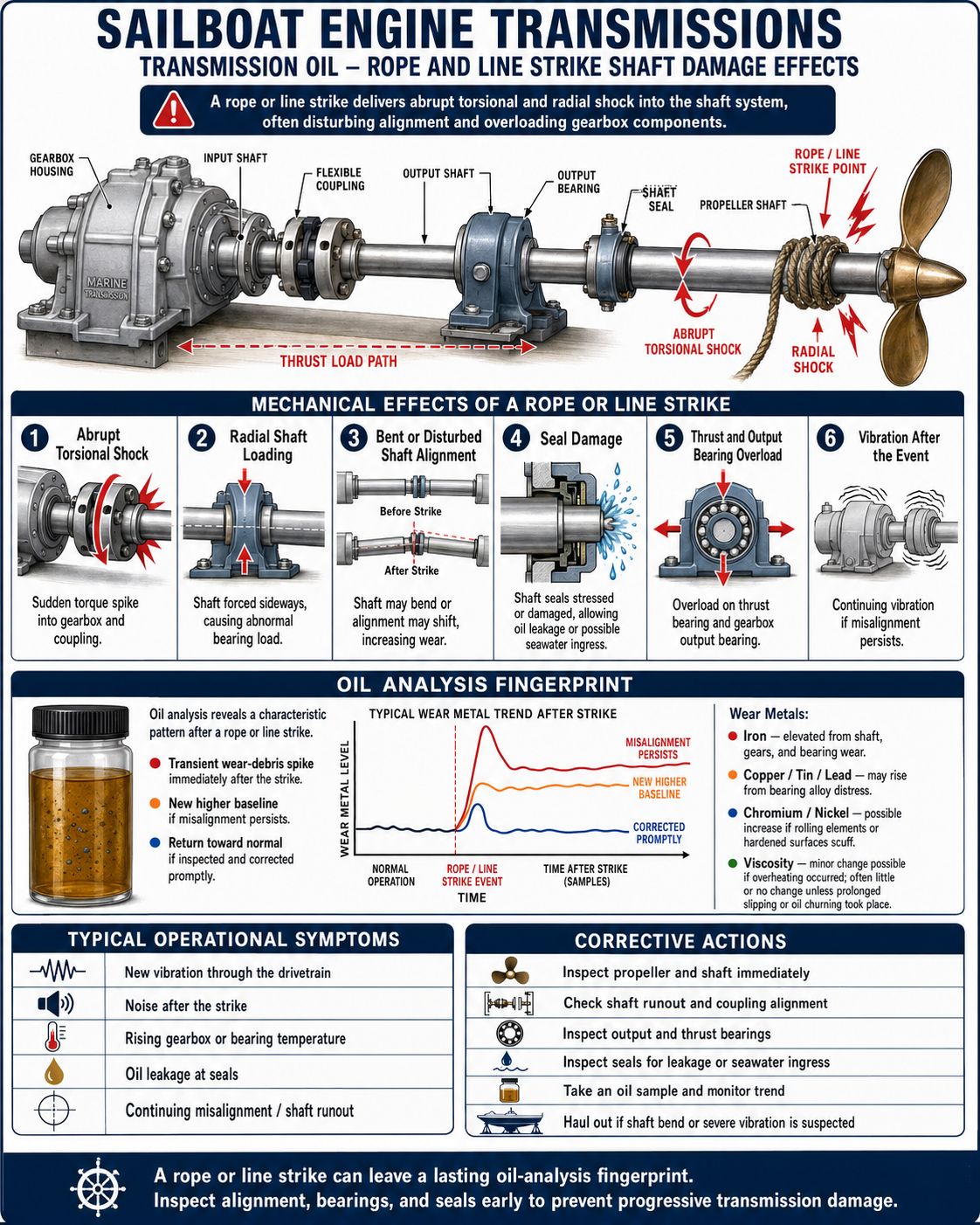
A rope or line strike on the prop shaft delivers an abrupt torsional and radial shock that can bend the shaft, disturb alignment, damage seals, and overload thrust and output bearings. Even if the gearbox continues to operate, the event often leaves a fingerprint in the oil, a transient spike of wear debris followed by a new, higher baseline if misalignment persists. Minor viscosity change is possible if the strike caused overheating; more often the change is negligible unless prolonged slipping or churning occurred.
Boat Transmission
Oil Trend Analysis
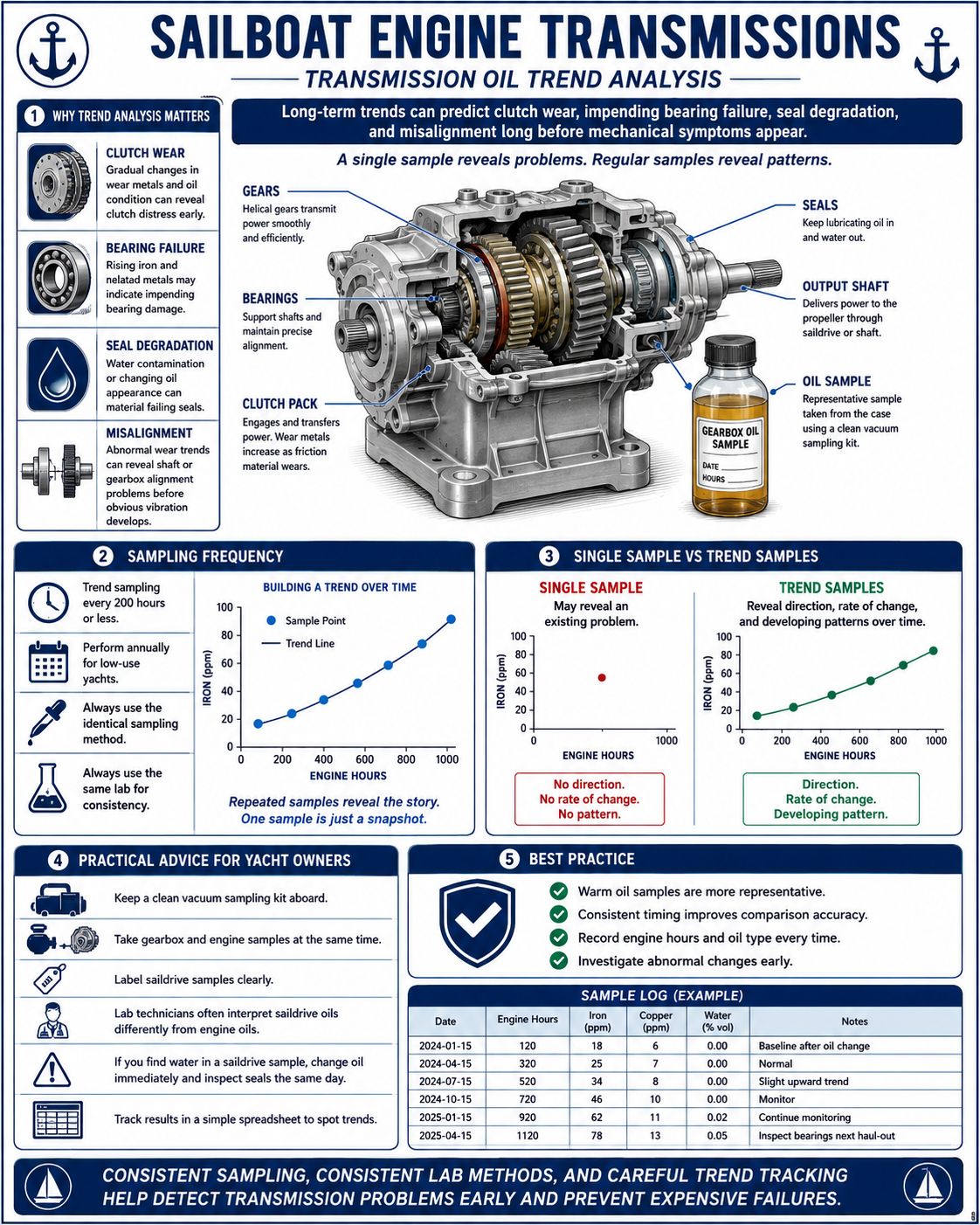
Long-term trends can predict clutch wear, impending bearing failure, seal degradation, and misalignment long before mechanical symptoms appear. A single sample reveals problems. Regular samples reveal patterns. Trend sampling every 200 hours or less. Perform annually for low-use yachts. Always use identical method and lab.


Boat Transmission
Oil Practical Advice for Yacht Owners
- Keep a clean vacuum sampling kit aboard.
- Take gearbox and engine samples at the same time.
- Label saildrive samples clearly. Lab technicians often interpret them differently from engine oils.
- If you find water in a saildrive sample, change oil immediately and inspect seals the same day.
- Track results in a simple spreadsheet to spot trends.
Boat Transmission
Oil
Boat transmission oil sampling and analysing gearbox or saildrive oil is one of the most effective ways to monitor the internal health of marine drivetrains. Because these units contain little oil, even small amounts of wear metal, water, or contamination are highly diagnostic. Proper sampling technique, warm oil, vacuum extraction, clean handling, mid-depth positioning, ensures the lab receives an accurate, representative sample. Combined with trend analysis, the results can detect gear wear, clutch deterioration, bearing fatigue, water ingress, misalignment, and seal failure long before they cause breakdowns or expensive repairs. Boat transmission oil sampling can tell you a lot about your engine transmission and warn of degradation and impending failure.