Boat Exhaust Systems
The boat exhaust systems that support a small marine diesel engine is a critical but often under-appreciated assembly that performs several essential roles. These roles are the safe discharge of combustion gases, noise attenuation, thermal management, and prevention of seawater intrusion back into the engine.
While the system appears simple from the outside, essentially a hose leading overboard, it is in fact a carefully designed combination of metallic and polymer components working together under challenging thermal, corrosive, and operational conditions. A well-designed exhaust system directly affects engine reliability, vessel safety, and onboard comfort.
Boat Exhaust Systems
Fundamentals
Unlike automotive systems, a marine diesel exhaust must manage not only hot gases but also seawater from the engine’s heat exchanger. In most small yacht installations (Yanmar, Volvo Penta, Nanni, Beta, and others), cooling water is injected into the exhaust stream immediately after the turbocharger or exhaust elbow. This creates a wet exhaust, drastically reducing gas temperature and allowing the use of lightweight rubber hose downstream. At the same time, the system must prevent backflow of seawater into the cylinders, a critical requirement because even a small amount of water entering through an exhaust valve can hydrolock the engine or cause major corrosion.
Boat Exhaust
Systems - Mixing Elbow
Exhaust Mixing Elbow. The exhaust mixing elbow, typically cast stainless steel, cast iron, or high-temperature alloy, is where raw cooling water meets hot exhaust gas. Gases leaving the manifold or turbocharger are frequently in the 300–450°C range during normal load. Injection of water drops this temperature to under 80–100°C almost instantly. The design of the elbow is central to efficient cooling and to minimising the risk of water backflow. Poor elbows, or elbows in advanced corrosion, can restrict flow, increase back-pressure, and introduce water into the wrong parts of the system.
Manufacturers employ various geometries, downward-facing riser types, 180-degree loops, and extended mixing zones to maintain positive drainage away from the engine. The elbow is also a high-service-life component; internal salt deposits, thermal cracking, and corrosion mean replacement every 5–7 years is considered prudent on many engines.
Mechanical
and Electrical Repairs Resource
If you are headed somewhere remote consider the need to expand your knowledge base or have an information resource on board. Why not get a copy of my book The Marine and Electrical and Electronics Bible 4th Edition. By and for yachties, with everything from batteries and charging, solar and wind, diesel engines and marine electronics and so much more. Your complete systems guide. 650 pages of practical advice. In Australia order a copy through Boat Books. UK based boats can Order Here. US based boats can get the US Edition Order Here. Marine systems are my profession so let me help you. By a liveaboard boat owner for other boat owners

Boat Exhaust Systems - Riser or Lift
In many installations, especially on sailboats where the engine may sit below the vessel’s waterline, the exhaust outlet must be routed above the static waterline to avoid flooding. A riser or “gooseneck” performs this function. Some risers integrate the mixing elbow at the top; others use a dry section downstream before introducing water. The geometry is crucial, the crest of the riser must rise sufficiently high, and the fall to the waterlock must be steep enough to ensure self-draining while also preventing siphoning during shutdown.
Waterlock (Water
Trap, Exhaust Muffler)
After the elbow, the gas–water mixture flows into a waterlock, often made from fiberglass or reinforced polymer. Its principal purpose is twofold: noise reduction and water containment. The waterlock traps a volume of water which acts as a muffling medium, reducing exhaust noise transmitted back into the hull. It also ensures that any seawater present in the hose stays low in the system when the engine stops, rather than running back toward the engine.
Sizing is critical. A waterlock that is too small may not contain enough water and can allow backflooding during heeled sailing or when cranking a reluctant engine. One too large may present unnecessary restriction. Installation angles must allow free drainage under all vessel trim conditions.
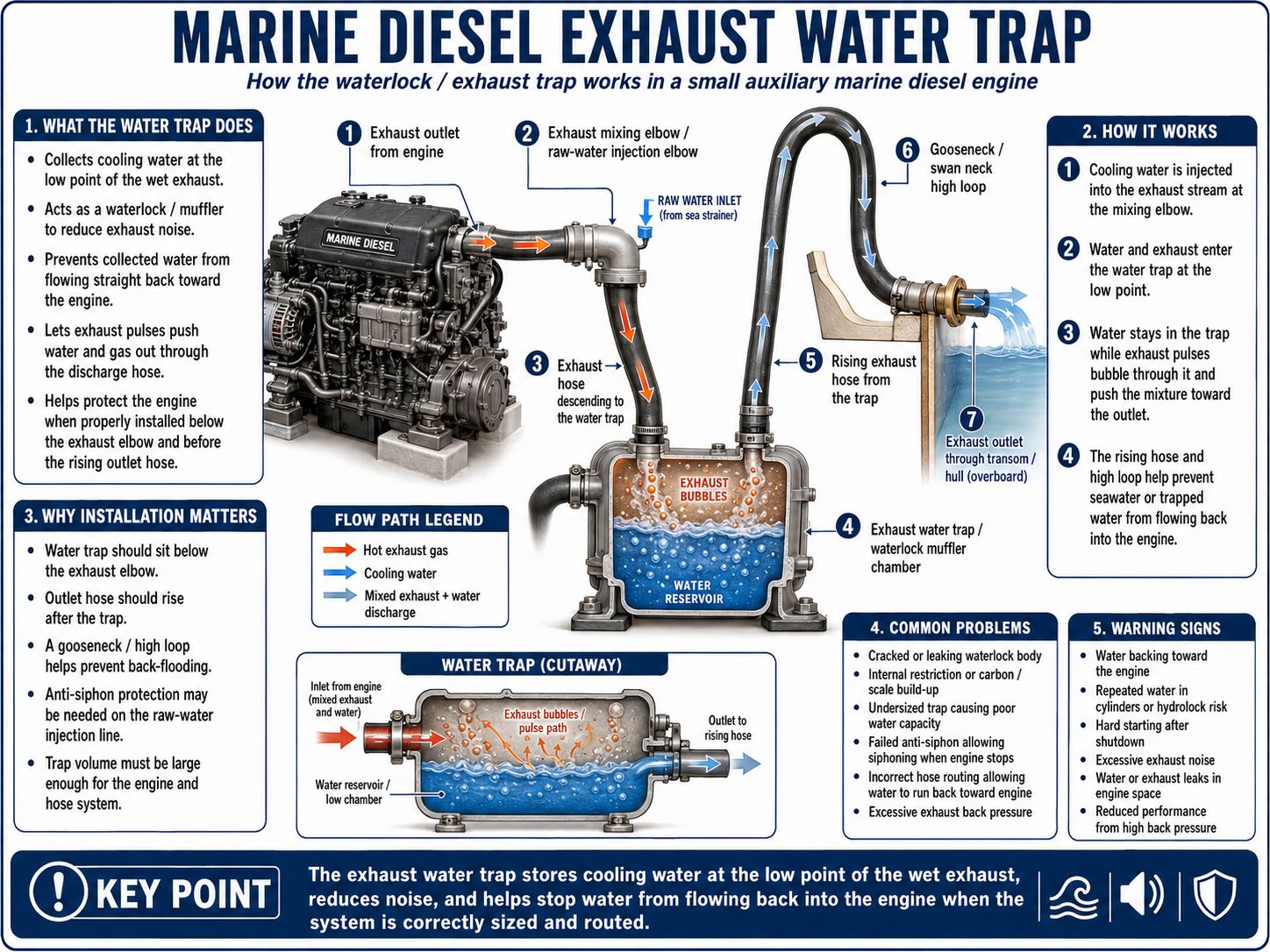
Boat Exhaust Systems Hose
Marine-grade wet-exhaust hose is designed to withstand elevated temperatures, hydrocarbon exposure, and continuous vibration. Internally reinforced with wire or high-strength fabric, it must handle not only the flowing mixture but also static head, bending loads, and occasional pressure spikes. Overheating is the most common failure mode. If water flow is lost due to a blocked strainer, failed pump impeller, or kinked injection line, temperatures can rise rapidly and destroy the hose, sometimes producing toxic smoke or onboard fire risk.
Hose runs should be as short and straight as possible, with sweeping curves rather than tight bends. All clamps must be double-clamped at each connection with high-grade stainless bands.
Anti-Siphon Valve
or Break
On engines installed below the waterline, back-siphoning is a serious threat. An anti-siphon valve, typically located at the top of the cooling-water injection line, allows air to enter the line when the engine is off, breaking any siphon effect. Valves must be installed above the vessel’s heeled waterline and require periodic cleaning. Failure can allow water to be drawn into the exhaust manifold and then into cylinders.
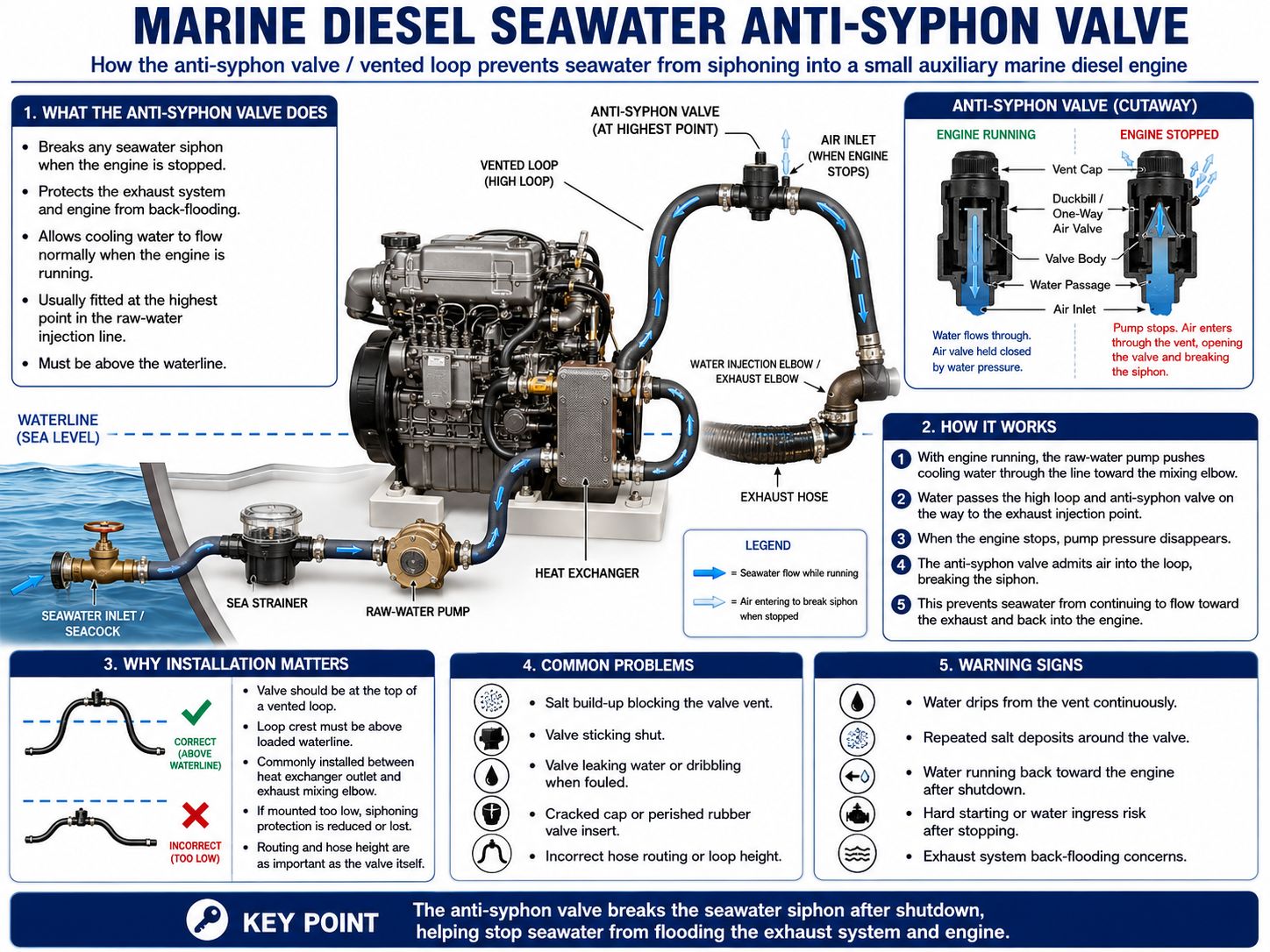


Silencers and
Water Separators
Some systems incorporate additional silencers or water separators downstream. Water separators remove entrained water from the exhaust gas and discharge water quietly below the waterline, reducing exhaust splash noise, valuable for night sailing or long-distance cruising. Secondary silencers can reduce low-frequency resonance in larger diameter hose runs.
Through-Hull
Outlet
The final exit point must be carefully positioned, many are at the transom. Ideally above the static waterline but not so high that it allows siphoning back into the system. Angled outlets, flaps, or rubber duckbill valves help prevent following seas from forcing water back into the hose. The outlet must be rigidly supported to avoid fatigue cracks.
Exhaust
Back-Pressure Considerations
The entire system must maintain back-pressure within manufacturer specifications. Excessive back-pressure, often caused by a clogged elbow, collapsed hose, saturated waterlock, or too many bends, reduces engine performance, increases fuel consumption, and raises exhaust temperature. Turbocharged engines are especially sensitive. Routine inspection of elbows and clear flow through hoses is essential.
Boat Exhaust
Systems Failure Modes
Common failure modes include internal elbow corrosion, hose delamination, waterlock rupture, and anti-siphon blockage. Symptoms may include elevated operating temperature, steam or excessive smoke from the outlet, difficulty starting, water in cylinders, or gradual loss of power. Regular inspection intervals should include removing and checking elbows, verifying anti-siphon valve operation, inspecting hose condition, feeling for soft spots, and confirming secure clamps.
Boat Exhaust Systems
A well-designed exhaust system on a small marine diesel combines thermal management, water handling, noise control, and safety engineering in a compact assembly. Its proper maintenance is as vital as fuel or lubrication system care. Understanding the components—elbow, riser, waterlock, hose, anti-siphon valve, and outlet, allows boat owners and technicians to identify problems early, maintain low back-pressure, and ensure reliable and safe engine operation in the marine environment. Understand how your Boat Exhaust Systems are configured and installed.