Boat Cockpit Drains
Boat cockpit drains are among the most important safety and seaworthiness systems on any sailing yacht. Although conceptually simple, their performance is vital to ensuring that water boarding the cockpit, whether from rain, spray, following seas, or breaking waves, can be evacuated rapidly and reliably. Poorly designed or poorly maintained cockpit drains have contributed to numerous flooding incidents, loss-of-stability events, and vessel sinkings. This makes an understanding of their function, design, installation, and maintenance essential for boat owners, builders, and surveyors.
Boat cockpit drains are essential safety features on a sailing boat, designed to quickly remove water that enters the cockpit from rain, spray, or waves. By channeling water overboard through scuppers or drain pipes, they prevent pooling that could compromise stability or damage equipment. Properly sized and maintained drains ensure the cockpit remains dry, reducing slip hazards and protecting gear, while contributing to overall seaworthiness and crew confidence during challenging conditions
Boat Cockpit Drains Basics
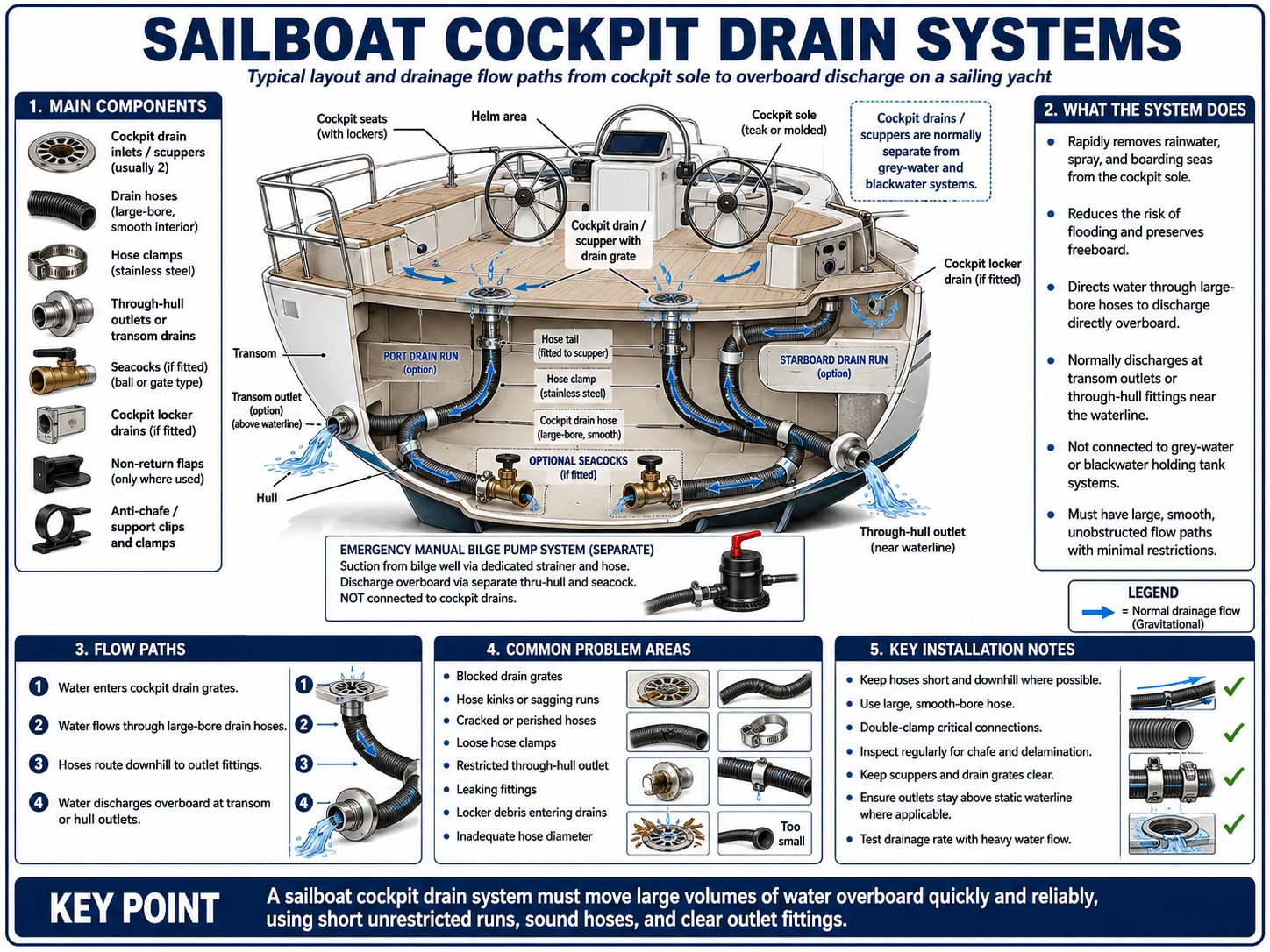
The cockpit on most sailing yachts is a partially enclosed, low-lying area that naturally collects water. The cockpit drains, sometimes called cockpit scuppers when applied to the cockpit, serve the critical function of routing this water overboard without allowing any ingress into the hull. Key functions of boat cockpit drains are as follows:
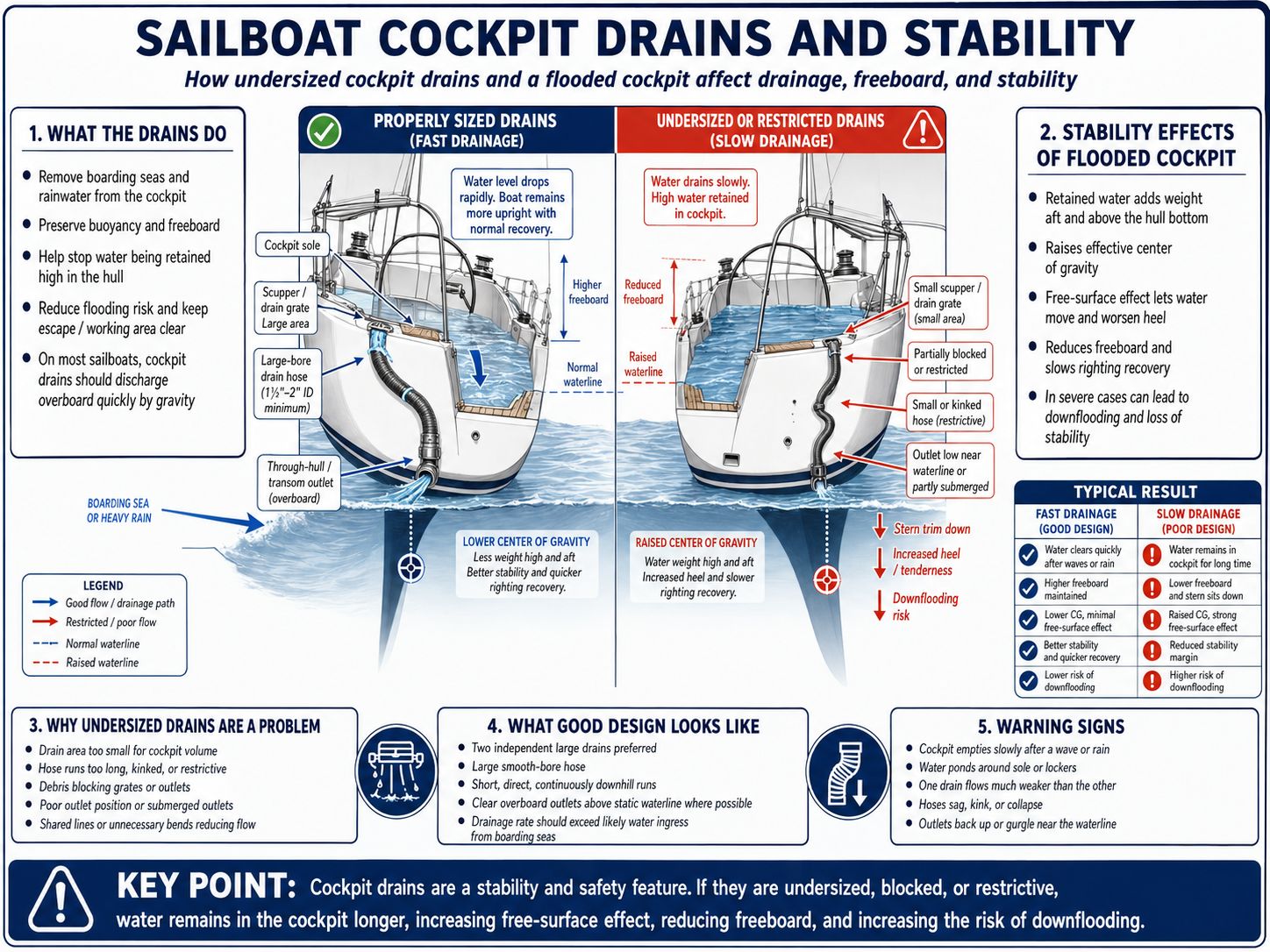
- Rapid Water Removal. Efficient drains ensure that water does not accumulate and add weight, raise the vessel’s center of gravity, or impede steering and crew mobility.
- Protection Against Boarding Seas. Sailing yachts occasionally encounter steep waves or breaking seas that can dump hundreds of liters of water into the cockpit. Sizing and redundancy of drains are essential to prevent dangerous retention.
- Preventing down flooding. By swiftly removing water, cockpit drains help keep water from entering companionways, locker lids, steering quadrant access hatches, and other potential openings.
- Contributing to Self-Righting. On offshore sailing yachts, cockpit volume and evacuation rate form part of overall stability calculations. Drains must empty the defined cockpit volume within time limits specified by ISO 11812 or offshore racing regulations.
Boat Cockpit Drains Design Principles
Cockpit drain system performance depends on a combination of hydraulic capacity, routing, materials, and installation quality. The following engineering principles govern proper design.
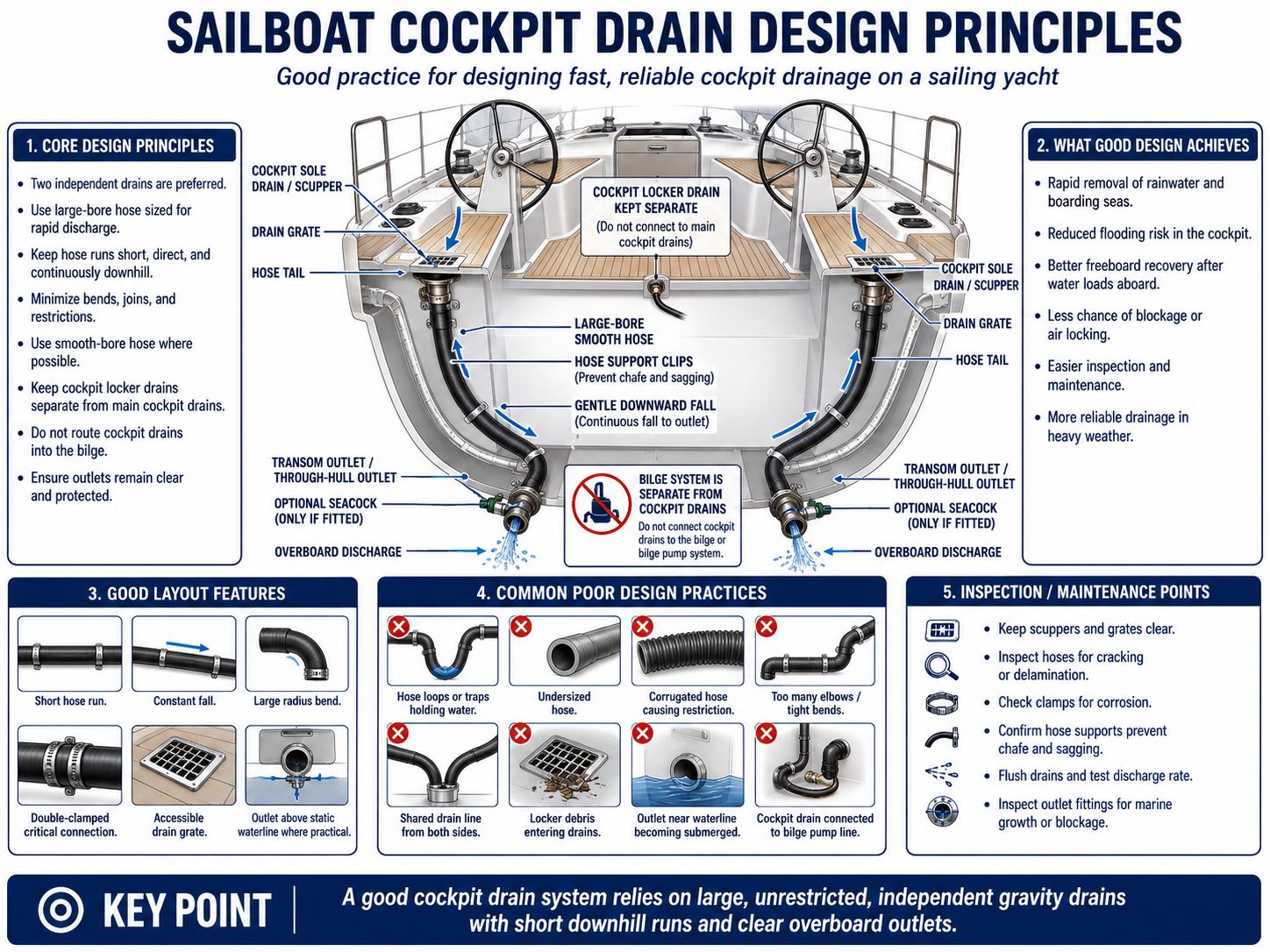
Hydraulic Capacity. The cross-sectional area of the drains must be adequate to move large volumes of water quickly. ISO and ABYC guidelines provide minimum cockpit drain sizing to ensure rapid emptying under heel and dynamic loads Most modern yachts use:
- Twin drains for redundancy and increased flow
- Diameters ranging from 38 mm to 50 mm for typical cruisers
- Even larger for offshore or racing yachts
Gravity Flow vs. Assisted Flow. Any inverted sections or dips create siphon risks or areas where water pools, reducing flow efficiency. Cockpit drains function via gravity. For this to work:
- The cockpit sole must be higher than the discharge point.
- The drain hoses must maintain a continuous downward slope
Mechanical
and Electrical Repairs Resource
If you are headed somewhere remote consider the need to expand your knowledge base or have an information resource on board. Why not get a copy of my book The Marine and Electrical and Electronics Bible 4th Edition. By and for yachties, with everything from batteries and charging, solar and wind, diesel engines and marine electronics and so much more. Your complete systems guide. 650 pages of practical advice. In Australia order a copy through Boat Books. UK based boats can Order Here. US based boats can get the US edition Order Here. Marine systems are my profession so let me help you. By a liveaboard boat owner for other boat owners

Routing of Drain Lines
Sailing yacht cockpit drains typically follow one of two arrangements:
- Direct Through-Hull Drains (Above Waterline). These discharge straight out of the topsides. Advantages include simple routing and minimal risk of back flooding. However, heel angles may temporarily submerge one side, requiring robust non-return flaps.
- Transom Drains or Aft Overboard Drains. Common on boats with open transoms or broad aft sections. These drains often use short, straight hoses for optimal flow.
Where drains pass below the waterline, vented loops or anti-siphon systems must be installed to prevent unintentional flooding.
Boat Cockpit Drains Redundancy
Redundancy is vital for offshore boats. Many survey standards require:
- A minimum of two drains
- Each drain capable of emptying the cockpit independently
- Separate through-hulls so that a single failure does not compromise the entire system
- Some blue water yachts even include four drains for enhanced safety.
Freeboard and Discharge Height
Discharge ports should ideally be well above the dynamic waterline to avoid seawater entering the cockpit through the drains. The relative height of the outlet to the waterline influences:
- Backflow risk
- Drain performance under heel
- Compliance with load-line rules
Construction and Materials
Drain Bodies and Fittings. Cockpit drains can be formed by:
- Molded-in deck recesses
- Stainless or bronze drain fittings
- Composite flanged fittings glassed into the cockpit sole
Hoses. Drain hoses must be:
- Smooth-bore marine-grade to maximize flow
- Reinforced to prevent collapse under suction or external pressure
- Abrasion-resistant and UV-stable
- Avoid corrugated bilge-type hoses, which significantly reduce flow and trap debris.
Hose Clamps. At least two 316 stainless clamps per connection are recommended. Perforated automotive clamps must never be used in seawater applications.
Backflow Prevention. Cockpit drains discharging near the waterline require:
- External flapper valves
- Internal non-return valves
- Sometimes hinged plates on offshore boats
- Care must be taken, however, as valves can reduce flow or clog if neglected.
Performance Under Heel and Sea Conditions
Sailing yachts rarely remain upright when water enters the cockpit. Designers must consider:
Heel Angle Effects. On starboard tack, the port drain may rise significantly above the waterline, decreasing flow. Conversely, the leeward drain may be submerged, increasing back pressure. Drain systems are sized to function acceptably even when the yacht is at 15–30° of heel.
Dynamic Conditions. Regulations for offshore yachts often require a complete cockpit evacuation within 3 minutes or less. When large volumes of water enter the cockpit in a single event (e.g., a breaking wave), drains must:
- Handle peak flow without blockage
- Maintain drainage under pitch-induced sloshing
- Resist siphoning or back flooding during stern immersion
Boat Cockpit Drains Failure Modes
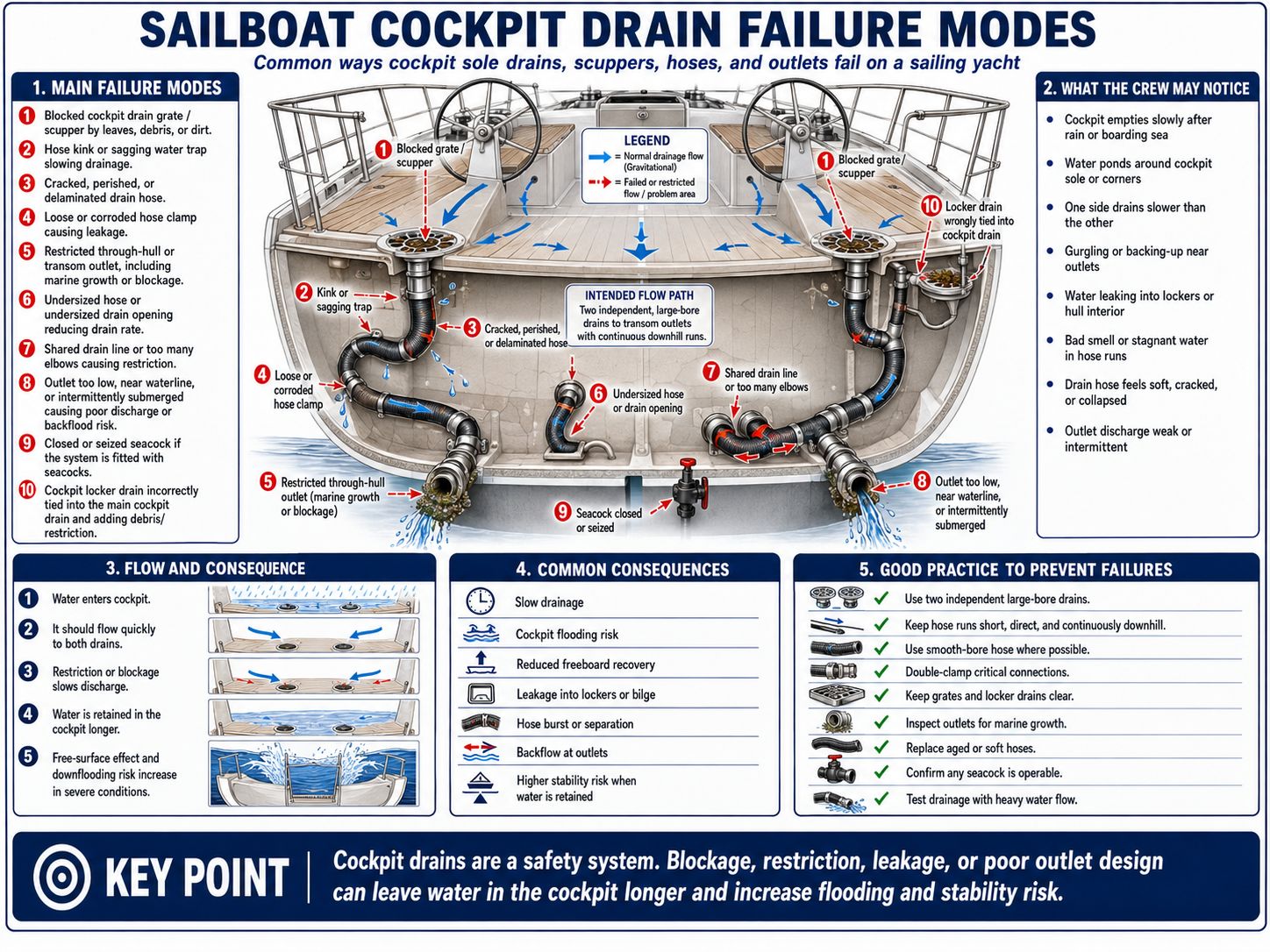
Cockpit drain system failures can be catastrophic. Common problems include:
- Hose Detachment. A disconnected hose below the cockpit sole creates an immediate and large hole in the hull.
- Blockage. Debris, leaves, fish remnants, or loose items can obstruct drains, reducing flow.
- Backflow. If flaps fail or outlets sit too close to the waterline, seawater can enter the cockpit.
- Cracked or UV-Degraded Fittings. Older plastic drain fittings can fail without warning.
- Corrosion. Bronze fittings can dezincify; stainless fittings can develop crevice corrosion.


Boat Cockpit Drains Maintenance
It is common during surveys to find drain systems partially compromised by previous owners’ DIY work. Many do not fully understand the subject and requirements. Proper inspection and maintenance greatly reduce risk:
- Regularly clear debris from drain grates and channels
- Inspect hoses annually for soft spots, brittleness, cracking, or swelling
- Test backflow valves and flaps for free movement
- Check hose clamps for corrosion or weakening
- Ensure structural bedding of drain fittings is intact
- During haul-out, backflush hoses to verify clear passages
Sail Boat Cockpit Drains
Cockpit drains on a sailing boat are an essential part of the vessel’s drainage and safety system. Their ability to evacuate large volumes of water rapidly, even when the yacht is heeled, laden, or in rough conditions, depends on sound engineering, robust construction, proper installation, and diligent maintenance. Though easily overlooked, they play a central role in preserving buoyancy, preventing down flooding, and maintaining overall seaworthiness. For offshore sailors especially, a well-designed cockpit drainage system is a fundamental requirement that can make the difference between a manageable incident and a life-threatening emergency. Boat cockpit drains are crucial to vessel safety; make sure you don’t ignore yours.