Anchor Light for Boat
The anchor light for boat is a fundamental safety signal required under international maritime regulations and essential for collision avoidance during nighttime anchoring. Its purpose is simple, make the vessel visible to other traffic, but the technical and operational considerations around its use are more complex than many sailors appreciate. It has a daytime equivalent day shape of a round black ball but that is a rare sight, recently I was ridiculed for carrying one by some others on the marina.
A properly selected, installed, and used anchor light for boat significantly
reduces the risk of nighttime collision, improves situational awareness for
nearby vessels, and ensures compliance with navigational rules. This article
outlines the technical characteristics, legal requirements, installation
factors, and operational best practices for the anchor light on sailing yachts. The common questions center around USCG anchor light requirements. There is also confusion on where to mount anchor light. Many aks what are the best anchor light for sailboats.
Regulatory
Requirements for Anchor Lights
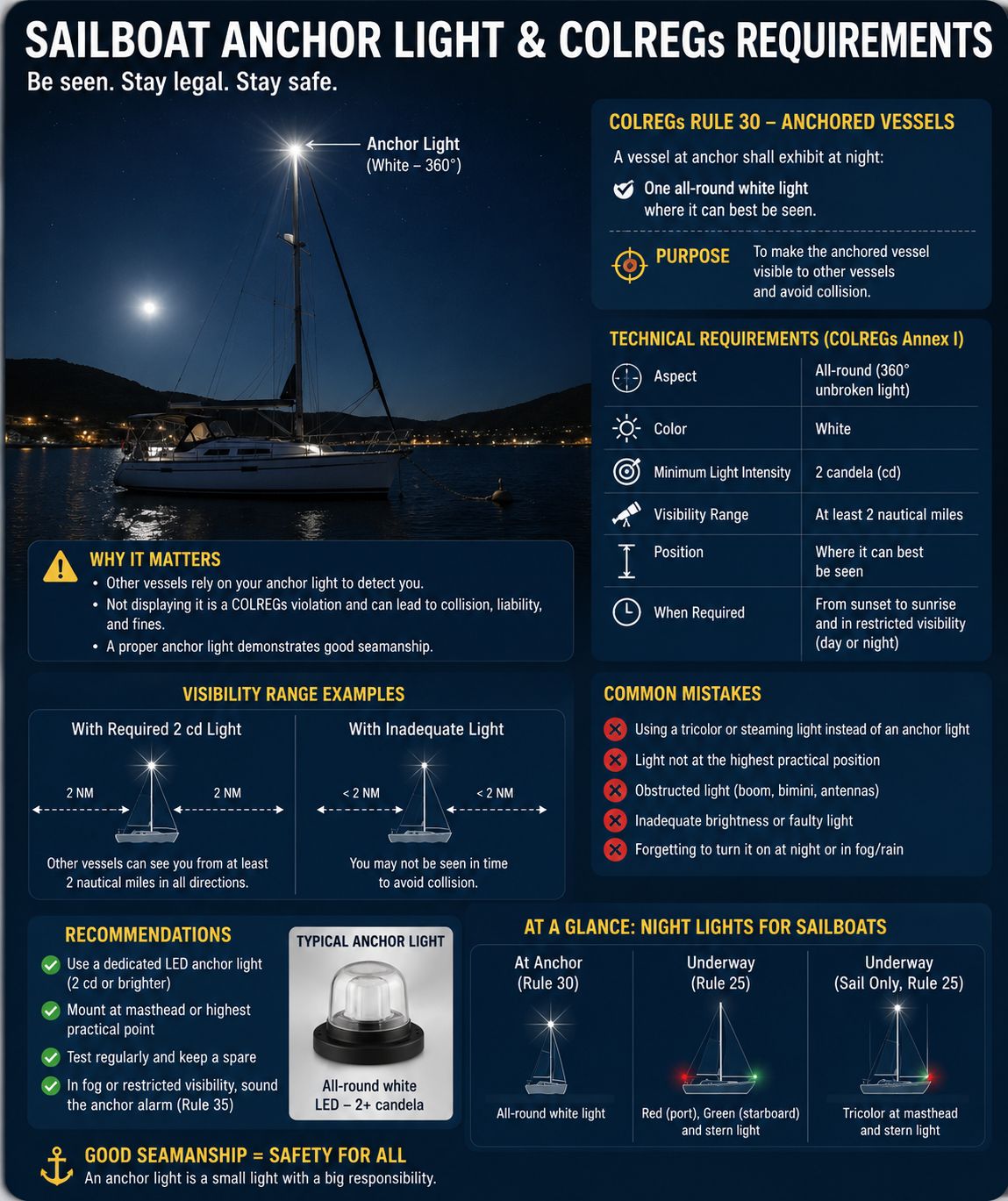
Under COLREGS Rule 30, a vessel at anchor must display an all-round white light in the forepart of the vessel where it can be best seen. Even if anchored in a quiet or remote location, best practice is to always show an anchor light, as unlit or poorly lit boats pose significant collision risk even in seemingly empty bays. The requirements for an anchor light on boat differ slightly depending on vessel length:
- Vessels < 50 m (most sailing yachts): Must display one all-round white light visible for 2 nautical miles, located where it will provide full 360° visibility. This is typically in a masthead fitting.
- Vessels < 7 m: Required to show an anchor light “if practicable,” but must always be lit in or near a narrow channel, a fairway, or busy traffic area.
- Vessels > 50 m: Must show two all-round white lights, one at the bow and one lower and aft, but this does not apply to typical yachts.
Purpose and
Function of an Anchor Light
The anchor light performs several critical functions:
- Collision Avoidance. It visually alerts approaching vessels that the yacht is stationary and anchored. Without it, the silhouette of a yacht is nearly invisible at night, especially in moonless or poor-visibility conditions. The true terminology for a moving vessel hitting an anchored one is allision
- Position Indication. The masthead anchor light helps other mariners judge distance and relative motion (or lack thereof). A fixed light that does not move relative to the viewer and therefore suggests a stationary vessel.
- Compliance with Maritime Law. Operating without a proper anchor light displayed not only risks collision but also places legal liability on the yacht operator. A ship colliding with an anchored vessel is actually called allision.
Mechanical
and Electrical Repairs Resource
If you are headed somewhere remote consider the need to expand your knowledge base or have an information resource on board. Why not get a copy of my book The Marine and Electrical and Electronics Bible 4th Edition. By and for yachties, with everything from batteries and charging, solar and wind, diesel engines and marine electronics and so much more. Your complete systems guide. 650 pages of practical advice. Order a copy through Barnes and Noble or check out Amazon. Marine systems are my profession so let me help you. By a liveaboard boat owner for other boat owners.

Types of Anchor
Lights
Masthead Anchor Light. Traditionally installed at or near the masthead, it provides the highest visibility and longest range. Masthead lights can appear distant or “aloft,” making it harder for small craft to judge proximity at close range. The advantages include:
- 360° unimpeded visibility
- Visible over long distances
- Less affected by deck-level obstructions
Deck-Level or Solar Auxiliary Lights. Often placed near the bow or amidships, these lights supplement the masthead light. They improve visibility for boats approaching closer to the waterline. They are not a substitute for masthead lights. Most commercial ships anchor and switch on deck lights to improve visibility. The advantages are :
- Easy to see from dinghies or small fishing boats
- Improve depth perception for approaching vessels
- Provide redundancy if masthead light fails
LED Anchor Lights. A typical LED anchor light may draw 0.1–0.3 A, making them ideal for conserving battery power. Modern anchor lights are predominantly LED because of the following:
- Consume very low power (important for overnight anchoring)
- Offer better brightness and colour consistency
- Have long lifespan and vibration resistance
- Provide reliable 2-mile visibility
During Daylight - Anchorage Indication
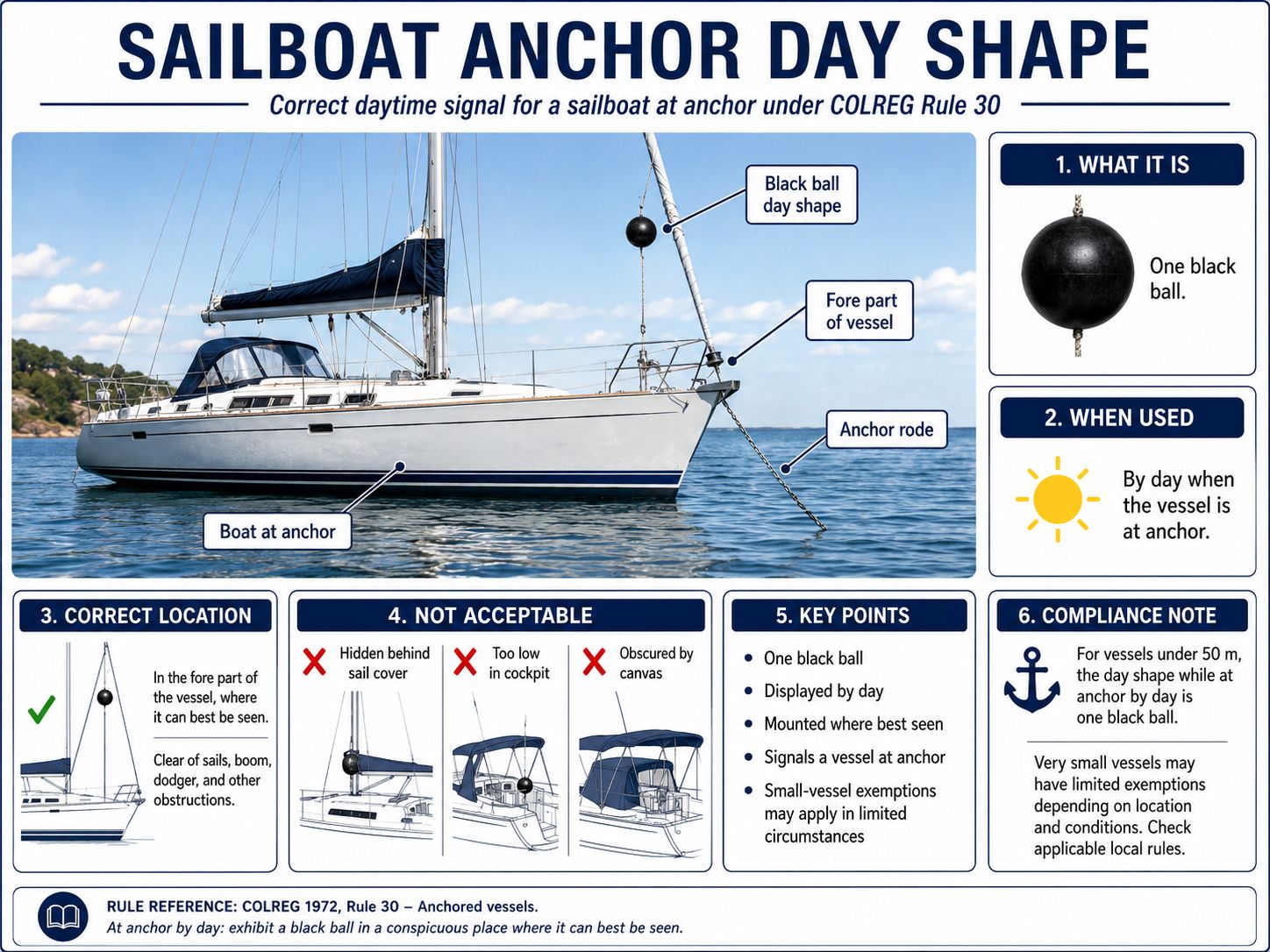
An anchor day shape is the daytime signal used to show that a vessel is lying at anchor. For a sailing yacht, this is normally a single black ball displayed in the fore part of the vessel, positioned where it can best be seen by other vessels. It should be clear of sails, the boom, dodger, bimini, mast fittings, radar reflectors, rigging, and any other obstruction that could hide it from one direction.
The anchor day shape is the daytime equivalent of the anchor light used at night. It tells approaching vessels that the yacht is not underway and may be lying to wind, tide, or current. Under COLREG Rule 30, a vessel at anchor is required to show the prescribed anchor signal where it can best be seen, with the black ball used during daylight and the appropriate all-round white anchor light used at night. Small-vessel exemptions can apply in limited circumstances, but for normal anchoring areas, harbours, channels, approaches, and places where other vessels navigate, the black ball should be displayed.


Installation Considerations
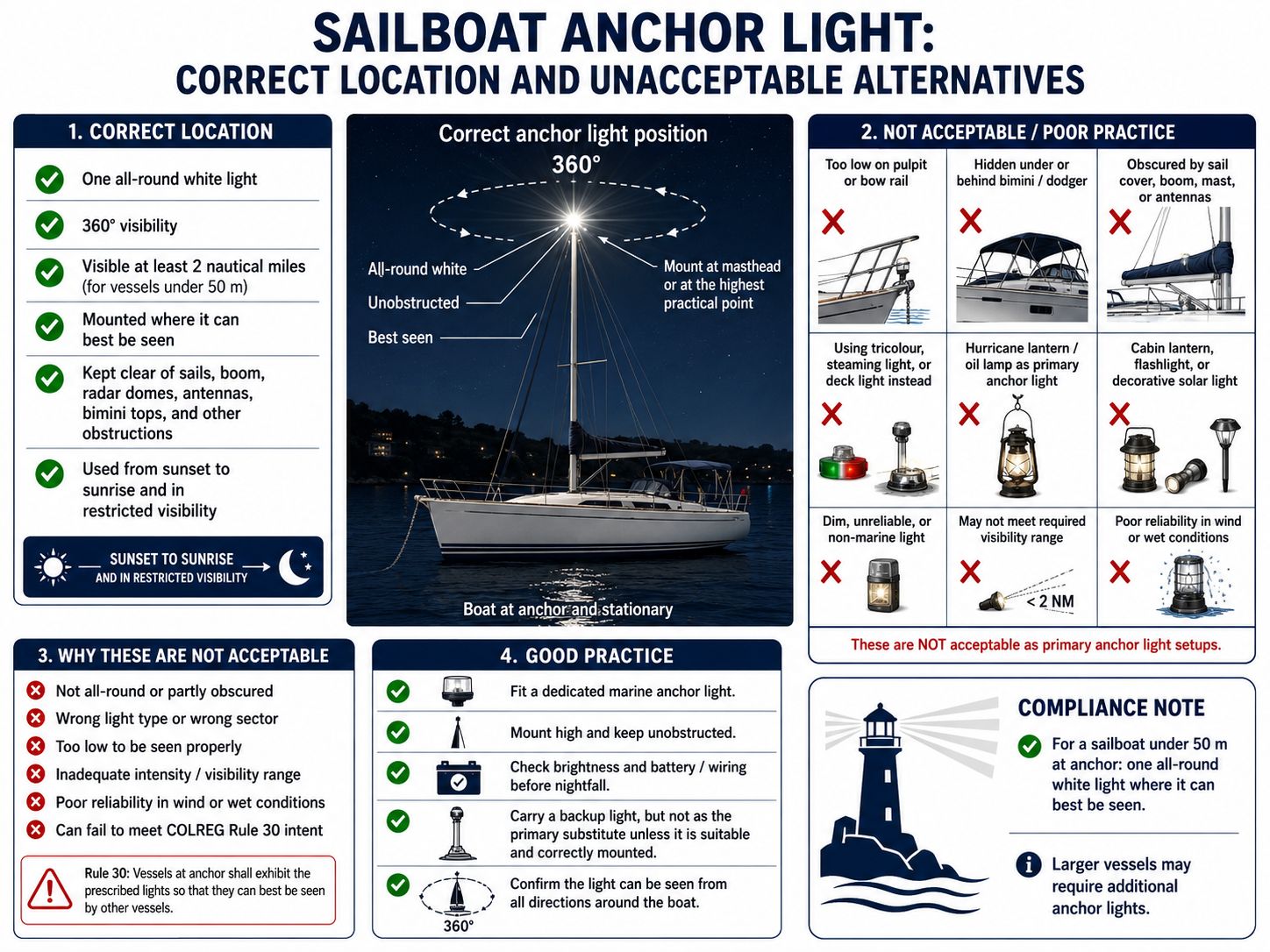
Light Placement. If obstructions exist, relocate or adjust equipment to maintain full visibility. Hanging a small light on one of the flag halyards is not legal. To comply with regulations, the light must:
- Provide true 360° visibility with no shadows cast by rigging, antennas, radar, or wind instruments.
- Be mounted high enough to avoid obstruction by sails or deck structures.
- Be on the forepart of the vessel (masthead qualifies).
Anchor Light for Boat - Electrical Factors
Redundant wiring or a backup light is beneficial for offshore cruising. Anchor lights must be:
- Wired through a dedicated circuit breaker or labelled switch
- Protected from corrosion and moisture
- Installed with UV-resistant wiring and proper strain relief
Light Intensity and Colour. The anchor light must emit pure white light within IMO-compliant intensity. Mixing warm and cool LEDs or using decorative lighting does not meet requirements.
Anchor Light for Boat - Operational Best
Practices
- Always Use the Anchor Light When Anchored Overnight (or in poor visibility conditions). Even in isolated anchorages, unexpected traffic, from ferries, fishing vessels, charter boats may pass close by. Failure to show a light can make a yacht effectively invisible. Failure to show a light is illegal and in case of allision your insurer may disallow the claim.
- Use an Auxiliary Deck Light for Better Close-Range Visibility. The combination of masthead light (long-range visibility) and deck-level light (short-range visibility) offers the best protection against collision. I tend use uses low power.my foredeck spotlight which is LED and
- Avoid Excessively Bright Lights. Over-powerful lights can confuse other mariners or impair their night vision. Use lights certified for marine use and appropriate intensity. I keep in my vessel file the certificates that came with the lights as proof.
- Do Not Use Coloured or Decorative LED Strips as Anchor Lights. These do not comply with COLREGS and can misidentify the vessel’s status or direction.
Anchor Light for Boat Maintenance
Salt, UV exposure, and vibration can degrade lights quickly. Check before sunset and easier before you leave the marina:
- Lens clarity
- Light output
- Wiring integrity
- Switch function
- Consider Shadow Zones
If radar reflectors, antennas, or wind instruments cast shadows, reposition the light.
Keep the Light Lens Clean. Salt residue and insect or bird contamination can reduce visibility significantly. Cleaning the lens should be part of routine deck maintenance.
Anchor Light for Boat
The proper use of an anchor light is a fundamental element of safe seamanship on sailing yachts. Compliance with COLREGS ensures legal operation, but more importantly, a correctly selected, installed, and used anchor light greatly reduces the risk of nighttime collision. By combining a certified masthead LED anchor light with good operational practices, regular testing, redundancy, and auxiliary deck illumination, yacht owners can ensure maximum visibility, protect their vessel and crew, and improve safety for all mariners navigating at night. The anchor light for boat is simple but too often neglected, stay legal.