Singapore Sailing and Cruising Guide
Singapore Sailing and Cruising Guide. Singapore is Southeast Asia’s most capable maritime hub and one of the busiest shipping zones in the world. For yachts, it offers world‑class marina facilities, exceptional provisioning, and reliable access to technical services, but it also demands disciplined navigation and strict compliance with regulations. The coastline is defined by deep‑water channels, industrial terminals, and controlled anchorages, with recreational movement confined to designated routes. Despite the density of commercial traffic, Singapore remains one of the safest operational environments in the region due to its clear rules, accurate charting, and predictable infrastructure, making it a dependable base for any Singapore sailing guide or Singapore yacht navigation reference. I have lived and worked in Singapore for several years and this is a summary.
Most yachts use Singapore as a major reset point, taking advantage of its haul‑out capacity, technical depth, and global‑scale provisioning before continuing toward Malaysia, Indonesia, or the wider Indian Ocean. The marinas on the southern, western, and eastern coasts provide secure berthing, deep water, and direct access to transport and services. Singapore is not a casual cruising destination, but it is one of the most professionally managed yacht hubs in Asia, offering predictable access to everything required for maintenance, repairs, provisioning, and crew movements, and forming a natural hub for Singapore yacht services and Singapore sailing weather planning.
Navigation,
Depths, Tides and Currents
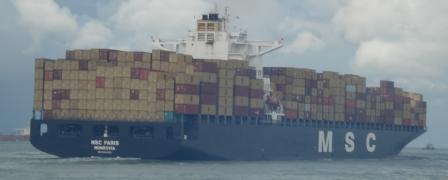
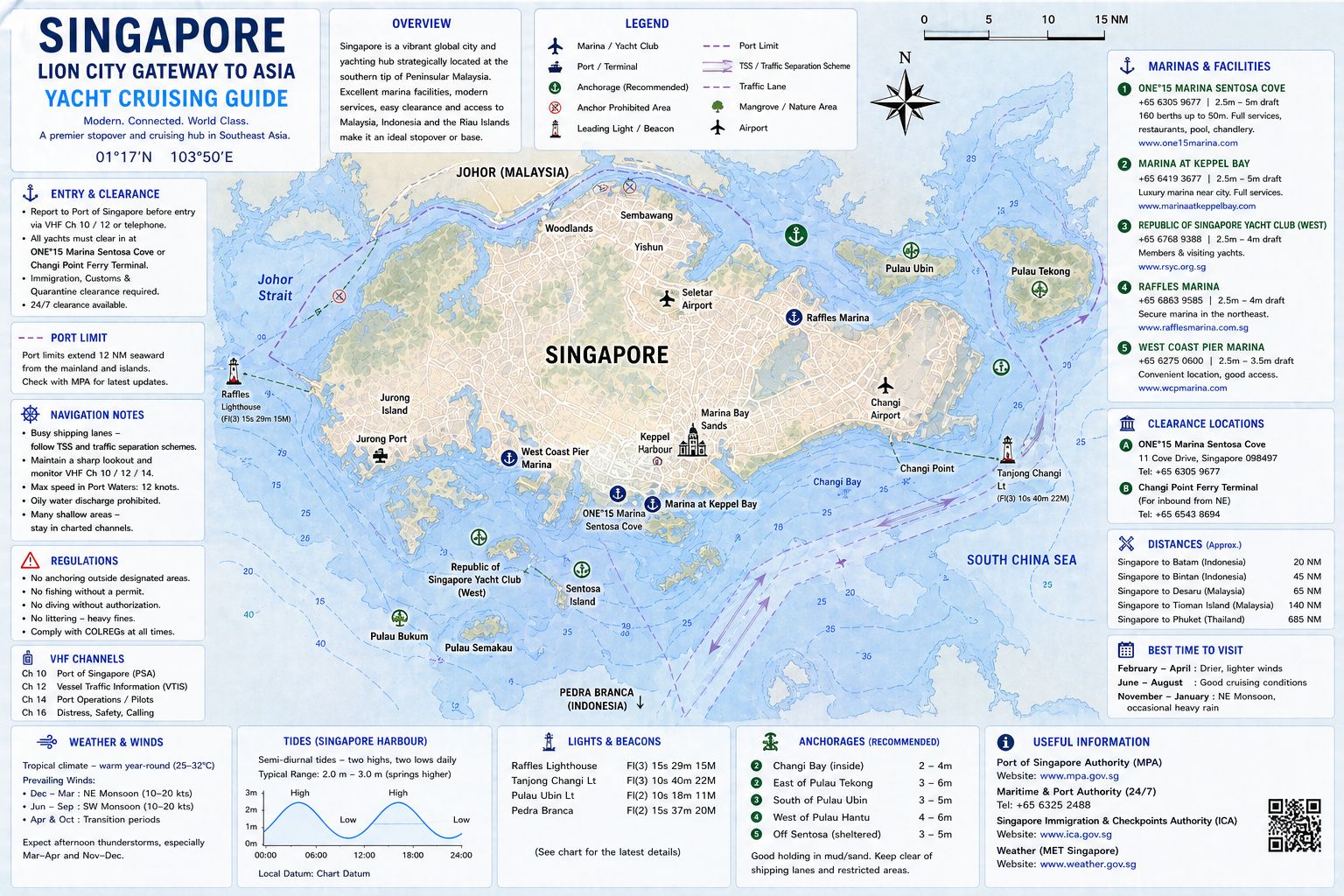
Navigation in Singapore requires accuracy due to the density of commercial traffic and the confined nature of the Singapore Strait. The main deep‑water fairways carry charted depths between 20 and 40 metres, while the recreational routes used by yachts run in 8 to 18 metres and remain clearly marked. Approaches to the marinas are dredged and maintained, with 5 to 10 metres in the access channels and 3 to 5 metres inside the basins. These depths remain stable because the port maintains continuous dredging to support commercial operations, and they form the basis of most Singapore marina approach depths queries
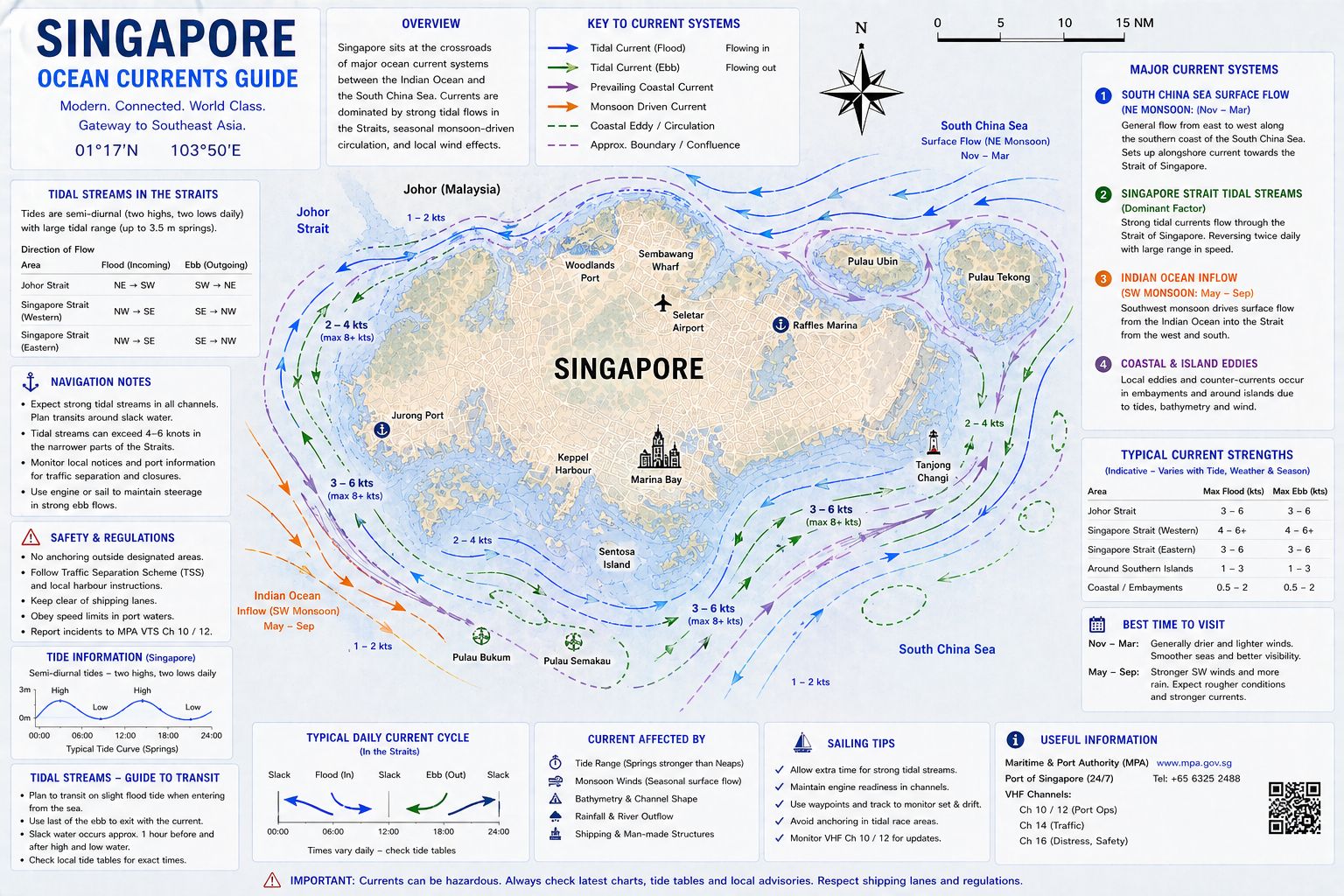
Tidal behaviour follows a mixed semidiurnal pattern, with a typical range of 1.5 to 3.0 metres, springs occasionally reaching 3.2 metres, and neaps falling below 1.0 metre. These variations influence clearance over shallow patches near Sentosa and Changi and affect the strength of the tidal streams. The Singapore Strait is known for strong currents, with 2 to 3 knots common on ordinary tides, 4 to 5 knots during springs, and up to 6 knots in constricted areas such as the approaches to St John’s Island or the edges of the commercial anchorages. These patterns are central to Singapore strait tidal streams for yachts and Singapore tides and currents planning. The east‑going stream sets toward the Malacca Strait, while the west‑going stream sets toward the South China Sea, and slack water is often brief. Cross‑set is strongest around the Southern Islands, Keppel Harbour, and the eastern approaches toward Changi, and skippers must anticipate lateral movement when entering marina channels or crossing shipping lanes.
Traffic Separation
Scheme and Hazards
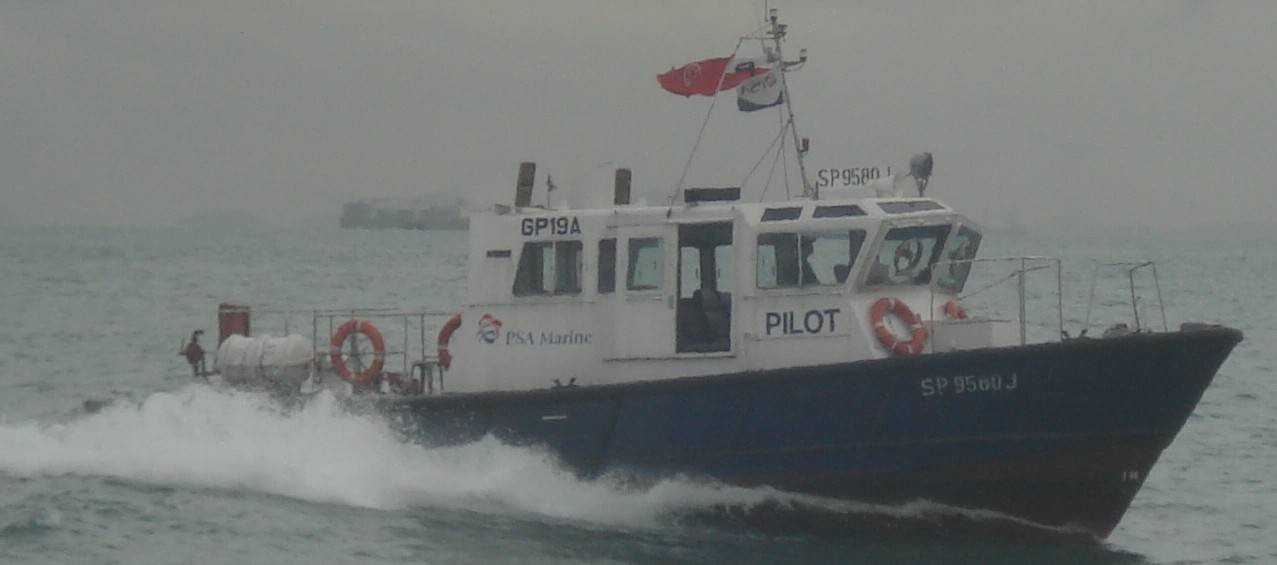
The Traffic Separation Scheme dominates the central strait and must be avoided by yachts except when crossing at right angles. The density of shipping, tug and barge movements, and bunker operations creates a visually complex environment, especially at night. Naval zones, petrochemical terminals, and commercial anchorages are strictly off‑limits. Wake from large vessels can be significant, and bunker barges may show inconsistent lighting. Despite these challenges, navigation remains predictable because buoyage is clear, charting is accurate, and enforcement is consistent, forming the backbone of most Singapore recreational vessel routes guidance.
Singapore Sailing and Cruising Guide - Pilotage
Pilotage into the marinas follows a disciplined approach. ONE°15 Sentosa Cove requires a transit through a dredged channel where a 2 to 3 knot cross‑set is common and ferry traffic is frequent. Keppel Bay is approached through Keppel Harbour, a narrow but deep channel where lateral set can push a yacht off line if not anticipated. RSYC on the West Coast offers a more straightforward approach, though tug and shipyard movements require attention. Changi Sailing Club has the shallowest approach, with depths between 4 and 7 metres depending on tide, making daylight entry preferable. Raffles Marina near Tuas provides deep water and a wide entrance channel, making it a practical base for maintenance and long‑term berthing. These approaches collectively form the core of Singapore yacht pilotage notes used by visiting skippers.
Singapore Sailing and Cruising Guide - Anchorages
Anchoring in Singapore is tightly controlled. Recreational anchoring is permitted only in designated areas, and most yachts choose marina berths due to the density of commercial traffic and the limited availability of safe anchorages. The permitted anchorages lie in sheltered waters with mud bottoms and reliable holding, but they are functional rather than scenic and require compliance with reporting and movement restrictions. These rules underpin most Singapore yacht anchorage rules queries from visiting yachts.
Singapore Sailing and Cruising Guide - Entry Formalities
Entry formalities in Singapore are precise but efficient. Yachts must submit arrival notifications, follow designated reporting points, and comply with Immigration, Customs, and Maritime and Port Authority requirements. Documentation for crew, vessel registration, and communications equipment must be in order, and AIS must remain active. These procedures form the basis of most Singapore yacht entry requirements searches and remain consistent year‑round.
Singapore Sailing and Cruising Guide - Marinas
Singapore’s marina network is extensive and professionally managed, with each facility offering a distinct operational role. ONE°15 Sentosa Cove functions as the primary leisure marina, with a dredged approach channel carrying 6 to 8 metres of depth and a basin between 3.5 and 5 metres. The fairways are wide, the berths secure, and the marina provides direct access to provisioning, technical contractors, and transport links.
Marina at Keppel Bay sits within Keppel Harbour and is approached through a narrow but deep channel that maintains 10 to 15 metres in the fairway and 6 to 8 metres at the entrance. The marina basin holds between 3.5 and 5 metres. It is built to superyacht standards and benefits from close proximity to shipyards and specialist contractors, making it a strong choice for yachts requiring technical support while remaining close to the city centre.
RSYC on the West Coast is the most technically focused facility, with 5 to 7 metres in the approach and 3 to 4.5 metres inside the basin. It offers haul‑out capability, mechanical and electrical workshops, and a protected environment suited to long‑term berthing. Tug and shipyard movements are common in the surrounding waters, but the marina itself remains calm and operationally straightforward.
Changi Sailing Club provides a quieter, club‑style environment on the eastern side of Singapore. Depths in the mooring field range from 3 to 6 metres, and the approach varies between 4 and 7 metres depending on tide. It is the shallowest of the recreational facilities and benefits from daylight entry, but it offers a sheltered anchorage and convenient access for yachts transiting to or from the South China Sea.
Raffles Marina near Tuas offers deep‑water access with 6 to 8 metres in the approach and 3.5 to 5 metres inside the basin. It is well suited to maintenance and long‑term berthing, with haul‑out capability and fabrication services on site. Its location near the western approaches makes it a practical base for yachts preparing to move toward the Malacca Strait or the west coast of Peninsular Malaysia
Singapore Sailing and Cruising Guide - Local Weather
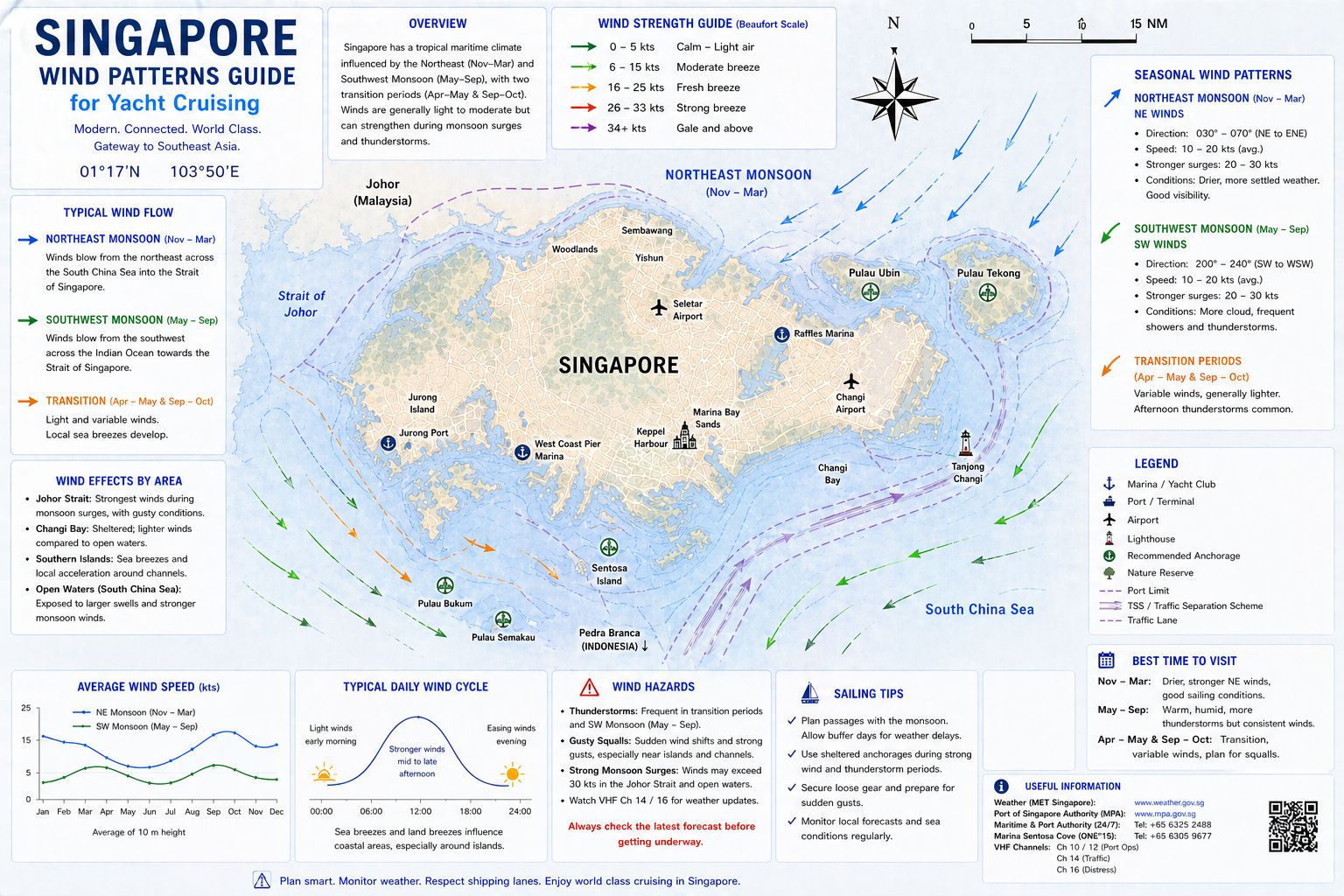
Singapore experiences a tropical climate with two monsoon seasons. The Northeast Monsoon brings steadier winds and more frequent rain, while the Southwest Monsoon introduces humidity, thunderstorms, and variable conditions. The sea state remains manageable year‑round due to the sheltered nature of the Singapore Strait, though thunderstorms can produce strong gusts and reduced visibility. These patterns define the operational weather considerations for Singapore and underpin most Singapore sailing weather searches.
Singapore Sailing and Cruising Guide - Currents
Ocean currents around Singapore are dominated by strong tidal streams rather than large oceanic currents, due to its position between the Strait of Malacca and the South China Sea via the Singapore Strait. Tidal currents in the Singapore Strait can be significant, commonly running 2–4 knots and occasionally stronger in constricted channels, with direction reversing approximately every six hours. The west-going stream (ebb) sets toward the Strait of Malacca, while the east-going stream (flood) flows toward the South China Sea, often creating steep, short seas when opposed by strong monsoonal winds. Seasonal monsoon patterns influence surface drift, with the northeast monsoon (December–March) reinforcing westward flow and the southwest monsoon (June–September) introducing more variable conditions. Complex bathymetry, heavy traffic, and numerous islands and shoals generate localized eddies and turbulence, particularly near headlands, port approaches, and reclamation zones. For yacht navigation, careful tidal planning is essential, as current set and drift can significantly affect course over ground, especially in narrow passages and busy shipping lanes.
Singapore Sailing and Cruising Guide - Provisioning
Supermarkets: Singapore has extensive supermarket coverage with reliable stock levels. Cold Storage (CS Fresh) carries Western imports including cheeses, cured meats, baking supplies, cereals, and packaged foods. FairPrice Finest and FairPrice Xtra provide fresh produce, dry goods, and bulk staples. Sheng Siong supplies Asian staples, herbs, spices, noodles, and competitively priced fresh ingredients. Little Farms offers premium organic produce and specialty imports, while Mustafa Centre provides a wide range of international dry goods and spices and operates continuously. These outlets collectively support most Singapore provisioning for yachts and Singapore provisioning supermarkets searches.
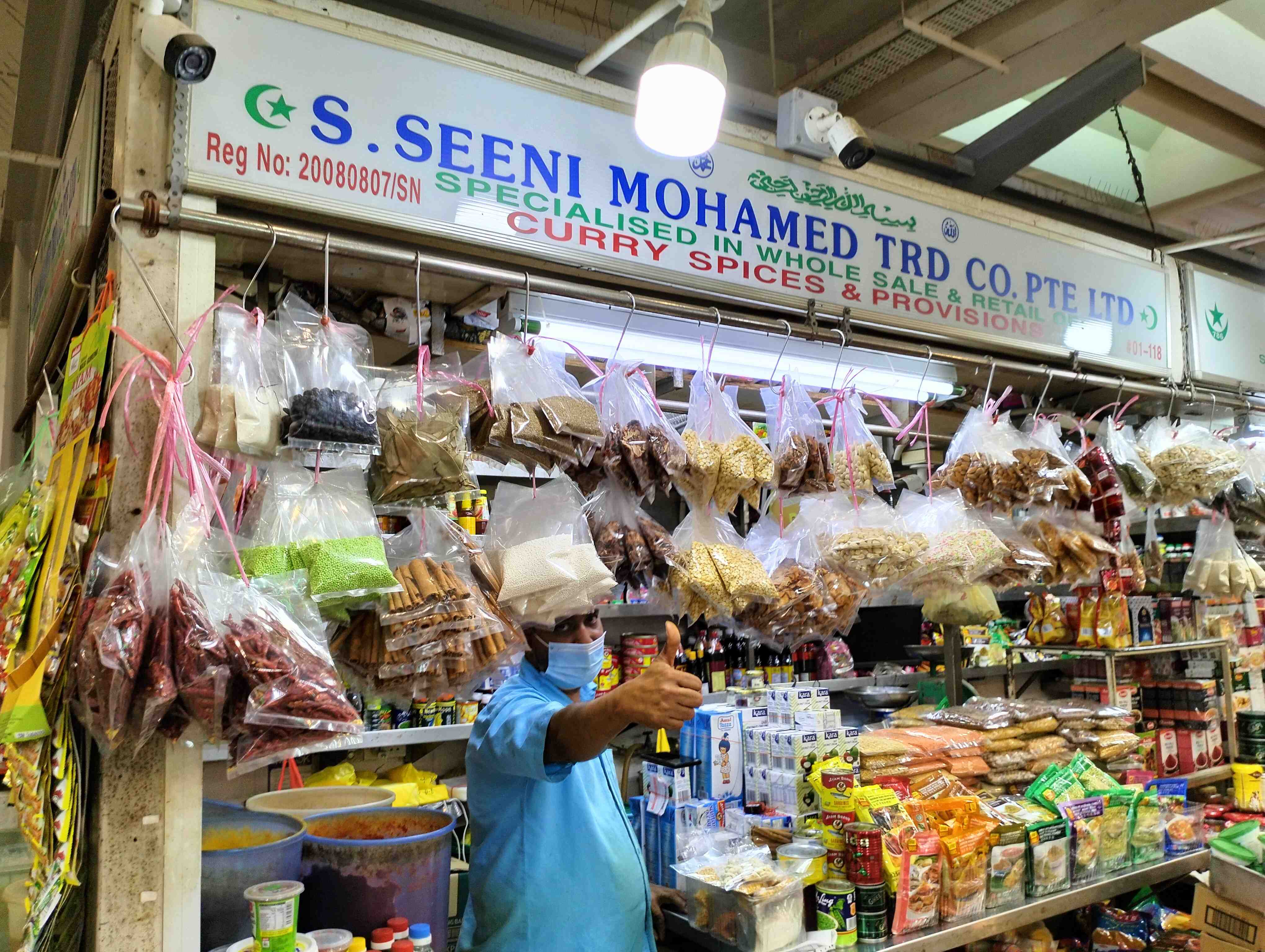
Markets: Tekka Market in Little India operates as a two‑level municipal market complex with a wet market on the ground floor and a hawker centre above. The downstairs market carries high‑turnover vegetables, herbs, spices, tofu, noodles, poultry, and seafood, with stock replenished daily through local household demand. The seafood section receives early‑morning coastal landings, and the spice vendors supply bulk quantities of dried spices and curry blends (they will mix you a blend to order which is what I do) at lower prices than supermarkets. The hawker centre upstairs provides reliable, low‑cost meals with fast turnover, allowing crews to combine provisioning and meals in a single stop. Its location beside the Little India MRT interchange makes it accessible from all marina districts.

Tiong Bahru Market serves as one of Singapore’s most consistent fresh‑produce markets, with a ground‑floor wet market supplying vegetables, greens, herbs, tofu, noodles, poultry, and a strong seafood section. Turnover is high due to steady local demand, and the seafood stalls carry coastal fish, prawns, squid, and shellfish with predictable quality. Pricing is stable and generally lower than supermarket equivalents. The upper‑level hawker centre provides cooked meals with long operating hours, making it a practical stop for crews needing both provisioning and food. Its central location and reliable stock levels make Tiong Bahru a preferred option for yachts seeking fresh produce without travelling to wholesale ports.
Chinatown Complex Market continues to offer Chinese greens, tofu, noodles, dried goods, and preserved ingredients with strong turnover driven by local residents. Geylang Serai Market remains the primary source for Malay ingredients, fresh coconut, spice pastes, and sambal components. Together, these markets provide consistent provisioning options for yachts preparing for onward passages.
Fish Markets. Seafood supply is dependable and sourced daily from regional fleets. Jurong Fishery Port is the main wholesale landing point, receiving fish, prawns, squid, and shellfish in volume during early morning hours. Senoko Fishery Port provides similar wholesale access in the north. Tekka Market and Tiong Bahru Market offer smaller‑scale fresh coastal fish and shellfish with reliable turnover (this is my favourite place for seafood). These sources support most Singapore fish markets for yacht provisioning searches.
Singapore Sailing and Cruising Guide - Local Cuisine
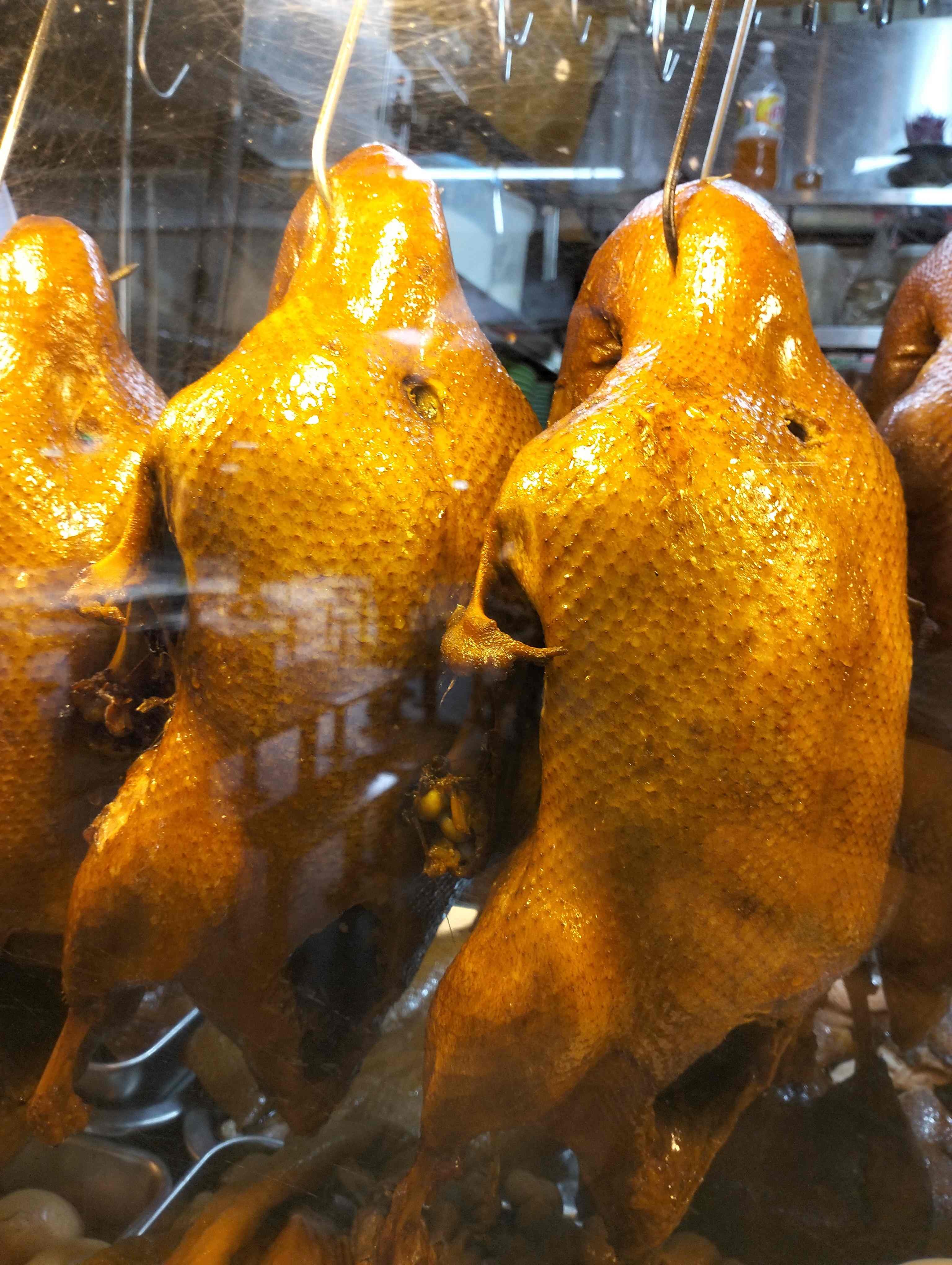
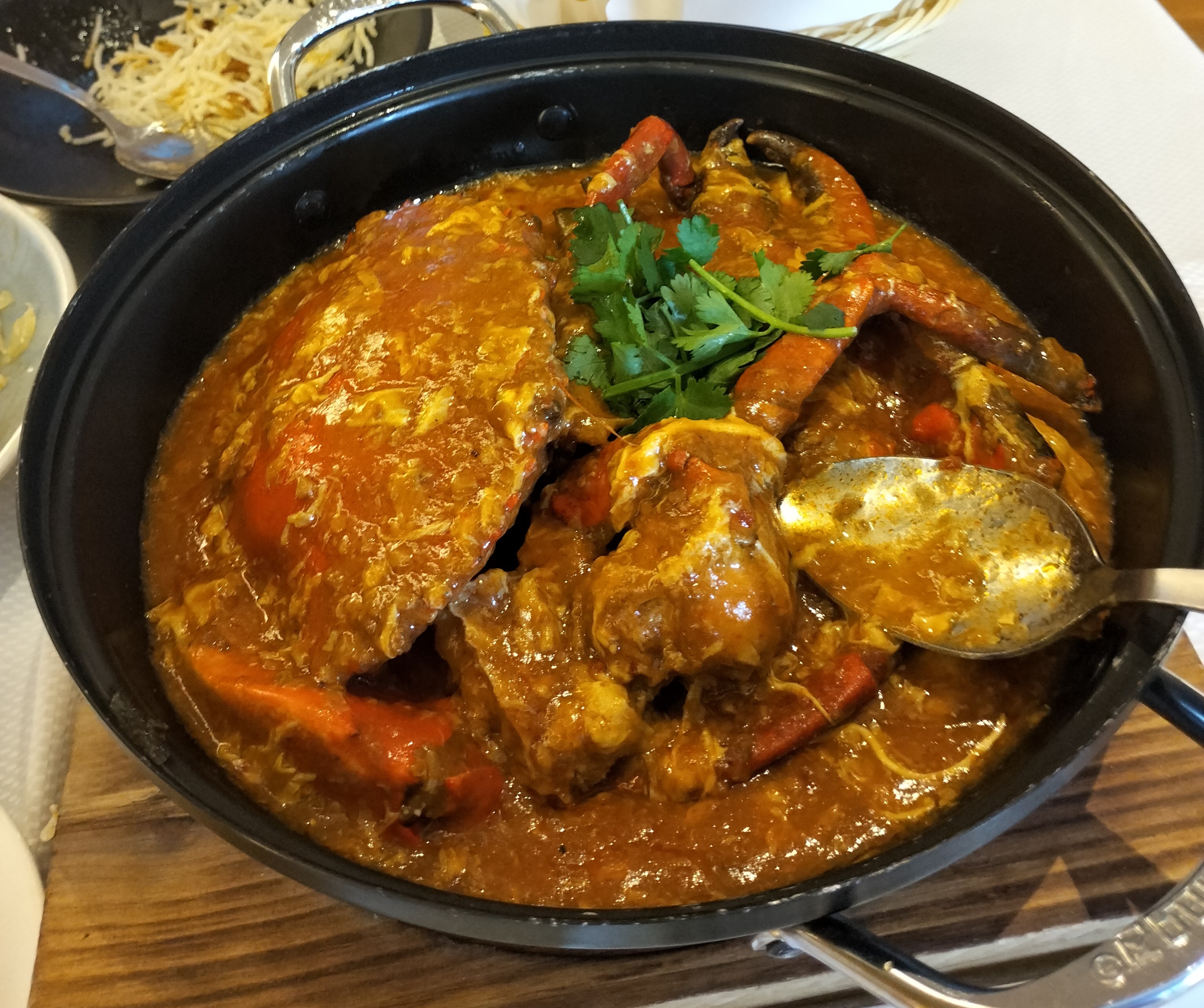
Singapore’s cuisine reflects its Malay, Chinese, Indian, and Peranakan influences, with dishes such as chilli crab, laksa, Hainanese chicken rice, sambal stingray, nasi lemak, roti prata, and fish head curry widely available. These dishes form the core of everyday eating and are accessible throughout the city.
Hawker centres are central to Singapore’s food culture and provide the most reliable and cost‑effective eating options for yacht crews. They offer cooked meals at predictable prices, high turnover, and long operating hours, making them the default choice for value dining. Many centres also include fresh‑produce sections that function as practical provisioning alternatives to supermarkets.
Singapore Sailing and Cruising Guide - Fuel Supplies
Fuel is available at marina fuel docks and roadside stations. Supply is reliable and of high quality due to Singapore’s role as a global bunkering hub. Most yachts refuel here before long‑range passages, forming the basis of many Singapore yacht fuel queries.
Singapore Sailing and Cruising Guide - Water Supplies
Potable water is available at all marinas. Quality is high and consistent, and most yachts fill tanks here before offshore passages.
Mechanical
and Electrical Repairs Resource
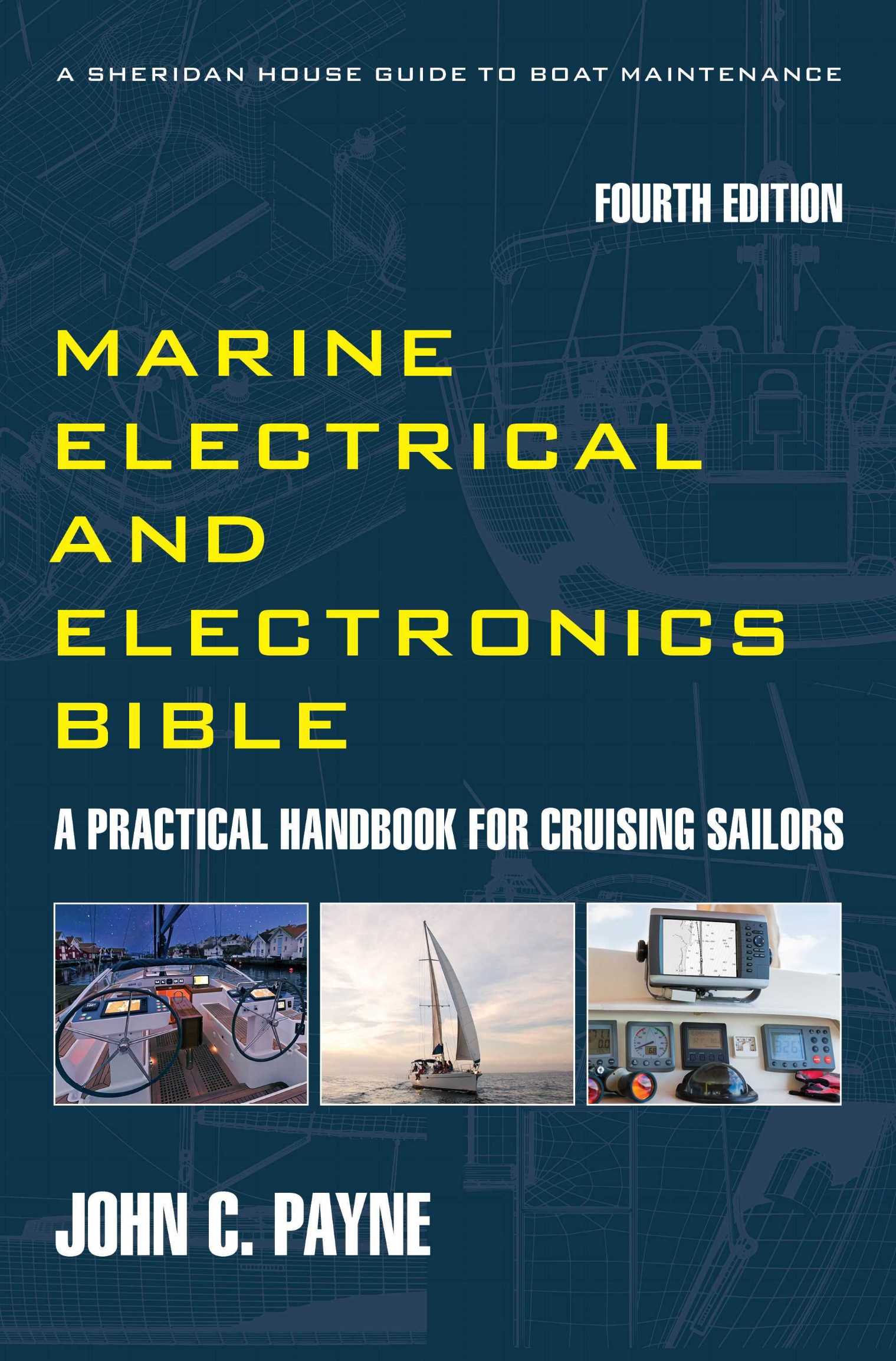
If you are headed somewhere remote consider the need to expand your knowledge base or have an information resource on board. Why not get a copy of my book The Marine and Electrical and Electronics Bible 4th Edition. By and for yachties, with everything from batteries and charging, solar and wind, diesel engines and marine electronics and so much more. Your complete systems guide. 650 pages of practical advice. In Australia and New Zealand order a copy through Boat Books. UK and European boats can buy the UK Edition Here. US and Canadian boats can get the US Edition Order Here. Marine systems are my profession so let me help you. By a liveaboard boat owner for other boat owners


Singapore Sailing and Cruising Guide - Marine Services
Singapore supports one of the strongest marine‑service ecosystems in Asia, with full coverage for mechanical, electrical, rigging, electronics, fabrication, and haul‑out requirements. Most services cluster around the West Coast, Tuas, and Keppel Harbour, with additional contractors operating from Sentosa and Changi.
Chandleries operate near the main marina districts and supply general hardware, ropes, paints, sealants. Specialist suppliers also carry antifouling coatings, stainless‑steel fastenings, and deck hardware. Marine Hub, East Marine, and Chandlery Mart are the primary outlets
Engine service agents for major brands are well represented. Yanmar, Volvo Penta, Cummins, Caterpillar, and Perkins have authorised service centres. Response times are generally fast, and most routine servicing, diagnostics can be completed without delay.
Electronics support is comprehensive, with Raymarine, Garmin, Furuno, and Simrad agents offering installation, calibration, and troubleshooting. Rigging services are available for both wire and synthetic systems.
Rigging services are available for both wire and synthetic systems, with Asia Pacific Rigging and Rope Services Singapore providing inspections, replacements, and fabrication of standing and running rigging.
Sailmaking and sail repair are supported by established lofts including North Sails, Quantum Sails, and Ullman Sails. These lofts provide inspection, repair, recutting, and new‑sail production
Haul‑out capability is provided at RSYC and Raffles Marina, with travel‑lift and hard‑stand facilities suitable for monohulls and multihulls.
Singapore Sailing and Cruising Guide - Transport
Singapore’s MRT network is the quickest and cheapest way to move around the city, with direct links to most marina districts and predictable travel times regardless of traffic. Stations are located close to major markets, hawker centres, and provisioning areas, making it the most efficient option for crew movements. Taxis and ride‑share services are widely available, but visitors must download the local ride‑share app to access standard pricing and avoid delays during peak periods. These options provide reliable point‑to‑point transport when carrying provisions or equipment.
Singapore Sailing
and Cruising Guide - Local Customs
Singapore is a highly regulated environment with strict expectations around behaviour and environmental compliance. Discharge restrictions are enforced, anchoring rules must be followed precisely, and marinas maintain professional standards. Despite the density of traffic and the complexity of the port, Singapore remains one of the safest and most predictable operational bases in the region.
Singapore Sailing
and Cruising Guide - Summary
Singapore is Southeast Asia’s premier yacht hub, offering world‑class marina facilities, exceptional provisioning, and strong technical support. With strict formalities and dense commercial traffic, it requires disciplined navigation, but its infrastructure and reliability make it one of the most valuable operational bases in the region. Singapore Sailing and Cruising Guide for practical first-hand experience.