Sailing to the
Marshall Islands
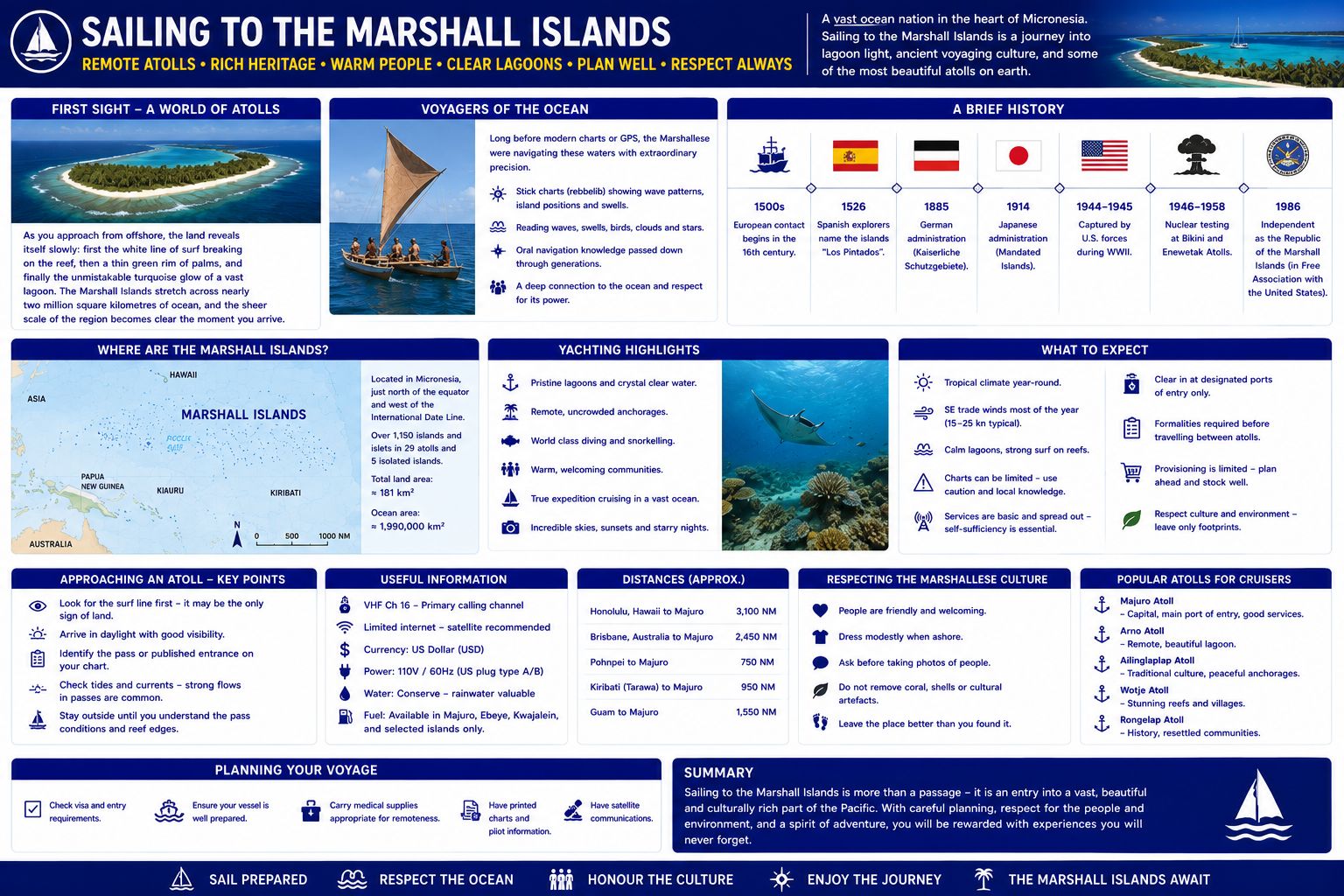
Sailing to the Marshall Islands feels like crossing into a world shaped by lagoon light, long horizons, and the quiet geometry of coral atolls. As you approach from offshore, the land reveals itself slowly: first the white line of surf breaking on the reef, then a thin green rim of palms, and finally the unmistakable turquoise glow of a vast lagoon. For many bluewater cruisers Sailing to the Marshall Islands, this is their first encounter with a truly remote atoll nation, and the experience sets the tone for everything that follows. The Marshall Islands stretch across nearly two million square kilometres of ocean, and the sheer scale of the region becomes clear the moment you arrive.
Long before modern charts or GPS, the Marshallese were navigating these waters with extraordinary precision. Their ancestors settled the atolls thousands of years ago, developing a voyaging tradition built on stick charts, wave‑pattern reading, and an intimate understanding of the sea. European contact began in the 1500s, followed by periods of Spanish, German, and Japanese administration, each leaving subtle marks on language, place names, and infrastructure. After World War II, the islands became part of the U.S. Trust Territory of the Pacific, a period defined by nuclear testing at Bikini and Enewetak events that continue to shape the nation’s identity. Today, the Republic of the Marshall Islands stands as an independent country in free association with the United States, balancing modern governance with a strong cultural heritage.
Sailing to the Marshall Islands - Navigation &
Atoll Passes
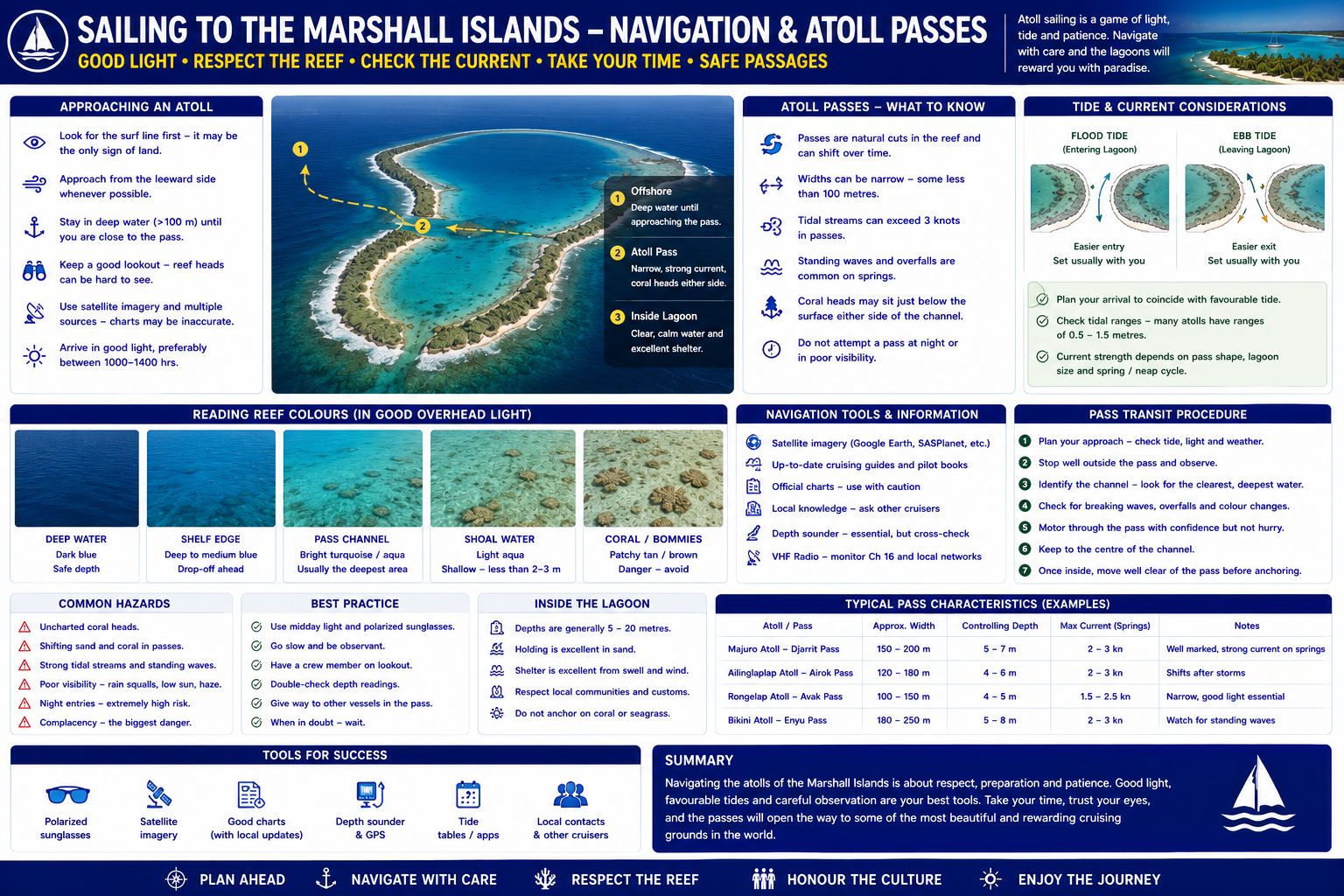
Sailing to the Marshall Islands and navigating requires patience, good light, and a deep respect for the subtleties of atoll sailing. Many lagoon passes are narrow, shifting, and influenced by strong tidal currents, making them challenging even for experienced cruisers. Approaching a pass at midday, with the sun high and polarized glasses on, becomes a non‑negotiable ritual rather than a suggestion. Satellite imagery is invaluable, especially when official charts prove inaccurate, a common reality in remote Pacific cruising grounds. These waters reward sailors who understand coral navigation, lagoon sailing techniques, and the nuances of reading reef colours. Once inside, the lagoons offer calm water, shelter, and some of the most pristine anchorages in Micronesia.
Arrival
Formalities & Port of Entry
When Sailing to the Marshall Islands the port and capital of Majuro serves as the primary port of entry for yachts and the administrative heart of the Republic of the Marshall Islands. Clearing in involves Immigration, Customs, Quarantine, and the Port Authority, all located within reach of the main anchorage. The process is straightforward but can take time, especially when several boats arrive together. Yachts typically receive an initial stay that can be extended, and officials are accustomed to visiting cruising vessels. Once formalities are complete, Majuro becomes your staging ground for exploring the wider archipelago.
Sailing to the Marshall Islands - Provisioning
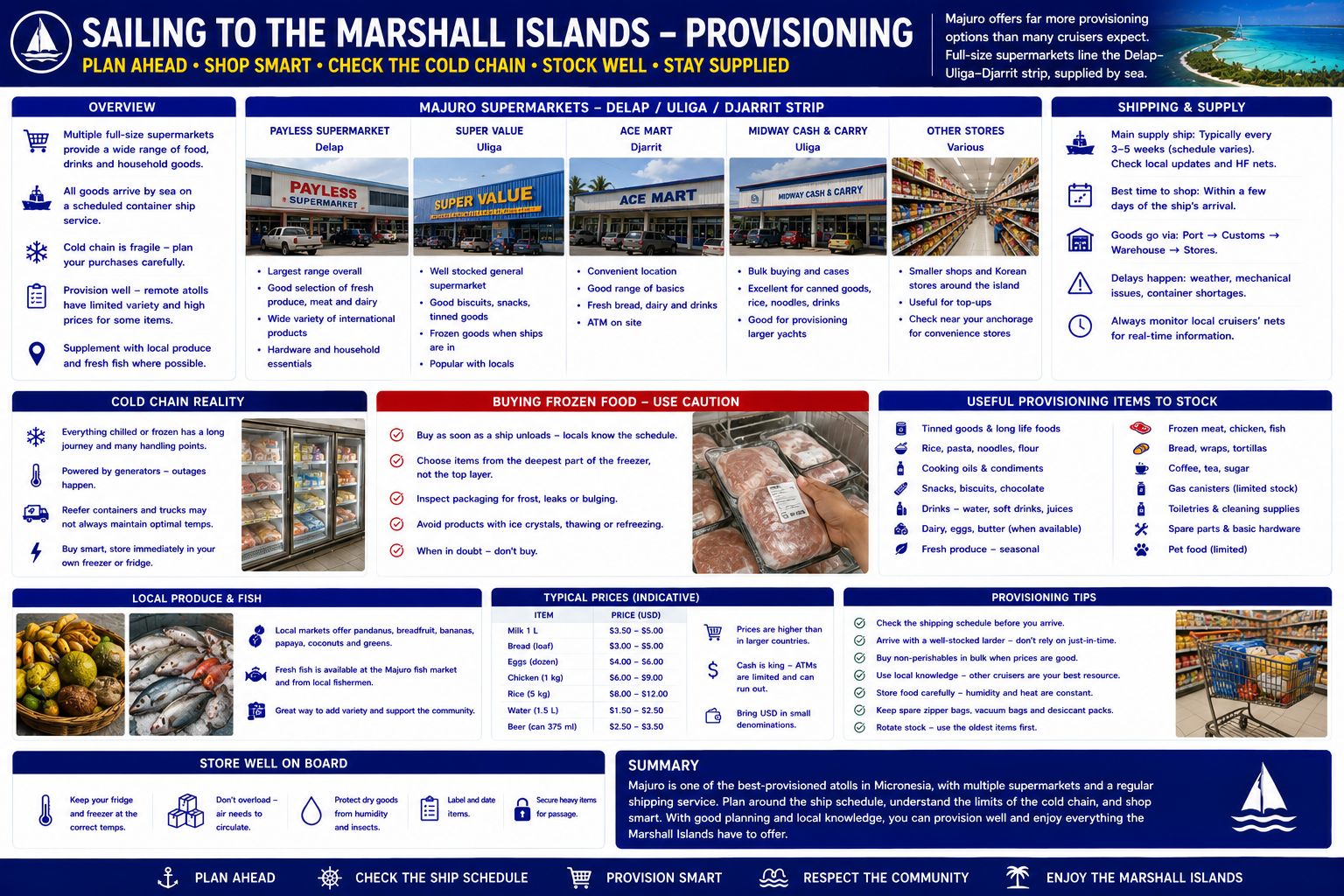
It is some years since my last visit to Majuro. Majuro’s provisioning scene is far more robust than many sailors expect when approaching a remote Pacific atoll. Instead of relying on one or two shops, cruisers find a string of full‑size supermarkets spread along the Delap–Uliga–Djarrit strip, each with its own offerings and all tied to the island’s shipping schedule. These stores form the backbone of provisioning for both locals and visiting yachts, and together they create a surprisingly workable supply chain in a place where almost everything arrives by sea. Majuro’s cold chain is fragile because every chilled or frozen item arrives by ship, passes through multiple handling points, and depends on generators, reef‑side warehouses, and local delivery trucks. Any delay, a late container ship, a power outage, a broken reefer unit can compromise temperature‑sensitive goods. Apply caution as described for other Pacific Islands when buying frozen food. Buy frozen goods as soon as a ship unloads — locals know the schedule. Choose items from the deepest part of the freezer, not the top layer. Inspect packaging for frost, leaks, or bulging.
Sailing to the Marshall Islands - Provisioning in Majuro
Supermarkets. The largest and most consistent supermarkets include K&K Island Pride, Payless Supermarket, Formosa Supermarket, and EZ Price Mart. Each carries a broad mix of imported American, Asian, and Australian goods, with shelves stocked with dry staples, frozen meats, canned foods, snacks, and household supplies. Because shipments arrive irregularly, one store might have fresh apples while another has just received a pallet of frozen chicken or a rare batch of leafy greens. You soon learn to visit several supermarkets in a single provisioning run, piecing together a complete load from whatever happens to be available that week.
Fresh produce remains the most unpredictable part of provisioning. When a container ship arrives, the vegetable aisles briefly look abundant, but a few days later, the selection narrows to hardy staples like cabbage, carrots, and onions. Freezer sections, however, are consistently reliable, making them essential for long‑term cruising plans. Specialty items, cheeses, cured meats, gluten‑free foods, plant‑based products appear occasionally.
Majuro is dotted with smaller Asian groceries and convenience shops that fill in the gaps. These places often carry noodles, sauces, spices, and snacks that don’t appear in the larger supermarkets, and they’re invaluable for adding variety to a provisioning run.
Markets. Majuro’s local markets are small but essential for anyone chasing truly fresh produce. Instead of supermarket imports, these stalls offer whatever the land and sea have provided that week, breadfruit, pandanus, bananas, coconuts, and the occasional bundle of greens brought in from outer islands. Supplies are seasonal and limited, but the freshness is unmatched. For cruisers, these markets are the best source of island‑grown food and a welcome break from container‑ship vegetables.
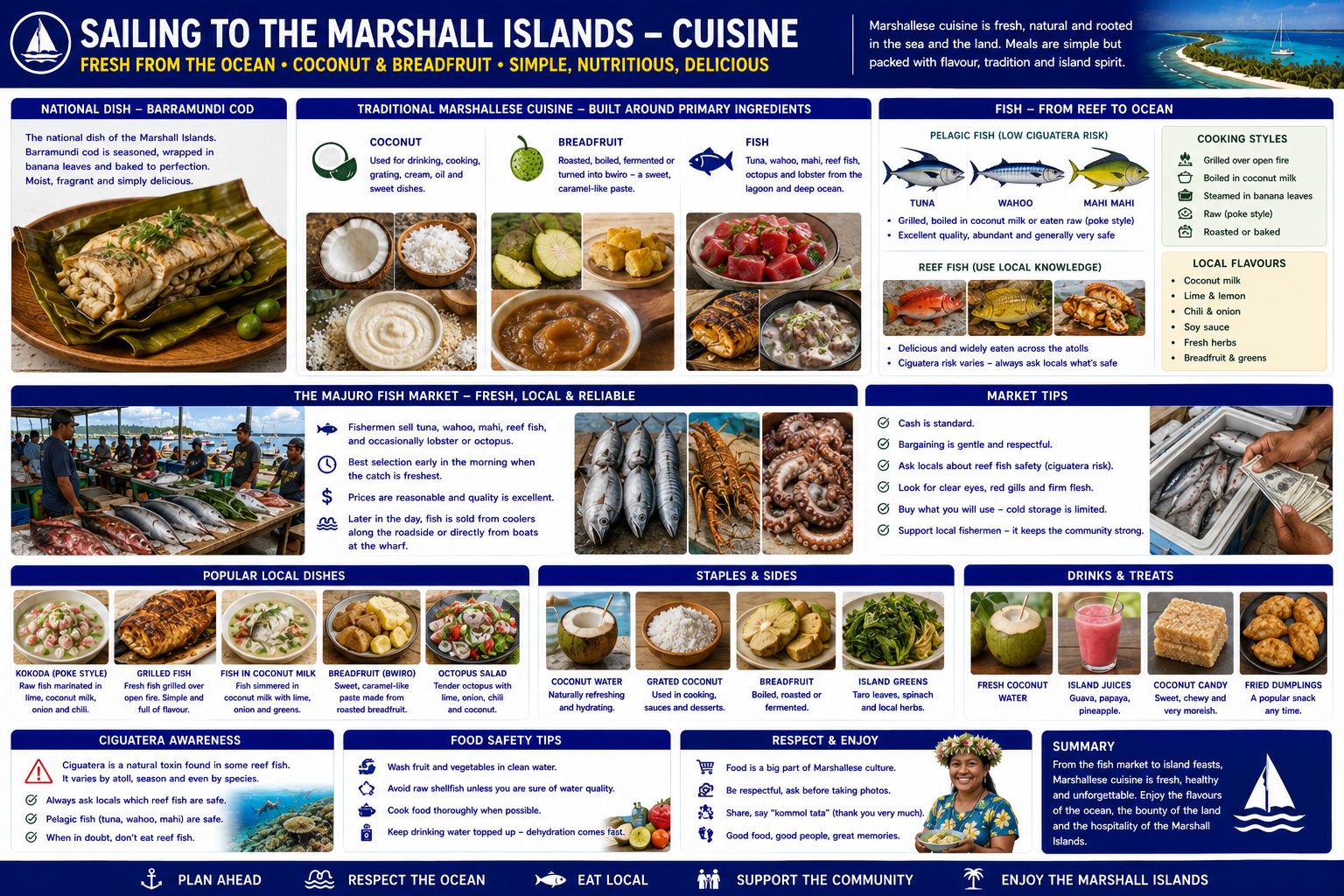
The Majuro Fish Market. Fishermen sell tuna, wahoo, mahi, reef fish, and occasionally lobster or octopus. Prices are reasonable, and the quality is excellent, especially early in the morning when the catch is freshest. Because reef fish can carry ciguatera in some atolls, many cruisers prefer to buy pelagics here rather than rely on lagoon fishing. Later in the day, fishermen often sell from coolers along the roadside or directly from small boats at the wharf. Quality is excellent, prices are fair, and everything depends on the day’s catch. Cash is standard, bargaining is gentle, and local advice is invaluable, especially when deciding which reef fish are safe from ciguatera.
Sailing to the Marshall Islands - Cuisine
The national dish of the Marshall Islands is Barramundi Cod, which is seasoned, wrapped in banana leaves and baked. Traditional Marshallese cuisine is built around primary ingredients. Coconut which is used for drinking, cooking, grating, cream, oil, and sweet dishes. Breadfruit which is roasted, boiled, fermented, or turned into bwiro (a sweet, caramel‑like paste) and of course fish which includes tuna, wahoo, mahi, reef fish, octopus, and lobster. Pelagic fish like tuna and wahoo are grilled, boiled in coconut milk, or eaten raw in dishes similar to poke. Reef fish are eaten too, though ciguatera risk varies by atoll, so local knowledge guides what’s safe.
Sailing to the Marshall Islands - Water Supplies
Majuro survives on rain, and the entire atoll is shaped by the rhythm of collecting and storing it. Most households rely on rooftop catchments that feed into personal tanks, but the island’s most important source is the vast airport runway catchment, where every rainfall is channelled into huge concrete reservoirs near the airfield. With no rivers or reliable groundwater, this system becomes Majuro’s lifeline, especially during long dry spells. When the rains come, the runway gleams like a giant harvesting sheet, filling the tanks that keep the capital supplied. In drought years, desalination plants step in as an expensive backup.
Sailing to the Marshall Islands - Diesel Fuel
Supplies
Because the Marshall Islands are spread across such a vast area, and because many passes require careful timing, diesel isn’t just convenience , it’s safety. Calm days, squalls, and long inter‑atoll hops all make reliable fuel essential. Plan your cruising range around that fact, and treat every litre as precious once you head into the outer atolls. Majuro’s fuel supply is handled through large bulk storage tanks near the main wharf. Tankers arrive on a schedule that can be disrupted by weather, mechanical issues, or regional shipping delays. When a tanker is late, the island can experience tight supply periods, though outright shortages are rare. Most yachts refuel from the main commercial wharf, where diesel is pumped directly from the storage system. Like many you can visit service stations, filling jerry cans when dockside access isn’t possible. The quality is generally good, but because storage tanks sit in a humid, salt‑air environment, many cruisers use extra filtration and water‑separating funnels (Baja Funnels) as a precaution. Once you leave Majuro, diesel becomes scarce to nonexistent. Most outer atolls have no fuel stations, no bulk storage, no reliable supply chain. Villages may have a few drums for local boats, but these are often reserved for community use, expensive, or simply unavailable. For sailors, this means depart Majuro full, and carry more jerry cans than you think you’ll need.
Sailing to the Marshall Islands Services and
Repairs
Majuro may be the administrative and logistical heart of the Marshall Islands, but it is not a marine‑services hub in the way many Pacific sailors might expect. There is no shipyard, no travel lift, no haul‑out facility, and no trawler base anywhere on the atoll. The lagoon is full of commercial vessels, purse‑seiners, longliners, and transshipment ships, but they come to refuel, re‑crew, and provision, not to repair. Any serious work, whether for yachts or commercial vessels, is done overseas in places like Fiji, Guam, Cairns, or New Zealand. What Majuro does offer is a patchwork of small‑scale, practical services that keep local boats running and help visiting cruisers solve problems afloat. Welders work from barges or shoreline sheds, mechanics can service outboards and small diesels, and fiberglass workers can tackle modest repairs. These are talented tradespeople, but they operate without the infrastructure of a formal yard. Everything happens in the water, tied to a wharf, or alongside a workboat. If you need assistance go and walk and talk to the locals.
Mechanical
and Electrical Repairs Resource
If you are headed somewhere remote consider the need to expand your knowledge base or have an information resource on board. Why not get a copy of my book The Marine and Electrical and Electronics Bible 4th Edition. By and for yachties, with everything from batteries and charging, solar and wind, diesel engines and marine electronics and so much more. Your complete systems guide. 650 pages of practical advice. In Australia and New Zealand order a copy through Boat Books. UK and European boats can buy the UK Edition Here. US and Canadian boats can get the US Edition Order Here. Marine systems are my profession so let me help you. By a liveaboard boat owner for other boat owners

Sailing to the Marshall Islands - The Atolls
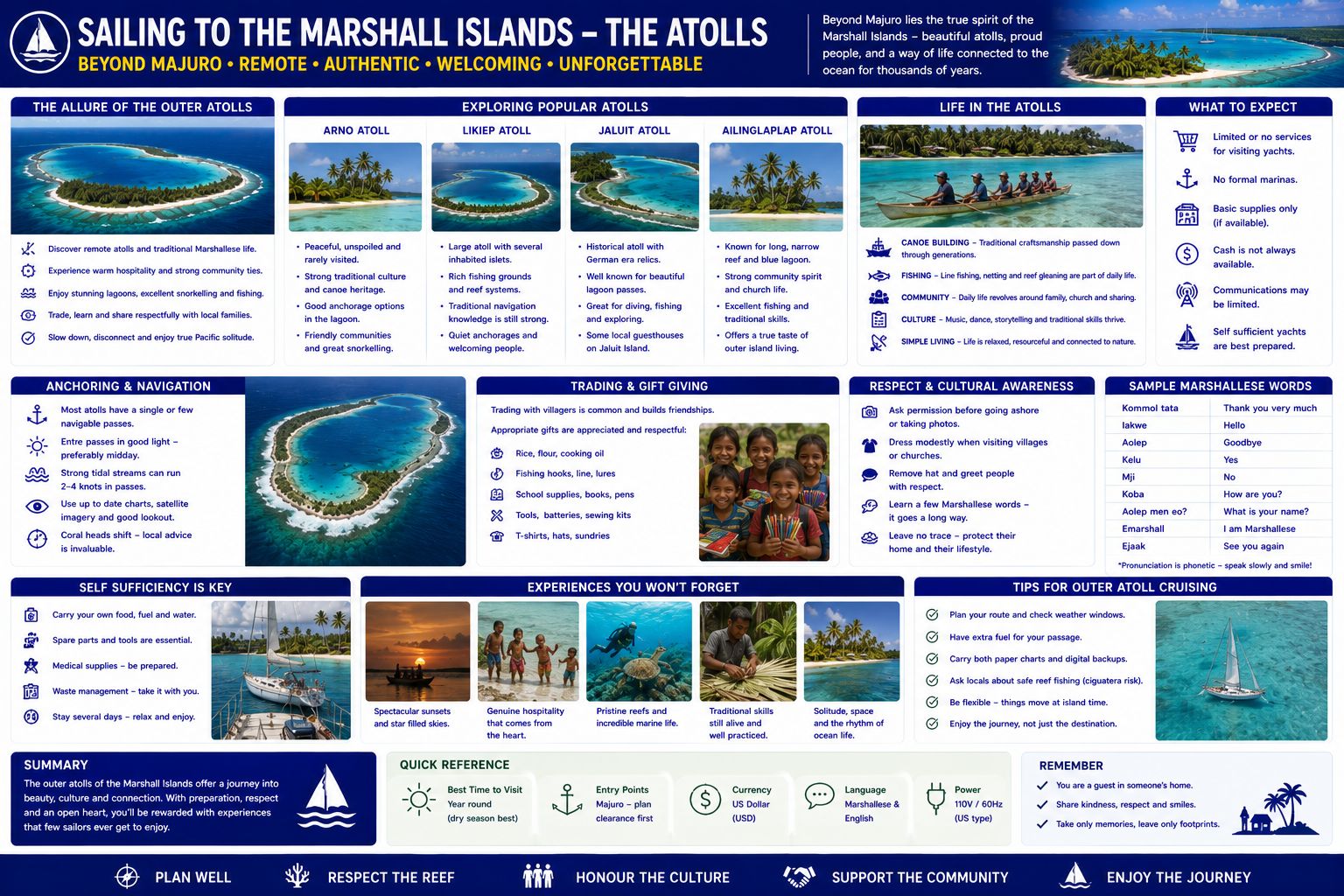
Venturing beyond Majuro reveals the deeper character of the Marshall Islands. Atolls such as Arno, Likiep, Jaluit, and Ailinglaplap offer a glimpse into traditional Marshallese life, where canoe building, fishing, and community gatherings shape the rhythm of each day. These islands are quiet, welcoming, and culturally rich, but they offer few if non-existent services for visiting yachts. Cruisers searching for authentic Marshallese culture, outer atoll sailing experiences, or remote Pacific island anchorages will find these places unforgettable. Trading with villagers is common, and simple gifts, rice, hooks, school supplies are appreciated and appropriate.
Weather, Seasons
& Cruising Conditions
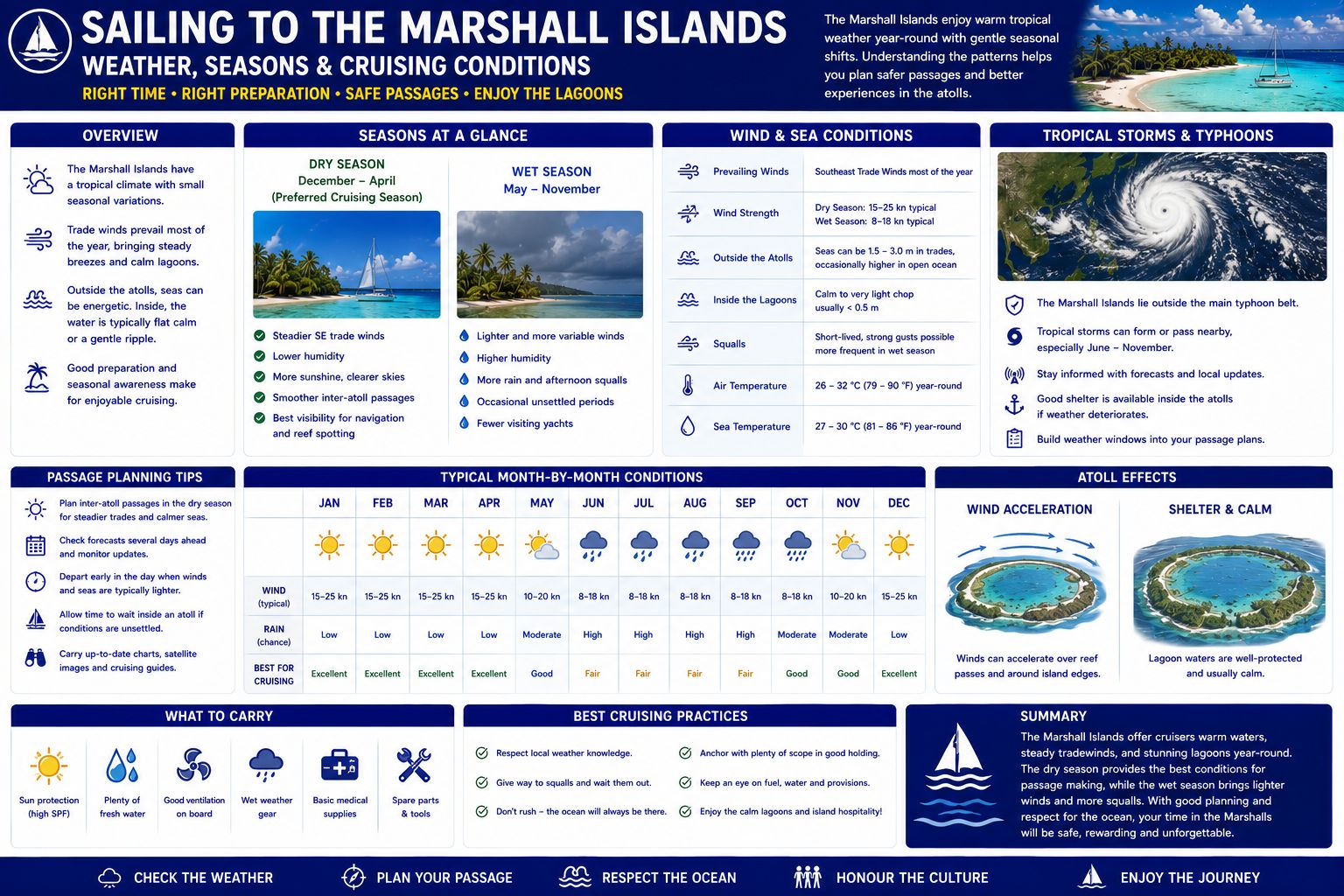
The Marshall Islands sit in a region where weather patterns shift gently rather than dramatically. The dry season, from December to April, brings steadier trade winds and clearer skies, making it the preferred time for inter‑atoll passages. The wet season softens the winds and introduces more humidity, squalls, and unsettled conditions. Although the country lies outside the main typhoon belt, storms can still form or pass nearby, so seasonal awareness remains important. Outside the atolls, the sea state can be lively, but once inside the lagoons, the water becomes calm.
Sailing to the Marshall Islands - WW2 History
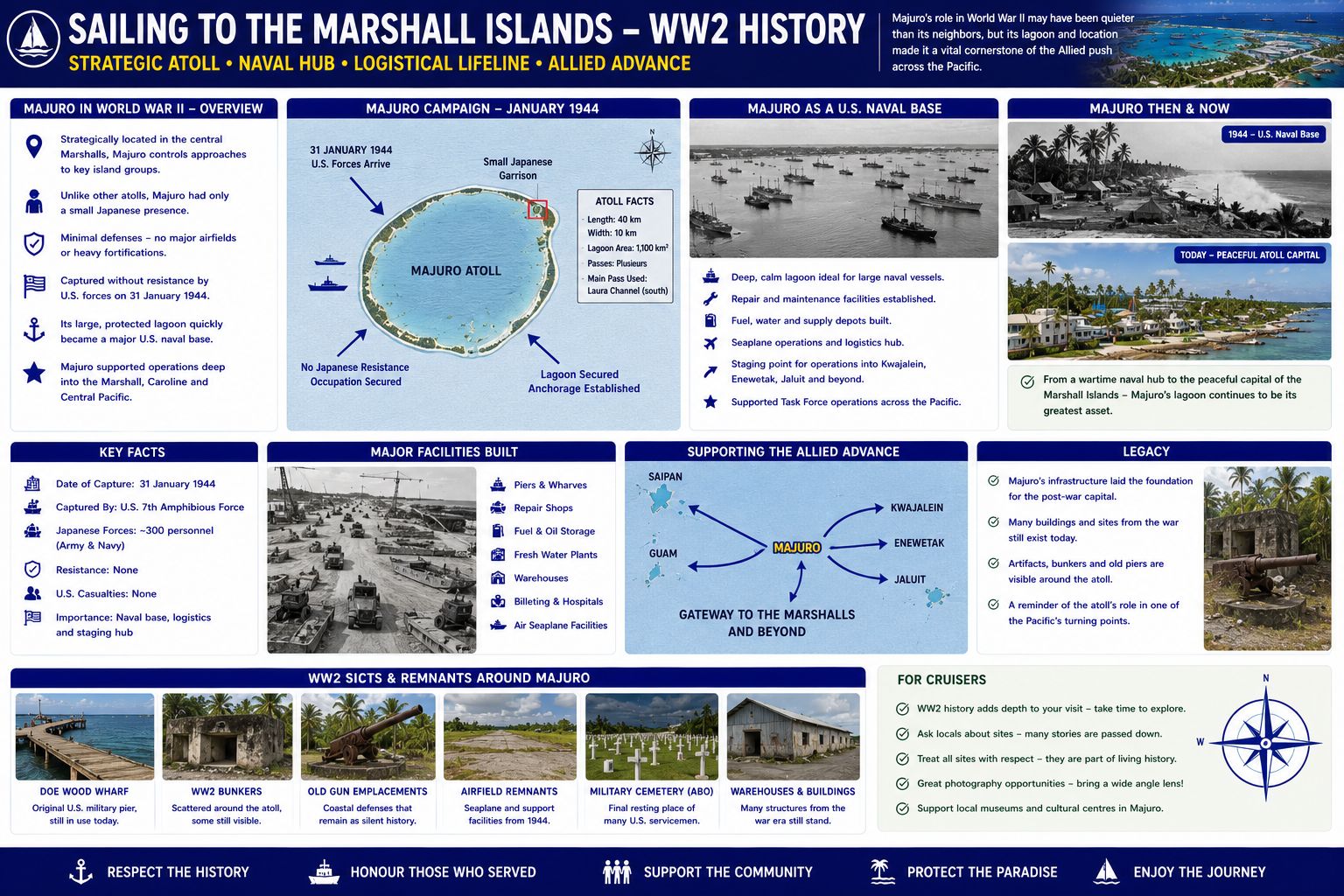
Majuro played a quieter but strategically important role in World War II. Unlike the heavily fortified atolls of Kwajalein and Maloelap, Majuro had only a small Japanese presence and minimal defenses. When U.S. forces arrived in January 1944, they captured the atoll without resistance, making it one of the easiest American occupations in the Pacific. Its large, protected lagoon quickly became a major U.S. naval anchorage, repair hub, and staging base for operations deeper into the Marshall and Caroline Islands. Majuro’s calm waters and central location turned it into a vital logistical platform that supported the Allied advance across the Pacific.
Culture, Etiquette
& Community Interaction
Marshallese culture is warm, soft‑spoken, and deeply community‑oriented. Visitors who approach with humility and respect are welcomed generously. Modest dress is appreciated in villages, and permission should always be sought before anchoring near a community, walking inland, or fishing in certain areas. Land ownership is personal and complex, and relationships matter. Sundays are quiet, with church activities taking precedence. For sailors searching for Marshall Islands cultural etiquette, respectful cruising practices, or village protocol for sailors, this guidance helps ensure positive interactions.
Connectivity &
Communications
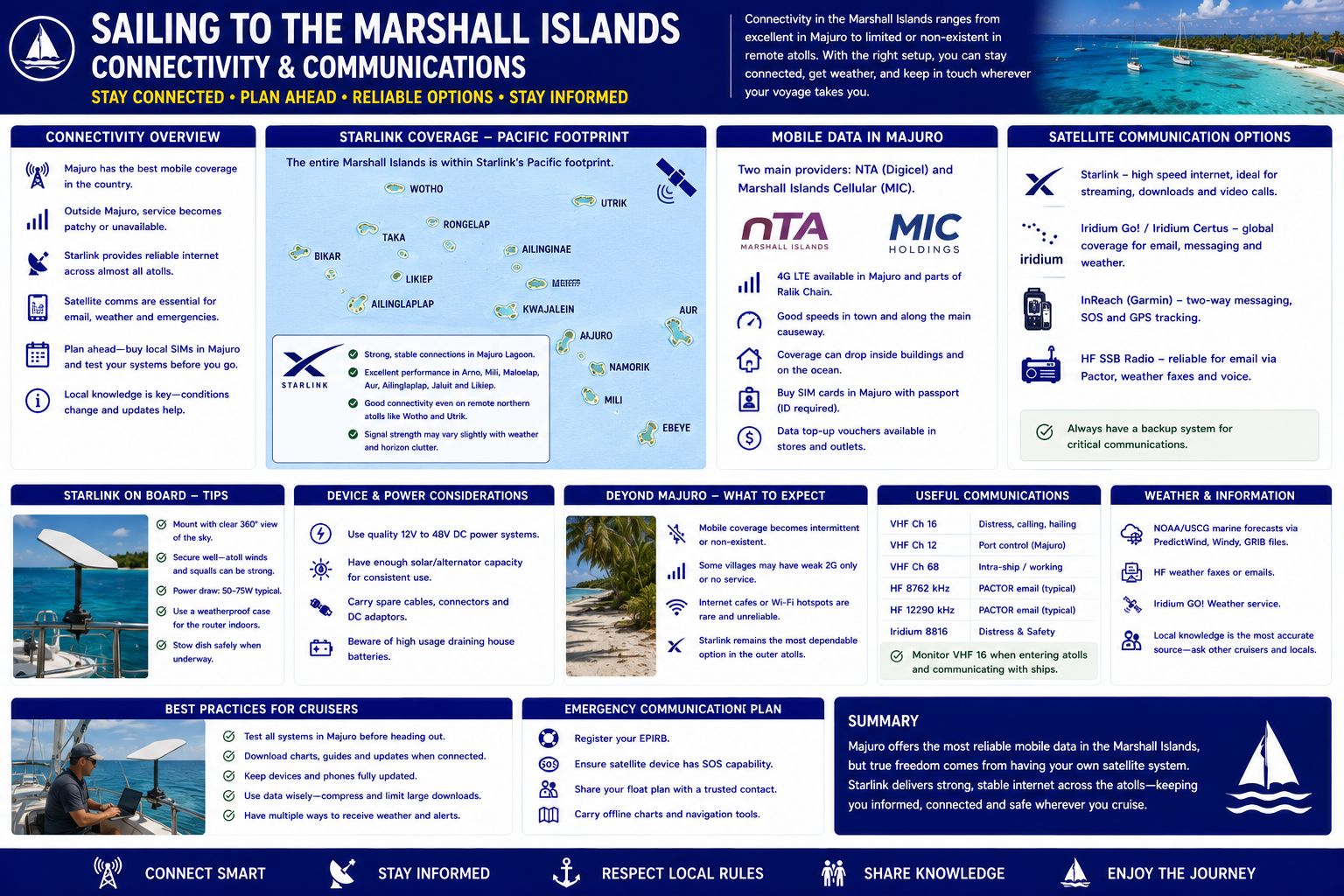
Majuro offers the most reliable mobile data in the country, though speeds and coverage vary. Beyond the capital, connectivity becomes patchy or non-existent, making satellite systems. The entire country sits inside Starlink’s Pacific footprint. Cruisers report strong, stable connections in Majuro Lagoon, Arno, Mili, Maloelap, Aur, Ailinglaplap, Jaluit, Likiep and even very remote northern atolls like Wotho and Utrik. Signal strength varies slightly with weather and horizon clutter, but overall performance is excellent.


Sailing to the Marshall
Islands
The Marshall Islands reward sailors who value remoteness, cultural depth, and the quiet beauty of atoll life. The country offers pristine lagoons, rich traditions, WWII history, and anchorages untouched by mass tourism. For many cruisers, it becomes one of the most meaningful chapters of their Pacific voyage a place where preparation meets wonder, and where the ocean feels both vast and intimate. Keywords like remote Pacific cruising destinations, Marshall Islands sailing experiences, and Micronesia yacht travel insights capture the essence of what makes this region unforgettable.