Sailing to Tokelau: Atoll
Navigation, Restrictions & Cruiser’s Guide
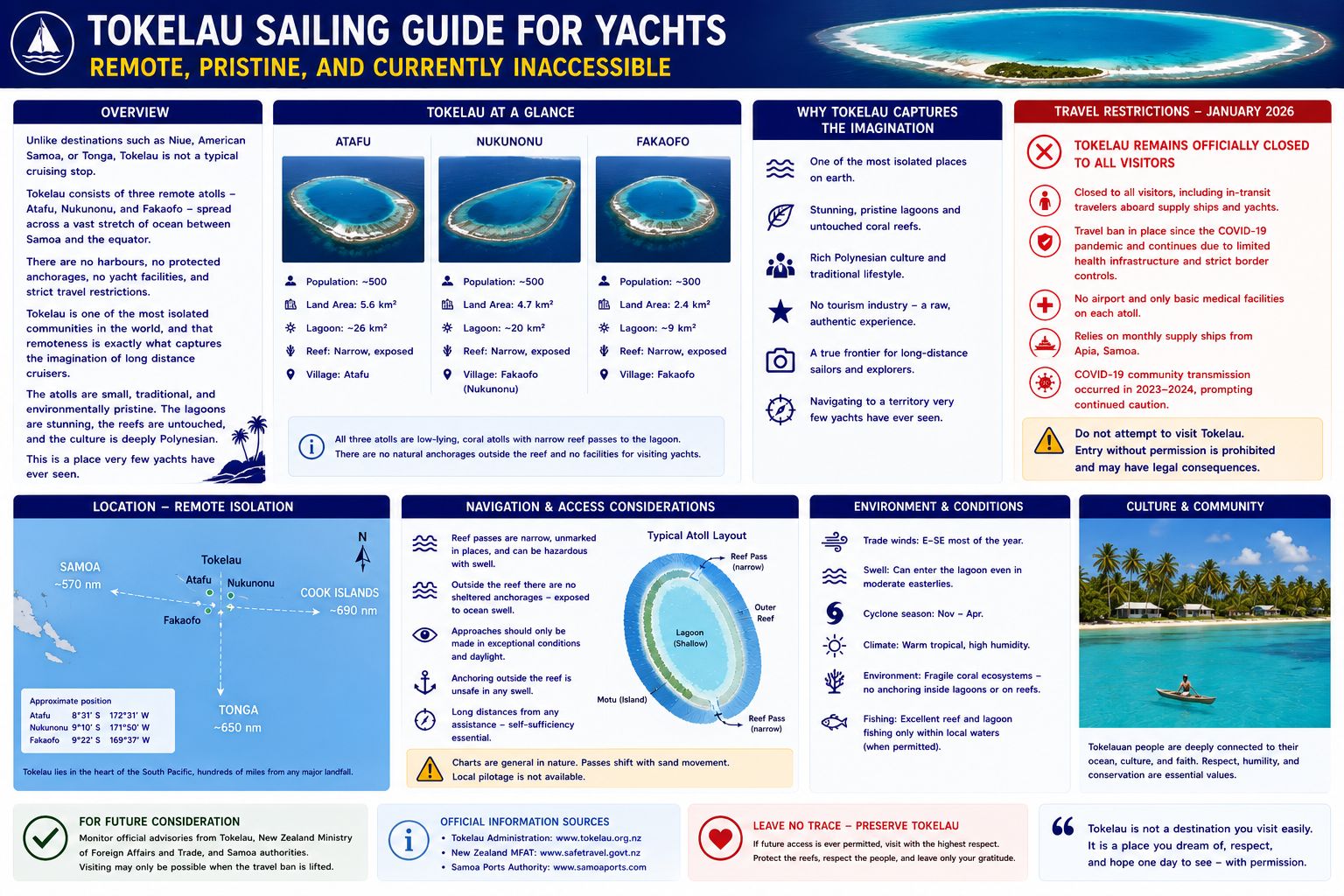
Sailing to Tokelau is one of the most unusual and challenging prospects in the South Pacific. Unlike destinations such as Niue, American Samoa, or Tonga, Tokelau is not a typical cruising stop. The territory consists of three remote atolls, Atafu, Nukunonu, and Fakaofo spread across a vast stretch of ocean between Samoa and the equator. With no harbours, no protected anchorages, no yacht facilities, and strict travel restrictions, Tokelau is a destination that fascinates sailors but remains largely inaccessible. Tokelau was known for its lack of facilities and hazardous approaches.
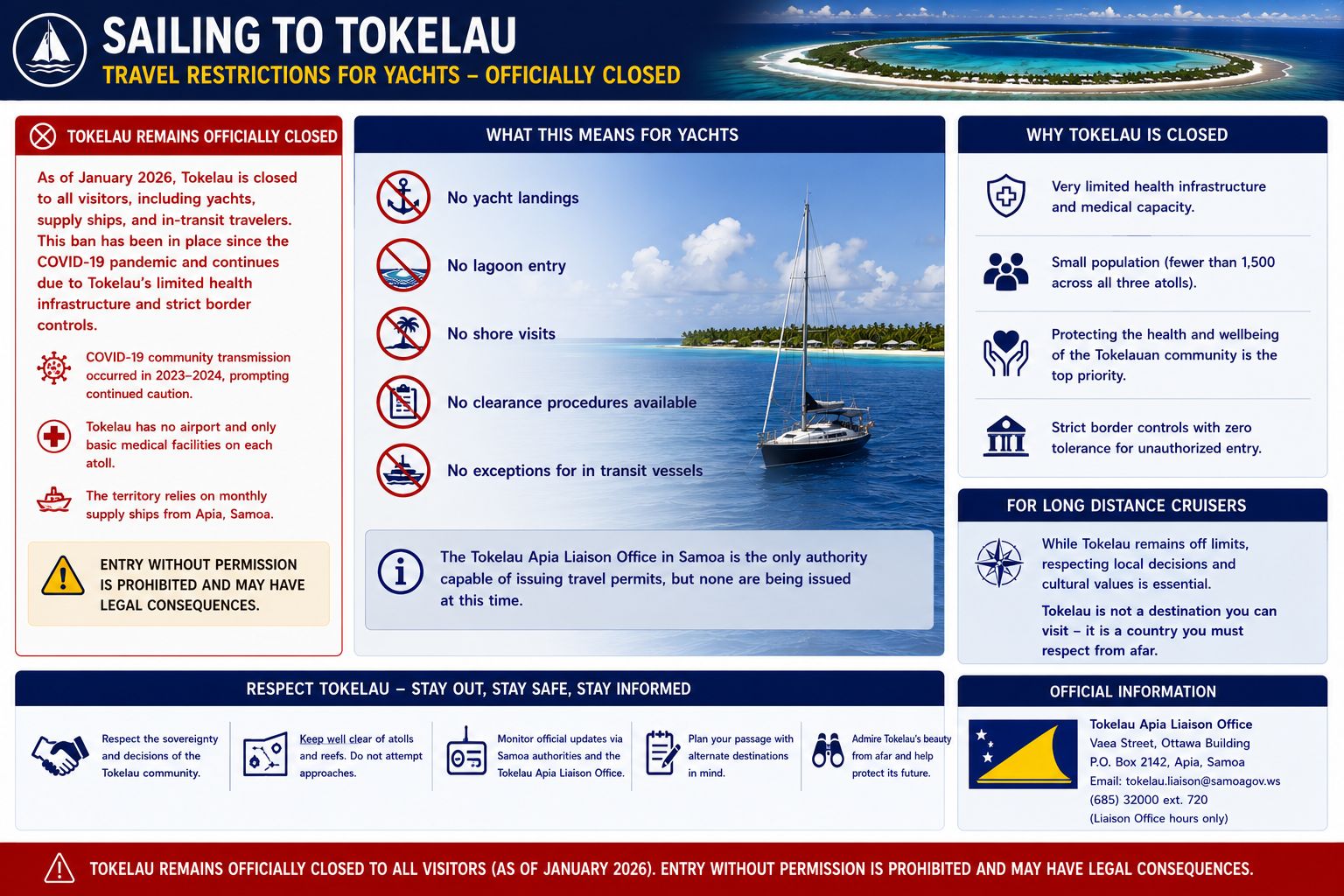
Tokelau is one of the most isolated communities in the world, and that remoteness is exactly what captures the imagination of long‑distance cruisers. The atolls are small, traditional, and environmentally pristine. The lagoons are stunning, the reefs are untouched, and the culture is deeply Polynesian. This is a place very few yachts have ever seen. The idea of navigating to a territory with no tourism industry, no marinas, and no commercial development is compelling for those who value raw, authentic exploration. However, Tokelau is not a practical cruising destination. As of January 2026, Tokelau remains officially closed to all visitors, including in-transit travelers aboard supply ships and yachts. This travel ban has been in place since the COVID-19 pandemic and continues due to Tokelau’s limited health infrastructure and strict border controls. Tokelau has no airport and only basic medical facilities on each atoll. The territory relies on monthly supply ships from Apia, Samoa. COVID-19 community transmission occurred in 2023–2024, prompting continued caution.
Tokelau Geography & Island
Overview
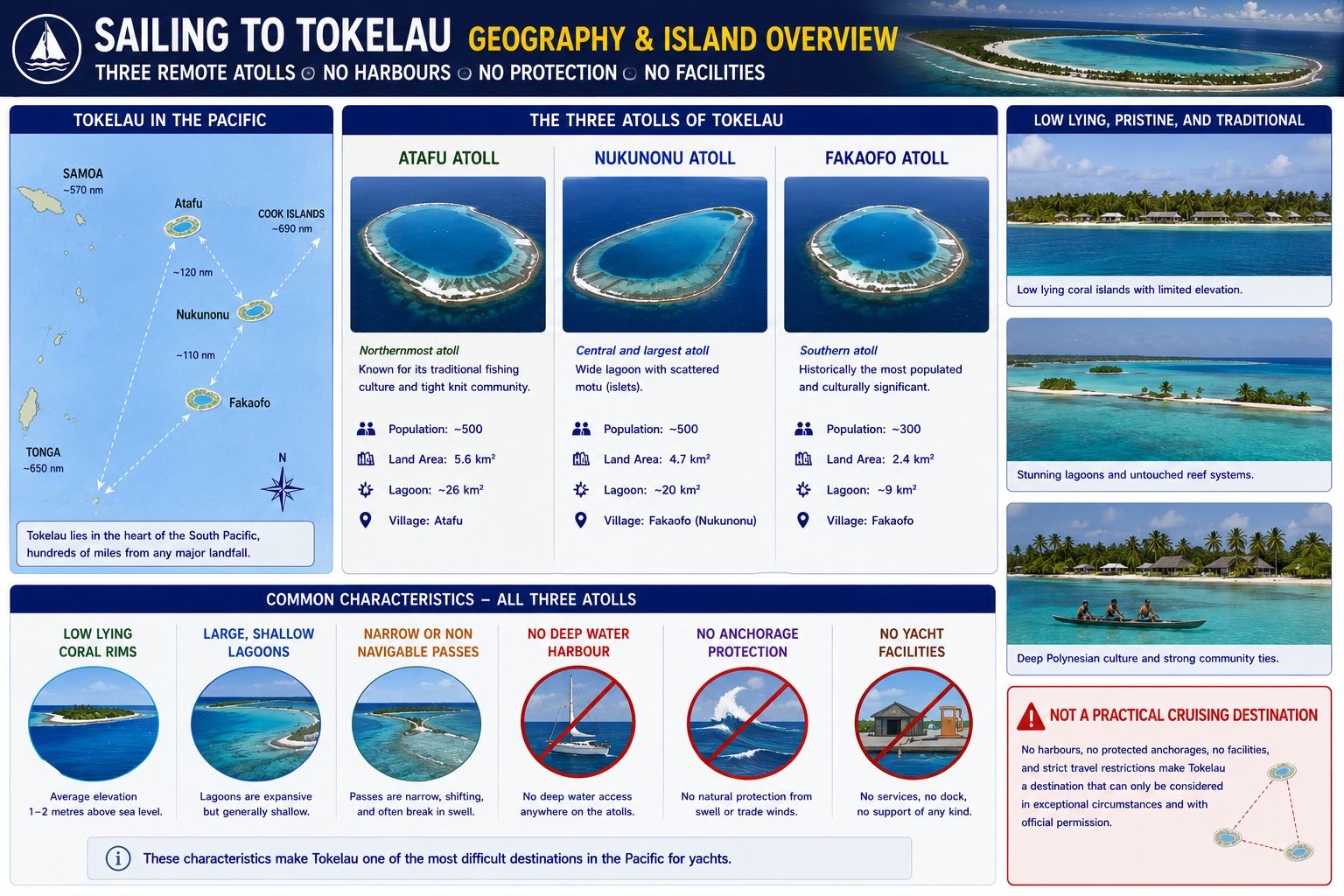
Tokelau is made up of three atolls arranged in a loose triangle:
- Atafu Atoll. The northernmost atoll, known for its traditional fishing culture and tight‑knit community.
- Nukunonu Atoll. The central and largest atoll, with a wide lagoon and scattered motu (islets).
- Fakaofo Atoll. The southern atoll, historically the most populated and culturally significant and access is extremely limited.
All three atolls share similar characteristics:
- Low‑lying coral rims
- Large, shallow lagoons
- Narrow or non‑navigable passes
- No deep‑water harbour
- No anchorage protection
This makes Tokelau one of the most difficult destinations in the Pacific for yachts.
Sailing Conditions Around
Tokelau
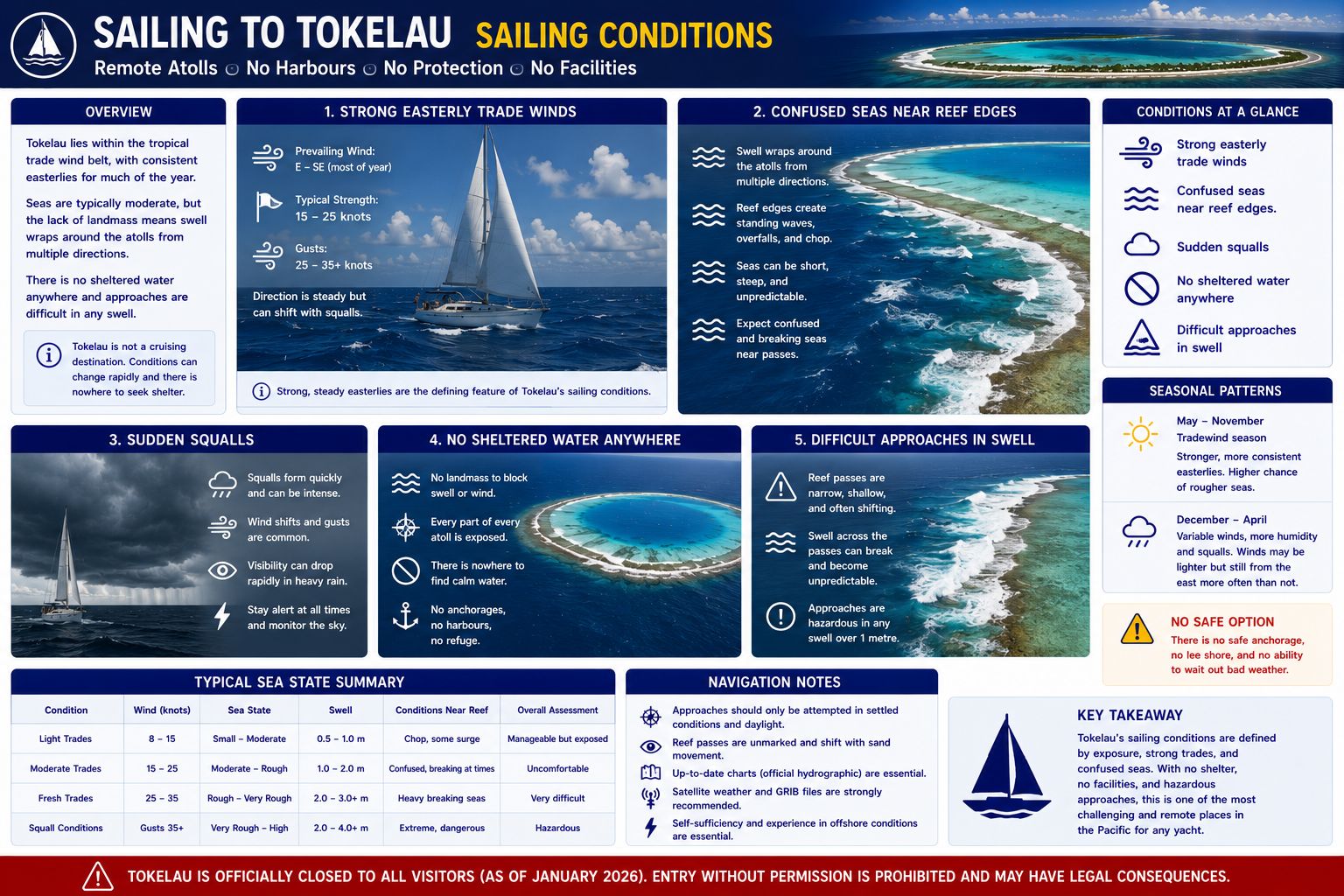
Tokelau lies within the tropical trade‑wind belt, with consistent easterlies for much of the year. Seas are typically moderate, but the lack of landmass means swell wraps around the atolls from multiple directions. Expect the following:
- Strong easterly trade winds
- Confused seas near reef edges
- Sudden squalls
- No sheltered water anywhere
- Difficult approaches in swell
Navigation Requirements &
Challenges
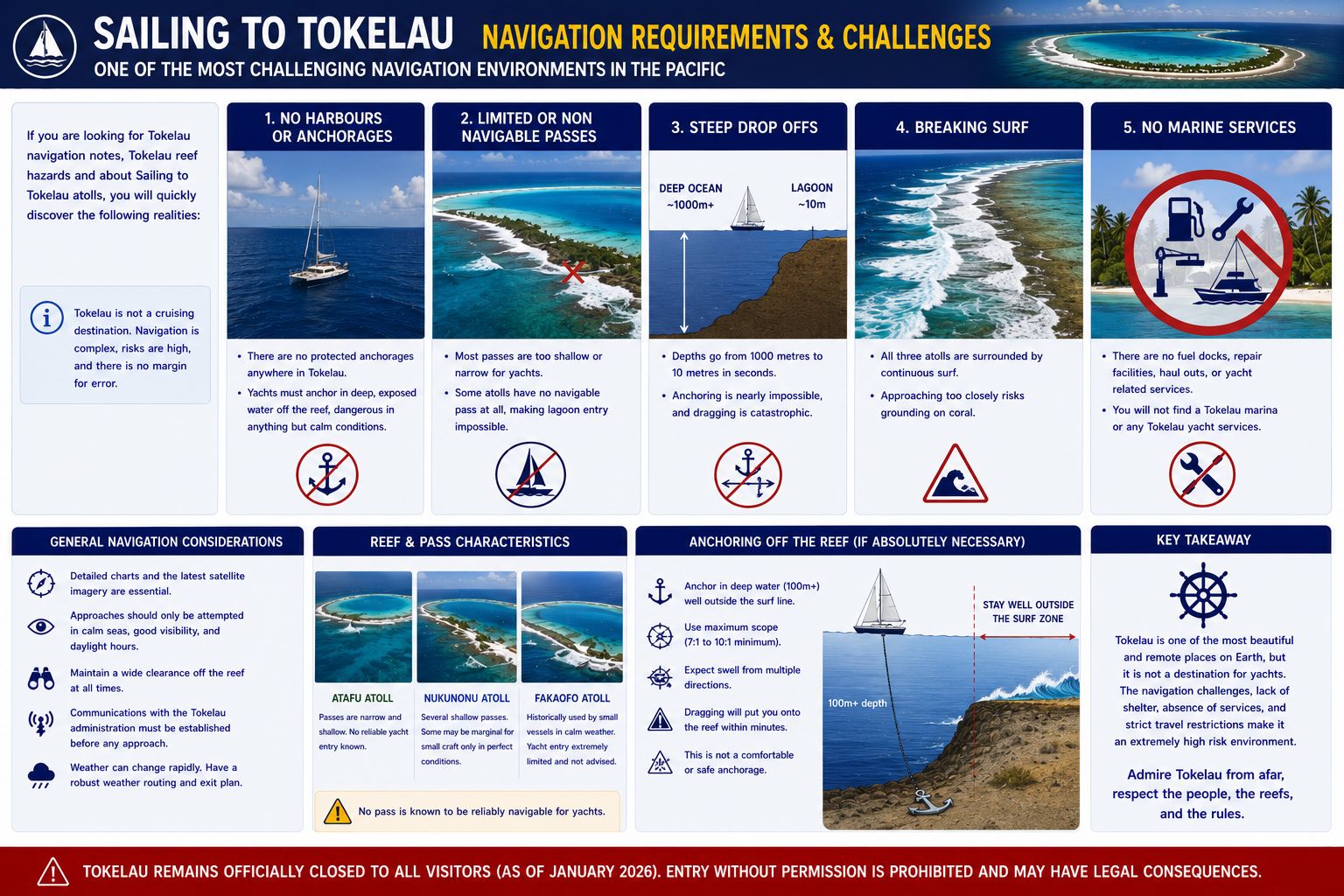
Tokelau is one of the most challenging navigation environments in the Pacific. If you are looking for Tokelau navigation notes, Tokelau reef hazards and about Sailing to Tokelau atolls, you will quickly discover the following realities:
- No Harbours or Anchorages. There are no protected anchorages anywhere in Tokelau. Yachts must anchor in deep, exposed water off the reef, dangerous in anything but calm conditions.
- Limited or Non‑Navigable Passes. Most passes are too shallow or narrow for yachts. Some atolls have no navigable pass at all, making lagoon entry impossible.
- Steep Drop‑Offs. Depths go from 1000 metres to 10 metres in seconds. Anchoring is nearly impossible, and dragging is catastrophic.
- Breaking Surf. All three atolls are surrounded by continuous surf. Approaching too closely risks grounding on coral.
- No Marine Services. There are no fuel docks, repair facilities, haul‑outs, or yacht‑related services. You will not find a Tokelau marina or and Tokelau yacht services.
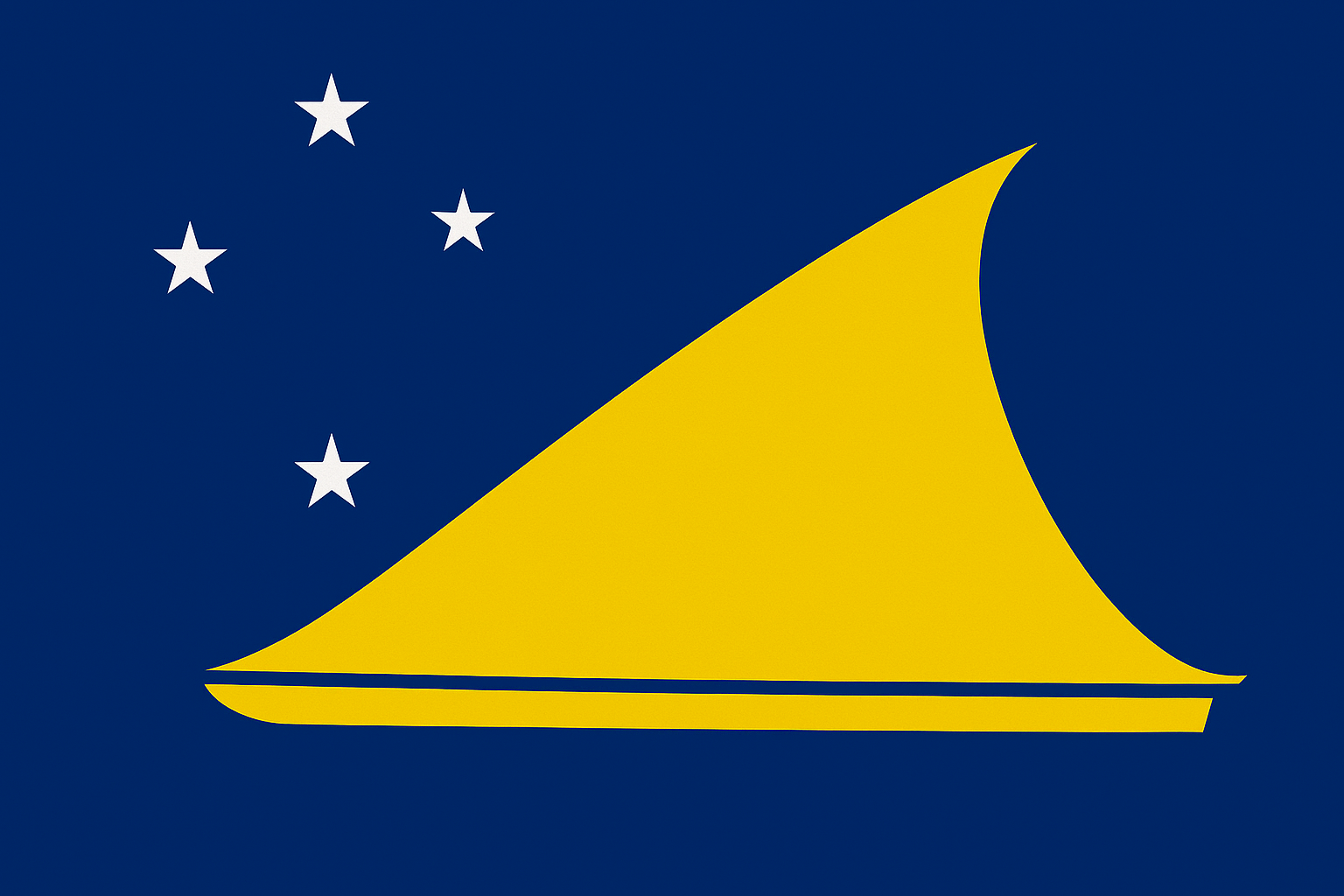
Tokelau Courtesy Flag
Food and Provisioning
The national dish of Tokelau is Ota. The local food comprises a great range of fish including tuna (ahi), mahimahi, parrot fish (pakati) and barracuda (ono), coconut crabs and crayfish, sweet potato, breadfruit, taro, coconuts, poultry and pork. Imported food is expensive and available at the various village cooperative stores. A fermented drink, Kaleva, is made from coconut milk. Imported foods are available in the village cooperative stores.
Tokelau Travel Restrictions
for Yachts
What this means:
- No yacht landings
- No lagoon entry
- No shore visits
- No clearance procedures available
- No exceptions for in‑transit vessels
The Tokelau Apia Liaison Office in Samoa is the only authority capable of issuing travel permits, but none are being issued at this time.
Mechanical
and Electrical Repairs Resource
If you are headed somewhere remote consider the need to expand your knowledge base or have an information resource on board. Why not get a copy of my book The Marine and Electrical and Electronics Bible 4th Edition. By and for yachties, with everything from batteries and charging, solar and wind, diesel engines and marine electronics and so much more. Your complete systems guide. 650 pages of practical advice. In Australia and New Zealand order a copy through Boat Books. UK and European boats can buy the UK Edition Here. US and Canadian boats can get the US Edition Order Here. Marine systems are my profession so let me help you. By a liveaboard boat owner for other boat owners


Tokelau Culture & Local Life
Tokelauans maintain a deeply traditional Polynesian lifestyle. Communities are small, communal, and self‑sufficient. English is spoken, but Tokelauan is the primary language. The islands rely heavily on supply ships from Samoa. Because of the travel ban, cultural interaction is currently not possible for visiting yachts. Tokelau culture and Tokelau traditional life are like many Polynesian atoll communities and should you ever get ashore you will find Tokelau to be one of the most authentic societies in the Pacific.
Sailing to Tokelau - Or Not!
Tokelau is not a practical destination for most sailors. It may appeal to ocean navigators passing nearby, sailors studying remote atoll geography, passage‑makers between Samoa and the Line Islands. But due to restrictions and hazards, Tokelau is not suitable for casual cruisers, charter yachts, boats seeking anchorages or crews needing services or shelter. Tokelau is one of the most remote and culturally unique places in the Pacific, but it is also one of the least accessible. With no harbours, no yacht facilities, and an ongoing travel ban, it remains a destination best admired from a distance. For sailors planning long Pacific passages, Tokelau is a fascinating waypoint to understand but not a landfall to attempt under current conditions.