Guam cruising guide - all you need to know
The Guam cruising guide is essential because Guam is the primary maritime hub of the western Pacific and the most practical entry point for yachts arriving from the Philippines, Japan, Palau, or the central Micronesian islands. Unlike the smaller islands to the north, Guam has a deep commercial harbor, multiple small‑craft facilities, reliable provisioning, and access to technical services that are not available elsewhere in the region. For most crews, Guam becomes the operational base for repairs, resupply, and administrative formalities before continuing north toward the Northern Marianas or west toward Asia.
The island’s coastline is shaped by steep drop‑offs, fringing reef, and a limited number of safe approaches. Almost all yacht activity is concentrated inside Apra Harbor on the western side of the island. The eastern coast is fully exposed to swell and wind and offers no safe anchorages. Guam is not a cruising ground in the recreational sense; it is a functional stop where crews can complete essential tasks before moving on.
Guam Cruising Guide - Entry
Formalities
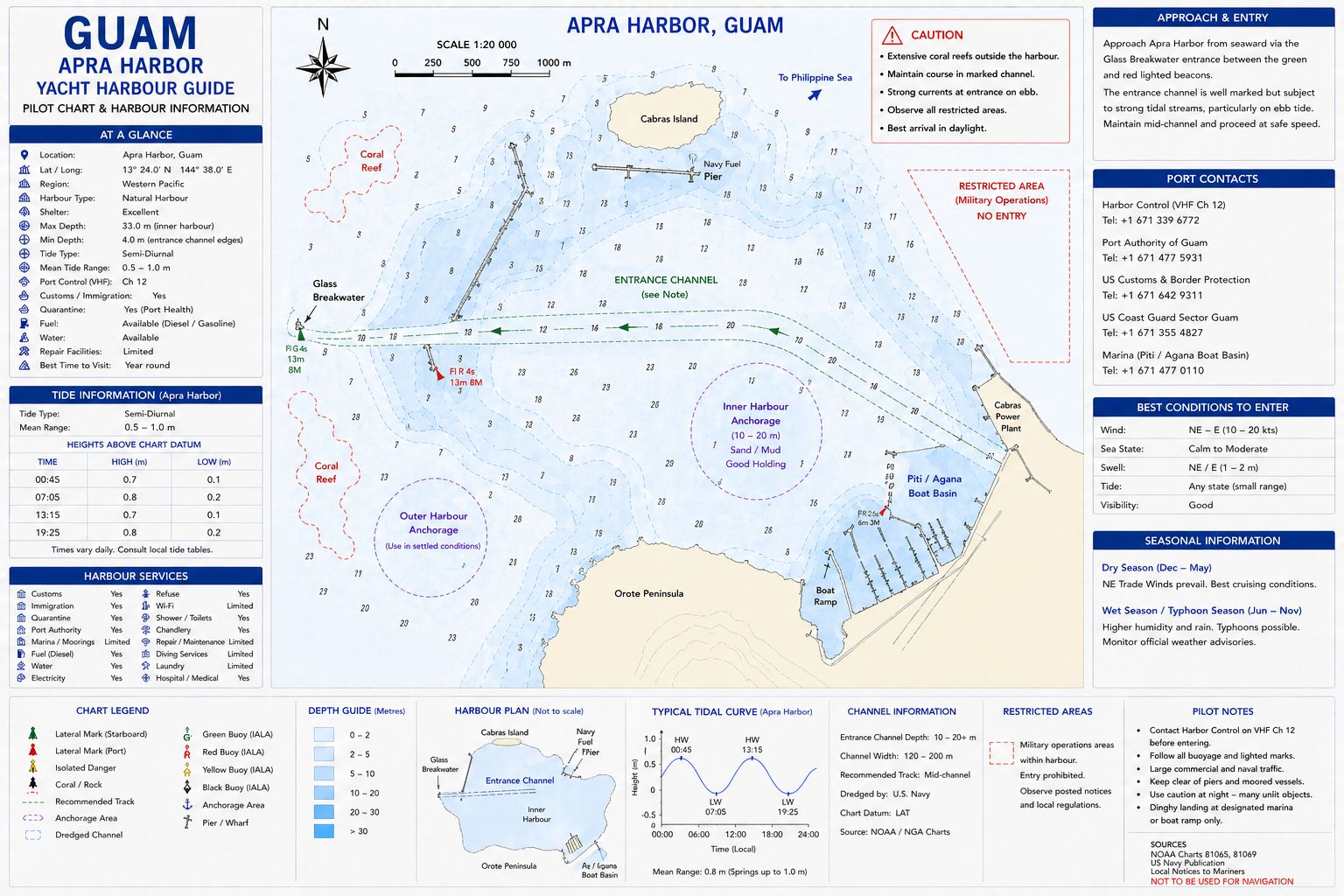
All foreign yachts must clear into Guam through Apra Harbor, which is the island’s only port of entry. The approach is straightforward: a wide, deep channel with clear lateral marks and predictable commercial traffic. Yachts must contact port control on VHF before entering and follow instructions regarding anchoring or berthing for inspection.
Clearance is conducted by U.S. Customs and Border Protection. The process includes immigration, customs, and agricultural inspection, and crews should expect a structured, methodical procedure. Documentation requirements include passports, vessel registration, crew list, and any relevant visas. Arrivals outside normal working hours may be required to wait at anchor until officers are available. Once cleared, yachts may proceed to designated anchoring areas or to one of the marinas within the harbor.
Guam Cruising Guide - Ocean Currents
Guam Cruising Guide - Navigation
Apra Harbor dominates Guam’s maritime landscape. The entrance channel is wide, deep, and maintained for commercial shipping and naval operations. Inside the harbor, depths are generous, and maneuvering room is ample, though yachts must remain aware of large‑vessel movements and restricted naval zones.
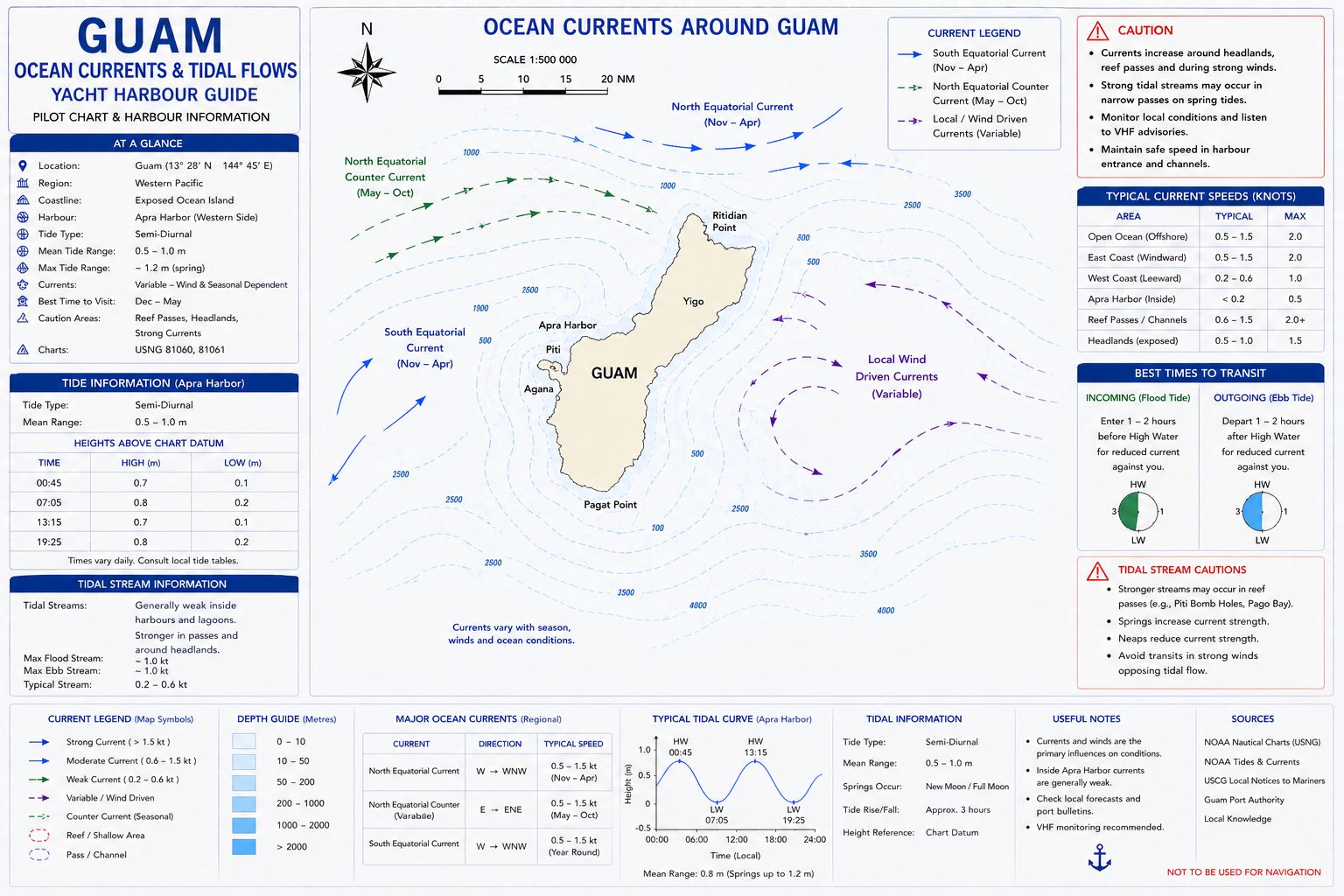
Outside Apra Harbor, navigation becomes more constrained. The western coast has a few small bays, but most are affected by swell or have limited access due to reef. The eastern coast is fully exposed and unsuitable for anchoring. The northern and southern tips of the island can produce strong currents and confused seas during certain conditions, and rounding these points requires attention to weather and sea state.
Guam’s waters are clear, and visual navigation is effective in good light. Coral shelves extend outward from many parts of the coastline, and yachts should avoid approaching the reef edge except in settled conditions with adequate visibility.
Guam Cruising Guide - Wind and Weather
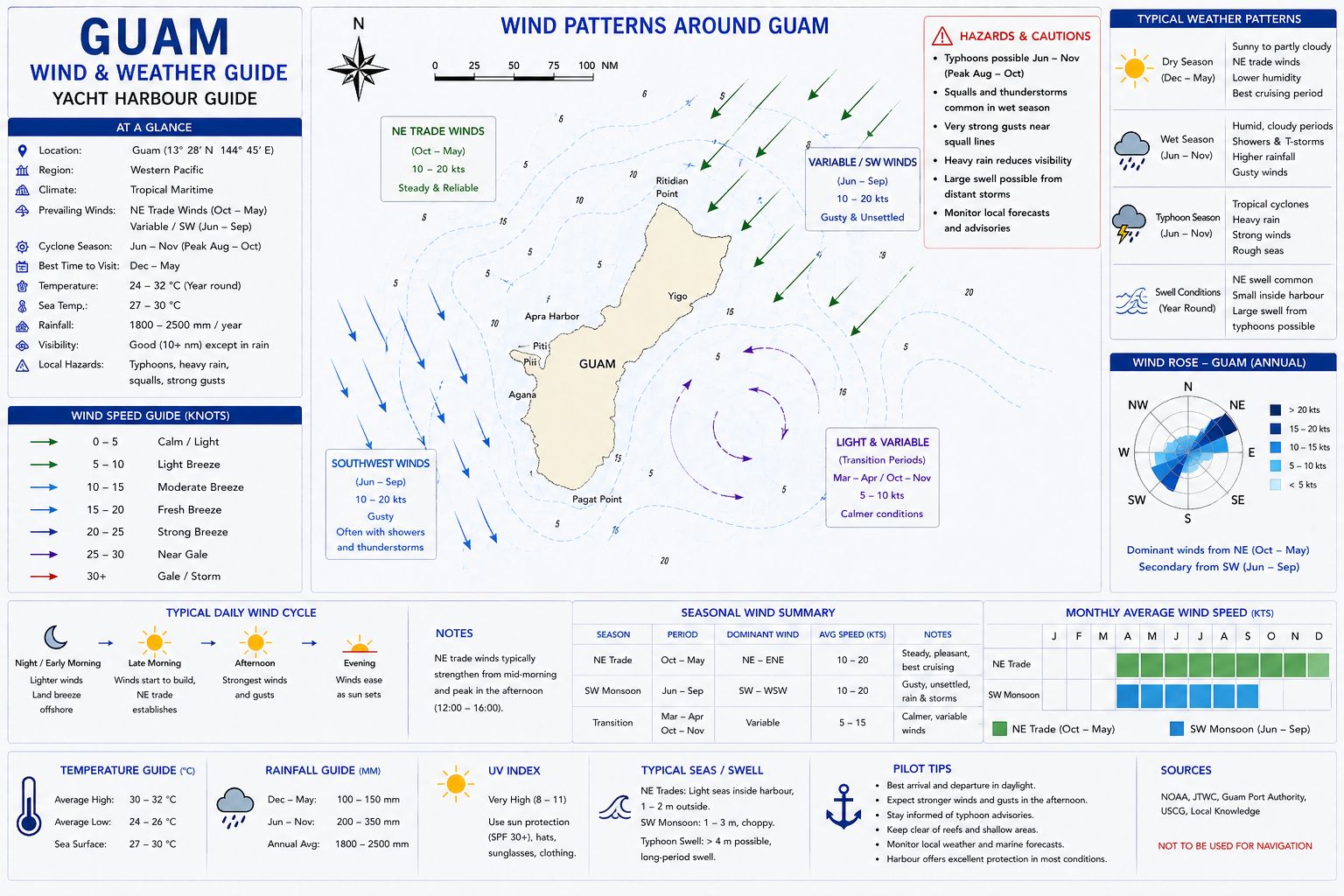
Guam experiences consistent northeast trade winds for much of the year, with stable conditions from December through June. During this period, seas are predictable, and approaches to Apra Harbor are straightforward. The wet season brings more variable winds, increased squalls, and occasional westerly weather that can make the harbor’s outer anchorage uncomfortable.
Typhoons remain a seasonal risk, particularly from July to November. Guam’s position in the western Pacific means that cyclones can develop rapidly or arrive from the east with limited warning. Crews planning extended stays should monitor forecasts closely and be prepared to move into the most sheltered parts of Apra Harbor if conditions deteriorate. Local effects include acceleration zones along the western coast and gusts near high terrain. Inside Apra Harbor, conditions are generally calm, though strong trades can funnel through certain gaps.
Guam Cruising Guide - Provisioning
Supermarkets. The most useful supermarkets for visiting yachts are the Pay‑Less Supermarkets, which operate multiple full‑size stores across the island. These are the most consistent places to restock dry goods, refrigerated items, and general staples. Their supply chain is steady, and turnover is high enough that stock levels remain reliable throughout the week. For bulk provisioning, Cost.U.Less offers warehouse‑style shopping with large‑format dry goods, frozen foods, and long‑life items suitable for offshore passages. The store’s layout and inventory are similar to a scaled‑down Costco, making it a practical stop for loading up before leaving the region. A third major option is Don Don Donki, a Japanese supermarket that carries a wide range of Asian ingredients, packaged foods, and specialty items that are difficult to source elsewhere in Micronesia. This store is particularly useful for crews who rely on Japanese or Korean staples, sauces, snacks, or preserved foods.
Markets. Fresh produce is available from both supermarkets and local markets. Market A is one of the island’s central produce markets and is a source of locally grown fruit and vegetables. The selection typically includes bananas, papayas, pineapples, cucumbers, eggplants, leafy greens, and seasonal items. Produce here is often fresher than in the supermarkets, and turnover is high enough that quality is generally good. In addition, Guam has numerous small produce sellers, including A Plus Market, A‑Market, Ara Market, Besta Market, and Buenas Market. These smaller outlets vary in size and stock but are commonly used by residents for day‑to‑day fruit and vegetables. They are useful for topping up fresh items between larger provisioning runs.
Seafood. Fresh fish is best sourced from Mega Fish Mart in Dededo, which is one of the island’s main dedicated seafood markets. The catch varies with the season but typically includes mahi‑mahi, wahoo, tuna, and reef species. Visiting early in the morning provides the best selection. Another option is Bemyore Makit, listed as a fish and seafood retail/wholesale supplier.
Guam Cruising Guide - Local Cuisine
Food on Guam reflects the island’s diverse
population. Chamorro dishes such as red rice, grilled meats, and coconut‑based
preparations are common, alongside Filipino, Japanese, Korean, and American
influences. Restaurants and food outlets are more numerous than in the Northern
Marianas. Guam’s food culture blends indigenous
Chamorro, Filipino, Spanish, Japanese, and American
influences. Several dishes consistently appear as the island’s defining foods. Kelaguen. This the cornerstone of
Chamorro cuisine and one of Guam’s most recognized dishes. Made with chopped
chicken, beef, seafood, or even banana flower, mixed with lemon juice,
onions, peppers, and sometimes coconut. The acidity “cooks” the protein, similar to ceviche. Red Rice (Hineksa’ Agaga) is a fiesta
essential. It is rice colored and flavored with achiote (annatto), often
cooked with garlic or onions. Chicken BBQ (Guam‑style). It is marinated
in a mix of soy sauce, vinegar, garlic, and citrus, then grilled over
open flame. Finadene Sauce is a universal
condiment served with almost everything. Made from soy sauce, vinegar or
lemon, onions, and fresh chilies. Kadon Pika is a spicy Chamorro stew made with chicken, soy
sauce, vinegar, and hot peppers. Titiyas (Chamorro
Flatbread) are soft, slightly sweet flatbread served with BBQ, kelaguen, or
stews. They comes in corn or flour versions. Chamorro Empanadas. These are deep‑fried
turnovers filled with spiced ground rice and chicken. They are distinct
from Spanish or Filipino empanadas. Barbecue
Short Ribs & Pork Ribs are marinated in the same Guam‑style BBQ mix and
grilled. Apigigi is sweet coconut and tapioca mixture wrapped in banana
leaves and grilled.
Guam Cruising Guide - Diesel Supplies
Diesel is readily available in Guam. Yachts can refuel through marinas or by transporting jerry cans from nearby service stations. Fuel quality is generally reliable, and supply is consistent. Larger quantities can be arranged through commercial suppliers with advance notice. Because fuel availability in the Northern Marianas is more limited and less predictable, many crews choose to fill tanks completely in Guam before heading north.
Guam Cruising Guide - Water Supplies
Potable water is widely available in Guam, and marina supplies are generally suitable for onboard storage. The island’s water infrastructure is more developed than that of the Northern Marianas, and crews can expect consistent access to clean water. Yachts planning to visit Tinian or Rota should fill tanks in Guam, as water availability in the smaller islands is limited and may require filtration.
Guam Cruising Guide - Local Marine
Services
Guam is the only island in the region with a meaningful marine service sector. Mechanical, electrical, welding, fabrication, and electronics work can often be handled by local workshops. Haul‑out facilities exist, though availability varies and advance booking is recommended. While not all services are marine‑specific, the island’s industrial base provides options for repairs that would be difficult or impossible elsewhere in Micronesia. For major maintenance, refits, or long‑range preparation, Guam is the most practical location between Hawaii and the Philippines.
Guam Cruising Guide - Local Culture
Guam’s population includes Chamorro residents, Filipino communities, U.S. military personnel, and individuals from across Micronesia and Asia. English is widely spoken, and interactions with visitors are straightforward. The island has a more urban character than the Northern Marianas, with larger commercial districts, busier roads, and a wider range of services. Public spaces such as beaches and parks are commonly used by families, and visitors should be mindful of local customs regarding behavior near residential areas. Cultural practices are woven into daily life rather than presented as formal events, and visitors will encounter them through routine interactions.
Mechanical
and Electrical Repairs Resource
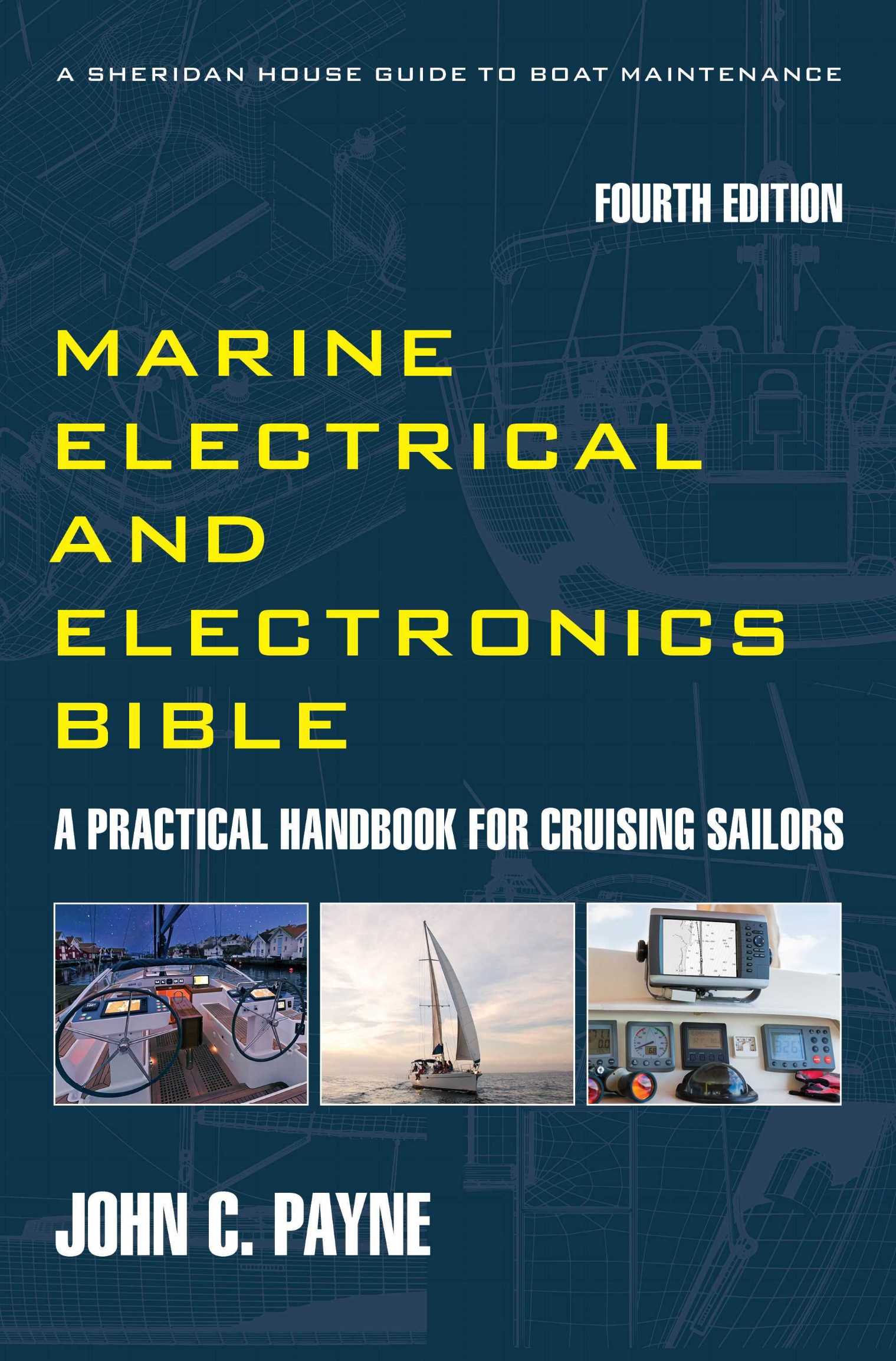
If you are headed somewhere remote consider the need to expand your knowledge base or have an information resource on board. Why not get a copy of my book The Marine and Electrical and Electronics Bible 4th Edition. By and for yachties, with everything from batteries and charging, solar and wind, diesel engines and marine electronics and so much more. Your complete systems guide. 650 pages of practical advice. In Australia and New Zealand order a copy through Boat Books. UK and European boats can buy the UK Edition Here. US and Canadian boats can get the US Edition Order Here. Marine systems are my profession so let me help you. By a liveaboard boat owner for other boat owners


Guam Cruising Guide Summary
Guam functions as the western Pacific’s most dependable operational base for visiting yachts, offering structured entry procedures, a deep and accessible harbor, reliable provisioning, and the only meaningful marine services in the region. Apra Harbor provides secure shelter and straightforward navigation, while the island’s supermarkets, hardware stores, and industrial workshops allow crews to restock and complete repairs before continuing north to the Northern Marianas or west toward Asia. Although Guam is not a recreational cruising ground, it excels as a practical stop for refit, resupply, and administrative formalities, giving yachts a stable foundation from which to plan the next stage of their passage.