Cruising the Philippines by Yacht
Cruising the Philippines by yacht offers one of the most diverse sailing experiences in Southeast Asia, but timing and route selection are essential. With more than 7,000 islands shaped by shifting monsoons, typhoons, and regional weather patterns, sailors planning cruising the Philippines by yacht quickly learn that seasons define every passage. Understanding the best months for smooth seas, predictable winds, and safe anchorages helps crews navigate confidently through Luzon, Palawan, and the Visayas. For cruisers preparing longer voyages, knowing the best cruising routes in the Philippines for yachts is just as important as choosing the right season. Entry ports, inter‑island channels, and offshore approaches all behave differently depending on monsoon direction and local exposure. By understanding how weather, currents, and geography interact, sailors can plan safe navigation in and out of the archipelago. This knowledge transforms the Philippines from a complex sailing environment into a rewarding, world‑class cruising destination.
The best conditions are generally during the Northeast Monsoon (Amihan, Nov–Apr), when winds are more moderate and seas are manageable on the western sides of island groups, making it the preferred cruising season. The Southwest Monsoon (Habagat, May–Oct) brings stronger winds, heavier rain, and more challenging sea states, particularly on exposed coasts. Navigation requires care due to reefs, shoals, and unlit hazards, but good pilotage and updated charts make island-hopping highly rewarding. Currents are usually moderate but can accelerate through narrow channels, and tidal range is relatively small. Provisioning is easy in larger towns, while remote areas offer limited facilities but outstanding natural beauty. Friendly local communities, clear water, and excellent diving make the Philippines one of the most attractive cruising grounds in Southeast Asia, provided weather windows—especially during typhoon season—are carefully managed.
Cruising the Philippines by Yacht - Winds
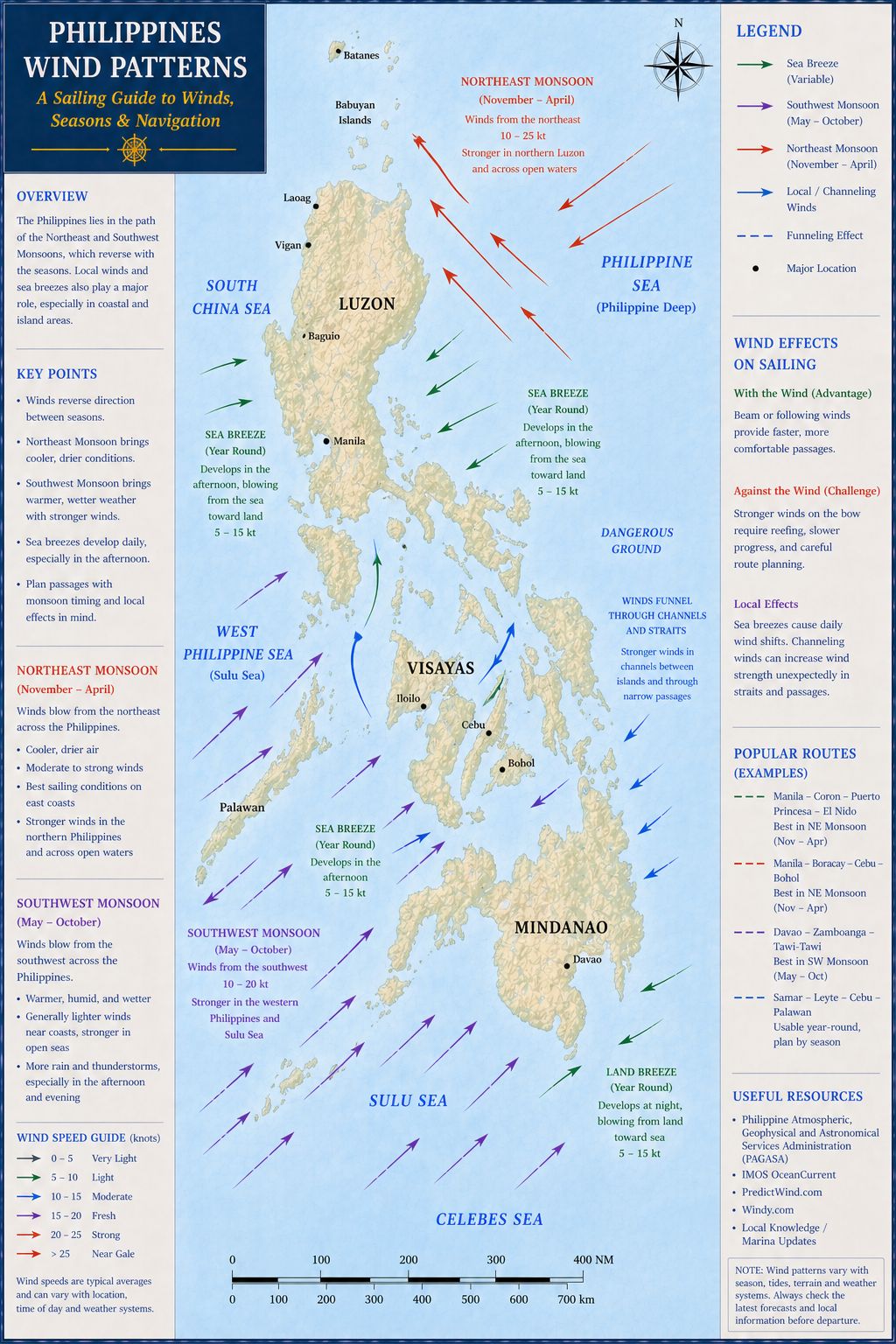
Wind patterns in the Philippines are governed by the monsoon system and modified by the country’s complex island geography, producing distinct seasonal regimes and strong local variability. From November to April, the Northeast Monsoon (Amihan) dominates, bringing generally steady northeasterly winds of 10–20 knots, often stronger in exposed channels and along the eastern seaboard facing the Pacific. These winds tend to be drier and more stable, creating the most reliable cruising conditions, particularly on the western (lee) sides of island groups such as Palawan and the Visayas. From May to October, the Southwest Monsoon (Habagat) takes over, with southwesterly winds that can be lighter at times but frequently build to 15–25 knots or more, accompanied by heavy rain, reduced visibility, and confused seas—especially along the western coasts exposed to the South China Sea. Superimposed on these seasonal flows are tropical disturbances and typhoons, most common from June to November, which can bring rapid wind shifts, gale to storm-force conditions, and large seas. During the inter-monsoon periods (April–May and October–November), winds are often light and variable with strong sea-breeze/land-breeze cycles, particularly in sheltered waters. Local effects are significant: wind acceleration through straits (such as the San Bernardino and Surigao), funneling between islands, and terrain-induced gusts near high land all require careful attention when planning passages.
Cruising the Philippines by Yacht - Typhoons
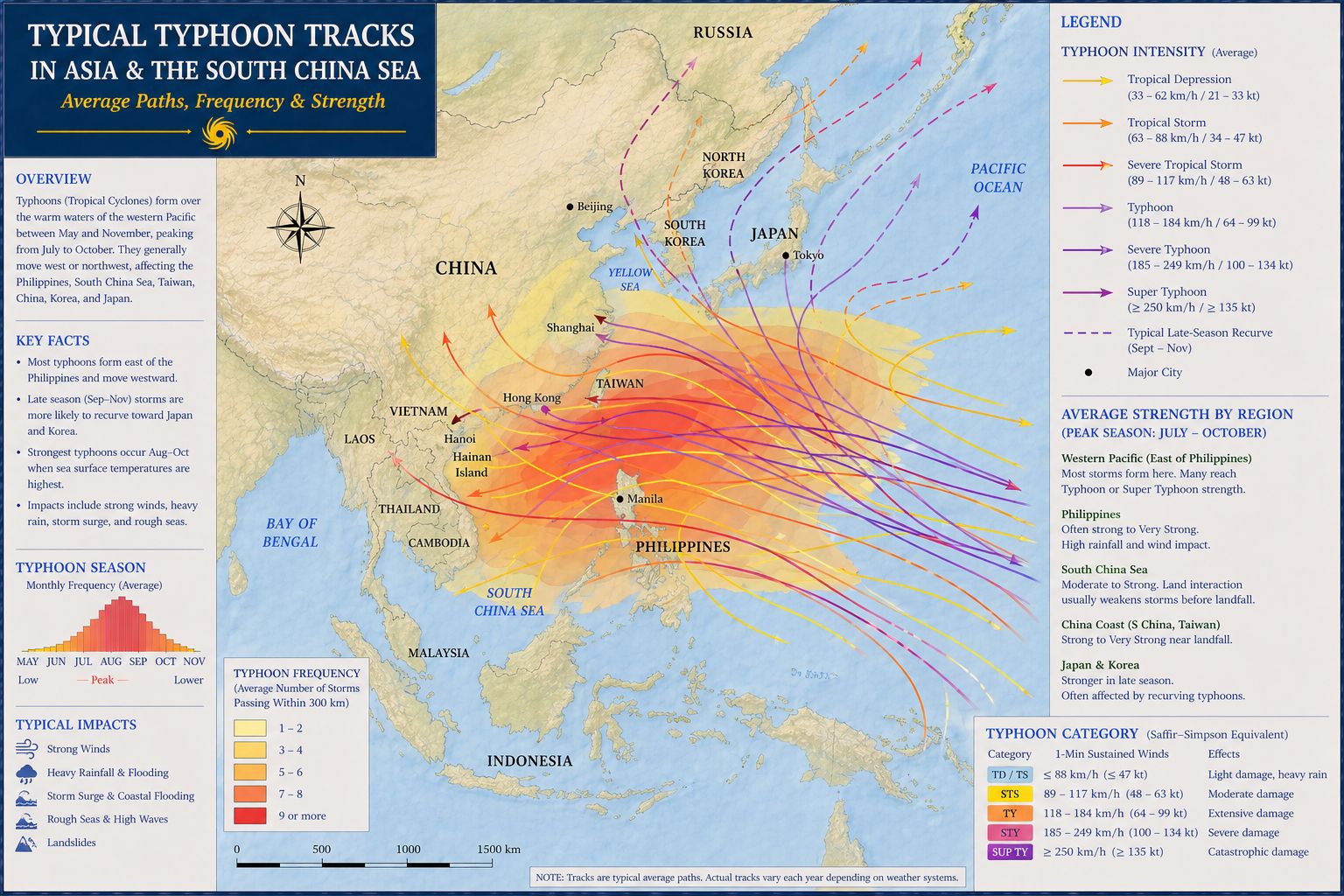
Typhoons are a major seasonal factor in the Philippines, with the country lying directly in the western Pacific cyclone belt. Most systems develop east of the islands and track west to northwest between June and November, with peak activity typically from August to October. These storms can bring violent winds, heavy rainfall, storm surge, and very rough seas, often affecting large areas as they pass through or near the archipelago. Even when not making landfall, passing typhoons can generate strong swell, squalls, and rapidly shifting winds hundreds of miles away. For cruising yachts, the key is avoidance: careful monitoring of forecasts, understanding typical storm tracks, and maintaining flexibility in passage plans are essential. Many sailors adopt a strategy of staying in protected western regions such as Palawan during the season, while avoiding the more exposed eastern seaboard. Reliable shelter, good holding ground, and early decision-making are critical, as conditions can deteriorate quickly once a system approaches.
Cruising the Philippines by Yacht - Currents
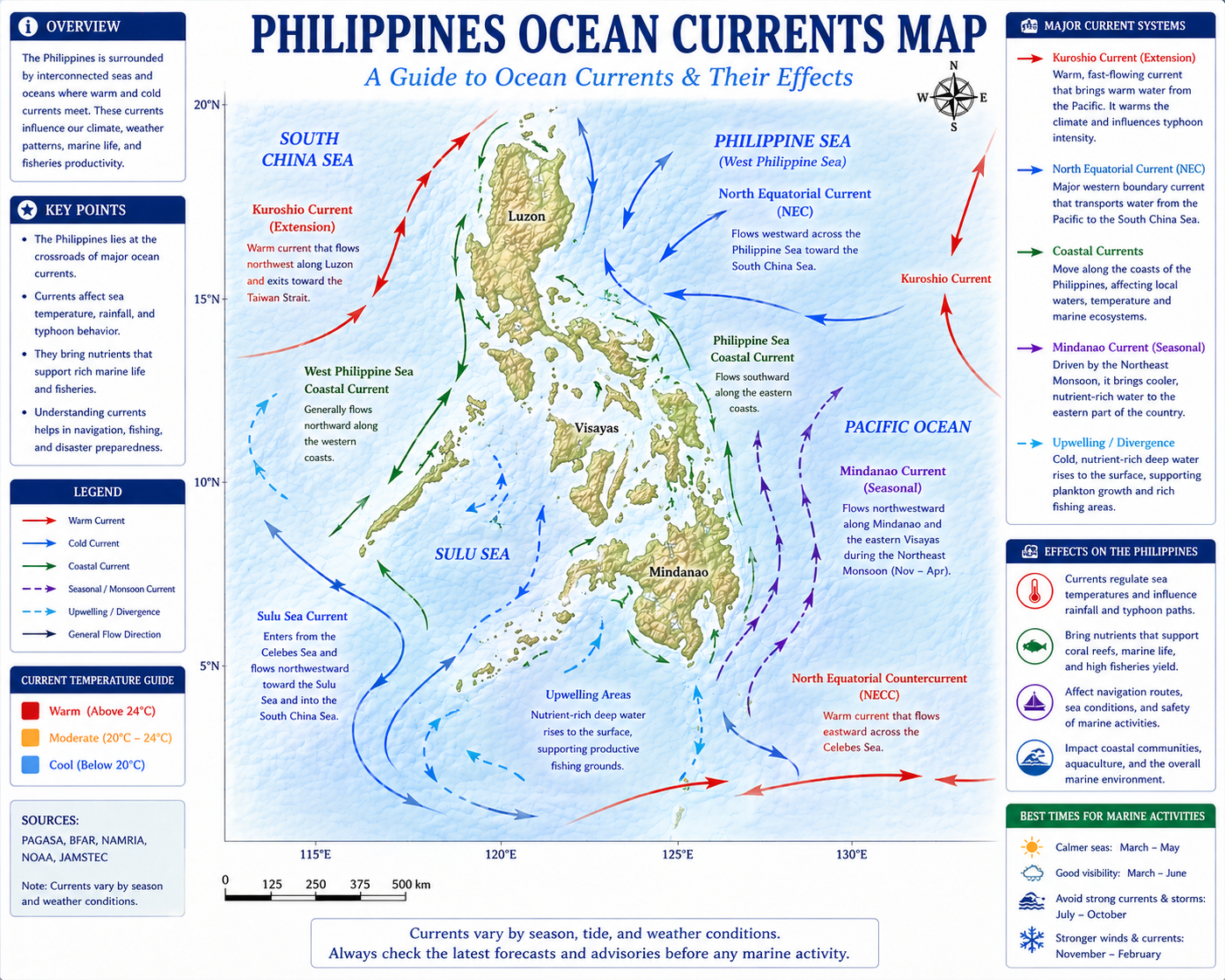
Ocean currents in the Philippines are influenced by the North Equatorial Current, the Kuroshio system, and strong local tidal flows, creating a complex and often variable pattern. To the east of the archipelago, the North Equatorial Current flows westward and splits on reaching the islands: the northern branch feeds into the Kuroshio Current, which runs northward past Luzon, while the southern branch contributes to westward flow into the South China Sea. Within the island groups, currents are generally moderate (0.5–2 knots) but can become significantly stronger in narrow straits and channels such as San Bernardino Strait, Surigao Strait, and Verde Island Passage, where tidal streams may exceed 3 knots and create overfalls and turbulent conditions. Coastal currents are strongly wind-driven, reversing seasonally with the monsoons—setting generally southwestward during the Northeast Monsoon and northeastward during the Southwest Monsoon. Eddies, countercurrents, and localized set around headlands and reef systems are common, particularly in areas of complex seabed topography. For cruising yachts, careful timing of tides and transits through constricted waterways is essential, as currents can have a significant impact on speed, fuel consumption, and overall passage safety
Cruising the
Philippines by Yacht - Entry
Yachts sailing to the Philippines typically arrive from Palau, Indonesia, Taiwan, or Hong Kong. Common entry ports include the following:
- Subic Bay (Luzon). Deep‑water port with marina and customs
- Puerto Princesa (Palawan). This a well‑protected harbor with full clearance facilities
- Cebu City (Visayas). Major urban center with full services
- Puerto Galera (Mindoro). Popular cruiser stop with marina and yacht club
- Bonbonon (Negros). Quiet anchorage with limited formalities
- Currimao (Ilocos Norte - Northern Luzon). Increasingly used by yachts arriving from Taiwan or Okinawa
Cruising the
Philippines by Yacht - Entry Protocols
Yachts must clear into the Philippines at a designated port of entry. Required documents include Vessel registration, Crew list, Passports, Last port clearance, Proof of insurance (occasionally requested). The process typically involves the following:
- Quarantine inspection. Conducted onboard; fresh produce and meat may be restricted, no problem as fruit and veg here is quite cheap
- Immigration. 30‑day visa on arrival for most nationalities; extensions available
- Customs. Declaration of goods; firearms must be declared
- Port Authority. Entry permit and cruising clearance
Yachts must report movements between regions. Some areas require local port clearance before departure. Fees vary but are generally modest. Agents are optional but helpful in busy ports like Cebu and Subic.

Cruising the
Philippines by Yacht - Primary Ports of Entry
Here’s a clear, practical list of all officially designated Ports of Entry (PoE) in the Philippines that are relevant to yachts and small craft. This list reflects the ports where Bureau of Customs, Immigration, and Quarantine (CIQ) services are available, which is what matters for cruising vessels. These are the ports most frequently used by cruising yachts and have reliable CIQ processing. Not all designated ports actually process yachts efficiently. Some ports are commercial‑only and may not welcome small craft. The most yacht‑friendly ports are Subic Bay, Puerto Princesa, Cebu, Puerto Galera (via agent), Davao and Coron
Luzon: Subic Bay Freeport Zone (Zambales); Manila / Port of Manila; Batangas International Port; Currimao Port (Ilocos Norte) – closest PoE to Pagudpud which is anchorage only; San Fernando Port (La Union) – alternative northern Luzon entry.
Mindoro: Puerto Galera – Not an official PoE, but yachts can clear in via an agent who processes CIQ in Batangas. Widely used by cruisers.
Palawan: Puerto Princesa – main Palawan entry. Coron (Busuanga) – CIQ available; often used by yachts. Brooke’s Point – southern Palawan entry point
Visayas. Cebu International Port, Mactan (Lapu‑Lapu City) – Immigration & Customs available, Iloilo International Port, Dumaguete (Negros Oriental) – CIQ available, Tagbilaran (Bohol) – limited CIQ but still a designated entry port
Mindanao. Davao (Sasa Wharf); General Santos City, Zamboanga City – not recommended for yachts due to security, Cagayan de Oro, Surigao City.
Cruising the
Philippines by Yacht - Notes on Northern Luzon
Ilocos Norte provides a strategic landfall for yachts approaching or departing to and from the north. The coastline is exposed, but several bays offer temporary shelter in calm conditions. Pagudpud, located near the northern tip of Luzon, has a broad sandy bay suitable for anchoring in light winds. There are no formal yacht facilities, but it serves as a practical rest stop before continuing south toward Subic Bay or east toward the Babuyan Islands.
Navigation throughout the Philippines requires vigilance. Reef systems, fishing nets, and unlit local boats are common. AIS is rare among local vessels. Tidal currents can be strong in straits and channels, especially around Palawan and the Visayas. Most anchorages are protected, though swell can enter during monsoon shifts
Cruising the
Philippines by Yacht - Diesel Fuel Supply
Diesel is available in all major ports. Quality varies; low‑sulfur diesel is not guaranteed.
- Palawan. Fuel stations in Puerto Princesa and Coron; jerrycan filling common
- Cebu. Marina fuel dock at Cebu Yacht Club; roadside stations also available
- Subic Bay. Fuel dock at Watercraft Ventures; truck delivery possible
- Puerto Galera. No fuel dock; jerrycan runs to local stations or Batangas
- Bonbonon (Negros). No fuel dock; jerrycan runs to Dumaguete
- Currimao. Several small fuel stations are located 5–10 minutes inland. Diesel is available in standard jerrycan quantities. Transport is by tricycle, van, or private hire.
Cash payment is preferred. Fuel delivery by truck is possible in some marinas with prior arrangement. Fuel quality improves near commercial ports.
Cruising the Philippines by Yacht - Fresh Water Supply
Municipal water is available at marinas and public taps. Rainwater harvesting is effective during the wet season. Water makers perform well offshore but not recommended in coastal waters and anchorages. Water potability varies by region:
- Puerto Princesa. Marina water is treated; filtering highly recommended
- Coron and El Nido. Water from local wells; not potable without treatment
- Cebu. Marina water is chlorinated; safe with onboard filtration
- Subic Bay. Reliable municipal supply is available at the docks
- Puerto Galera. Water available at the yacht club and marina; filtration strongly advised
- Bonbonon. Rainwater collection common; limited public taps
- Currimao. The port is a cargo wharf with no marina‑grade water supply. There are no dockside taps for yachts. Local water‑refill station are common throughout Ilocos Norte and provide purified drinking water in 20‑L containers. This is the cheapest and safest option for potable water. Crews often hire a tricycle to Transport multiple 20‑L jugs and make repeated runs to refill stations. It is very inexpensive and reliable.
Cruising the
Philippines by Yacht - Marine Services and
Repairs
Service availability varies widely. Cebu and Subic Bay offer the most comprehensive options.
Cebu
- Cebu Yacht Club. Basic haul‑out, engine and electrical repairs
- Local workshops. Diesel mechanics, fiberglass, canvas, and welding
- Marine supply stores. Limited stock; importation often required
Subic Bay
- Watercraft Ventures. Haul‑out, bottom work, rigging, and mechanical services
- Subic Bay Freeport Zone. Access to industrial suppliers and skilled labor
Palawan
- Puerto Princesa. Minor repairs; limited parts
- Coron. Welding and engine work possible; no haul‑out
Puerto Galera
- Puerto Galera Yacht Club. Moorings, basic maintenance, and local technician referrals
- Local mechanics. Available for outboard and diesel repairs
- Canvas and sail work. Limited but possible with local referrals
Carrimao. There are no marine services although Laoag City has automotive workshops that can assist with basic mechanical and auto electrical work. This is best treated as a rest stop before heading North to Taiwan and Japan.
Bonbonon. No formal services; cruisers rely on local mechanics and DIY solutions Spare parts for common engines (Yanmar, Perkins, Volvo) may be found in Cebu or Manila. Specialized parts require importation.
About Filipino
Seafarers
This is a nation of 7000 islands; they are a seafaring nation. There are over 500,000 Filipino seafarers deployed worldwide. They represent about 25% of the world’s 1.2 million seafarers, meaning one in every four seafarers globally is Filipino. They are well trained and competent to international standards. Chances are most merchant ships you sail past will have Filipino officers or crew.
Cruising the
Philippines by Yacht - Language
English is widely spoken, in fact almost everyone but local dialects vary. And the national language is Tagalog. Basic Tagalog Words
- Oo — Yes (oh Oh)
- Hindi — No
- Salamat — Thank you
- Maraming salamat — Thank you very much
- Magandang araw — Good day
- Magandang umaga — Good morning
- Magandang hapon — Good afternoon
- Magandang gabi — Good evening
- Masarap – Delicious (pronounced: mah‑SAH‑rahp)
- Tubig — Water
- Pagkain — Food
- Presyo — Price
- Kaunti — A little
- Marami — A lot
Useful Everyday Phrases
- Magkano po? — How much?
- Paki‑ulit po. — Please repeat.
- Saan ang palengke? — Where is the market?
- Saan ang gasolina? — Where is the fuel station?
- May tubig ba? — Is there water?
- Gusto ko nito. — I want this.
- Pwede tumulong? — Can you help?
- Hindi ko alam. — I don’t know.
- Sandali lang. — Just a moment
- Masarap ito - this is delicious
- May diesel ba dito? — Is there diesel here?
- Paki‑refill ng tubig. — Please refill the water.
- Saan ang pinakamalapit na tindahan? — Where is the nearest store?
Useful
Ilocano Phrases
- Naimas daytoy. — This is delicious.
- Naimas ti makan yo. — Your food is delicious.
- Manu daytoy? — How much is this?
- Mabalin ti discount? — Can I get a discount?
- Adu pay. — More, please.
- Bassit laeng. — Just a little.
- Awan garud. — There’s none / Not available.
- with elders or strangers)
- Paki‑ — Please (when asking someone to do something)
- Pasensya na — Sorry / Excuse me
- Wen — Yes
- Saan — No
- Agyamanak — Thank you
- Naimbag a bigat — Good morning
- Naimbag a malem — Good afternoon
- Naimbag a rabii — Good evening
Useful
Cebuano Phrases
- Lami kaayo. — Very delicious.
- Lami ni. — This is delicious.
- Ganahan ko ani. — I like this.
- Ganahan ko mokaon. — I want to eat.
- Unsa ni? — What is this?
- Tagpila ni? — How much is this?
- Asa ang merkado? — Where is the market?
- Asa ko makapalit ug tubig? — Where can I buy water?
- Naa moy yelo? — Do you have ice?
- Asa ang duol nga tindahan? — Where is the nearest store?
- Pwede ko mangayo ug diskwento? — Can I get a discount?
- Gamay ra. — Just a little.
- Daghan, palihog. — A lot, please.
- Oo — Yes (oh oh)
- Dili — No
- Salamat — Thank you
- Daghang salamat — Thank you very much
- Maayong buntag — Good morning
- Maayong hapon — Good afternoon
- Maayong gabii — Good evening
Palawan - Useful Cuyonon Phrases
- Mansaram iton. — This is delicious.
- Tag‑pila ran? — How much is this.
- Diin ro merkado? — Where is the market.
- May yelo kamo? — Do you have ice.
- Pangayo ako tubig. — I need water.
- Salamat gid. — Thank you very much.
- Mayad nga adlaw. — Good day.
- Mayad nga aga. — Good morning.
- Mayad nga hapon. — Good afternoon.
- Mayad nga gabi. — Good evening.
- Salamat gid. — Thank you very much.
- Pasensya na. — Sorry / Excuse me.
- Diin ka gikan? — Where are you from.
- Diin ka makadto? — Where are you going.
- Ano ran? — What is that.
- Tag‑pila ran? — How much is this.
Cruising the
Philippines by Yacht - Cultural Requirements
Filipino culture emphasizes hospitality and respect. Filipino people are known for a warmth that feels immediate and genuine. They’re naturally gregarious, quick to smile, and effortlessly open in conversation, whether you’re chatting with market vendors or fishermen. Filipino culture places a remarkably high value on education, and you feel it everywhere, from small island barangays to the busiest city schools. Many Philippine people are highly educated to University level and you should be aware that talking down to them is very unwise, they have some very smart people.
- Dress modestly in towns and villages
- Dress down and don’t flaunt wealth like Rolex watches and gold neck chains if you get my drift. Most are not wealthy here and don’t make yourself a target.
- Ask permission before photographing people or property
- Sundays are very quiet; many businesses close up.
- Alcohol is widely consumed but public drunkenness is frowned upon
- Religious festivals may affect business hours and transport
Yachts are generally welcomed, but anchoring near fishing villages or private resorts may require permission. Conservation zones are expanding; check local rules before anchoring or diving.
Cruising the Philippines by Yacht - Local Cuisine
Philippine cuisine blends indigenous, Spanish, Chinese, and American influences. Staples include rice, pork, fish, and tropical vegetables. Common dishes:
- Adobo. Pork or chicken stewed in vinegar and soy sauce
- Sinigang. Sour tamarind soup with fish or pork
- Lechon. Roasted pig, often served at festivals
- Kinilaw. Raw fish marinated in vinegar and citrus
- Pancit. Stir‑fried noodles with vegetables and meat
Street food is abundant and inexpensive. Fresh fruit (mango, banana, papaya) is widely available. Local beer (San Miguel) is cheap and popular and one of my favorites when chilled down ice cold.
Cruising the Philippines by Yacht - Beverages
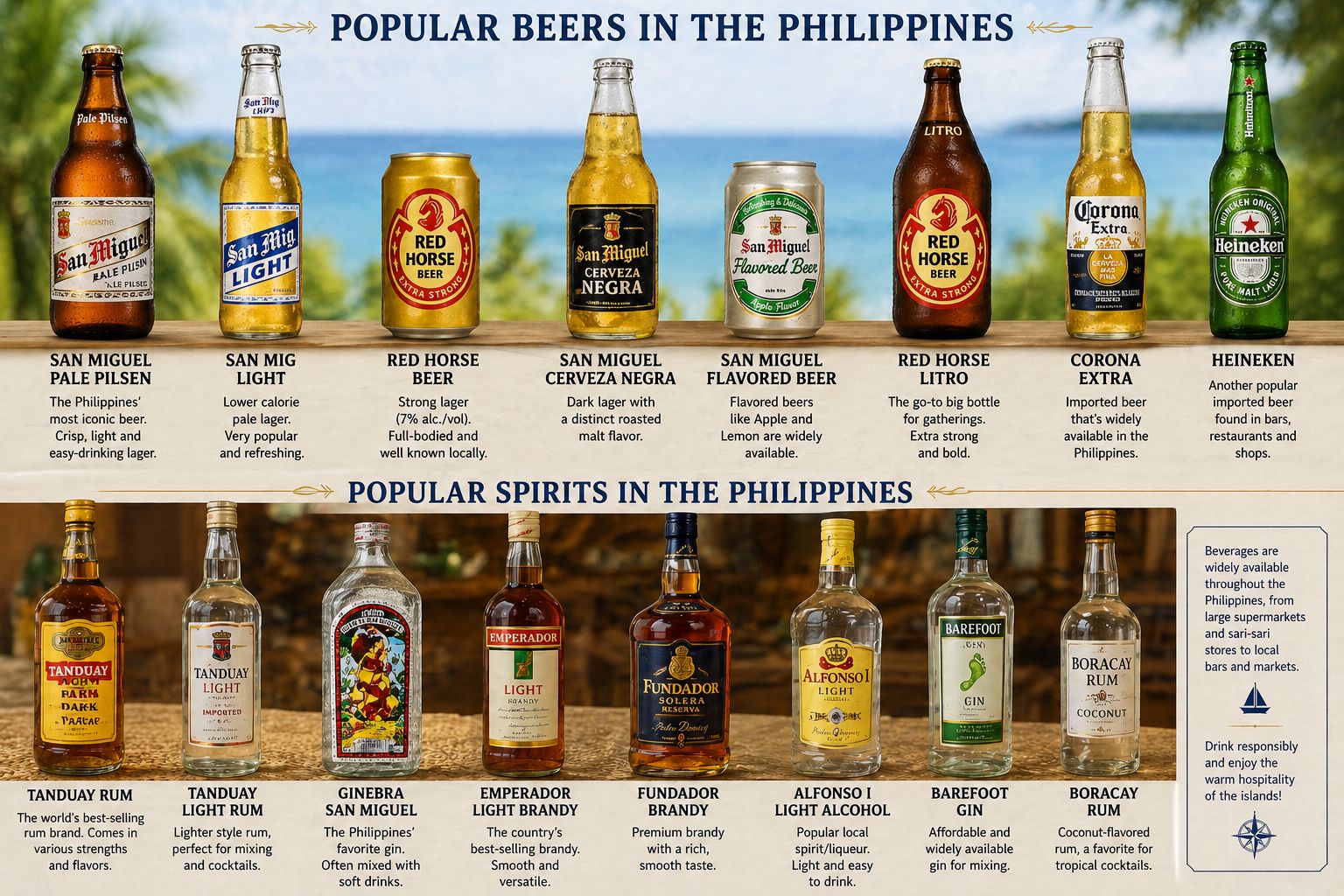
Beverages in the Philippines reflect a mix of local tradition and international influence, with cold drinks playing an important role in the tropical climate. Popular beers are dominated by San Miguel Pale Pilsen, along with San Mig Light and Red Horse Beer, the latter being a stronger lager widely available across the country. Local spirits are equally prominent, particularly rum, with brands like Tanduay among the most consumed in the world, as well as gin such as Ginebra San Miguel, often mixed simply with soft drinks or juice. In addition to alcohol, a wide variety of non-alcoholic drinks are available, including fresh coconut water (buko juice), fruit shakes made from mango, banana, or pineapple, and sweet iced beverages like sago’t gulaman. Soft drinks and bottled water are readily accessible even in smaller towns, making provisioning straightforward for cruising sailors. Personally after much experience I think San Mig is one of the nicest beers on the planet.
Jollibee for
Foreigners: What You’re Actually Walking Into
Jollibee is the Philippines’ answer to fast food, but calling it “the Filipino McDonald’s” doesn’t do it justice. It’s more like stepping into a national hug disguised as a restaurant. The mascot is a giant, smiling red bee, the menu is a joyful mash‑up of American comfort food and Filipino childhood nostalgia, and everything tastes slightly sweeter than you expect, on purpose. The star is Chickenjoy, a fried chicken so beloved that Filipinos abroad will cross state lines just to get it. Then there’s Jolly Spaghetti, which looks like spaghetti but tastes like someone added ketchup, sugar, and happiness. Foreigners are often confused at first… then weirdly addicted by the second visit. Jollibee isn’t just a restaurant it’s a symbol of Filipino comfort food, family gatherings, and national pride. Many Filipinos abroad describe it as “a taste of home.”
Mechanical
and Electrical Repairs Resource
If you are headed somewhere remote consider the need to expand your knowledge base or have an information resource on board. Why not get a copy of my book The Marine and Electrical and Electronics Bible 4th Edition. By and for yachties, with everything from batteries and charging, solar and wind, diesel engines and marine electronics and so much more. Your complete systems guide. 650 pages of practical advice. In Australia and New Zealand order a copy through Boat Books. UK and European boats can buy the UK Edition Here. US and Canadian boats can get the US Edition Order Here. Marine systems are my profession so let me help you. By a liveaboard boat owner for other boat owners


Cruising the
Philippines by Yacht - Summary
Cruising the Philippines offers yachts a wide range of anchorages, provisioning hubs, and repair options. Navigation requires care, especially in reef‑strewn areas, but charts are generally reliable. Entry procedures are straightforward, and visa extensions are easily managed. Palawan provides scenic anchorages and modest services. Cebu is the best all‑around hub for provisioning and repairs. Subic Bay offers industrial support and duty‑free goods. Puerto Galera is a well‑equipped cruiser stop with a yacht club, moorings, and access to local services. Ilocos Norte and Pagudpud provide a useful northern landfall for yachts arriving from Taiwan or Japan, though facilities are limited. Bonbonon remains a quiet cruiser haven with minimal infrastructure. With attention to seasonal weather, local permits, and cultural norms, the Philippines remains a practical and rewarding destination for long‑term cruising. Cruising the Philippines by Yacht in the Philippines is very rewarding.