Bass Strait Sailing Conditions - For NSW & Victoria Sailors
Bass Strait Sailing Conditions. As yachts leave the New South Wales coast and begin shaping a course toward Bass Strait, the oceanographic environment changes rapidly. The deep offshore waters influenced by the East Australian Current give way to a shallow, tide‑driven basin where wind, fetch, and tidal streams dominate. Although the EAC weakens significantly south of Sydney, its residual eddies and warm‑water tongues can still influence the eastern approaches to Bass Strait, particularly between Gabo Island and Wilsons Promontory. Understanding how these remnants interact with the strait’s strong tidal flows and rapidly shifting weather patterns is essential for safe and efficient passage planning.
Bass Strait is one of the most dynamic marine environments in Australia. Its shallow depth, narrow entrances, and exposure to Southern Ocean weather systems create conditions that can change far more quickly than those experienced offshore along the NSW coast. For sailors transitioning between these two regions, the key challenge is recognising the shift from a current‑dominated offshore system to a tide‑dominated strait. This companion section explains how the EAC influences the eastern approaches, how tidal streams shape the central strait, and what operational considerations matter most for yachts entering Victorian waters.
Bass Strait Sailing Conditions - EAC Influence
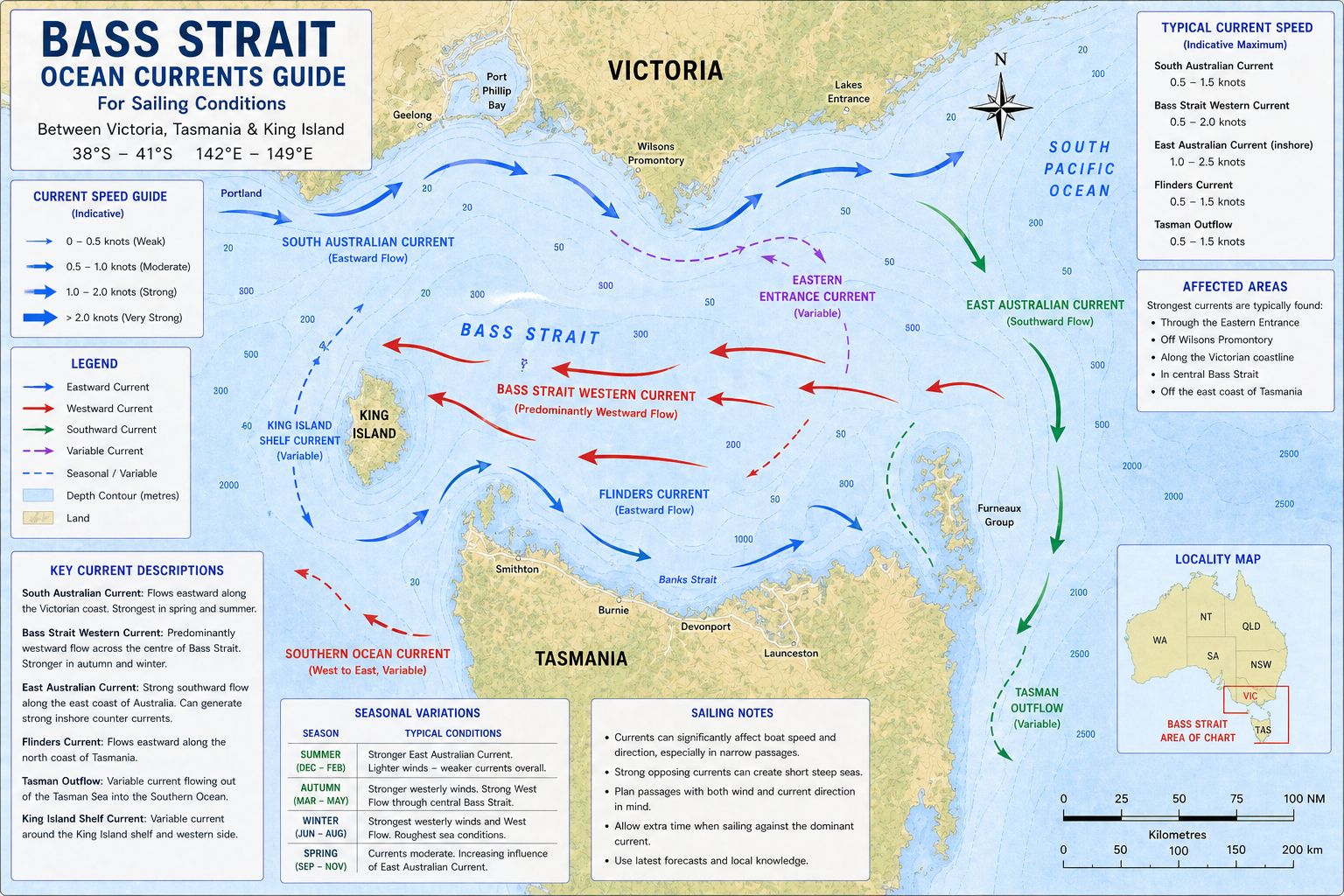
Although the EAC no longer forms a coherent south‑setting jet by the time it reaches Bass Strait, its offshore eddies can still affect the eastern entrance. Warm‑core eddies drifting south‑east from the NSW coast occasionally push warmer water toward the region between Gabo Island and Wilsons Promontory. These features create subtle current anomalies and temperature gradients that may influence sea state, particularly when interacting with westerly winds or the strong tidal streams that characterise the strait. A yacht approaching from Eden or Bermagui may encounter patches of smoother water followed by short, steep seas as it crosses eddy boundaries or residual current lines.
These effects are generally modest, rarely more than a knot of current, but they can alter landfall accuracy and influence the comfort of the approach. For yachts planning a precise entry toward Wilsons Promontory, Corner Inlet, or the Gippsland coast, recognising these residual EAC signatures can help refine routing decisions.
Bass Strait Sailing Conditions - Transition
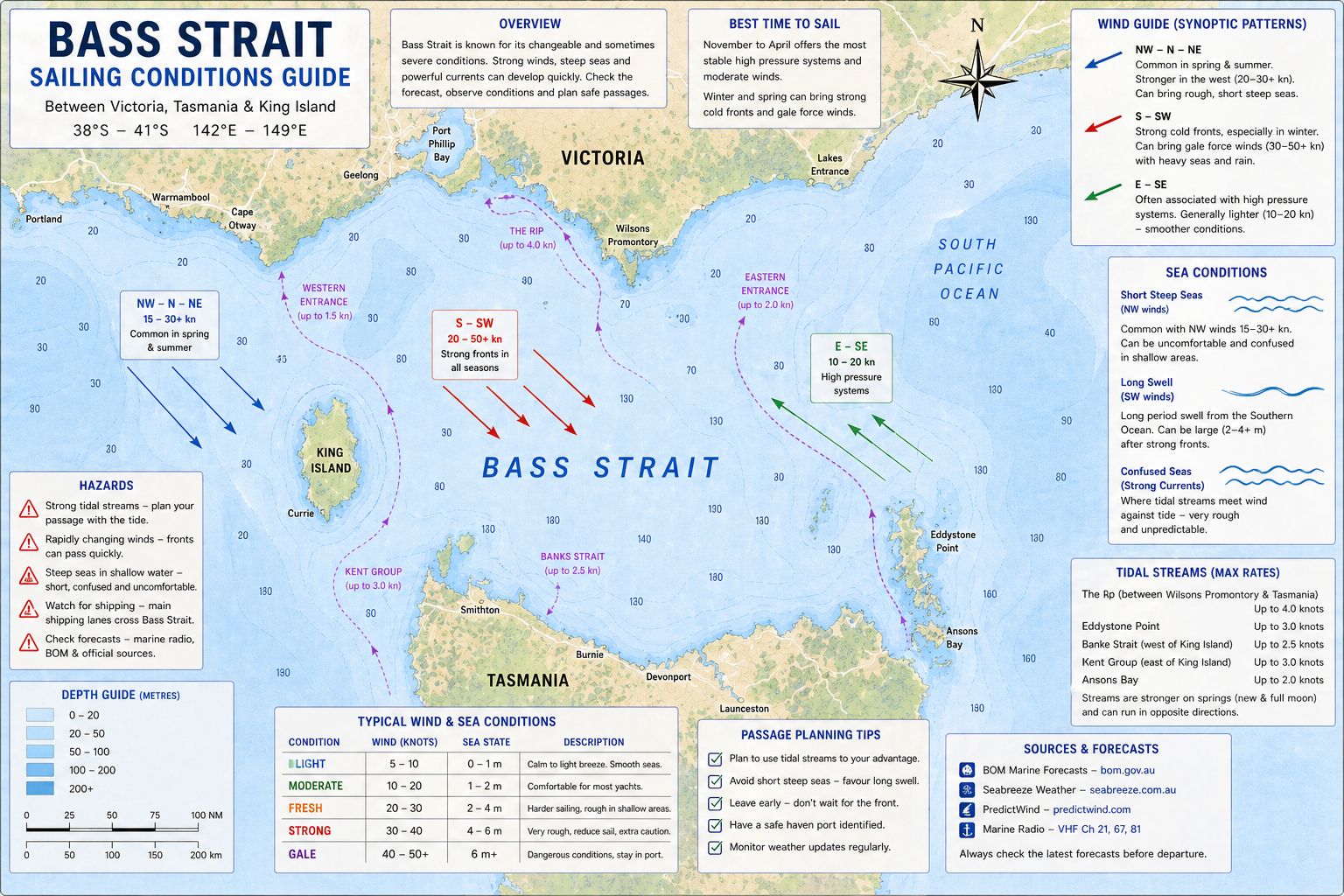
The most significant operational shift occurs once a yacht enters Bass Strait proper. The deep offshore waters of the NSW coast give way to a shallow basin where tidal streams, wind‑driven currents, and fetch dominate. Tidal flows in Bass Strait can exceed two to three knots in places, particularly near constricted passages and headlands. When these streams oppose strong westerlies or south‑westerlies, the sea state steepens rapidly, producing short, breaking seas that are far more severe than anything generated by the EAC alone.
This transition zone is especially noticeable near Wilsons Promontory, the Hogan Group, and the eastern approaches to the Kent Group. Here, tidal acceleration zones combine with swell refracting around granite headlands, creating turbulent water that demands conservative seamanship. For sailors accustomed to the long, rolling offshore swell of the NSW coast, the abrupt, energetic chop of Bass Strait can be a surprise.
Bass Strait Sailing Conditions - Sea‑State
Inside the strait, the dominant forces are wind, tide, and fetch. The shallow depth allows wind to build steep seas quickly, and the long east–west fetch amplifies this effect. Westerly gales can create corridors of breaking seas stretching from King Island to the Victorian mainland, while easterlies can produce uncomfortable conditions along the Gippsland coast. The interaction between tidal streams and wind is the primary driver of hazardous sea states, and sailors must plan their passages around both tidal timing and weather windows.
Residual EAC influence becomes secondary once inside the strait. Warm‑core eddies rarely penetrate far west of the eastern entrance, and when they do, their impact is limited to subtle temperature anomalies rather than meaningful current flow. The central and western strait are shaped almost entirely by localised tidal flows and the complex bathymetry around the Kent Group, Curtis Island, and the Furneaux Islands.
Bass Strait Sailing Conditions - Routing Considerations
For yachts approaching Bass Strait from NSW, the key is recognising the shift in planning priorities. Offshore routing along the NSW coast is often shaped by the position of the EAC, the strength of the main jet, and the behaviour of warm‑core eddies. Once a yacht enters Bass Strait, routing becomes a matter of timing tidal gates, avoiding wind‑against‑tide scenarios, and selecting conservative weather windows.
A yacht approaching from Eden may choose a more offshore route to avoid residual EAC flow, but once within range of Gabo Island or the Prom, the focus shifts to tidal timing. Entrances such as Wilsons Promontory, Hogan Island passages, and the approaches to Corner Inlet all require careful planning around tidal streams. Even small timing errors can result in steep, uncomfortable seas or reduced control near headlands.
For yachts continuing westward across the strait, the EAC’s influence fades almost entirely. The central and western regions demand attention to tidal atlases, local weather patterns, and the interaction between wind and shallow water. By the time a yacht reaches the approaches to King Island or the Victorian west coast, the EAC is no longer a meaningful factor.
Mechanical
and Electrical Repairs Resource
If you are headed somewhere remote consider the need to expand your knowledge base or have an information resource on board. Why not get a copy of my book The Marine and Electrical and Electronics Bible 4th Edition. By and for yachties, with everything from batteries and charging, solar and wind, diesel engines and marine electronics and so much more. Your complete systems guide. 650 pages of practical advice. Order a copy through Boat Books. Marine systems are my profession so let me help you. By a liveaboard boat owner for other boat owners.


Bass Strait Sailing Conditions - Summary
The East Australian Current plays a diminishing but still relevant role in the eastern approaches to Bass Strait, influencing sea‑surface temperature, residual flow, and the behaviour of offshore eddies. Once inside the strait, however, the dominant forces shift decisively to wind, tide, and fetch. For sailors transitioning from NSW to Victoria, the key is recognising this change and adjusting passage planning accordingly. Accurate oceanographic data remains useful in the approach, but once inside Bass Strait, tidal timing, weather windows, and conservative seamanship become the primary tools for safe navigation. Understanding this transition allows skippers to manage risk effectively and handle one of Australia’s most dynamic marine environments with confidence. The Bass Strait Sailing Conditions summary is here to help.